
Perfect Discovery Call

The Anatomy of a Perfect Discovery Call | All You Need to Know

The Anatomy of a Perfect Discovery Call | All You Need to Know

Most reps treat discovery as a form they have to fill out before the real selling starts. The best discovery calls do not feel like discovery at all. They feel like the most useful conversation the buyer had that week.

There is a version of discovery that most sales teams run. It goes like this: open with rapport, ask about current state, ask about desired state, ask who else is involved, ask about budget, ask about timeline, summarize back, book the next meeting.

The buyer has been through this exact sequence enough times that they can feel the framework running underneath it. They answer the questions because they are polite. They share what they planned to share before the call started. They hang up and nothing has changed in how they think about the problem.

That is not discovery. That is a questionnaire with better eye contact.

What Discovery Is Actually For

The point of a discovery call is not to qualify the account. Qualification is a byproduct.The point of a discovery call is not to qualify the account or simply generate sales-qualified leads.The point of a discovery call is not to qualify the account. Qualification is a byproduct.

The actual point is to understand the problem better than the buyer has articulated it to anyone, including themselves. That sounds ambitious. It is. And it is also where every meaningful sale begins.

Buyers walk into discovery calls with a surface version of their problem. It is the version they wrote in the brief, the one they told their manager, the one that made it into the internal project proposal. It is real, but it is not complete. It is the problem as they have been able to frame it given their current understanding of the situation.

The rep’s job is to help them get to the layer underneath.

Not by being clever. Not by asking gotcha questions that reveal the buyer’s blind spots in a way that makes them feel exposed. By listening carefully enough to notice what the buyer is circling around, what they keep returning to, what they say with slightly more energy than everything else, and following that thread until it leads somewhere the buyer had not yet been.

Carl Rogers spent a career explaining that most people have never been fully heard. That when someone listens without agenda, without preparing their next line, without filtering what they hear through what they need from the conversation, the person speaking often discovers things about their own situation they did not know they knew.

Discovery calls are the business application of that principle. And most reps have been trained to skip it entirely.

Discovery Call: The Research Phase That Most People Skip

A perfect discovery call is ninety percent prepared before it starts, much like how strong preparation defines success in any outbound sales playbook.

Not scripted. Prepared. There is a difference.

Scripted means you know what you are going to say. Prepared means you know enough about the account, the industry, the buyer’s role, and the likely shape of their problem that you can ask real questions instead of generic ones.

Before the call: read everything publicly available about the company and use insights similar to those leveraged in sales data analytics. Their recent announcements, their job postings, their earnings calls if they are public, their competitive positioning. Job postings in particular are underrated intelligence. A company posting aggressively for data engineers while their marketing team shrinks is telling you something specific about where their priorities are shifting. That is not information the buyer will volunteer. It is context that shapes every question you ask.

Know the buyer’s title and think through what that role is actually responsible for, especially when planning effective sales personalization strategies. Not the generic persona card. What does a VP of Revenue Operations at a mid-market SaaS company in year three of a PE-backed growth plan actually care about this quarter? What is the thing that keeps them accountable? What would a bad Q4 look like for them personally?

Walk in with two or three hypotheses about what the real problem might be, a mindset that aligns closely with strong sales pipeline analysis practices. Not conclusions. Hypotheses. Things you suspect based on what you know that you are going to test by listening, not by asserting.

The prepared rep does not fill the call with their own voice because they come in with genuine questions they actually want answered.

The Hidden Secret behind every discovery Call

Most discovery calls open with small talk about the weather, a comment about being busy, a request to confirm how much time they have.

None of that is wrong. It is just inert.

A better opening establishes immediately that this call is going to be different, much like how strong first touches define success in top-of-the-funnel sales. from the last vendor call they sat through.

One way: come in with an observation. Something specific you noticed about their business that is genuinely relevant to the conversation. Not a compliment. An observation. “I was looking at your job postings before this call and noticed you’re building out your data infrastructure heavily while the product team seems to be consolidating. I’m curious what’s driving that.” That is not a pitch. It is a signal that the rep paid attention before arriving, and it shifts the dynamic of the conversation from the first sentence.

The buyer leans in slightly differently when they realize the person across from them actually knows something about their situation.

The Questions That Open the Conversation
The Questions That Open the Conversation

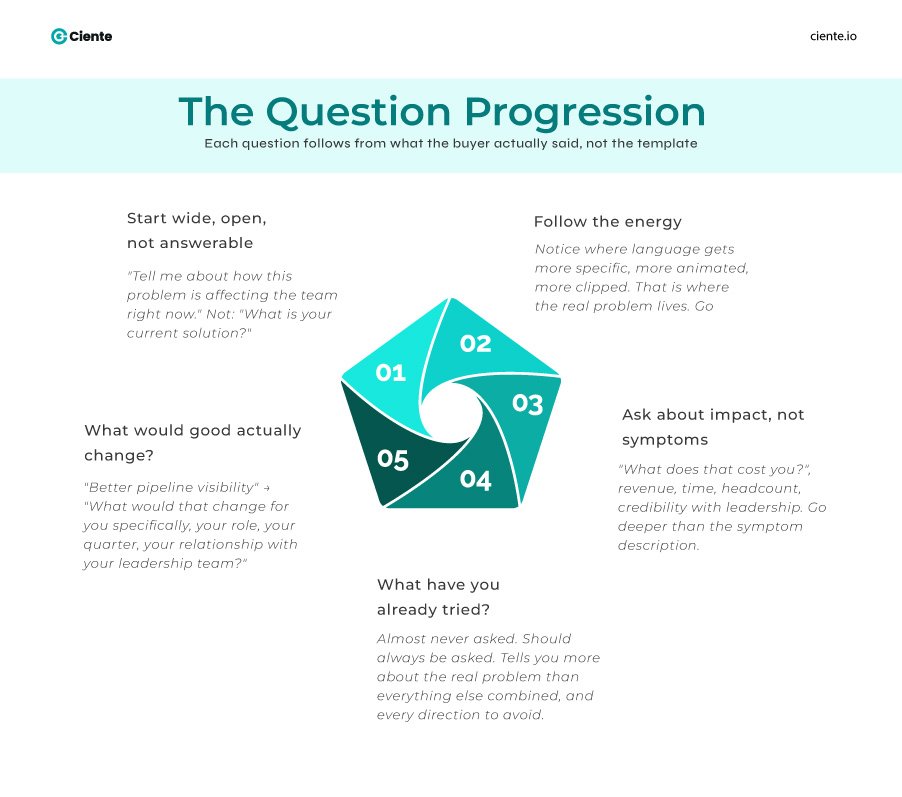
Discovery questions are not a list. They are a progression. Each one should follow from what the buyer actually said, not from what the template said comes next.

The questions that matter most are the ones that move the buyer from what they planned to say to what they have not yet articulated.

Start wide, then follow the energy. Open questions first. Not “what is your current solution?” but “tell me about how this problem is affecting the team right now.” The difference is that the first question has a clean answer. The second one requires the buyer to actually think. Pay attention to where their language gets more specific, more animated, more clipped. That is where the real problem is.

Ask about impact, not just symptoms. especially if you want to tie conversations to measurable sales metrics. When a buyer describes a problem, the instinct is to categorize it and move on. The better move is to go deeper. “What does that cost you?” means revenue, time, headcount, credibility with leadership, whatever it costs. People do not buy solutions to abstract problems. They buy relief from specific, felt pain. You cannot speak to the felt pain if you stop at the symptom.

Ask about what they have already tried. a crucial step often overlooked in structured sales prospecting approaches. This question is almost never asked. It should always be asked. What a buyer has already tried and why it did not work tells you more about the actual problem than anything they have said so far. It also tells you every wrong direction to avoid taking the conversation.

Ask what a good outcome looks like, then ask what that would mean. Most buyers answer the first question in the abstract. “Better visibility into the pipeline.” “Faster reporting cycles.” “A single source of truth.” Ask what that would actually change. For them specifically. Not for the business in the abstract but for them, their role, their quarter, their relationship with their leadership team. The answer to that question is the real buying motivation. Everything else is the path to it.

The Listening That Changes the Call

There is a moment in most discovery calls where the buyer says something the rep was not expecting, which becomes critical in complex deals involving multi-threading in sales.

It usually comes about fifteen minutes in, when the buyer has relaxed slightly and the scripted part of their answer has run out and they start talking about what is actually going on.

Most reps miss it because they are already thinking about the next question on the list.

The moment sounds like this: the buyer is explaining their current process and then says something slightly off the main thread. A comment about the team being stretched. A mention that they tried to address this last year but it stalled. An observation about a shift in how leadership is prioritizing things. A sentence that starts “the real issue is…” before they course-correct back to the official version.

That is the moment. That is the thing the buyer has not fully articulated to anyone yet.

The rep who catches it does not let it pass. They slow down. They say: “you said the real issue is, I want to make sure I understood that. Say more about that.” Not a pivot. Not a segue into the pitch. Just an invitation to continue.

What usually comes next is the clearest version of the real problem the buyer has said out loud yet. Sometimes they surprise themselves by saying it. They will occasionally pause and acknowledge that they have not put it quite that way before. That moment is the call. Everything else is administrative.

What To Do With Silence

Silence in a discovery call makes most reps uncomfortable enough to fill it, especially those trained in rigid sales cadence structures.

Do not fill it.

When a buyer finishes answering a question and goes quiet, they are usually still thinking. The thought that comes after the silence is almost always more honest than the one that came before it. It is the answer after the prepared answer. Give it room.

The same applies when you ask a question that genuinely makes the buyer think. If they pause, they are working through something. That pause is valuable. Interrupting it with a rephrasing of the question or a clarification robs the call of whatever was about to surface.

The Trap Every Prepared Rep Falls Into

is similar to challenges seen in scaling modern sales enablement strategies. Knowing a lot about an account before the call creates one specific failure mode: the rep starts confirming their hypotheses instead of listening for what is actually true.

They asked a question about X because they suspected X was the problem. The buyer gave a partial answer about X. The rep moved on because X was confirmed. But the buyer was also trying to say something about Y that they did not quite get to because the question was already moving elsewhere.

Preparation creates hypotheses. Listening either confirms or corrects them. The rep who walks in prepared and then listens as if they know nothing has done both things correctly. The rep who walks in prepared and then runs the hypotheses as a checklist has used their preparation against themselves.

The question to hold throughout the call: what is this buyer telling me that I did not already know?

Closing the Discovery Call

effectively plays a key role in moving deals through the sales pipeline. Most reps end discovery by summarizing what they heard and proposing a next step. That is the minimum.

The version that converts better does something additional: it reflects back the shape of the problem in a way the buyer has not heard before.

Not a pitch. Not a solution. A reframing.

“From what you’ve described, it sounds like the issue isn’t just the tool — it’s that the team doesn’t have a shared definition of what good looks like, so even when the data is available, there’s no agreement on what to do with it. Is that close to what you’re experiencing?”

If it lands, the buyer will say yes with more energy than anything they said during the call. Because you have named something they were feeling but had not organized into a sentence. That is the moment they decide whether this rep is worth continuing the conversation with.

The discovery call is not the place to impress the buyer with what you know about your product, but rather to support broader b2b sales strategies that focus on understanding. It is the place to impress them with what you understand about their problem.

Consultative Selling Advantages

Consultative Selling Advantages: Keeping Your Best Foot Forward

Consultative Selling Advantages: Keeping Your Best Foot Forward

Consultative selling promises better relationships and bigger deals. But the advantages go deeper than most sales teams realize, until it’s too late.

Most B2B sales teams love to tell themselves they practice consultative selling because it sounds sophisticated. It looks good on a slide deck for a board meeting. But if you actually sit in on their discovery calls, you see the same old routine. They run through a checklist of pain points, pinpoint a gap, much like a rigid approach seen in a typical sales process framework. and then spend forty minutes mentioning how their product fills that gap.

That is not consultative selling. That is just solution selling with a slightly more polite discovery process.

The real advantages of consultative selling aren’t just about being “nicer” to your prospects, but about fundamentally improving sales performance management outcomes and/or building a vague sense of rapport. They are structural. They change the math of your pipeline.

When you stop acting like a vendor and start acting like a consultant, you change the power dynamic of the entire deal.

Most teams miss the deeper benefits until it is too late, often because they fail to align with broader sales and marketing alignment. They focus on the tip of the iceberg, such as better relationships, while ignoring the massive advantages that sit below the surface.

These are the advantages that separate the teams that grow 30% year-over-year from the ones that are stuck fighting for every single percentage point.

The Core Consultative Selling Advantages for B2B Teams

The most overlooked advantage is the ability to reframe the problem. Trust is a byproduct. You don’t get trust by being friendly. You get trust by seeing a buyer’s business more clearly than they see it themselves.

Consultative sellers don’t just diagnose a problem; they go deeper than typical sales prospecting approaches. They often find a completely different problem than the one the buyer originally sought. That is where you find real leverage.

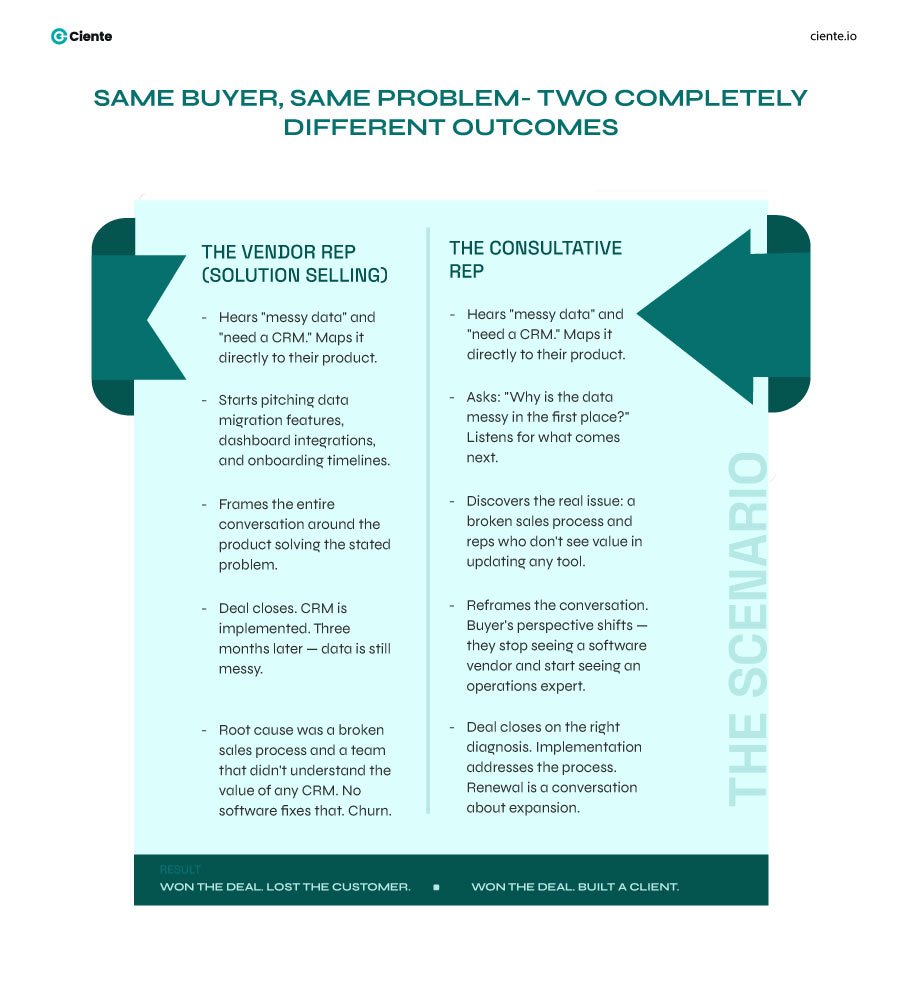
Same buyers, same problem - thow completely different outcomes

Think about a standard scenario.

A company reaches out because they think they need a new CRM, often influenced by trends in crm solutions. They say their sales data is messy. A typical SDR starts mentioning data migration and dashboard features. A consultative seller stops and asks why the data is messy in the first place. They might discover that the real issue is a lack of sales process or a team that doesn’t understand the value of the tool.

When you point that out, the buyer’s entire perspective shifts. They stop looking at you as someone selling software and start looking at you as an expert who understands their operations. That is a massive competitive moat.

Once a buyer sees you as a strategic partner, you move beyond transactional selling into more advanced sales enablement strategy. It becomes very hard for a competitor to come in and win on price alone. You aren’t just selling a tool anymore. You are selling a path to a better business outcome.

Realizing Consultative Selling Advantages in Win Rates and Deal Speed

There is a persistent myth in sales management, often driven by outdated sales metrics. That consultative selling is too slow. Managers worry that if reps spend too much time consulting, they won’t close enough deals.

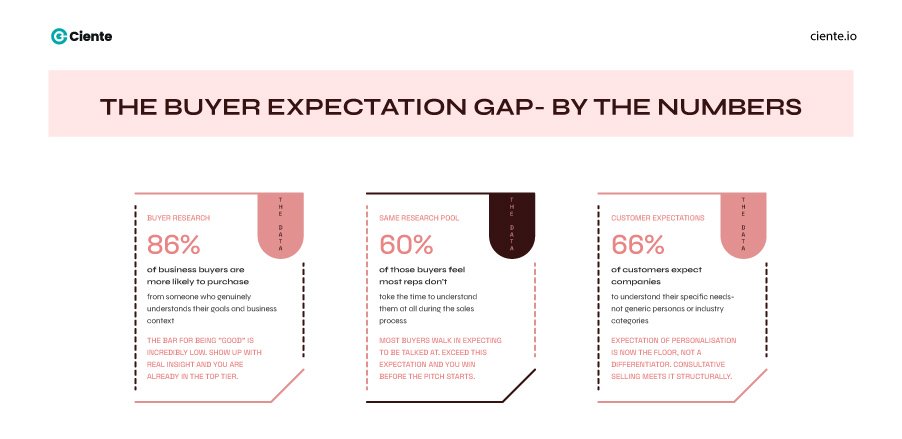
The reality is exactly the opposite. You will see that over 86% of business buyers are more likely to buy from someone who actually understands their goals. On the flip side, nearly 60% of those same buyers feel that most sales reps don’t take the time to understand them at all.

Buyer expectation gap

That means the bar for being good is incredibly low right now. Most buyers walk into a meeting expecting to be talked at. They expect to feel misunderstood.

One of the most immediate consultative selling advantages is reducing friction typically seen in sales cadence structures. Is that you clear this hurdle instantly by showing up with genuine insight. You observe fewer objections and faster decision-making when your recommendation aligns with the buyer’s day-to-day life.

In traditional sales, you spend half your time handling objections. But in a consultative model, you handle those objections before you ever make a pitch.

You aren’t selling them on a solution, but guiding them through a refined b2b sales funnel structure. You are presenting a logical conclusion that you both reached together during the discovery phase. That changes the psychology of the close entirely.

3. How Consultative Selling Advantages Build Long-Term Customer Trust

Sales leaders often mention trust as if it’s a fluffy, intangible metric. It shows up in CRM notes or is mentioned during a quarterly business review. But trust is a commercial asset with a very specific dollar value.

Research shows that over 66% of customers expect companies to understand their specific needs. Because of this, buyers will often choose a product that is slightly less perfect technically if they trust the person selling it more than your competitor.

That’s the advisory relationship in action. It acts as an insurance policy for the buyer. They know that if the implementation hits a snag or the market shifts, a consultative partner will help them navigate those changes. A product pusher will point to the contract and move.

This trust also compounds over time.

When you are a trusted consultant, you naturally unlock growth opportunities beyond traditional sales lead generation. Your customers start to reach out to you between purchase cycles. They might ask for your take on a new trend or a problem they are having with a different department.

It is how you get expansion revenue without having to run a formal, high-pressure sales motion.

You aren’t “upselling” them. You are just helping them solve the next problem in their business evolution. That is a revenue stream that traditional sales teams rarely tap into effectively.

Key Consultative Selling Advantages for Retention and LTV

If you are in a SaaS or service-based business, retention is your lifeblood and closely tied to the customer lifecycle sales funnel. That’s where product-centric selling is at its weakest.

If you win a deal because your product has one specific feature that the competitor doesn’t, you are in a dangerous position. The second that a competitor launches a similar feature, or your customer’s needs change, your reason for existing in their tech stack disappears. Half of once-loyal customers move to competitors simply because they feel their evolving needs aren’t being met.

One of the most durable consultative selling advantages for retention is that you anchor the relationship to the business outcome rather than the feature set.

Your history of offering good advice and your understanding of their internal culture can’t be copied by competitors.

You become an integrated part of their strategic planning process. When a competitor calls your customer to offer a lower price, the customer doesn’t just think about the software. They think about the value they get from your expertise.

That creates a level of loyalty that can survive market shifts and competitive pressure.

Strategic Consultative Selling Advantages in Competitive Markets

We have to be honest about the state of modern digital sales transformation.

Most categories are becoming commodities faster than we want to admit. Buyers have access to all the same information we do. They read comparison sites. They talk to their peers on LinkedIn. They often have a shortlist and a price range in mind before they ever talk to a rep.

If you show up to that first call and start listing features, you risk blending into generic sales prospecting tools comparisons. You are just another row on a spreadsheet. You are competing on price and specs.

But McKinsey research illustrates that the fastest-growing B2B companies engage customers earlier- with a consultative mindset. This timing is everything.

If you can get in early and help the buyer define their requirements, you get to shape the criteria they use to judge your competitors.

When your sales conversation is the most useful part of their entire evaluation process, you stop being just an “option.” You become the benchmark. You are the one setting the standard for what a successful solution looks like.

That is a strategic advantage that no software update can ever match.

Managing Large Buying Groups Using Consultative Selling Advantages

The modern buying group is getting bigger, making multi-threading in sales more critical than ever. and more complex every year. We are now seeing an average of ten unique decision-makers involved in a single deal. More than half of those groups now include VPs or C-suite executives.

Traditional solution selling usually falls apart in this environment. A rep might tell one story to a manager and a different story to a director, hoping that no one notices the discrepancy.

Consultative selling handles these large groups much more effectively. Because your approach is based on a deep, objective analysis of the business, you have a single source of truth that resonates across the entire committee.

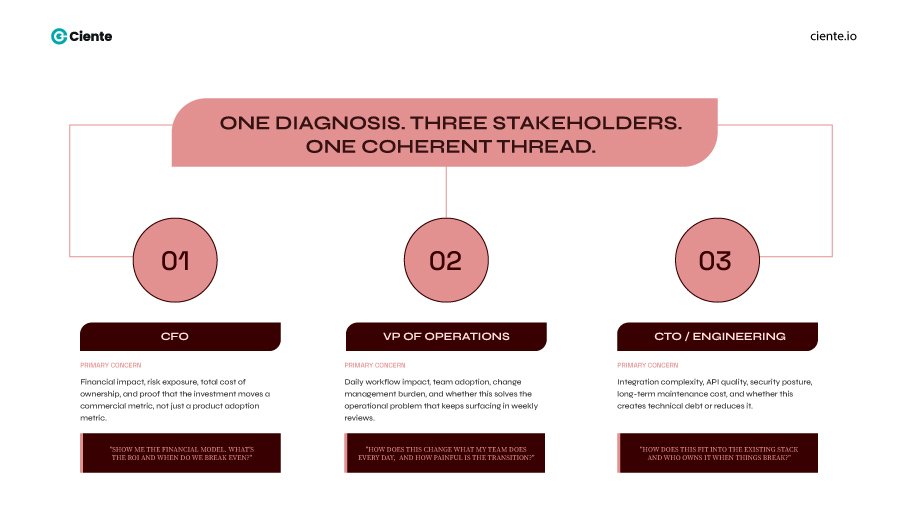
One Diagnosis. three stakegolders

•           The CFO cares about the financial impact and risk.

•           The VP of Operations cares about how it changes the daily workflow.

•           The CTO cares about how it integrates with the existing stack.

Even though you are talking to different people about different concerns, the underlying diagnosis is the same.

The coherence of your analysis becomes the thread that holds the entire buying committee together. That’s why consultative deals often move quickly through the final stages.

You aren’t spending weeks trying to settle internal disagreements between the buyer’s stakeholders because you have already aligned them around a common problem.

Why Sales Teams Struggle to Capture Consultative Selling Advantages

If the consultative selling advantages are so obvious, why aren’t they reflected in most sales enablement trends? Why isn’t every team doing this?

The problem is usually structural. Most companies attempt to solve this with a two-day training workshop. They teach people some active listening skills and give them a new set of discovery questions, and then they expect everything to change.

It doesn’t work because consultative selling requires genuine business acumen. You cannot fake this.

To ask a question that actually makes a senior executive stop and think, an SDR needs to understand how that specific company makes money. They need to understand the industry pressures and where the market is going.

You don’t get that from a workshop. You get it from years of focusing on a specific vertical and actually caring about business outcomes.

Research shows that proactive sellers, especially those leveraging Consultative selling is not a “tactic.”, outperform reactive ones. i.e., those who bring new ideas to the table and challenge the buyer’s assumptions, generate up to 30% more annual revenue than reactive sellers.

Being proactive is the core of the consultative approach.

Companies must transform their hiring and training to capture these advantages. You have to hire for curiosity. You have to invest in making your reps experts in their industry, not just experts in your product. And change your metrics to measure relationship quality, not just the call volume.

The Consultative Selling Advantage That Outlasts Products

Overall, products will always be duplicated. Features will be commoditized. Pricing will be undercut.

But what cannot be copied is a sales professional who understands a buyer’s world better than anyone else. That is the ultimate consultative selling advantage- it builds a durable commercial position.

It doesn’t wash away the next time a competitor releases a new version or cuts their price.

The teams that recognize this are the ones that invest in their people’s ability to think, not just their ability to pitch. But the ones that don’t will continue to struggle with flat retention numbers and deals that stall for no clear reason.

Consultative selling is not a “tactic.” It is a fundamental shift in how you provide value to the market.

Claude

Claude Code Leak on X Directs Scrutiny Towards Anthropic

Claude Code Leak on X Directs Scrutiny Towards Anthropic

Users caught a look into how Claude really thinks- and it thinks a lot about ASCII capybaras and memory pruning.

AI development is transforming industries- and at the very core of where it stems from, it’s changing the coding landscape too. It’s more of a psychological take than a technical one.

We assume that software developers need minimal distraction and high-efficiency tools to code. But, agentic development changed that- it’s the rise of the buddy system in engineering circles. Humans write the code, and the “buddy” helps them through soft errors that AI workflows often instill.

When Claude’s 512000-line code repository was leaked on X, it also revealed a secret April Fools’ gamification feature Anthropic was planning. That was a bigger discovery- a “/buddy” repository.

It drew as much focus as the code itself- how Claude handles shell execution and permissions. Security researchers now don’t have to guess how to break out of the agentic sandbox. And given all the tip-toeing around AI, security through obscurity can’t be the only tactic known.

Now that the agent’s logic is known? It sounds impossible to pull back the harness. However, Anthropic is attempting its best, playing Whack-a-Mole. So far, it has removed over 8k forks from GitHub. However, the consequence of a simple human error is present on several decentralized platforms.

Users can already notice numerous clean-room implementations uploaded on Rust and Python.

This scenario has set history for AI IP: Claude Code has given its competitors a blueprint, even when there was no user data leak. While some will receive access to the downloadable leaked Claude mirrors, others will end up with malware-laden cracked versions.

The black box era of AI just took a huge hit. Now that we have had our glimpse behind the curtains, can one declare with confidence- “we now know how the world’s most advanced AI agent thinks?” Or could there be more to what meets the eye?

Video Apps

Video Apps are Reeling in More Active Users Than Social Media Apps

Video Apps are Reeling in More Active Users Than Social Media Apps

Is it the era of the great digital retreat? Ofcom’s latest report concludes so.

Ofcom recently conducted a survey across UK social media users and noticed a strange dip. Only 49% of the UK adults actually post, share or even comment on social media. That’s a 61% decline since 2024.

The reason, one can assume, is the panopticon effect. Social media was always thought be a space for the ‘now’- the ‘present.’ But if one hasn’t noticed, it’s now used as a record of our past and present followings.

You can also call this: archive anxiety. It’s the fear that a single version of ‘you’ will be used against you today. The migration to more ephemeral media isn’t sudden. People would rather opt for posting on Instagram stories than make grid posts.

But another reason- adults are migrating towards more-video oriented content, such as Reels and TikTok.

Empty consumption over active creation- users merely wish to be passive on-lookers. And scrolling video (with infinite scroll loop) feeds into a dopamine hit that creating the content doesn’t fill.

Video-centric feeds have turned social media into more of cinema- one that’s observed not actively interacted with. But what use is an interaction that’s majorly AI-driven? The study also asserts that over 54% of UK adults leverage AI for conversation.

Because it’s the path of least resistance. The friendship is low-stakes and the AI is more of a one-sided consultant than a friend that requires mutual effort.

Bottom line? Humans are retreating from the chaotic complexities of ‘human’ social media- inching more and more towards a controlled comfort of AI dialogue. And honestly, more than half of them truly hold the belief that social media isn’t good for their mental health.

Their retreat is backed by some compelling arguments. 89% still use the platforms even though they believe its harmful- that’s the hold social media has built on users. That’s the psychological trap that big tech is counting on, to keep users hooked to these echo-chambers.  

Consultative Selling vs Solution Selling

Which One Actually Wins the Modern B2B Deal Between Consultative Selling vs Solution Selling?

Which One Actually Wins the Modern B2B Deal Between Consultative Selling vs Solution Selling?

Most sales teams think they’re doing consultative selling. They’re probably not. And the difference shows up exactly when it matters most.

Here’s something that happens in sales kickoffs all the time. A sales leader asks the room who practices consultative selling. Every hand goes up. Then the deal review occurs, and what surfaces is a lot of reps leading with product, matching pain points to features, and calling it a needs assessment.

That’s not consultative selling. That’s solution selling with a friendlier tone. And the difference between the two matters a lot more than most teams acknowledge, especially when you consider how teams define and move from leads vs prospects in the sales journey.

Solution Selling Is Not the Problem. Misapplying It Is.

Solution selling earned its reputation for good reason. It moved salespeople away from feature dumping toward something more useful: understanding the buyer’s challenge. And the core logic still holds up in the right contexts.

The mechanics are clean. The mechanics are clean. Find the pain, connect it to your product, prove the fit, close, often relying on structured frameworks like a lead qualification process to guide decisions. Solution sellers craft a pitch that covers each of the needs the prospect listed and proves their product is the best solution, adapted to what the prospect wants and believes they need, rather than presenting a new or different way of solving a problem.

Read that carefully. Solution selling takes the buyer’s problem at face value. It’s designed to answer the question asked, and not to interrogate whether it’s the right one to ask.

That works in a specific scenario.

Buyers who already know exactly what they want and have clear requirements, often shaped by strong inbound lead generation strategies prefer to move straight to pricing and implementation details. When a buyer walks in with a defined problem and a shortlist already formed, a drawn-out consultative process doesn’t impress them. It wastes their time.

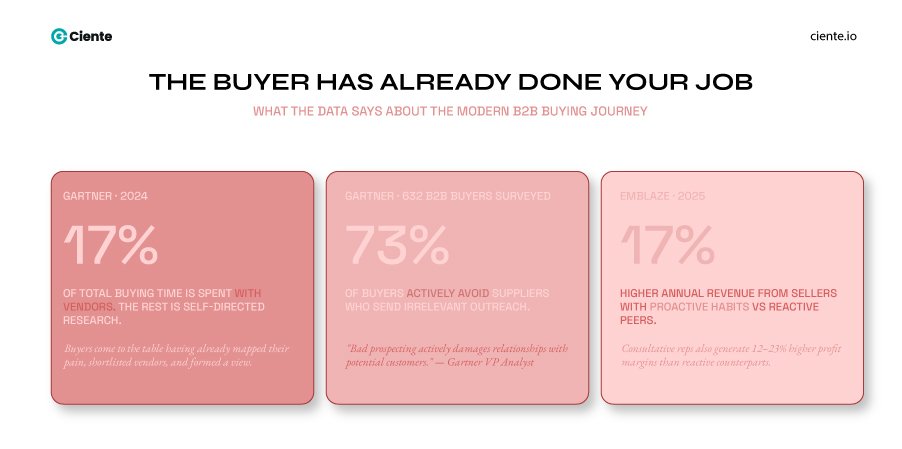
Buyers already done your job

The trouble starts when sales teams use solution selling as a default for every deal type, especially in complex environments where target account selling demands deeper insight and customization. In such situations, matching a product to a stated need doesn’t solve a problem. It’s just closing one efficiently and setting up a messy post-sale.

Consultative Selling Operates from a Different Premise Entirely

The consultative seller walks into a meeting with a different question. Not “how do I map their pain to my product?” but “do I actually understand what’s going on here?”

Consultative sellers invest time:

  1. Building relationships
  2. Asking curious, in-depth questions
  3. Developing a comprehensive POV of the prospect’s situation
  4. Prioritizing long-term partnership over quick transactions

That sounds like a platitude until you see it play out in a real deal.

A buyer describes a revenue problem. The solution seller hears that and starts positioning their forecasting tool. The consultative seller asks three more questions and realizes the revenue problem is actually a territory design problem- and no forecasting tool is going to fix that.

One of those reps closes a deal. The other one builds a client.

A company complaining about low sales productivity may be struggling with poor lead qualification criteria or inadequate training. Consultative selling uncovers these underlying issues through thoughtful questioning and business analysis.

That’s why consultative selling is inseparable from genuine expertise.

You cannot reframe a buyer’s problem without knowing enough about their world to see what they’re missing. That’s not something you can fake with a better discovery script. It comes from reps who have logged enough hours in a specific industry to recognize patterns the buyer hasn’t seen yet.

The Actual Difference Shows Up in Three Places

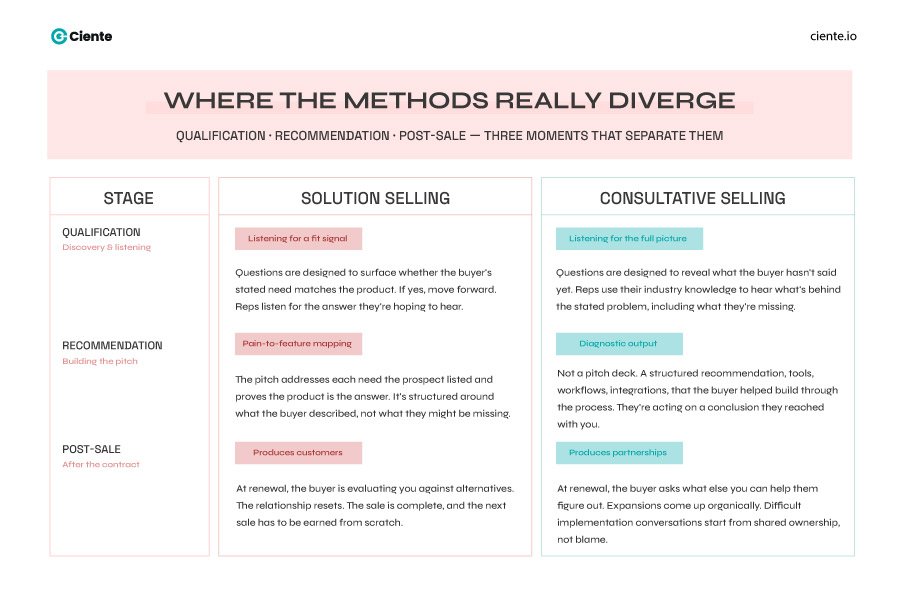
Both methodologies use discovery questions. Both claim to care about the buyer’s outcome. The divergence is easy to miss until you look at what’s actually happening at each stage.

How They Each Run Qualification

when supported by modern approaches like lead scoring models, the questions look similar on the surface. The intent is completely different. Solution sellers focus on matching the prospect’s stated needs with their product; consultative sellers use their questions to demonstrate deep knowledge of the industry and the prospect’s business, positioning themselves as industry experts.

One rep is listening for a fit signal. The other is listening for the full picture, including what the buyer hasn’t said yet.

How They Each Build the Recommendation

Solution sellers build their pitch around the needs the prospect surfaced, often aligning closely with predefined marketing qualified lead (MQL) expectations. Whatever the buyer described is what gets addressed, with the product positioned as the answer.

A consultative SDR outlines which solutions will work best for the prospect- the tools, strategies, workflows, and integrations.

That’s a fundamentally different output. It’s not a pitch deck that maps pain points to features. But a diagnostic process that the buyer participated in.

What Happens After the Contract Is Signed

That’s where the methodologies really separate. Solution selling produces customers. Consultative selling produces something stickier.

Prospects view consultative sellers as valuable advisors rather than product pushers, a perception often strengthened through consistent thought leadership in demand generation programs. creating loyalty that survives competitive pressure and extends beyond individual transactions to ongoing partnerships.

When renewal time comes around, the solution-sold customer is evaluating you against alternatives. often influenced by how well you managed cx and lead nurturing together. The consultatively sold customer is asking what else you can help them figure out.

The Buyer Has Changed. Both Methodologies Need to Reckon with That.

method

The environment these two approaches operate within looks nothing like it did ten years ago. Buyers are more informed, more skeptical, and significantly less dependent on salespeople to understand their own problems.

Gartner’s 2024 data shows that B2B buyers spend only 17% of their total buying time in direct contact with potential vendors, meaning roughly 80% of the journey is self-directed.

Think about what that means for the solution seller. The buyer has already done the research. They’ve already mapped the pain. They’ve already shortlisted vendors. A rep who walks in and runs a standard pain-to-product pitch isn’t adding anything to a conversation the buyer already had with themselves.

A Gartner survey of 632 B2B buyers found that 73% actively avoid suppliers who send irrelevant outreach, with Gartner’s VP Analyst noting that “bad prospecting actively damages relationships with potential customers.”

The consultative seller’s value in this environment is specific, often enhanced by insights drawn from AI-driven decision-making in sales. They bring something the buyer couldn’t get from a search engine or a competitor’s case study: a sharper dive into the situation, pattern recognition from working with similar companies, and the confidence to say “what you’re describing sounds like X, but in my experience it’s usually Y.”

6Sense’s data shows that buyers still mostly or fully define their purchase requirements, often influenced by AI-powered lead generation agents, before speaking with SDRs. By the time the solution seller arrives, the frame is set. The consultative seller either arrives early enough to help set it or asks questions sharp enough to reset it.

These Two Approaches Are Not Actually Opposites

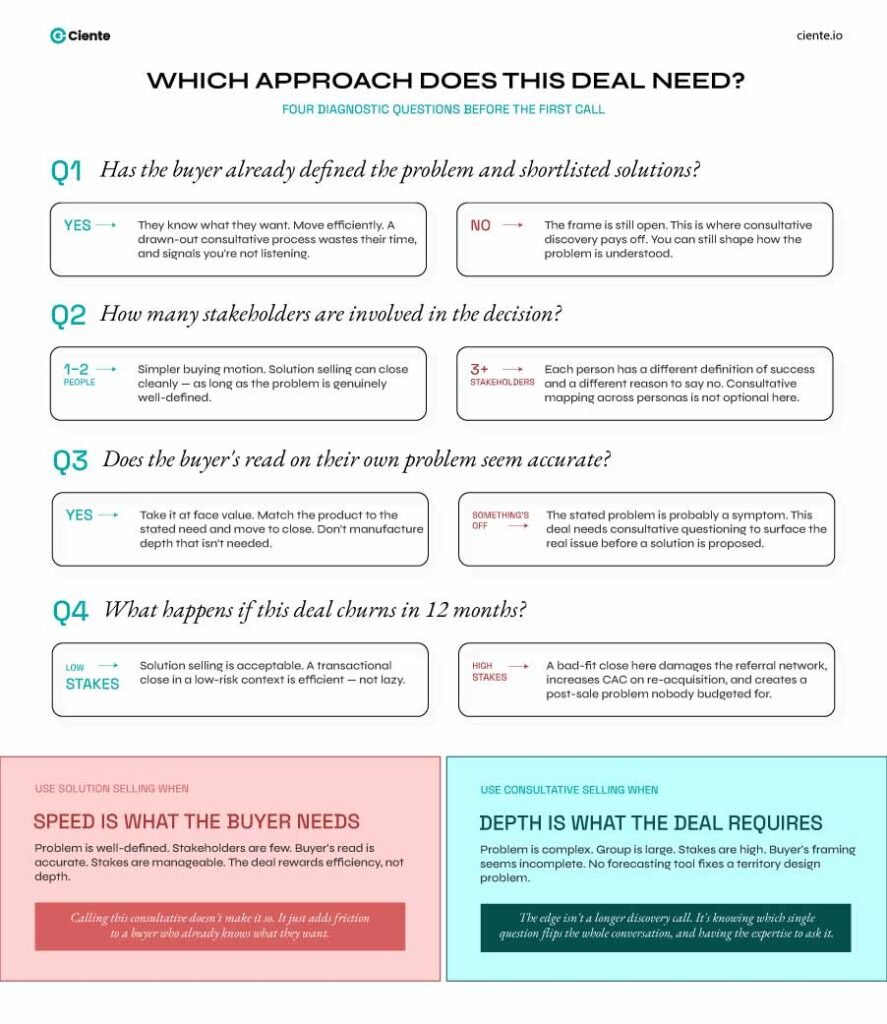
Diagnostic approach questions

Here’s the framing that clarifies everything. Solution selling is one string to the bow of a consultative strategy, and when looking at the offshoots of selling, their roots tend to trace back to consultative selling advantages.

Consultative sellers sell solutions. They do it constantly. but in a way that aligns more closely with ABM vs lead generation strategies. The difference is that the solution they recommend comes out of a diagnostic process the buyer went through with them. The buyer isn’t just purchasing a product but acting on a conclusion they helped reach.

That’s a different psychological position for the buyer to be in, and it changes everything about how the relationship develops after the sale. Renewals are easier. Expansions come up organically. Even difficult conversations about implementation gaps start from a place of shared ownership rather than finger-pointing.

Solution selling is a piece of the world of consultative selling. Consultative sellers do work to sell a solution, but they are primarily consultants and coaches for their prospects, not just sales reps.

What This Difference Actually Demands from Sales Organizations

Most sales leaders hear “consultative selling” and immediately think of training. Better discovery questions. Active listening workshops. Coaching on objection handling.

That stuff helps. But it’s not the core problem.

Consultative selling requires business acumen, not just sales skills. something increasingly supported by AI transforming the selling process.

The rep needs to walk into a CFO’s office and understand enough about how that company makes money, where it’s exposed, and what’s keeping that CFO up at night to ask a question that actually lands. That’s not something a two-day workshop builds. It accumulates over years of working in a specific vertical, with a specific buyer type, on a specific set of problems.

Emblaze’s 2025 research found that sellers with proactive sales habits generate 19 to 30% higher annual sales revenue and 12 to 23% higher profit margins than their more reactive peers.

The organizations that get this right don’t treat consultative selling as an enterprise-only motion; they activate for big logos. They hire for curiosity and domain depth, build it into onboarding, and run discovery the same way across every deal size.

When the context genuinely calls for speed over depth, they shift to solution-selling precision. But that’s a deliberate choice, not a default.

Which One Should You Actually Be Using?

The honest answer is that the question itself is slightly wrong.

When the buyer has a well-defined problem, knows the solution category, and wants the process to move efficiently, solution selling works best, especially when supported by fast speed-to-lead strategies. knows the solution category, and wants the process to move efficiently, solution selling is the right gear. Slowing it down with unnecessary diagnostic depth doesn’t make you look more consultative. It makes you seem as if you’re not listening.

When the problem is complex, the buying group is large, the stakes are high, or the buyer’s own read on the situation seems off, consultative selling is the only approach that holds. Solution selling in that context closes a deal and creates a problem.

The real issue most teams face isn’t picking the wrong methodology.

It’s calling everything consultative when most of it is still solution selling, just with a better pre-call research document. And the consultative seller’s edge isn’t a longer discovery call. It’s knowing which single question flips the whole conversation, and having the expertise to ask it without sounding like they’re running a script.

Consultative Selling

Consultative Selling: It’s either the best thing in sales or isn’t

Consultative Selling: It’s either the best thing in sales or isn’t

The quick sale has always been a false promise, a vision forced upon others. Consultative selling might be a solution or the worst thing ever. It’s your call to choose.

As Tyler Durden says, “Advertising has us chasing cars and clothes, working jobs we hate so we can buy shit we don’t need.”

While quoting Fight Club can seem like the start of a satirical critique on the nature of selling, it is not that.

None can escape the hamster wheel of consumerism; everyone wants to survive, eat well, and live luxurious lives, including work lives. But what we can eliminate here is the forced sell; the tranquilizer to modern life can be transformed into a genuine promise.

Not a lullaby to lull your buyers into a false sense of security, but rather a consultative approach to corporate (B2B?) growth.

Consultative Selling is not altruistic

Let’s get something out of the way before this becomes a hopecore piece- consultative selling is not altruism, though that can be a good byproduct of it, an amazing marketing tactic.

Because if you help your buyer find the right fit for them, they will recommend you to others in similar buying scenarios.

So then what is consultative selling?

It’s a simple calculus- buyers feel that B2B is transactional- devoid of feeling and empathy. Thus, the consultative vs solution selling approach adds real problem-solving and the ability to understand what buyers might be facing on multiple levels.

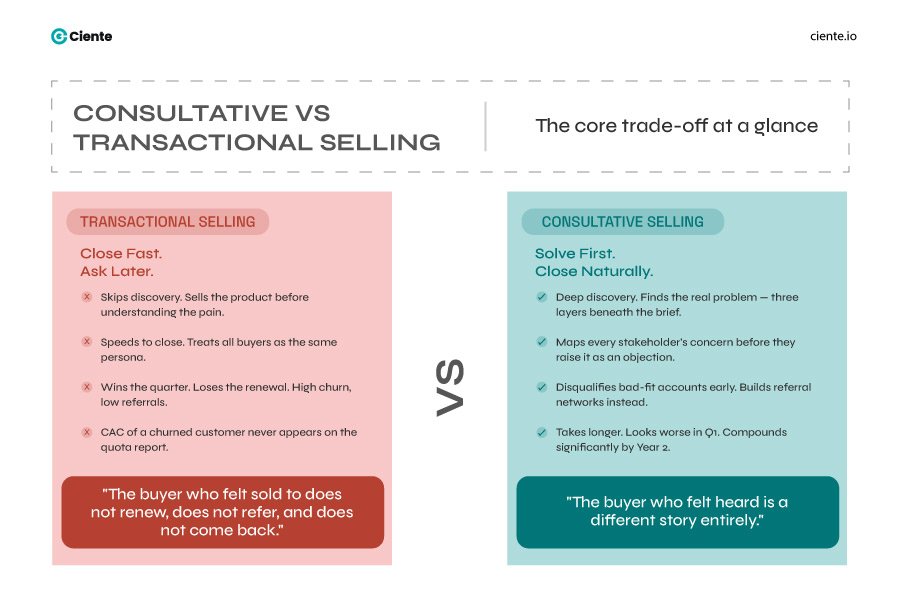
Consultative vs transactional selling

Consultative selling, when done properly, is the approach to maximizing sales by understanding buyers’ core needs and problems, then guiding them to make the right choice—much like a structured lead qualification process ensures you’re solving for the right customer from the start. This has a major consultative selling advantage over other forms of selling-

  1. It provides you with buyer objections and requirements
  2. It gives your marketing team data to work with by finding out what the buyers are asking and why.
  3. It helps teams brainstorm new ways of approaching the buyers, equipped with a deeper understanding of their needs. especially when aligned with target account selling approaches.

But there is also a huge drawback – you might miss the sale. There is a good chance that you realize that your solution might not be ideal for the buyer and, you might have to reroute them to a better solution.

That is where consultative selling is going to lose a majority of leaders who must fill the pipeline.

The Multi-layered Sale

Here is where consultative selling stops being a philosophy and starts being a skill problem.

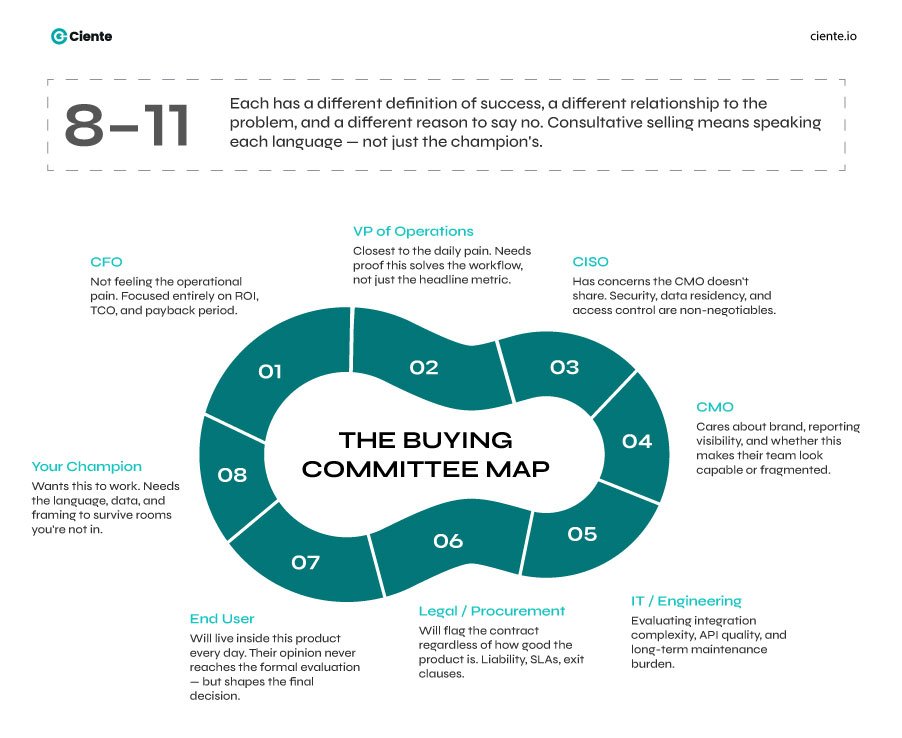
A B2B deal rarely has one buyer. It has a buying committee. something that becomes even more critical when comparing ABM vs lead generation strategies. Eight to eleven people, on average, each with a different relationship to the problem your product solves, a different definition of success, and a different reason to say no.

 buying committee map

The CFO is not feeling the pain the VP of Operations is feeling. The CISO has concerns the CMO does not share. The end user who will live inside your product every day has opinions that never make it into the formal evaluation process but absolutely influence the final decision.

Consultative selling in a multi-stakeholder environment means you are not solving one problem, but engaging across personas much like personalized enterprise selling strategies demand. You are mapping an organization’s problem across every layer it exists in and speaking to each layer in its own language.

This is not as complicated as it sounds, but it requires one thing most reps skip: genuine curiosity about how the organization actually works, not just where the budget sits.

Start with the problem behind the problem. When a buyer says they need a better reporting solution, that is rarely the real problem. The real problem is that someone senior is asking questions the current system cannot answer and someone is getting embarrassed in a meeting. Find that. The solution sells itself once you are speaking to the actual pain rather than the symptom they led with.

Map the objections before they surface. using insights similar to those derived from lead scoring models. Every stakeholder in a buying committee has a version of the objection they will eventually raise. The CFO will ask about ROI and total cost of ownership. The IT team will ask about integration and security. The legal team will flag the contract. A consultative rep does not wait for these to arrive. They surface them early, address them on their own terms, and reframe them before they become blockers.

Give each stakeholder something to champion internally. The deal you are working through a champion still has to survive the rooms you are not in. Give your champion the language, the data, and the framing to represent the solution accurately to each person on the committee. A rep who only sells to the champion and hopes they will carry the message is leaving the outcome to chance.

The Objection You Have to Be Honest About

Consultative selling takes longer. There is no getting around it.

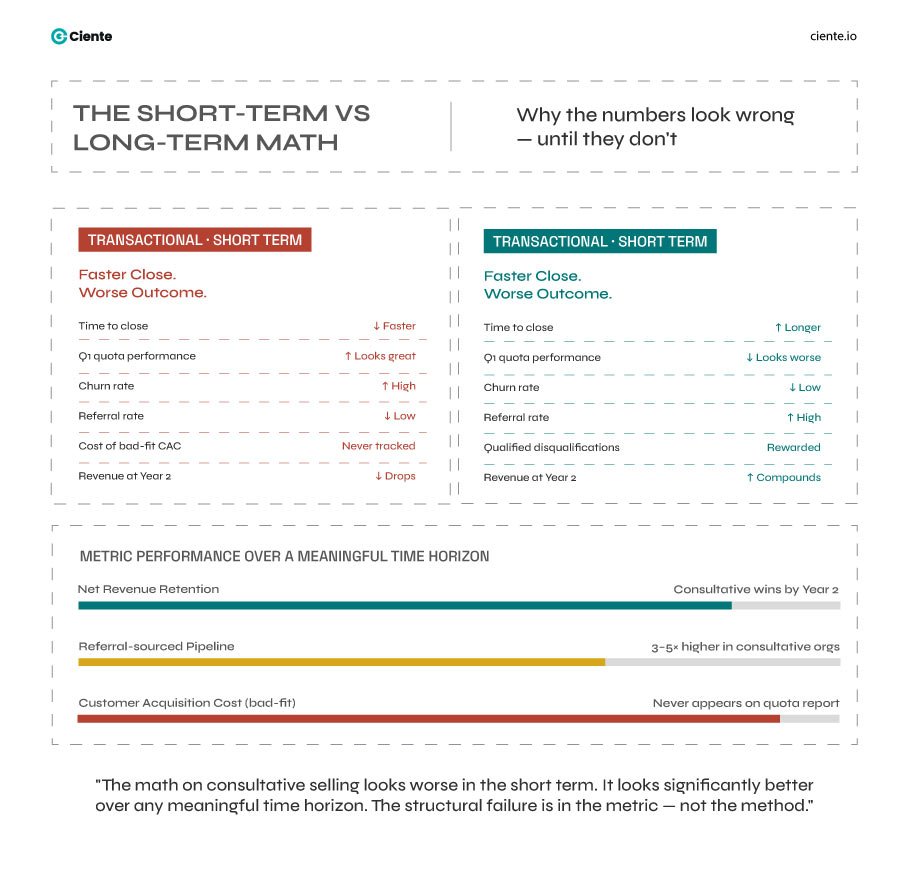
The transactional approach is faster on the surface because it skips the hard conversations. often leading to issues highlighted in why businesses stop losing leads too late. It skips the moment where you realize the buyer might not be the right fit. It skips the discovery that reveals the real problem is three layers deeper than the one in the brief. It closes faster, and it churns faster, and the CAC of winning back a churned customer or repairing a referral network damaged by a bad fit sale never appears on the rep’s quota report.

The math on consultative selling looks worse in the short term. but aligns better with long-term value seen in customer experience and lead nurturing alignment. It looks significantly better over any meaningful time horizon.

The Short Term vs Long Term Math

But here is the honest concession: if your pipeline is thin, if the quarter is ending and the number is not there, the consultative approach becomes very difficult to justify to leadership that is looking at a dashboard and not a relationship.

This is not a character failure. It is a structural one. Organizations that reward quarterly closes and ignore lifetime value are building the exact incentive that produces transactional selling, regardless of what the sales training deck says.

If you want consultative selling to work, the metrics around it have to reflect the behavior it requires. That means measuring deal quality alongside deal volume. It means tracking referral rates from closed accounts. It means giving reps credit for the qualified disqualification, the account they walked away from because it was not the right fit, instead of punishing them for a low close rate on bad-fit opportunities.

Without that, consultative selling is something the company says it does and the reps do when the quarter is comfortable.

What Actionable Actually Looks Like for Consultative Selling

Before the first call, know what success looks like for this specific buyer at this specific moment. Not the generic persona. The actual company, the actual initiative, the actual pressure they are operating under. Their recent earnings call, their job postings, their leadership changes. The consultative rep arrives informed, not scripted.

Ask the question behind the question. When a buyer raises a concern, the instinct is to answer it. The better move is to understand it first. “What’s driving that concern?” gets you further than a prepared rebuttal. Most objections are not about what they appear to be about.

Make the disqualification explicit when it is the right call. If the solution is not the right fit, say so clearly and early. Offer them a direction toward what is. This feels like losing the deal. It is actually building a referral source, a market reputation, and occasionally the exact condition that brings that buyer back two years later when their situation changes.

Use your data as a consultative asset, not just a closing tool. similar to how lead tracking systems provide actionable intelligence. Marketing data on what buyers in similar roles are searching for, what content they are consuming, and what objections are appearing most frequently across accounts is intelligence the buyer does not have about their own market. Sharing it, in context, in a way that is useful to their decision-making rather than just favorable to yours, is what makes the conversation feel different from every other vendor conversation they sat through that week.

Follow up on the outcome, not the sale. After a deal closes, the consultative rep asks whether it is working. Not because they are required to by a customer success process, but because they told the buyer this would solve a specific problem and they want to know if it did. That behavior, more than any pitch, is what gets someone to pick up the phone the next time you call.

The quick sale has always been a false promise.

Not because it is immoral, but because it is inefficient. The buyer who felt sold to does not renew, does not refer, and does not come back.

The buyer who felt heard is a different story entirely.