2B Prospecting Strategies

B2B Prospecting Strategies: Why Most Pipelines Are Built on Guesswork

B2B Prospecting Strategies: Why Most Pipelines Are Built on Guesswork

The prospecting advice has not changed much in a decade. Build your list. Personalize your outreach. Follow up relentlessly. Use multiple channels. Add value in every touch.

All correct. All insufficient.

Because the reps following that advice to the letter are still generating the same mediocre response rates, still burning through lists faster than they can refill them, still treating prospecting as a volume game while wondering why the quality of conversations keeps dropping.

The advice describes the mechanics. It does not describe the thinking that makes the mechanics work, or how prospecting fits into a broader go-to-market strategy.

The Problem With How Most Prospecting Starts

Most B2B prospecting starts with a list, often without clearly understanding the difference between leads and prospects.

Someone in revenue operations pulls an account list from a tool, segments it by firmographic criteria, assigns territories, and hands it to the sales team. The team works the list. They track activity. They measure response rates. They refine the messaging.

The list is the problem.

Not because lists are wrong, but because a firmographic list tells you who a company is on paper. It tells you nothing about whether they have a problem you can solve right now, whether they have the internal urgency to act on that problem, or whether they are even thinking about this category at all.

A company that matches your ICP perfectly and has no active pain is not a prospect. It is a future prospect, possibly a good one, but working it like an active opportunity is how pipelines fill up with accounts that go nowhere, and reps burn out chasing ghosts.

The starting question is not who fits our profile. It is those who have a problem that needs solving and some urgency around solving it.

Those are different lists.

Signals Over Demographics

The shift that separates high-conversion prospecting from average prospecting is moving from demographic targeting to signal-based targeting, a key evolution in modern sales prospecting approaches.

Demographic targeting: this company is in the right industry, the right size, the right geography, the right tech stack.

Signal-based targeting: this company just hired three enterprise sales reps after two years of mid-market focus. This company just posted a VP of Data role for the second time in eighteen months, which means the first hire did not work out. This company just announced a new market expansion in a region where they have no existing infrastructure. This company’s CEO just gave an interview talking about the exact problem your product solves.

Each of those signals is a door. The demographic criteria tells you the house exists. The signal tells you someone is home and the timing might be right to knock.

Signals come from everywhere once you start looking. especially when supported by the right sales prospecting tools. Job postings are the most underused intelligence source in B2B sales. A company’s hiring patterns reveal their priorities, their problems, and their budget allocations more honestly than anything in a press release. A company scaling their data team while shrinking their analytics headcount is telling you something. A company posting for a third RevOps hire in a year is telling you something different.

Funding announcements, leadership changes, earnings calls, product launches, competitive moves, regulatory changes in the industry — all of it creates urgency somewhere in an account that did not exist six months ago.

The rep who prospects into that urgency is having a different conversation than the one cold-calling into a static list.

The ICP Conversation Most Teams Have Wrong

Ideal Customer Profile work tends to be a marketing exercise that sales inherits, often disconnected from account-based marketing strategy execution. It describes the best-fit customer in terms of who they are. Industry, size, revenue, tech stack, number of employees.

That is a start. It is not enough.

The ICP that actually guides prospecting needs to describe the customer at a specific moment. Not just who they are but what is happening inside their organization that makes them ready to buy.

What does a trigger event look like for this account type? What internal shift, external pressure, or growth inflection creates the kind of urgency that moves a deal from “interesting” to “let’s evaluate this now”?
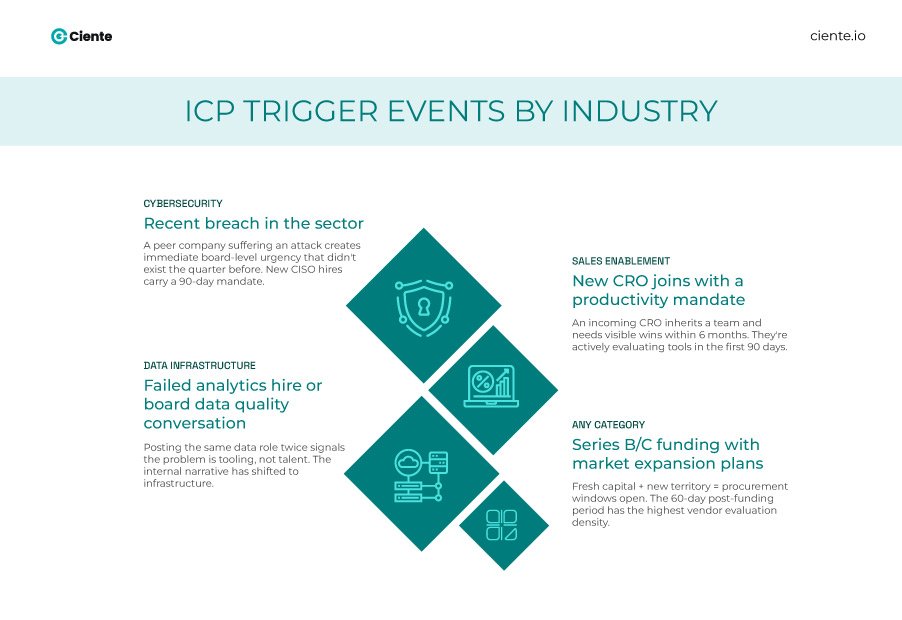
ICP Trigger events by industry

For a cybersecurity company, the trigger might be a recent breach in the industry, a new compliance requirement, or a CISO hire. For a sales enablement platform, it might be a new CRO joining with a mandate to improve rep productivity. For a data infrastructure tool, it might be a failed analytics hire or a board conversation about data quality.

Build the trigger events into the ICP. Then prospect for the trigger, not just the firmographic match, aligning closely with a strong client strategy.

Personalization Is Not a Sentence About Their LinkedIn Post

The word personalization has been stretched so thin it means almost nothing anymore, especially in the context of email marketing strategy.

A message that starts with “I saw your post about Q4 challenges” is not personalized. It is a template with a fill-in-the-blank that took the rep forty-five seconds to complete. The buyer can feel the difference between a message written for them and a message written for their category with their name at the top.

Real personalization is specific enough that the message could not have been sent to anyone else.

It references something true about their specific situation: a business challenge visible from the outside, a relevant change in their market, a tension between two things they have said publicly, an observation about their company that connects directly to a problem the rep knows how to solve.

That level of specificity takes more time per account. It should. It forces a trade-off. If personalization at that depth requires genuine research, then the rep cannot prospect two hundred accounts a week with the same output quality. The list has to get shorter and better.

The reps who run high-volume low-personalization sequences are optimizing for activity. The ones who run focused high-quality outreach are optimizing for conversation. Both approaches have a place. The mistake is confusing one for the other, or trying to get the volume of the first approach with the quality of the second.

Channel Logic, Not Channel Preference

Most prospecting advice tells you to go multichannel, blending outbound efforts with an inbound strategy. Email, phone, LinkedIn, sometimes direct mail or video. The data supports it.

What the advice skips is that the channel should follow the buyer, not the rep’s comfort zone.

A C-suite buyer at an enterprise account who has never responded to cold email in their career is not going to start because the sequence is well-written. Phone or a warm introduction are the right channels for that buyer. The email is a support vehicle, not the primary one.

A technical buyer doing their own research before they ever talk to a vendor is not going to respond to a cold call at 8am. But they will engage with a thoughtful LinkedIn comment on something they posted, or a piece of content that addresses the exact question they have been trying to answer internally.

Channel preference is a buyer characteristic, not a rep preference. The rep who defaults to email because they find calls uncomfortable is not being strategic. They are avoiding the channel the buyer actually uses.

The question before any outreach: where does this type of buyer actually engage, and at what stage of their process do they want to be found?

The Referral That Everyone Underuses

Referral-based leads convert at around 26%, the highest of any channel in B2B, outperforming traditional lead generation methods.

Most sales teams treat referrals as a nice thing that happens occasionally rather than a channel they actively build.

The rep who closes a deal and moves on has left the most valuable prospecting asset untouched. Every satisfied customer is a node in a network of people with similar problems, similar roles, similar challenges. The question “is there anyone you know who might be dealing with a similar situation?” asked at the right moment in a strong customer relationship costs nothing and produces the highest-quality leads available.

The problem is that asking feels uncomfortable to reps who have not been told it is part of the job. So it does not happen systematically. It happens when someone remembers, which means it barely happens at all.

Build referral asks into the post-close process. Build them into quarterly check-ins. Build them into the moment a customer shares a positive outcome unprompted, because that is the moment they are most likely to say yes.

What Prospecting Into a Buying Committee Actually Looks Like
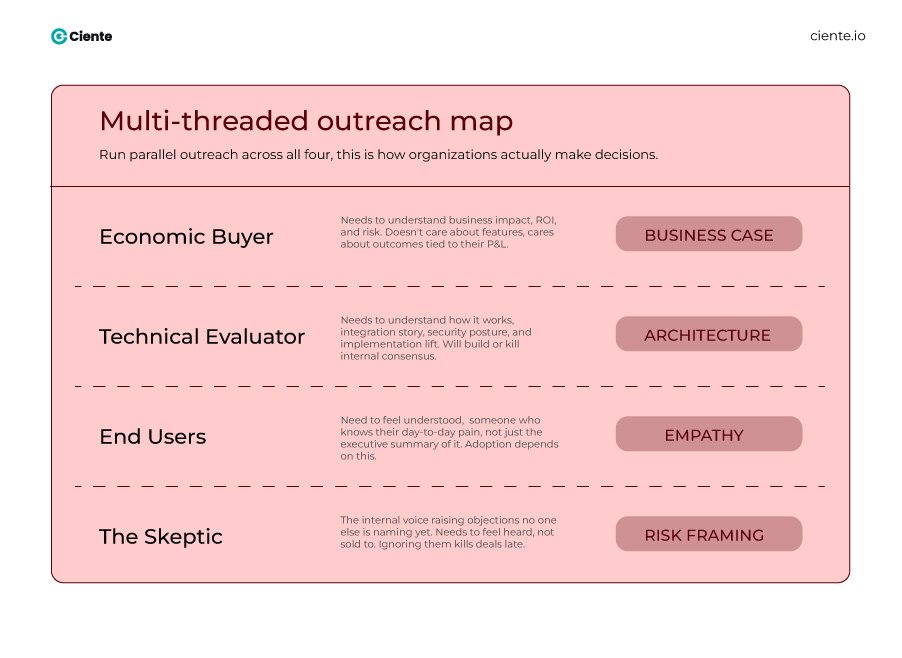
Multi-threaded outreach map

Single-threaded prospecting into a large account is how deals stall before they start.

The champion who responds to outreach is rarely the only person who matters in the buying decision. The rep who invests everything in one contact inside an account and treats everyone else as secondary is building a deal on a single point of failure.

Multi-threaded prospecting from the beginning means identifying multiple stakeholders across the buying committee before the conversation even starts, a core principle in ABX strategy. The economic buyer. The technical evaluator. The end users. The internal skeptic who will raise the objection nobody is naming yet.

Each requires different outreach logic. The economic buyer needs to understand business impact. The technical evaluator needs to understand how things work and what the integration story looks like. The end user needs to feel like someone understands their day-to-day. The skeptic needs to feel heard, not sold to.

Running parallel outreach into the same account across multiple contacts is not aggressive. It is how organizations actually make decisions, and prospecting that reflects that reality converts at a higher rate than prospecting that pretends decisions happen through a single champion.

The Follow-Up Nobody Wants to Send
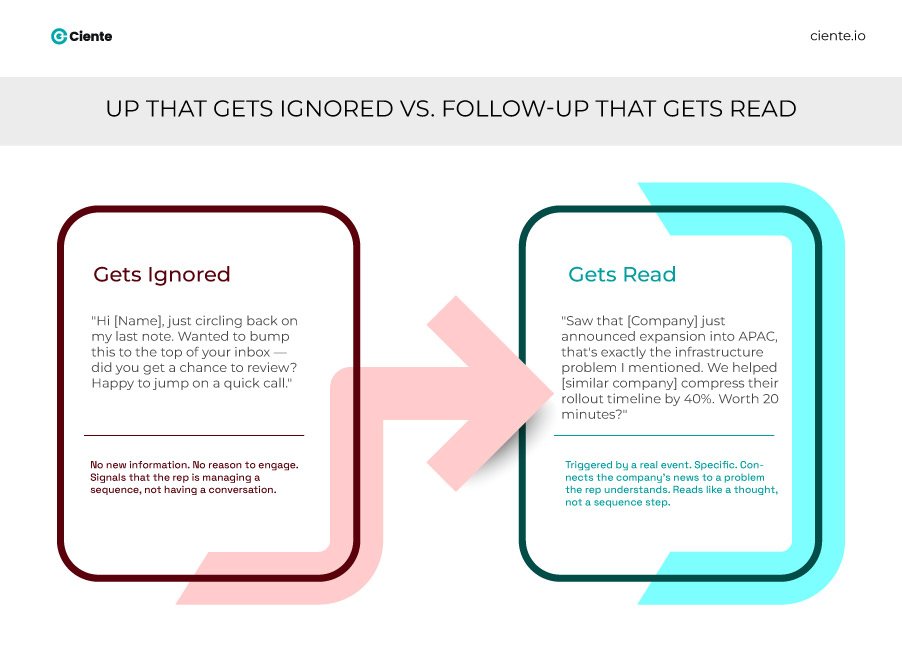
UP- that gets ignored vs follow-up that gets read

Most follow-up fails because it has nothing new in it.

“Just circling back.” “Wanted to bump this to the top of your inbox.” “Did you get a chance to look at my last message?” These are not follow-ups. They are reminders that the rep exists and the buyer has not responded. They communicate nothing and ask for attention without offering a reason to give it.

Every follow-up needs a reason to exist beyond the fact that the previous message went unanswered, often supported by a relevant content strategy.

A piece of relevant content. An observation about something that changed in their market. A question triggered by something the company announced. A stat or insight that directly relates to the problem the initial outreach was about. Something that makes the buyer feel like time has passed and things have developed rather than feeling like the rep is just pressing send again.

The follow-up that gets opened is the one that reads like something the rep thought of, not something the sequence tool scheduled.

The Prospecting Conversation Most Leaders Are Not Having

Prospecting is treated almost universally as a rep skill problem, instead of being addressed through a structured CRM strategy. Train the reps better. Give them better scripts. Run more role plays. Review the cadences.

Some of it is a rep skill problem. Most of it is not.

The deeper issue is that prospecting is an organizational intelligence problem. Are reps working the right accounts? Do they have the signals they need to find urgency before they pick up the phone? Does the ICP reflect what actually converts, or what marketing decided eighteen months ago? Is the territory designed around where the real opportunity is, or around geography and historical patterns?

A rep with average skills working a high-signal account list in the right territory will outperform a rep with excellent skills working a static list of accounts with no active pain.

Prospecting strategy is not the rep’s individual problem to solve. It is a system that either gives reps the right raw material or it does not.

The organizations generating consistent pipeline are the ones that have figured out that the work done before the first message goes out determines more about the outcome than anything that happens in the outreach itself, often supported by a data-driven marketing strategy.

The message is the last ten percent. Everything before it is the job.
Customer Journey Analytics

Customer Journey Analytics: What Happens When Messy Data Creates Confident Mistakes?

Customer Journey Analytics: What Happens When Messy Data Creates Confident Mistakes?

Your customer journey analytics dashboard looks great. But you still don’t know why your customers are churning. The answer probably has nothing to do with your data.

Marketers aren’t lacking customer data; they have more than they know what to do with. Session recordings, funnel reports, attribution dashboards, and heatmaps. And yet, you still cannot tell with confidence why someone dropped off at step three of checkout, despite investing in customer analytics platforms that promise complete visibility.

That gap is not a data problem. It never was.

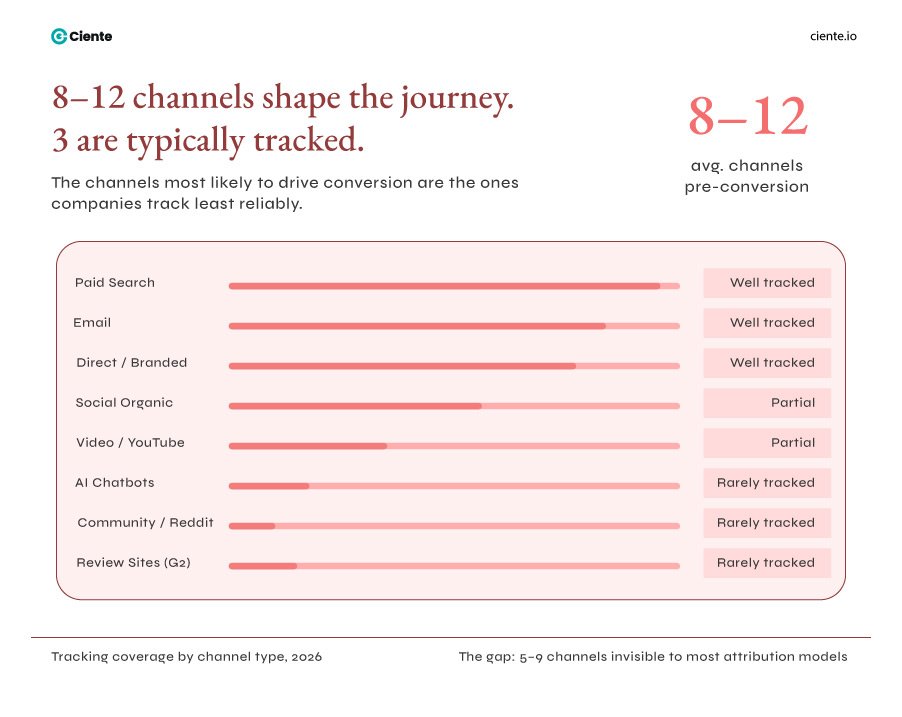
The Channel Tracking Gap

It is an interpretation problem. A structural problem. And in 2026, it will become more expensive to ignore.

The Actual Definition of Customer Journey Analytics

Customer journey analytics is tracking, connecting, and making sense of every interaction a customer has with your brand, often powered by a unified customer data platform that brings fragmented data together, from the first time they hear your name to the moment they renew, refer, or churn.

Sounds clean. But the reality is messier.

Today’s customer does not move in a straight line, which makes customer journey orchestration increasingly critical to guide experiences across fragmented touchpoints. They spot your product on Instagram, scroll past it, catch a YouTube review three weeks later, ask an AI chatbot how you compare to your competitors, fall down a Reddit rabbit hole, and then show up on your site via branded search as they’ve never encountered you before.

Research illustrates that the average pre-conversion journey occurs between 8 and 12 channels in 2026, which reinforces the need for stronger customer acquisition strategies that account for multi-touch journeys. Most companies track three of those well, on a good day.

So when your attribution report says paid search drove the sale, what it usually means is that this search was the last visible stop before purchase. That is not attribution. That is recency bias dressed up in a dashboard.

The real job of customer journey analytics is not reporting what happened. It is understanding why it happened and predicting what comes next. Those are very different problems, and conflating them is where most programs quietly fall apart.

On Markov Chains: A Customer Journey Analytics Approach

Here is where most blog posts either oversell the model or dismiss it. Neither is useful.

The Markov chain model is still one of the more principled approaches to journey analytics. Unlike first-touch or last-touch attribution, which merely assign credit based on position, Markov calculates actual transition probabilities between touchpoints. It asks: given that a customer is here right now, where are they most likely to go next? And it uses a clever tool called the removal effect, i.e., delete a channel entirely to observe how conversion probability changes.

That is honest. That is causal thinking, not positional thinking.

The Mixture of Markov Models extension takes it further.

Instead of one generic model for all customers, it builds separate transition matrices for distinct behavioral clusters. Three buyer archetypes, three models. It can predict the next most likely step in an incomplete journey. That is real predictive value, and anyone who dismisses it has not actually used it.

But here is where the seams show.

Markov chains have a memoryless design.

With no memory of the path that led there, every prediction is based only on the current state. Two customers land on your pricing page. One has spent six weeks reading your content, attended a webinar, and compared three competitors. The other clicked on a cold ad this morning.

Markov gives both the same prediction.

That is not a minor rounding error. On a long, considered purchase, it is a fundamental misread of intent.

The second limitation is scope. Markov runs on structured events- touchpoints you have pre-defined and built into the model. It cannot read a frustrated comment on your Facebook ad.

It does not know that your G2 reviews are full of one specific complaint that is silently killing consideration. Sentiment, language, and emotional signals are increasingly where the strongest intent data lives, making voice of customer analysis essential for deeper insight beyond structured events. Markov is blind to all of them.

None of this makes Markov obsolete.

The smartest teams use it as an interpretability layer- translating what more complex AI models surface into transition probabilities that non-technical stakeholders can actually act on. That is a legitimate and useful role.

But it is a supporting role, not the architecture itself.

Deep learning models, particularly LSTMs, were built specifically to overcome the memory problem and unlock richer insights similar to those used in data analytics for CX initiatives. They hold the full sequence in context and produce fundamentally different predictions for customers with different histories, even when they share the same current state.

The tradeoff is interpretability- they are harder to explain to a CMO. That’s exactly why Markov and LSTM used together are a more powerful combination than either one alone.

The Problem Is Not with Your Customer Analytics Journey Model.

Your attribution model can be perfect, but it cannot help you if the data feeding it remains fragmented across five teams that don’t converse with each other.

Marketing owns the campaign data, sales owns the CRM, and support has its ticketing system, which creates fragmentation that directly impacts customer success and long-term retention. The product has event tracking. Each function optimizes for its own metrics. The customer, who has continuous experience across all of them, ends up as disconnected fragments in four different databases.

Nobody has the full picture, and the journey map reflects that incompleteness.

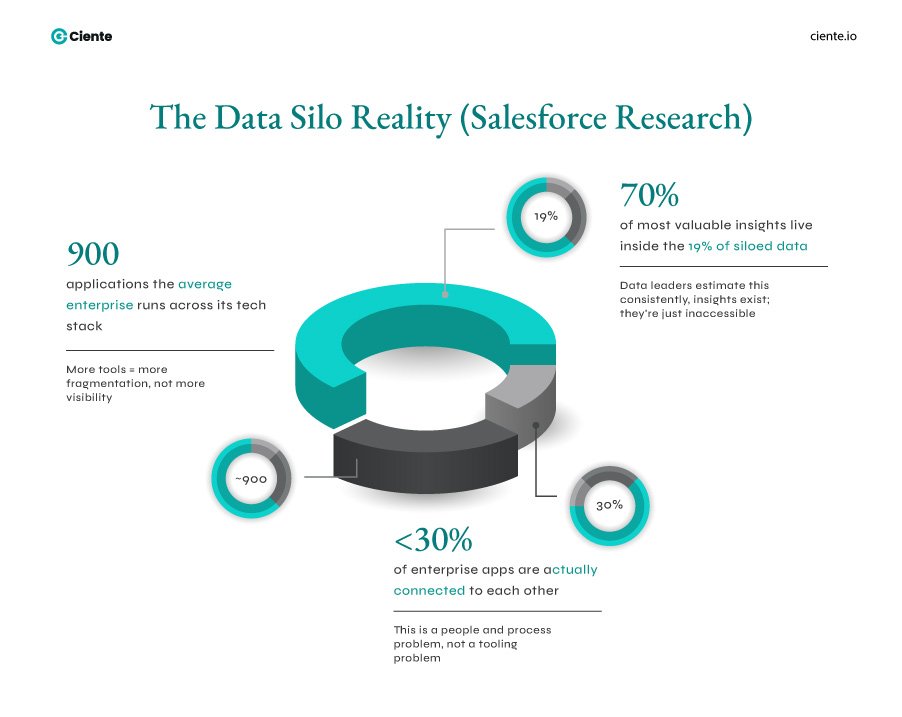
Salesforce research puts numbers on this.

Salesforce research

Data leaders estimate that 70% of their most valuable insights sit inside the 19% of data that is siloed or inaccessible. The average enterprise runs nearly 900 applications. Fewer than 30% are connected.

That is not a tooling problem. That is a people and process problem. And it is the reason why many companies invest heavily in customer journey analytics platforms and see modest returns. The platform is only as powerful as the data architecture and the organizational will behind it.

AI makes this more urgent.

An alert is only useful if someone can act on it before the customer gives up when a real-time system flags a friction point in the customer journey. In a siloed organization, the insight sits in a dashboard, the right person never sees it in time, and the customer churns for a reason that was entirely visible and entirely unaddressed.

The companies pulling ahead are not running the most sophisticated models; they are aligning data, teams, and messaging around a clear customer value proposition. They have done the unglamorous work of connecting their systems, aligning teams around a shared customer definition, and building the operational speed to respond to what the data reveals.

That is the actual competitive advantage.

What Good Looks Like in Customer Journey Analytics Tracking

Analytics programs that change outcomes differ from those that merely produce reports in small ways.

The journey map is a living document, not a deliverable. Connect it to live VoC data and continuously refine it using insights from customer behavior psychology to reflect how decision-making actually evolves. Update it when behavior shifts. Own it actively, not ceremonially.

Define the journey from the real beginning.

Most companies begin mapping at the moment a customer considers a purchase, which causes them to miss earlier stages shaped by digital fatigue and attention fragmentation. But the journey starts when the customer first becomes aware of a need- sometimes months before they find you.

Brands that define the journey too narrowly miss the earliest, cheapest opportunities to build trust.

Combine quantitative and qualitative signals deliberately.

Numbers tell you what happened. Customer interviews, session replays, and sentiment analysis tell you why. A drop-off in your checkout funnel might be a UX problem in the data and turn out to be a trust problem in the recordings.

You need both before you build a fix.

Test before you scale.

especially when optimizing channels like email within broader email-marketing lead-generation programs. A channel that appears in most converting journeys did not necessarily cause those conversions. It may have just been present. Holdout experiments and incrementality tests are not optional if you want attribution for staking a budget on.

The Part Everyone Skips

The market for customer journey analytics is going to reach $25 billion. The investment is real. The outcomes are well documented for companies that actually close the loop between insight and action.

However, the graveyard is full of companies that bought the platform, ran the models, sat through the onboarding calls, and got nothing. It was because the data was fragmented, and the teams were in siloes. The insights sat in dashboards nobody opened. And customers kept churning for reasons that were visible in the data and invisible to those with the authority to fix them.

The question is not whether your company does customer journey analytics in 2026. Almost all of you do. The question is whether your company is structurally capable of transforming what it finds into something actionable. Fast enough to matter.

That is the real work. It happens in the org chart before it ever happens in the model.

Mercor

Security Breach at Mercor Halts Meta-Related Work as OpenAI Launches its Own Investigation

Security Breach at Mercor Halts Meta-Related Work as OpenAI Launches its Own Investigation

Meta is running for the hills after a $10 billion security leak, while OpenAI stays to investigate. Are the industry’s biggest secrets finally out?

Meta just hit the panic button.

The tech giant has frozen all work with Mercor, its $10 billion AI data partner. It’s a full-blown security disaster more than a leak. But as Meta is sprinting for the exit, OpenAI is staying put to run its own investigation.

This mess is a rare image of the brittle infrastructure behind the AI boom.

The breach didn’t come from a direct hack.

It started with a poisoned open-source tool called LiteLLM. A group called TeamPCP hid a “worm” inside code that millions of developers trust. When Mercor used it, the hackers walked right in. They reportedly stole four terabytes of data.

It includes the highly guarded blueprints for training AI models.

Meta’s reaction tells the real story. They didn’t just pause. They cut the cord indefinitely. That suggests they found something truly ugly in the logs.

OpenAI is playing it cool, but they are clearly on edge. If a hacker has the blueprints for how these models are “taught,” the multi-billion dollar edge these companies have disappears.

The 40,000 contractors are the real victims.

Their work is on a pause with zero warning. And many of their Social Security numbers also leaked. They are the hidden labor of the AI era. They are always the first to face the brunt.

The AI supply chain is a mess. If one bad tool can topple a $10 billion partner, the foundation is rotten.

Britain

Britain woos Anthropic to expand after clash with Pentagon

Britain woos Anthropic to expand after clash with Pentagon

Here is where things stand. The US Defense Department designated Anthropic a national-security supply-chain risk after the company refused to allow its Claude models to be used for military surveillance and autonomous weapons.

A federal judge blocked the designation, ruling it likely violated constitutional protections. The Trump administration is now appealing that ruling. The President, separately, called Anthropic’s leadership “leftwing nut jobs” for holding that line.

Into that opening, Britain moved quickly.

The UK government is courting Anthropic with proposals that include expanding its London office footprint and pursuing a dual listing on the London Stock Exchange. Officials at the Department for Science, Innovation and Technology have drafted the proposals for Anthropic CEO Dario Amodei, who visits Britain in late May on a European customer and policy tour. Downing Street is backing the effort.  London Mayor Sadiq Khan followed up in writing, pitching the capital as a “steadfast” base for the company. The FT broke the story on Sunday.

The proposal on the table is part expansion offer, part diplomatic signal. Britain wants Anthropic in London. It also wants to be seen wanting Anthropic in London, which is a different thing and equally intentional.

The honest subtext, acknowledged privately by officials, is that Britain has no homegrown frontier lab to rival the Americans. The strategy is partnership, not competition. The goal is to tie the best US labs to UK infrastructure, research base, and talent pipeline before other European capitals do.  OpenAI has already committed to making London its largest research hub outside the US. Google is completing a roughly £1 billion King’s Cross campus. The Anthropic pitch fits a pattern.

But this story is not really about office space or stock listings. Those are instruments. The story is about what a government does when a private company refuses a government’s demand and gets punished for it, and another government decides that refusal is an asset worth recruiting.

Anthropic drew a line. It said Claude will not be used for surveillance. It said Claude will not be used for autonomous weapons. The Pentagon designated it a risk for saying so. That sequence is the thing worth sitting with, because it describes something new about where AI sits in the world right now.

For most of computing history, technology was neutral in the geopolitical sense. Governments bought it, used it, regulated it, but the tools themselves did not have positions. What is happening now is different. The major AI labs are being asked to take sides, not rhetorically, but operationally. Will your model help target people? Will it automate lethal decisions? The answer to those questions is becoming a foreign policy matter.

Britain is not offering Anthropic a home because it agrees with every position Anthropic holds. It is offering a home because a company willing to refuse the US military on ethical grounds is a company that other governments can negotiate with. That is valuable in a world where AI is becoming as strategically significant as energy or communications infrastructure.

A dual listing remains, in the words of one insider, “the dream” rather than a realistic near-term scenario, particularly with Anthropic expected to IPO in the US as early as this year. The legal cloud from the Pentagon appeal is still in place, and formal commitments are unlikely before that resolves.

What is not in question is the direction of travel. The AI labs are no longer just technology companies navigating markets. They are entities with enough independent weight that governments court them, punish them, and position themselves around them the way they once did around oil companies or defense contractors.

The question of whether that power comes with accountability, and to whom, and under which legal framework, is one nobody has answered yet. Britain is not answering it either. It is just making sure it has a seat at the table when someone does.

That is what this visit in late May is really about.

Google

Google Launches its Most Versatile Models to Date: the Gemma 4

Google Launches its Most Versatile Models to Date: the Gemma 4

If Google is giving away the same AI that OpenAI charges for, does a $20 monthly subscription even make sense anymore?

Google just dropped Gemma 4, and it feels like a direct hit to the subscription model. For the last few years, the best AI lived behind a paywall. If you wanted the good stuff, you had to pay OpenAI or Anthropic every month.

Google is now giving away a model that runs on your own hardware for free. It is a smart move to turn high-end AI into a basic utility that anyone can use.

The license is the real story here.

Google is allowing anyone to use the code without requiring permission by leveraging the Apache 2.0 standard framework. You can take this model, put it on a private server, and use it to handle sensitive data such as medical records or bank statements.

You never have to send a single byte of data to a third-party cloud. It solves the privacy challenge that has been bothering prominent industries for years.

Gemma 4 is surprisingly versatile.

It handles audio, vision, and text all at once. Because it runs locally, it works in airplane mode. You could be in a remote area and use your phone to translate a conversation or identify a plant through your camera. It removes the lag and the cost of the cloud.

Google’s strategy is simple.

If they can’t be the biggest paid service, they will be the best free foundation. They want every developer on the planet building on their tech. By making the “brain” a commodity, they are forcing competitors to justify their high prices. It is a race to the bottom, and for once, the users are winning.

The elite AI paywall just hit a wall.

Search moves beyond keywords as AI reshapes ad targeting

Search moves beyond keywords as AI reshapes ad targeting

Search moves beyond keywords as AI reshapes ad targeting

AI has taken over the mechanics of search advertising. Bidding, targeting, copy generation, and placement decisions. All automated. The efficiency gains are real. So is the risk that your brand is saying things you never said, appearing in places you never intended, to audiences assembled by logic you cannot fully inspect.

Search advertising used to be legible. You picked keywords. You wrote headlines. You set bids. You watched what happened. The feedback loop was slow, but it was yours.

That model has not disappeared. It has been absorbed into something considerably more opaque and considerably more powerful. In 2026, the platforms are not asking advertisers to participate in campaign management so much as they are asking them to supervise it. The AI handles the rest.

The question is: what exactly is it handling, and is anyone watching?

From Keywords to Conversations

The mechanics of how people search have changed faster than most advertisers have updated their mental models. Users are no longer typing two-word queries into a search bar and clicking the first blue link. They are having conversations with AI assistants, asking multi-part questions in natural language, and receiving synthesized answers that may never require them to visit a website at all.

Microsoft’s research puts roughly 80% of consumers now relying on zero-click results in at least 40% of their searches. Voice queries on mobile are five times more frequent than they were a few years ago. Visual search, where a user points a phone camera at something and expects results, has become a meaningful entry point for product discovery.

These are not edge behaviors. They are becoming the norm, and the advertising infrastructure has repositioned itself around them. Google’s AI Mode, its conversational search experience, embeds ads directly into the context of a dialogue rather than alongside a list of results. When a user asks which running shoes suit a marathon with a budget under a specific amount, the system does not return ten blue links. It assembles a recommendation, and relevant brand offers marked as Sponsored appear within that recommendation, at the precise moment purchase intent has already formed.

The logic of search advertising has shifted from interception to integration. Ads are no longer a block competing for attention above organic results. They are part of the answer.

The Automation That Cannot Be Opted Out Of

Google’s Performance Max and AI Max for Search are no longer optional add-ons for advertisers who want to experiment with automation. They are increasingly the mechanism through which premium real estate is accessible at all.

Google has confirmed that ads appearing in AI Overviews and AI Mode, the AI-generated answer surfaces now prominent at the top of search results, are eligible only for Performance Max, AI Max for Search, and broad match campaigns. Standard campaigns using exact or phrase match keywords are structurally excluded from these placements. As AI-enhanced surfaces capture a growing share of search traffic, the pressure to migrate toward automated campaign types is not a suggestion. It is how the inventory is organized.

Meta has followed a similar logic with its Andromeda system, a ranking and delivery engine that processes behavioral data in real time and decides which ad reaches which person at which moment. The system learns, predicts, and optimizes without waiting for an advertiser to define an audience. According to Meta’s own framing, the advertiser’s job is no longer to identify the audience. It is to feed the system the right creative and business signals.

OpenAI began testing ads in ChatGPT in January 2026. The targeting there operates on conversational context rather than keyword match, meaning ads are served based on the full meaning and intent of an ongoing dialogue. Kantar’s 2026 data shows 24% of AI users already rely on an AI assistant to make purchasing decisions on their behalf. The platform infrastructure is building toward that behavior. The commercial logic follows.

The Brand Safety Problem Nobody Advertised

Here is where the efficiency story develops a complication.

When a human campaign manager decided where an ad would appear, the decision involved judgment. Context. A recognition that a financial services brand probably does not want its ad next to a story about fraud, or that a children’s product should not appear on content intended for adults. That judgment was imperfect, but it was present.

Automated systems optimize for performance signals. Conversions, clicks, cost per acquisition. If a website generates conversions at an attractive cost, the algorithm sends more budget there, regardless of whether the editorial context around the ad is consistent with the brand’s positioning. The AI is not indifferent to brand safety in malice. It simply was not designed to care about it in the first place.

The December 2025 IAS Industry Pulse Report found that 56% of UK media experts identified ad adjacency to AI-generated content as a major challenge for 2026. This is a specific concern: as AI generates more of the content on the web, ads can end up placed alongside material that no human editor reviewed, approved, or in some cases wrote. The content may be technically inoffensive while still being contextually wrong for the brand appearing next to it. Low-quality aggregator sites, arbitrage pages, toolbar search results, parked domains: Performance Max was serving ads across all of these until Google began removing categories of inventory in late 2025 and early 2026.

The Copy Problem

The placement problem is visible. The copy problem is quieter, and potentially more damaging.

Performance Max and AI Max generate ad copy automatically. The system takes the assets an advertiser provides, headlines, descriptions, images, and recombines them into variations it predicts will perform. Google reported that advertisers used Gemini to generate nearly 70 million creative assets inside AI Max and Performance Max campaigns in Q4 alone. Seventy million variations. Most advertisers approved none of them individually.

Until March 2026, advertisers had limited control over what that copy said. The AI would generate headlines and descriptions that met Google’s ad policies but did not necessarily meet the brand’s own standards for tone, language, competitive positioning, or regulatory compliance. A pharma brand might find the AI generating copy that used unapproved clinical language. A premium brand might find discount framing in headlines it never wrote. A company with specific messaging around a sensitive product category might find the AI filling gaps with language drawn from the broader asset pool in ways that created ambiguity the brand had deliberately avoided.

The CMO of Athenahealth discovered the company’s AI profiles were pulling outdated information from obscure sources and failing to surface Athenahealth in relevant queries. That is an AI visibility problem rather than a paid advertising one, but it illustrates the same dynamic: the AI builds a representation of your brand from available signals, not from your intentions.

Google’s response, expanding text guidelines globally to all advertisers on February 26, 2026, allows brands to set explicit brand voice constraints, prohibit specific terms, enforce tone parameters, and restrict competitive mentions. The feature is a direct acknowledgment that the problem was real. Its arrival as a beta that took months to reach global availability is a direct acknowledgment of how long advertisers were running without it.

The Permutation Problem

The deeper issue is structural, and no single feature update fully resolves it.

When AI generates hundreds of headline and description combinations in real time, matching copy to individual user intent, the number of versions of your brand message in the wild becomes effectively uncountable. Two users with different browsing histories, different behavioral profiles, different search patterns, may see entirely different ads for the same product, assembled by the system from the same asset library.

This is the permutation problem. The brand you have built, the one with deliberate language choices and a carefully maintained positioning, is being rendered differently for different audiences by a system optimizing for clicks. Some of those permutations will be fine. Some will be off. A few will be actively inconsistent with what you have spent years establishing.

The issue is not that the AI performs badly on average. It is that averages are not how brand perception works. A buyer who sees an off-brand headline, or an ad adjacent to content that conflicts with the brand’s values, does not discount that experience because the campaign’s overall CTR was strong. They remember what they saw. The statistical performance of a campaign and the brand impression it leaves can diverge, and current reporting infrastructure is better at measuring the former than the latter.

What Advertisers Can Actually Do

The platform direction is set. Automation is the infrastructure. The question is not whether to operate within it but how to operate within it with enough deliberateness to preserve the brand value that makes the advertising worth doing in the first place.

Placement reporting is now available for Performance Max in ways it was not a year ago. Google’s February 2026 update expanded the Where Ads Showed report to include data that was previously hidden or returned as empty results. The report shows specific placement domains and network types across the account. It is a brand safety report, not a performance report: it shows the context your brand appeared in, not the clicks it drove. Reviewing it weekly is not optional if brand safety matters to the business.

Account-level placement exclusions, which Google rolled out in January 2026, allow advertisers to block specific websites, apps, and YouTube channels from a single centralized list that applies across all campaign types simultaneously. This is the mechanism for proactive brand safety management rather than reactive discovery. Building that exclusion list before a problematic placement shows up in a report is the difference between prevention and damage control.

Text guidelines are now available to all advertisers globally across Performance Max and AI Max. Setting explicit constraints on what language the AI can and cannot use in generated copy is not a nice-to-have for brands with specific positioning requirements. It is the minimum governance layer between the brand and the automation.

None of this eliminates the permutation problem. It constrains it. The AI still generates more variations than any human team reviews. The audit is sampling, not coverage. But sampling is better than nothing, and the tools for tighter governance exist now in ways they did not six months ago.

The Actual Risk

The industry conversation around AI in advertising tends to focus on performance metrics. Click-through rates. Conversion costs. Return on ad spend. These are real concerns, and on many of them, the automated systems are genuinely strong.

The risk that gets less attention is what happens to brand equity over time when the messaging is assembled by optimization logic rather than brand strategy. The two objectives are not always in conflict. But they are not always aligned either, and the systems running the ads are optimizing for one of them.

The businesses that built trust as a brand asset, the ones that have specific positioning, deliberate language, a reputation they have accumulated over years, are the ones with the most to lose from the unmonitored permutation of their message. The AI does not know what took you a decade to build. It knows what generated a click last Tuesday.

That is the gap. And closing it is not the platform’s job. It is yours.