Yahoo

Yahoo Repositions its DSP to Attract Downmarket Advertisers

Yahoo Repositions its DSP to Attract Downmarket Advertisers

Yahoo is opening its premium DSP to smaller advertisers, but can an AI-powered blueprint really convince mid-market brands to ditch Google and Meta?

Yahoo is currently rewriting its playbook.

For years, the Yahoo DSP was the playground of Fortune 500 brands with massive budgets and dedicated teams. But as of early 2026, the company is pivoting to attract downmarket advertisers- the mid-sized brands and local agencies that have long felt priced out of premium programmatic tools.

That’s a calculated move to become the primary alternative for those tired of the Google-Meta duopoly.

The shift is anchored by the launch of Yahoo Blueprint, an AI engine designed to do the heavy lifting that requires a fleet of data scientists. The goal is to make the platform self-service and intuitive. Instead of wrestling with complex bid strategies, a small marketing team can now use agentic AI to automate campaign optimization.

Yahoo is betting that by lowering the barrier to entry, it can capture the massive wave of ad spend currently flowing into simpler, but less powerful, social media platforms.

The real draw, however, isn’t just the ease of use; it’s the data.

Yahoo is opening up its “superpower,” i.e., first-party data from Finance, Sports, and Mail, to these smaller players. That gives a regional car dealership or a boutique e-commerce brand the same level of targeting precision as a national retailer.

By integrating its identity solutions directly into a more affordable tier, Yahoo is offering a walled garden experience on the open web.

Of course, this repositioning is also a defensive necessity.

With the recent merger of LINE and Yahoo Japan’s ad platforms, the global entity is searching for scale. They need more than just a few whales- a school of mid-sized fish to maintain the ecosystem.

Yahoo is betting that by becoming the approachable elite platform, it can finally turn its legacy data into a modern gold mine.

OpenAI

OpenAI Closes $122bn Funding Round, Achieves $852bn Valuation

OpenAI Closes $122bn Funding Round, Achieves $852bn Valuation

OpenAI just raised a staggering $122 billion. If it’s redesigning its roadmap- why does it smell of desperation to stay ahead of the hype cycle?

OpenAI just closed a massive funding round, which could be a small country’s GDP.

It isn’t just about paying the electric bill for servers. It is a loud, expensive bet that the path to AGI is paved with sheer, brute-force capital. By bringing in a mix of sovereign wealth funds and tech giants, Sam Altman is effectively trying to out-spend the laws of diminishing returns.

The real story here isn’t the number of zeros, but the shift in OpenAI’s identity.

The company is reportedly moving away from its complex non-profit roots to become a fully for-profit entity. This change is the price of admission for such a massive check.

Investors are no longer satisfied with saving humanity as a mission statement; they want a clear, legal path to a return on their hundred-billion-dollar investment. The road to AGI requires a level of commercialization that the founders once fought against.

However, there’s a lingering tension behind the hype.

As OpenAI scales, its hunger for data and power is hitting physical limits. We are seeing a pivot toward synthetic data and custom nuclear power deals because the internet is simply running out of fresh human thoughts to feed the machine.

This funding round buys them time to solve those engineering hurdles, and it places a massive target on their back for regulators who worry about a single company holding the keys to the future.

We are entering a phase where the AI race is determined by who has the deepest pockets. The $122 billion is a signal to rivals like Google and Anthropic that OpenAI is willing to burn through cash merely to become the pack leader.

The question is whether all that money can actually buy the breakthrough they’ve promised.

Bluesky

Bluesky Expands AI strategy with Attie, an App for Curating Personalized Social Feeds

Bluesky Expands AI strategy with Attie, an App for Curating Personalized Social Feeds

Bluesky is handing you the keys to the algorithm, but is a perfectly curated feed exactly what we need?

Social media feeds have always felt like a black box.

You begin following a few friends, and hidden code decides you want to see ads for floor mats. Bluesky is trying to break that cycle. Their new partnership with Attie, an AI customization startup, will allow users to create their own discovery engines. It is a sharp departure from the “take what we give you” model that defines X and Instagram.

The project, dubbed “Feed Gen AI,” lets people describe exactly what they want to see in plain English. Instead of hoping the algorithm catches on that you like mid-century architecture but hate home renovations, you merely tell it.

Attie’s tech handles the heavy lifting, scanning posts for context rather than just hashtags. It turns the feed from a passive stream into a tool you actually control.

It is a clever play for a platform that brands itself on decentralization.

By outsourcing the brain of the app to a third party, Bluesky avoids the ethical headache of being the sole arbiter of truth.

If you dislike the results, you don’t leave the platform; you merely switch your AI provider. It treats social media like a browser where you can pick your own extensions.

There’s, of course, a flip side.

If everyone builds their own perfectly curated bubble, the social part of social media might erode. We are moving toward a world where no two people see the same internet.

Bluesky is betting that we are so tired of corporate manipulation that we’ll take the risk of total isolation merely to feel like we’re back in the driver’s seat.

NVIDIA

Why NVIDIA Just Wrote a $2 Billion Check to Marvell

Why NVIDIA Just Wrote a $2 Billion Check to Marvell

NVIDIA just spent $2 billion to make its biggest rival its closest partners. Is this a new era of open tech or just a cleverer way to stay in control?

The narrative in the chip world was NVIDIA versus Everyone for a long time. But Jensen Huang has changed the script.

NVIDIA isn’t just buying a stake in a rival by investing $2 billion into Marvell Technology. It’s about building a bridge. This partnership centers on something called NVLink Fusion, a technology stack that allows other companies’ custom chips to plug directly into NVIDIA’s world-class AI factories.

The nuance here is a strategy shift.

Tech giants are increasingly designing their own specialized processors to save power and costs. That would usually be a threat to NVIDIA’s dominance. But NVIDIA is now effectively saying: “Go ahead and build your own ‘brains,’ but let us provide the ‘nervous system’ that connects them.”

NVIDIA aims to integrate Marvell’s high-speed networking and optical tech into its own ecosystem. A move that ensures that even if you aren’t using the company’s chips, you are still using its platform.

It’s a masterclass in staying indispensable.

Marvell is a leader in silicon photonics- using light to move data at speeds that traditional copper wires can’t reach. As AI models become massive, the bottleneck isn’t how fast a chip thinks, but how fast it talks to its neighbors.

They’ve created a walled garden that actually feels like an open field by tying Marvell’s pipes to NVIDIA’s architecture.

It’s a win for Marvell, whose stock jumped 13% on the news, but the real winner is NVIDIA’s long-term moat. They are moving from being a hardware vendor to becoming the universal operating system for AI infrastructure.

If the world is moving toward custom silicon, NVIDIA just ensured it’s the one holding the blueprint for how it all fits together.

NVIDIA just spent $2 billion to make its biggest rival its closest partners. Is this a new era of open tech or just a cleverer way to stay in control?

The narrative in the chip world was NVIDIA versus Everyone for a long time. But Jensen Huang has changed the script.

NVIDIA isn’t just buying a stake in a rival by investing $2 billion into Marvell Technology. It’s about building a bridge. This partnership centers on something called NVLink Fusion, a technology stack that allows other companies’ custom chips to plug directly into NVIDIA’s world-class AI factories.

The nuance here is a strategy shift.

Tech giants are increasingly designing their own specialized processors to save power and costs. That would usually be a threat to NVIDIA’s dominance. But NVIDIA is now effectively saying: “Go ahead and build your own ‘brains,’ but let us provide the ‘nervous system’ that connects them.”

NVIDIA aims to integrate Marvell’s high-speed networking and optical tech into its own ecosystem. A move that ensures that even if you aren’t using the company’s chips, you are still using its platform.

It’s a masterclass in staying indispensable.

Marvell is a leader in silicon photonics- using light to move data at speeds that traditional copper wires can’t reach. As AI models become massive, the bottleneck isn’t how fast a chip thinks, but how fast it talks to its neighbors.

They’ve created a walled garden that actually feels like an open field by tying Marvell’s pipes to NVIDIA’s architecture.

It’s a win for Marvell, whose stock jumped 13% on the news, but the real winner is NVIDIA’s long-term moat. They are moving from being a hardware vendor to becoming the universal operating system for AI infrastructure.

If the world is moving toward custom silicon, NVIDIA just ensured it’s the one holding the blueprint for how it all fits together.

Digital Marketing for SaaS

Digital Marketing for SaaS in 2026: Addressing the Logistics of Change

Digital Marketing for SaaS in 2026: Addressing the Logistics of Change

Forget the 2022 playbook. In 2026, SaaS buyers are “invisible”- researching in dark social and AI engines. Here’s how to stop chasing clicks and start winning.

The growth at all costs era of software has officially ended. The SaaSpocalypse is evidence of the changing environment- not mere strategies, the product quality is itself taking a turn for the worse(?).

The problem with these changes is that- they are too rapid and inconsistent. It’s making marketers panic and lean towards what they know best: the old playbooks. But the 2022 playbooks are obsolete, especially if you’re still relying on outdated approaches to SaaS startup marketing strategies.

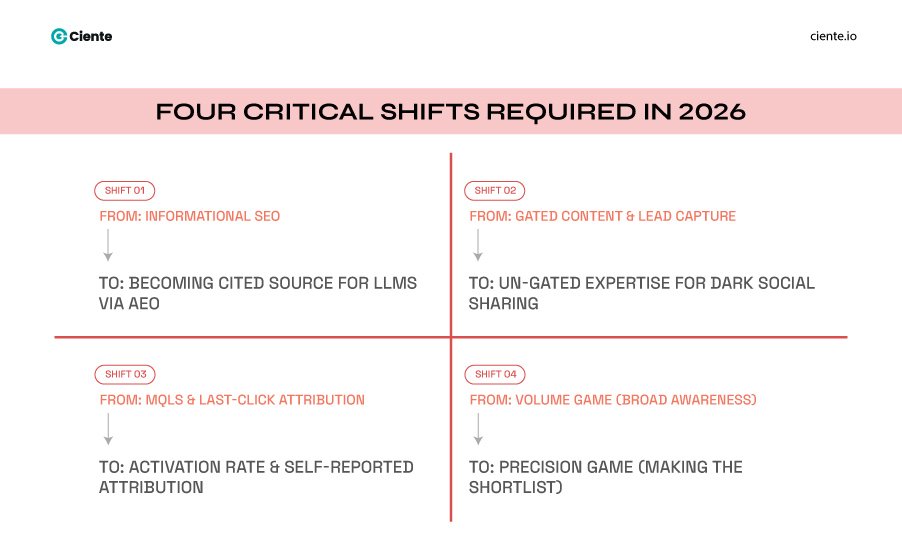
Four critical shifts required in 2026

Focusing on keyword volume, gated PDFs, and last-click attribution will not get in new customers, or in most cases, retain the existing ones, particularly when compared to a modern SaaS content marketing strategy built for intent and trust. However, if you believe that’s the best move, don’t be surprised at the results- rising CAC and stalling pipeline velocity.

Digital marketing for SaaS is no longer about winning the click in 2026.

It all boils down to a single thing- making the cut to the shortlist before the buyer even visits your site.

B2B buyers are as informed and skeptical as ever. And a significant section of the decision-making process remains invisible to traditional tracking tactics. So, scaling in this environment demands a pivot from broad awareness to precision-engineered trust.

The Death of Informational SEO and the Rise of AEO

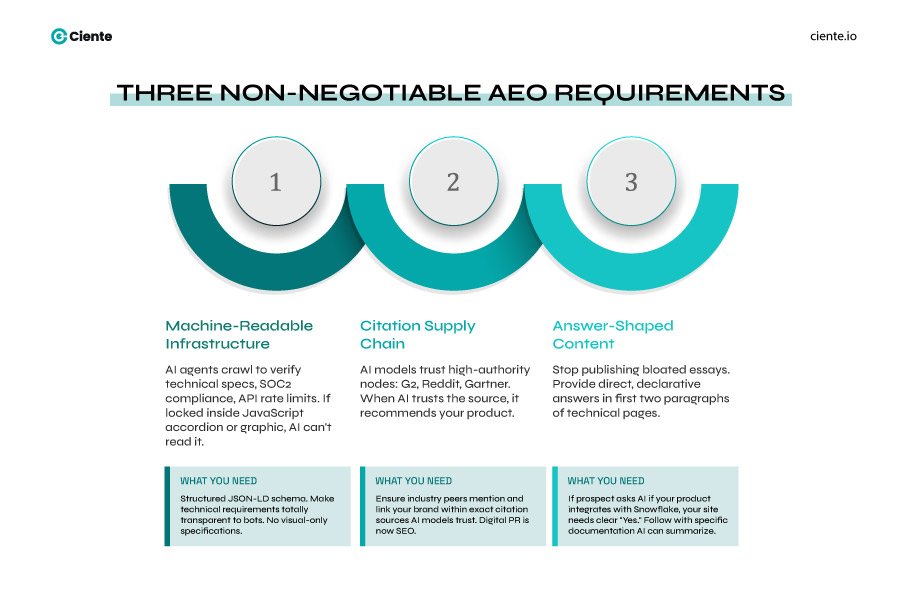
Non-negotiable AEO requirements

For years, software companies dominated search results by answering basic definition queries. Those easy clicks vanished. Google AI Overviews and answer engines, such as Perplexity, satisfy informational intent right on the search results page.

Effective digital marketing for SaaS now demands Answer Engine Optimization. AEO is non-negotiable. You are no longer ranking for keywords. You are fighting to become the cited source for LLMs.

  • Machine-Readable Infrastructure: AI agents crawl your website to verify specifications- technical, SOC2 compliance, and API rate limits. If you lock this data inside a JavaScript accordion or a graphic? The AI won’t be able to read it.

You need a structured JSON-LD schema to make your technical requirements totally transparent to these bots.

  • The Citation Supply Chain: AI models trust high-authority nodes such as G2, Reddit, and Gartner, making SaaS influencer marketing and third-party validation more critical than ever. A modern SEO strategy must include digital public relations.

You need to ensure industry peers mention and link your brand within these exact citation sources. When the AI trusts the source, it recommends your product.

  • Answer-Shaped Content: Stop publishing bloated essays. Provide direct and declarative answers in the first two paragraphs of your technical pages.

If a prospect asks an AI if your product integrates with Snowflake, your site needs to provide a clear “Yes.” Follow that immediately with specific documentation seamlessly summarized by AI.

Solving the Invisible Buyer Crisis in Digital Marketing for SaaS

A surprising ninety percent of B2B enterprise SaaS deals go to the vendor ranked first on the buyer’s initial shortlist. Buyers build that shortlist entirely in dark social. They consult private Slack communities, Discord servers, and internal Zoom calls. Your tracking pixels cannot reach these places.

You are likely looking at an untracked word-of-mouth win if your analytics dashboard shows a massive spike in direct traffic.

Mastering digital marketing for SaaS in this dark environment means changing how you distribute your assets, including leveraging channels like social media marketing SaaS tools for zero-click visibility.

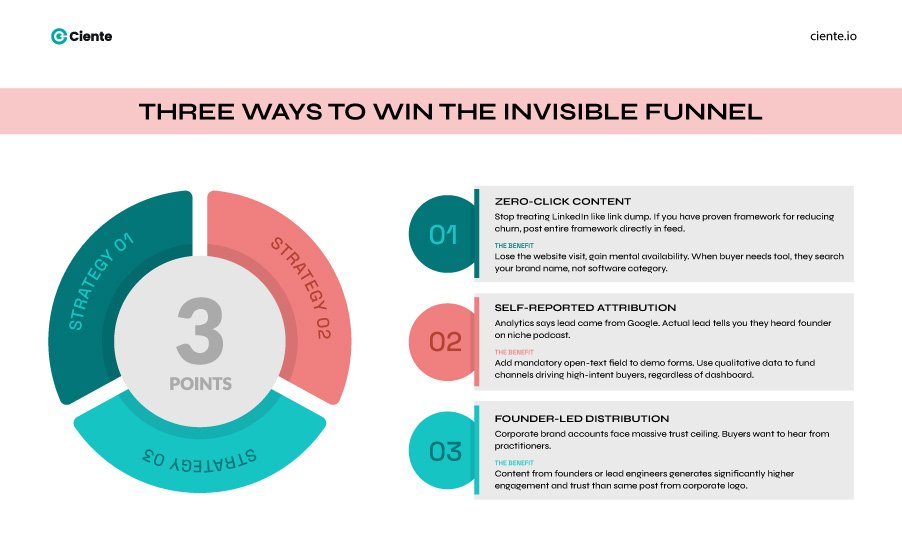
Invisible funnel

If you have a proven framework for reducing churn, post the entire framework directly in the feed. This works even better when it’s built on zero party data vs first party data insights about what your audience actually struggles with. You lose the website visit, but you gain mental availability. When a buyer finally needs a tool, they will search directly for your brand name rather than the software category.

  • Self-Reported Attribution: Your analytics software labels that the lead came from Google. The actual lead will tell you they heard your founder on a niche podcast.

Add a mandatory open-text field to your demo forms asking how they actually heard about you. Use this qualitative data to fund the channels driving high-intent buyers, regardless of what your dashboard says.

  • Founder-Led Distribution: Corporate brand accounts face a massive trust ceiling.

Buyers want to hear directly from practitioners. Content shared by founders or lead engineers generates significantly higher engagement and trust than the same post shared by a corporate logo.

Shifting from MQLs to Product-Qualified Growth

The marketing qualified lead is a legacy metric, especially when compared to more refined approaches like account-based marketing for SaaS that prioritize high-intent engagement. A lead is a liability if it downloads a whitepaper but never touches your software. Modern digital marketing for SaaS must align perfectly with product-led growth.

  • Activation as a Primary KPI: The marketing job does not end at the trial signup, and achieving this depends heavily on strong SaaS product-market fit. Leadership should measure your team on time-to-value. If a new user signs up but fails to achieve a key feature milestone within 24 hours, marketing automation must take the wheel.

Trigger highly specific educational content designed to eliminate that exact point of friction.

  • The Interactive Demo Moat: Forcing buyers to book a demo creates unnecessary friction. Over 60% of younger buyers prefer self-service research over talking to a sales rep.

Replace static screenshots with interactive sandbox environments. Let buyers prove the product’s value to themselves. This approach turns your website into a tangible product experience rather than a loud sales pitch.

  • Usage-Based Messaging: Artificial intelligence makes per-seat pricing completely obsolete, pushing companies to rethink traditional pricing models of SaaS marketing agencies. Your marketing messaging must reflect value-based or usage-based models. Stop selling seats. Start selling tangible outcomes such as the price per resolved ticket or the cost per automated workflow.

Marketing Against the Messy Middle of SaaS Implementation

Software buyers today are over-informed but under-confident. They know exactly what tools exist. They are simply terrified of implementation failures. Most digital marketing for SaaS focuses exclusively on the final benefits.

The real revenue opportunity lies in marketing directly to the implementation phase.

  • De-risking the Switch: Take note of the switching costs. Create content that explicitly shows a prospect how to migrate the data from your biggest competitor. Hand them the scripts, exact checklists, and plans to make the shift as seamless as possible.
  • Internal Champion Kits: Your initial lead has to pitch your software to a skeptical committee of stakeholders, making alignment with B2B SaaS contract management software and compliance documentation even more critical. including a ruthless CFO. Outstanding digital marketing for SaaS equips those leading with champion kits.

Offer them pre-made slide decks, ROI calculators, and security documentation so they can easily win internal buy-in.

Precision Over Volume is the New Digital Marketing Mantra for SaaS.

The sheer number of software companies has skyrocketed. Noise is your biggest competitor. Digital marketing for SaaS is no longer a volume game. It requires absolute precision.

Winning market share requires a return to fundamentals delivered through modern technical channels. Make your product machine-readable. Un-gate your best expertise. Focus your value proposition on how your software works rather than just what it does.

Stop trying to capture unqualified leads and instead invest in scalable channels like SaaS referral marketing and SaaS affiliate marketing. Start arming your internal champions. Your acquisition costs will finally stabilize, and your brand will become the default choice in the dark funnel.


CoreWeave Takes Out Billion Dollar Loan to Expand AI Infrastructure 1 1

CoreWeave Takes Out Billion-Dollar Loan to Expand AI Infrastructure

CoreWeave Takes Out Billion-Dollar Loan to Expand AI Infrastructure

Wall Street just gave CoreWeave’s AI chips an investment-grade rating. Is this a sign of a maturing industry or just a very expensive house of cards?

CoreWeave just closed an $8.5 billion financing deal that feels less like a startup loan and more like a structural shift in how the world funds technology.

It isn’t just about a mountain of cash. It’s the first time high-performance computing infrastructure, specifically the chips and servers that run AI, has an “investment-grade” rating by Moody’s.

In plain English? Wall Street has officially decided that AI hardware is now as safe a bet as a utility company or a toll road.

The deal is a masterclass in modern financial engineering.

CoreWeave is basically using its massive fleet of Nvidia GPUs and pre-signed customer contracts as collateral. It’s a “delayed draw” loan, meaning they can pull the money as they build, specifically to fulfill a massive, high-priority contract with a major AI enterprise.

By securing a lower cost of capital, CoreWeave is pivoting from a high-risk disruptor to a foundational landlord of the AI era.

But there is a catch that most headlines skip.

While the investment-grade tag suggests stability, the company’s stock has been a rollercoaster, losing nearly half its value since its 2025 highs. Investors are in a tug-of-war: they love the “land and expand” strategy, but they are wary of the sheer amount of debt CoreWeave is stacking- now totaling $28 billion in just a year.

That’s the ultimate test of the “AI bubble” theory.

If the demand for compute remains an infinite resource, CoreWeave becomes the backbone of the next century. If the appetite for large language models suddenly cools, the industry now has the world’s most expensive pile of silicon.

For now, Blackstone and JPMorgan are betting billions that we are nowhere near the ceiling.