
Content marketing ROI

Content Marketing ROI to Assess Impact Accurately

Content Marketing ROI to Assess Impact Accurately

Shrinking marketing budgets have led to higher expectations. The strategic solution? Move away from the vanity metrics to spotlight the actionable ones

Today’s market is utterly fast-paced. Buyers demand more, and businesses stitch new ways to catch up. And even if they do, it’s not the end.

Marketing, once transactional, has made a transformational leap to being relational. But has customer-centricity ended at personalization and value addition? Not quite.

It’s become crucial for marketing to get every tidbit right, from strategy to execution. Businesses desperate to repair their strategic ruptures and catch up are investing in updating their old playbooks.

But investment doesn’t equal impact- it’s an age-old story.

Marketers fail to bridge content marketing’s value with business objectives. B2B marketers invest a copious amount of time and resources into content marketing, often failing to show how it impacts their revenue or pipeline.

This strategic disconnect between content’s performance and business goals has made it complex to justify the spend, let alone the content marketing ROI.

So, it has become paramount for businesses to track whether their investments are actually worth it. The content marketing landscape is all too familiar with this dilemma, especially when relying on outdated content marketing metrics.

How can you prove to your CEOs and other stakeholders that investing in content actually works? An efficient solution to navigating this pushback and doubt starts from the basics.

What Is Content Marketing ROI?

Investing in content marketing means playing the long game. But what if your marketing team can’t showcase the results of this investment and procure initial buy-in? According to recent statistics, 65% of marketers can’t.

It’s truly about finding the relevant measuring methodology for your content, starting with content marketing ROI.

Content marketing ROI is simply the percentage that demonstrates the revenue generated (the earn back) compared to how much the business spent on its marketing efforts. It calculates the efficiency and effectiveness of your content marketing campaigns.

Why is measuring content marketing ROI important?

This performance metric is crucial for businesses to understand the extent to which their content is making waves generating revenue and aligning with content performance metrics meaningful outcomes. Calculating website traffic and engagement doesn’t correspond with the spend, and their weight is significant in capturing demand, but it doesn’t justify the entire investment.

The total investment into content marketing includes production, management, licensing, distribution, strategy management, and relevant software/tools.

These make it crucial to illustrate whether your content assets are actually moving the needle, i.e., converting prospects into active buyers.

Content marketing ROI plays an integral role here.

It assesses and offers tangible numbers to spotlight the impact generated through targeted campaigns and individual content assets such as blogs, email newsletters, and social media campaigns especially when supported by email marketing for content distribution.

And the benefit of calculating content marketing ROI is that it can highlight qualitative and quantitative factors. Beyond the numbers, it also helps demonstrate how your content pieces are faring to build customer loyalty, capture leads, and elevate brand awareness.

In short, your content marketing ROI is tangible proof to justify the overall marketing budget allocation. Because CMOs are being asked to do more with less.

Marketing faces the biggest budget cuts. A 2024 Gartner report illustrated how the department has faced a 15% year-over-year decline in average marketing budget. And in 2024, it accounted for only 7.7% of the company’s revenue.

Why is this the case?

We have come full circle here. Marketing is perceived as a cost center. And with narrower budgets, there’s more pressure on teams to showcase quantifiable outcomes.

So, the vitality of content marketing ROI.

It’s easier to make informed decisions with clear metrics, such as which marketing channel is bringing in the profit and which needs an upgrade.

This way, your content marketing team doesn’t spend unnecessary time churning out assets that don’t really influence leads or build your brand. To do so effectively, it’s primarily significant to outline how to measure content marketing ROI.

Measuring Content Marketing ROI: A Step-by-Step

winning B2B content marketing plan ensures long-term success. To measure real impact, marketers need to transcend the soft metrics and focus on what actually matters: the bottom line.

So, the commonplace formula for measuring content marketing ROI establishes a direct correlation between content marketing efforts and an increase in sales or revenue.

  Content Marketing ROI = (Revenue – total investment/total investment)/100  

Revenue is at the core of every business function– it’s the final boss. Hence, the traditional content marketing ROI formula centers on business revenue.

Although it is important, this formula is a bit constraining. It takes months for leads to convert into sales opportunities. And without these sales, it’s ascertained that the final metrics would again fail to prove how investing in content marketing has moved the needle.

Much of the content’s impact on the bottom line is subjective. It’s synonymous with asking- “Is the content good?” This aspect of content marketing doubles down, not on whether a purchase was made, but on the “why.”

It’s a long-term strategic content marketing perspective that we need- how do you measure such a metric that seems so intangible? You measure the distance between an account’s initial curiosity/awareness and the final conversion.

We can help you transform this subjective quality into a quantitative one with our step-by-step guidance.

1. Defining your contextual KPIs

Anyone can track random leads- but that doesn’t mean they entail purchasing propensity. So, you segment all accounts depending on where they fall on the intent spectrum.

Measuring page views and browsing time is old school. If you really must gauge how interested a prospect is in you, you must underscore metrics that highlight their state of mind.

  • Awareness stage: Here, the intent is low, and content marketing has one goal to build mental association, often achieved through effective content creation for the buyer’s journey. That means more people should be typing Ciente + [topic] into the search bar, i.e., if your content truly resonates. Measure branded search volume.
  • Consideration stage: An account can randomly fall onto your content when they’re casually browsing. That doesn’t signal intent. The next step here is to gauge if one piece of content is instilling interest in additional content pieces. Measure internal link click-through rate.
  • Decision stage: There must be a qualification framework, even for content engagement. A lot of your appointments that go nowhere are accounts that engaged with a single piece and dropped off. Ensure that the prospect engages with a specific number of content assets to schedule an appointment. Measure SQL contribution.

2. Inventory the Entire Cost

Most ROI calculations are a lie because they only account for the invoice from the writer. If you want a number that survives a CFO’s audit, you have to account for the total weight of your content engine. You aren’t just paying for words; you’re paying for the infrastructure that hosts them.

  • Don’t just track freelancer fees. Calculate the internal hours spent on “ideation meetings,” the back-and-forth of the approval loop, and the technical labor of uploading and optimizing. This is your true “Cost of Goods Sold.”
  • Your SEO tools, CMS, and AI subscriptions aren’t free overhead. Allocate a percentage of these software costs directly to your content budget. If you’re using a $500/month tool specifically to rank your blog, that $500 is part of the investment.
  • Organic reach is a long game, but in the short term, content is a pay-to-play asset. Include the paid social spend used to seed the content. If you spent $2,000 on LinkedIn ads to get eyes on a whitepaper, that $2,000 is the entry price for your ROI calculation.

Step 3: Capture Dark Social and Attribution Lag

If you rely solely on tracking pixels, your content ROI will always look lower than it actually is. In B2B, the most valuable “conversions” happen in the shadows where Google Analytics 4 cannot follow.

  • Self-Reported Attribution: The tracking pixel might say a lead came from “Direct Search,” but the human will tell you otherwise. Add a mandatory field to your demo forms: “How did you first hear about us?” When a high-value lead writes, “I’ve been reading your ‘Intent Drift’ series for months,” you’ve found your ROI.
  • The 90-Day Lookback: Content doesn’t always trigger an immediate purchase. It builds a “residual influence.” Set your attribution window to at least 90 days. A blog post read in January might not result in a sale until March, but without that January touchpoint, the March sale wouldn’t exist.

Step 4: Apply the Intent-Adjusted ROI Formula

Not all revenue is created equal.

A $10,000 deal from a cold lead who found your blog is more valuable to marketing than a $10,000 upsell from a current client. Your formula needs to be weighted to reflect the difficulty of the acquisition.

ROI = {(Weighted Influenced Revenue – Full Burden Cost) / (Full Burden Cost)} X 100  

Leverage a linear attribution model rather than giving 100% credit to the last click.

If a prospect touched five pieces of content before buying, each piece of content earns 20% of that deal’s value. This proves that your “Awareness” content is doing the heavy lifting, even if it isn’t the final closer.

Step 5: Identify and Rectify the Intent Drift

A viral post is often a failure in disguise. If your content is attracting thousands of “looky-loos” who have zero purchasing power, you are experiencing Intent Drift. You are paying for traffic that will never convert.

  • The Friction Test: The content is merely mismatched if a page has high traffic but a 98% bounce rate. You’ve attracted someone with a problem you don’t solve.
  • The Contextual Pivot: Analyze the Exit Pages. If prospects leave after reading a specific piece of strategy, it means you’ve given them enough information to walk away, but not enough reason to stay.

You must bridge this drift by inserting high-friction CTAs (like a gated calculator or a specific industry report) that force a hand-raise from the truly interested.

Step 6: Perform a “Cost of Inaction” (COI) Audit

The final step in proving ROI is showing what happens if you stop. Content is an equity-building asset; Paid Ads are a rental.

  • The Rent vs. Buy Analysis: Compare your organic traffic costs to PPC (Pay-Per-Click) rates. If your blog pulls in 5,000 visitors for a keyword that costs $15.00 a click on Google Ads, you aren’t just generating traffic- you are saving the company $75,000 every single month.
  • The Compounding Effect: Unlike an ad campaign that dies the moment the budget runs out, content ROI grows over time. A post written two years ago that still generates SQLs today has an ROI that approaches infinity.

Highlight this long-tail value to stakeholders who are obsessed with short-term quarterly gains.

The Need for an Upgrade in the Traditional ROI Formula

aligns with evolving B2B content marketing trends shaping modern strategies. There are other stages in your buyer’s journey where content illustrates substantial impact, especially in helping leads progress down the funnel.

It may take months to prove whether your content production and the relevant nitty-gritty have a fundamental role in revenue generation. But you can still demonstrate how it affects your pipeline.

Content impacts the deal velocity and lead volume, and is crucial to focus on.

Marketers require a much-needed upgrade in this formula- one that entails precision. This change is requisite because B2B customer journeys are rarely linear and straightforward.

Amidst the 95% of buying committees that make tech purchases, a whopping 49% of them don’t even speak to sales reps. They rely on the content assets available at the different digital touchpoints to finalize their decisions.

So, rather than the traditional formula, curate a more sophisticated one that allows you to measure different stats to build a more accurate picture of your business performance. It must be based on the KPIs that matter to you, not what your competitors are following.

It’s true that industry benchmarks significantly matter, but don’t lose sight of what is relevant to your brand and your customers something emphasized in content marketing case studies. Owing to this, it’s better to underline your own system that traces the KPIs you want.

Content Marketing ROI Breakdown by Industry

NicheAvg. Content ROI (3-Year)Avg. Organic CAC
B2B SaaS702% – 844%~$205
FinTech~600%~$644
Manufacturing~475%~$475
HealthTech~550%~$501
Legal Services~740%~$584

5 Effective Strategies to Improve Your Content Marketing ROI

Each content type has its own set of metrics to consider.

You don’t need to focus on all available metrics to calculate performance, but on the right strategies that augment your existing capabilities. And improve your ROI.

The pivotal ones you can begin with are:

1. Ascertain that the set KPIs align with the overarching business goals.

First, underline the fundamental goal of your campaign and the channels you’ll leverage. They significantly impact the metrics you’re required to measure.

For example, if your priorities are sales and revenue, track the customer journey from awareness to conversion. As the lead progresses down the funnel, focus on every micro-conversion and assign it a tangible value.

2. Focus on the actionable metrics that provide you with tangible insights.

It will help you underscore what to optimize over time. Move away from misleading vanity metrics such as web traffic or CTRs.

Do all the 10k website visitors convert into your buyers? No. Views and traffic don’t demonstrate interest or value.

The relevant metrics enable your marketing team to act. These don’t just look impressive on paper, but actually delve into what drives prospects to close deals with your brand.

3. Audit your authority and keyword rankings.

How your ICP perceives your brand is a crucial metric to study, i.e., your authority. It might be complex to track, but if you do it correctly, this metric can help supplement your efforts to improve the ROI.

Tracking your authority means auditing the number and quality of inbound links added to the brand’s social media mentions.

What do these illustrate? Whether your brand authority and awareness are growing.

The same goes for keyword rankings.

Analyzing SEO metrics helps you monitor the impact of your blogs. When carried out effectively, your blogs should boost your domain’s SERP and elevate your ranking. In tangible terms, this signifies more organic traffic for your website.

But to get a clear picture of whether you’re doing content marketing correctly, pair SEO metrics with conversion rates. It will give you a clearer view of whether your marketing team is:

  • Leveraging the right keywords
  • Truly reaching your target audience
  • Influencing leads’ journey through the funnel

4. Merge brand value into the metric mix.

Brand value is considered less significant in measuring success. And is often perceived as an intangible or fluffy aspect of a business.

Truthfully, building a brand takes time, patience, and consistency. But when paired with content, it functions as a multiplier.

But savvy marketers who have learned how to catch up with changing marketing dynamics know this is untrue. A strong brand ensures your prospects are warm, informed, and already leaning towards purchasing your solutions. This results in shortened sales cycles and improved conversion rates- two factors directly affecting revenue.

A strong brand identity attracts the most relevant leads (that fit your ICP) and pays off in the long term. Growing market recognition means you invest less in paid channels because your prospects are actively searching for you.

This results in compounding ROI, enhancing the value of all your content pieces, rather than just the latest ones.

5. Track the performance of the sales enablement assets.

Your sales teams utilize these content pieces to drive conversion. These aren’t blogs or LinkedIn posts.

These pieces are part of sales enablement, directly offered to a potential client at the BOFU stage. They help prospective buyers to finalize their purchasing decisions. Think of one-pagers, proposals, objection-handling decks, among others, that are built by marketing and leveraged by sales.

What makes sales enablement content vital is its direct involvement in sales deals, from a case study that can build trust to a one-pager highlighting the pricing model that accelerates negotiation.

If your sales enablement content is helping convert leads into opportunities, you’re looking at real and tangible impact- one that should be tracked and optimized.

But how do you do that?

Here is Ciente’s list of must-have tools to improve your content marketing ROI tracking.

The Intent-First Content Marketing ROI Tech Stack

You cannot measure the unmeasurable, i.e., the intent drift or dark social, with a basic WordPress dashboard and a spreadsheet. If you are still relying entirely on default tracking pixels, then your ROI calculation is missing the majority of your buyer’s journey.

To track the true multi-touch, intent-adjusted ROI we just outlined, you need a tech stack that bridges the gap between a casual blog read and a closed-won enterprise deal.

We have just the modern, four-part toolkit required to track B2B content ROI.

1. HockeyStack
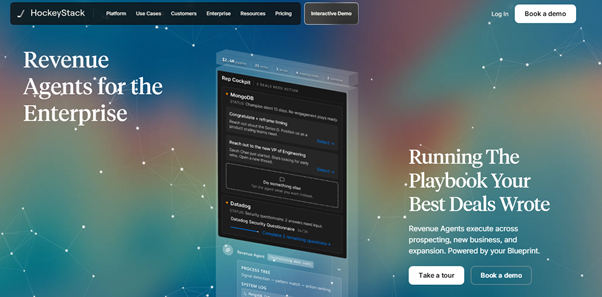
image 12

Google Analytics 4 is built for B2C e-commerce, where a user clicks an ad and purchases a pair of shoes. It is notoriously bad at tracking a B2B buying committee that takes 8 months to make a decision.

You need a tool that natively understands the B2B pipeline. And HockeyStack connects your website traffic directly to your CRM revenue. It allows you to see the exact sequence of content a specific account consumed before booking a demo.

Leverage it to prove the assisted value of your Top-of-Funnel blogs that GA4 routinely ignores.

2. 6sense
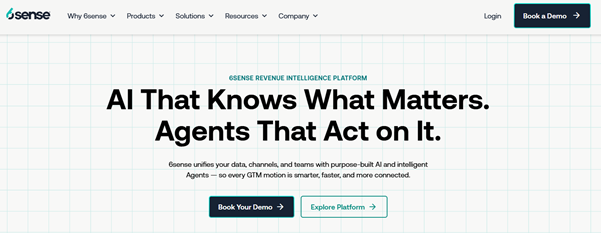
image 3

Your most valuable buyers often read your content for months without ever filling out a form or downloading a gated asset. In a standard setup, these users are merely anonymous traffic, making your content look like a failure.

Intent data platforms de-anonymize your website traffic at the account level. And 6sense is the leading one among them. They tell you which companies are reading your pricing pages or technical guides, allowing you to gauge account engagement as a hard metric.

If your content brings 15 target accounts from unaware to in-market (active research mode), that is a massive, quantifiable win for your sales team- even if those accounts haven’t formally requested a demo yet.

3. HubSpot

image 11

A CRM is standard issue, but most companies configure it poorly for content tracking. Your CRM is where quantitative data meets qualitative reality.

This is the home for your self-reported attribution. HubSpot allows you to easily build the “How did you hear about us?” field into your inbound forms and map that text directly to the contact record.

When your CEO asks why you spend time posting on LinkedIn or publishing editorial pieces, you pull a HubSpot report showing exactly how many closed-won deals explicitly typed “I read your blog” into the intake form.

4. Ahrefs

image 10

SEO tools are usually restricted to the content creation phase (keyword research). But they are secretly your best financial validators when it comes time to defend your budget.

You need hard numbers to prove the “Rent vs. Buy” thesis. Ahrefs provides a metric called Traffic Value, which calculates exactly how much your organic content traffic would cost if you had to buy it via Google Ads.

Take your Ahrefs Traffic Value report to your CFO. When you can definitively say, “Our blog generates traffic that would cost $40,000 a month in PPC spend,” you instantly justify the internal costs of your content team.

Content Marketing ROI Is More Than Just Following a Formula.

This is what actually matters to accurately measure the success of your content marketing efforts- impact on the bottom line.

Measuring the ROI is just a means to convert the said impact into understandable terms. But in practice, it’s not a piece of cake. Its multifaceted-ness really puts a schism into the entire process.

“Sometimes, there are still gaps in the data where it’s just impossible to see the immediate impact of certain metrics on core objectives.”

asserts Google’s VP of Large Customer Solutions.

The real game changer is knowing which metrics to actually track and using this knowledge to execute the right strategies. Content marketing ROI cannot prove your brand’s success and growth to the decimal, but it can help it grow and revamp.

Tracking your content marketing ROI is really just about highlighting the blind spots in your efforts and improving on what’s not working for you- setting you on the right track for the long term.


Canva

Canva, Autograph, Procreate, and More Undercut Prices to Stand Out Against Adobe’s Ecosystem

Canva, Autograph, Procreate, and More Undercut Prices to Stand Out Against Adobe’s Ecosystem

Adobe’s monopoly is officially cracking. From free Affinity to lean rivals like Cavalry, the Creative Cloud tax is at its end. Is it time to cancel?

The creative software industry just officially declared war on Adobe, and the “Creative Cloud Tax” is finally starting to feel like a choice rather than a mandatory life sentence.

For a decade, Adobe has lived in a fortress built on industry-standard file formats and the “but everyone uses it” excuse.

But as The Verge recently highlighted, the walls are crumbling. The most shocking blow? Affinity is now free. Since the Canva acquisition, what was once a $160 one-time purchase is now a zero-dollar entry point. That’s not just a discount; it’s a strategic decapitation of Adobe’s hobbyist and small-business user base.

But this isn’t just about price- it’s about subscription fatigue turning into genuine rebellion. Adobe spent years bloating its software with gen AI features, often feeling like it was all AI for AI’s sake. Meanwhile, rivals such as Cavalry and Affinity have focused on being lean, fast, and actually fun to use.

Cavalry is proving that motion graphics doesn’t have to feel like wrestling with a 20-year-old codebase in particular (looking at you, After Effects).

Here’s the nuance: Adobe still has the “Pro” workflow locked down.

If you’re in a high-end agency, you still need Premiere and Photoshop for the ecosystem alone. But for the next generation of creators, the barrier to entry has officially hit the floor. When a kid can download a pro-grade design suite for free on a laptop, they aren’t going to grow up and upgrade to a $60/month subscription just because it’s what their parents used.

The monopoly didn’t break because of a better feature list; it’s breaking because Adobe stopped respecting the “casual” pro.

Between the buggy updates and the “impossible to cancel” subscription traps, the goodwill is gone. We’re entering an era where specialized, nimble tools are winning over the “everything and the kitchen sink” monolith.

Adobe’s crown isn’t just slipping- it’s being auctioned off to anyone who can provide a “File > Save” button without a monthly bill.

Anthropic

It’s Time to Design with Anthropic: Meet “Claude Design”

It’s Time to Design with Anthropic: Meet “Claude Design”

Anthropic’s Claude Design promises to turn messy ideas into brand-perfect prototypes in seconds. Has the creative barrier to entry just hit the floor?

The era of AI as a glorified typewriter is officially dead. And Anthropic’s new Claude Design drop is about to make your current workflow look like stone-age tech.

Let’s be real: until now, the creative AI process has been a fragmented mess.

You’d get a decent idea from a chatbot, then spend three hours fighting with Figma or Canva to make it actually look professional. Anthropic Labs just deleted that middle step. With Claude Design (and the beefed-up Opus 4.7), we’re moving from “AI that talks” to “AI that builds.”

The real kicker isn’t just that it can generate a pretty slide deck; it’s the Design System integration. People are missing precisely this nuance. It’s not just spitting out generic templates, but digesting your company’s actual codebase and brand guidelines.

When Claude knows your specific hex codes and component logic, it stops being a creative assistant and starts acting like a Senior Designer who’s already read your brand bible.

However, let’s talk about the elephant in the room- the power shift.

Anthropic frames this as “giving designers room to explore,” which sounds impressive in a press release. But in reality? It’s a massive level-up for the non-creatives.

When a Product Manager can turn a messy whiteboard sketch into a high-fidelity, interactive prototype in two prompts, the traditional “request-and-wait” cycle between departments evaporates. It’s liberating for founders, but it’s a direct challenge to anyone whose value was purely “knowing how to use the tools.”

The partnership with Canva and the seamless handoff to Claude Code shows where this is going.

We’re approaching a world where the distance between a “thought” and a “shippable product” is practically zero. This shift is where the creative barrier to entry finally hits the floor.

The chat era was just the warm-up; the build era is where the real disruption begins.

Ciente's Picks of Underrated Fintech Marketing Campaigns

Ciente’s Picks of Underrated Fintech Marketing Campaigns

Ciente’s Picks of Underrated Fintech Marketing Campaigns

Fintech seems like it’s all technology. But it’s about imagination that transcends this limited perception. And here are fintech marketing campaigns that prove it.

At its core, fintech marketing is like any other industry-specific marketing. The tech complexity and nitty-gritty in fintech oscillate. But the shell framework remains the same.

What’s true for traditional financial institutions is true for fintech- reliability, trust, and credibility. These are essential requirements for even the earliest adopters. Because the to-and-fro of money isn’t mundane.

This automatically makes fintech marketing not about marketing a fintech, but about meeting your customers where they want you to. And transparency isn’t just a marketing trend.

Traditional financial institutions are going to catch up. Digital adoption is becoming imperative. Not a nice-to-have, but a must-have. Transparency or any other elements mentioned above can’t be used as value propositions by fintechs for the long term.

But fintech isn’t done. The revolution hasn’t ended. And that’s the sparkle.

However, this isn’t being leveraged correctly. There’s a dissonance because most customers belong to a non-financial background. They end up feeling disconnected from the brand’s vision. And overexplaining only makes them feel unintelligent. It’s challenging to connect with the audience because, honestly, no one gets up in the morning to feel enthusiastic about balancing their checkbooks. It’s tedious and not all that entertaining. But the demand’s there because it’s imperative to our living conditions.

How do you make your audience feel excited about something so acutely banal?

You build a truly innovative fintech marketing campaign.

You primarily focus on the different stages of your buyer’s journey, and design your fintech marketing campaign around that. similar to how a full-funnel marketing campaign aligns messaging across awareness, consideration, and decision stages.

The Three Growth Stages of an Enterprise Fintech Campaign

Enterprise fintech campaigns fail because a great idea gets deployed at the exact wrong stage of the buyer’s journey. Or worse, deployed like that, the journey doesn’t even exist.

In this space, there are three distinct levels of campaign maturity. Each has a highly specific job to do, and blurring the lines between them is exactly where your marketing budget quietly vanishes.

Level 1: Presence, i.e., Getting on the Radar Before the RFP Hits

In B2B fintech, the shortlist is largely written before a formal evaluation even starts. Decision-makers carry a mental map of the vendor landscape built from analyst briefings, industry chatter, and peer conversations.

If you aren’t on that map, no amount of hyper-targeted, bottom-of-funnel ads will save you.

Level 1 isn’t about generating leads; it’s about generating presence. something often overlooked in traditional lead generation campaigns that focus heavily on immediate conversions.

Nuvei nailed this.

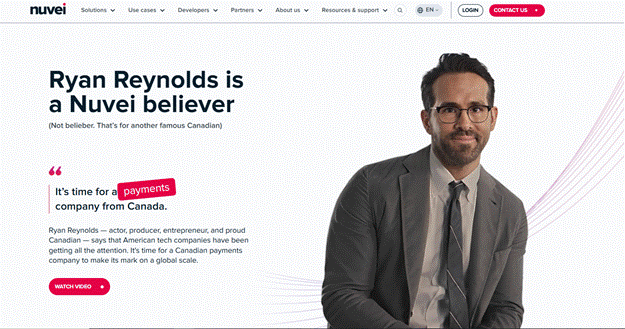
They knew their target enterprise accounts were structurally immune to standard SDR cold-calling. Their Ryan Reynolds campaign wasn’t just a vanity play for brand awareness- it was a calculated strike to get onto the mental shortlists that cold outreach couldn’t penetrate. At this stage, you measure success through share of voice, brand recall, and the caliber of inbound conversations.

Level 2: Relevance, i.e., Winning Over a Skeptical Buying Committee

Once they know who you are, your campaign’s job pivots from presence to relevance. That is where most enterprise brands trip up. They’ll build presence with a bold, distinct campaign, but the second a buyer enters evaluation mode, they abruptly default to dry product sheets and ROI calculators.

That whiplash is jarring, and it tells the buyer you don’t actually understand their day-to-day reality.

Think: you have to speak to the people who feel historically ignored by financial marketing. In an enterprise, that’s your IT Director or the skeptical Operations lead. If you only pitch the CFO, you ignore the exact people who will quietly kill your deal.

Level 2 campaigns earn relevance by engaging the entire committee. An approach closely aligned with ABM strategies for fintech startups using AI and predictive analytics, where messaging is tailored to multiple stakeholders. That means running different messages across different channels simultaneously, solving specific headaches for specific stakeholders.

Level 3: Conviction, i.e., Unseating the “Good Enough” Incumbent

This is the stage most campaigns miss entirely.

By Level 3, the buyer already believes your product is superior. The barrier isn’t awareness or even preference- it’s the sheer dread of switching.

Enterprise buyers have learned to tolerate clunky legacy systems because the pain of change (migration nightmares, retraining costs, burning political capital) feels heavier than the promise of a better platform.

Here, you don’t need to sell harder; you need to de-risk the decision. something that can be strengthened by leveraging buyer intent data in ABM campaigns to understand readiness and hesitation signals. You need case studies from equally complex organizations, clear migration roadmaps that make the switch feel seamless, and peer validation that makes choosing you a safe, defensible bet.

Just like Monzo leverages consumer “love” to drive adoption, enterprise brands need reference customers, third-party audits, and implementation guarantees. It is the campaign content that turns a buyer who wants to switch into one who do.

It’s nothing new. There are brands out there that have mastered the art of fintech marketing campaigns. much like other successful SaaS marketing campaigns that broke through crowded markets.

And that’s precisely what we’re here to talk about. Fintech marketing campaigns that broke through the tradition with their bold moments. And made an impression on the industry.

Fintech Marketing Campaigns: Moments that Broke Through the Humdrum Routine of the Fintech World

Catching and engaging the attention of your ICPs is not a simple feat. which is why studying examples of great ABM campaigns can offer practical direction on what resonates with high-value accounts. Especially when it’s something so monotonous- you must be tactical enough not to rub them inappropriately. Or create more problems when you wanted to solve one.

What does that require? Positioning yourself as a credible and trustworthy fintech brand. something that strong B2B branding campaigns consistently reinforce across touchpoints. You can’t mix and match random marketing strategies and expect them to work. Fintech demands finesse and insight. It requires strategy and creativity along with the statistics and features.

We have five fintech marketing campaigns to inspire you. And to help you break through the insipidness of marketing such crucial tech-centric solutions.

1. Nuvei x Ryan Reynolds

Nuvei is a payments powerhouse based in Canada. It has an impenetrable audience base of large enterprise merchants- it’s very challenging to reach these accounts. But without a way to reach its potential customers, Nuvei knew it would lose its market positioning.

The company had to find a way out of this conundrum. And the solution was quite unorthodox.

Nuvei stepped into influencer marketing.

Yes, it seems ambitious for a fintech company. But the point is that it actually worked. Nuvei, a Canadian platform, would now have to choose an influencer who would be its poster child and propagate its brand story through the most impactful means.

It chose a Hollywood A-lister: Ryan Reynolds. Known for his humour and quirky demeanor. Actually, it was Reynolds who invested in his homebound brand. As part of the deal, he became part of Nuvei’s ads.

image 1

Source: Nuvei

These ads became the talk of the fintech world. Because of its unique intersection of a B2B brand like Nuvei and Reynolds’ B2C storytelling method. He had complete control over the ads and the content, which allowed him to display his humor.

The impact?

“Huge. Especially on brand awareness,” shares Alexandra Bucur, Nuvei’s Head of Content Marketing.

They could reach publications that were difficult to receive unless you paid. SDRs’ job became a easier because now they could use Reynolds as the opener. And they had millions of views, that’s impossible without paid ad channels.

It didn’t come down to leads and sales for Nuvei. But the awareness that it brought? That had long-term effects on Nuvei’s brand positioning.

Maybe it’s not always about the numbers. But about creating memorable impact.

Nuvei made an unconventional call by borrowing a rather B2C tactic. But their logic was flawless- they knew that the business was struggling to get SDRs through the door. Engaging hard-to-reach enterprise accounts was challenging. Nuvei knew it was facing an awareness pain.

Unlike other B2B brands, it didn’t try to create more whitepapers and thought leadership content. It chose a lever that solved the specific problem of awareness and visibility. Ryan Reynolds gave them that leverage.

2. Your Way In by Revolut

Revolut is as ambitious as it was years ago. It aimed to become the leading digital banking platform globally.

In 2022, Revolut teased a special marketing campaign to “reach” each UK consumer wherever they were at home, outdoors, and online. It sought to meet its potential customers wherever they were. And that was quite a strategy.

Source: YouTube

Your Way In was Revolut’s most significant brand awareness omnichannel campaign. And it made substantial splashes because the brand hadn’t published campaigns across such a scale.

The marketing strategy revolved around a unique message: financial inclusion. It spoke directly to the financial underdogs, not experts. For example, one of the clips illustrated a woman trading on her phone in a bathroom. And then the wall breaks and collides with a room full of traders.

Revolut challenged financial stereotypes with this campaign. The rooms that were previously too difficult to crack? Cryptocurrencies? Trading? Investing? The most rewarding opportunities were only accessible to some segments.

Revolut wanted to show its audience that it was possible to enter these “closed off worlds of money.”

As ordinary characters (or regular people) crash through these barriers, the digital banking services platform illustrates them bursting through walls of financial arenas and through challenging financial situations by leveraging the Revolut app.

This campaign worked because the time was right. As the cost of living surges, ordinary people want more channels to gain confidence, financial advantages, and financial freedom.

Revolut understood the timing. And it delivered the campaign, full of relevance. An approach that aligns with broader B2B fintech trends for 2026, shaping customer expectations.

The impact? It resonated because users could enter a world they hadn’t been in before.

Look at what made this fintech marketing campaign truly successful- it included those financially excluded. Omnichannel was merely the means; it wasn’t the real genius. Revolut spotlights a new chasm- with this campaign, it tried changing the mundanity of how the messaging truly feels for end users, i.e., it’s not truly meant for them.

This maps to the enterprise context. Your campaigns also need to target the non-CFO stakeholders they’re actively ignoring.

3. Monzo: “Money Has Never Felt Better.”

The anxiety of money management plagues us all. And Monzo wanted to be relatable.

Its “Money Has Never Felt Better” campaign was a humorous juxtaposition- published across OOH and a 60″ hero film. This campaign focused on two sides of the same coin: the good and the bad.

In a consecutive series of shots, the video illustrates what managing money generally feels like and how it feels with Monzo. It’s creative and built to highlight Monzo’s value proposition. The former is cold, stressful, unsatisfying, and even painful. Meanwhile, using Monzo feels warm, peaceful, and zen.

Source: YouTube

The imagery is commendable.

In one part of the film, money management feels like the middle of your workday, and you keep on banging your head on the keyboard. Meanwhile, with Monzo, it feels like learning Kung Fu to break through a wooden board with your head.

That’s hope. And the power of learning. And that is propagated through a bunch of juxtapositions. Anxiety with celebration. Screaming match with a loving moment. Cold with warmth. Failure with success. The list goes on and on.

The idea is simple. And it requires no further explanation. The campaign delivers Monzo’s message straightforwardly. reinforcing how UX design for fintech plays a key role in shaping emotional and functional user experiences. It’s placing Monzo under a bright light, but also showcasing that it cares about its users’ feelings.

“Leveraging us will dispel the discomfort that you feel in your daily lives.”

The campaign promotes Monzo’s solutions for customers. Not about itself and what it can do for them. Monzo’s VP of Marketing puts it quite simply- “

Across the country, money evokes a variety of feelings, usually stress, anxiety, and avoidance. However, our customers tell us that on Monzo, money feels different, so much so that they’re seven times more likely to use the word ‘love’ when describing us than any other bank.”

The Gross Error Fintech Marketing Campaigns are Making

You learn specific things from these three fintech marketing campaigns.

The messaging comprises a similar authoritative and informative tone across all channels- even if the customers at the end of the day are humans, i.e., those who feel and partake in critical thinking.

But fintech companies must grasp that not all buyers are CFOs. CFOs, Controllers, and Treasurers have financial literacy. But they’re just one segment of the buying committee. Most of them are motivated by financial business and operational needs. IT Directors, Ops, or even end users don’t entail in-depth financial knowledge.

Talking in terms that only make sense to your own brand can drive your potential customers away.

Most buying decisions is meant for problem-solving. It’s not about having the financial or technical acumen. Even fintech companies orchestrate solutions with non-financial users in mind. It’s not about who the buyer is, but the end users who will leverage the solutions down the line.

That’s why fintech requires storytelling. moving beyond tactics into crafting memorable marketing campaigns beyond mindshare that truly connect with audiences. Clarity in what they offer and merely presenting the same information isn’t enough. Your fintech campaigns rely on financial jargon neatly packed with ribbons- “zero fees” or “instant loans.” A pitfall often addressed in a solid fintech ad mastery guide. But these copies only end up feeling spammy.

There’s no real value- A tempting yet bare minimum offer.

Do buyers remember these statistics? They don’t need more reasons to make a purchase. They are scared of the investment that could turn meaningless. Your buyers aren’t simply confident in their decision. And that’s what you need to help them weather this dilemma.

They need reasons they shouldn’t hesitate. Leaning into the uncertain is scary. How do they know if these solutions will reap rewards? They don’t. But they need to move past the hesitation. And feel safe in the decision they’re making. And that’s a problem that the market is struggling with, not merely fintech.

Fintech Marketing Campaigns: What They Should Be

In a far-fetched scenario, your competitors have it all figured out. The top to bottom of fintech marketing. It’s all about presenting valuable information for them.

The same message circulates in the industry like a single meme. You laugh at it again and again until it loses its essence. That’s what happens with marketing messages. Your fintech company requires its own unique storytelling to penetrate the complexity and oversimplification.

Beyond the financial tidbits, you must humanize your brand. The brand-building front isn’t the maturity of your marketing operations aligning with market structures. It’s merely a single part. In fintech marketing, the emotional segment is always neglected, even though thought leadership for fintech often emphasizes human-centric storytelling as a differentiator. because, honestly, which business leader needs emotional gibberish?

That’s incorrect.

If you don’t instill storytelling across campaigns, you lose your customers. Product differentiation in fintech is at an all-time low. And you need a truly disruptive product to stand out. There’s only an incremental or marginal difference in solutions, such as Stripe v/s PayPal. Fintech’s true worth gets lost in all of the noise.

Your fintech marketing campaigns should revolve around empowerment- that’s what this digital transformation trickles down to.

Traditional financial institutions have neglected financial inclusion for the longest time. Especially in the domain of asset and wealth management. It’s time for fintech to change that. And that should reflect in their messaging.

The Core Pillars of a B2B Fintech Marketing Campaign

Simply mentioning a product doesn’t offer a clear notion of what buyers truly expect from marketing campaigns, especially in fintech. The solutions themselves are so complex- and with an increasing dissonance in marketing comms, it’s not easy for fintech solutions to build mindshare quickly and with impact.

The market is crowded- every fintech marketer realizes that. However, reports assert that new contenders pop up even with tight funding. These newcomers influence investor interests towards something new, changing the industry’s momentum.  

This is the market problem. Adding on to it is the buyer’s problem. Buyers are changing almost disproportionately with the market, so businesses must change how they market to them, riding the waves for their own sakes as well.

For this, we must question- to what extent is the tech, i.e., the solution, the focal point? If we must talk about marketing, we obviously spotlight the solution launches in perspective, but it doesn’t negate why some campaigns succeed, and some don’t. Because B2B fintech is an entirely different beast to tackle.

So, if we’re building some core pillars for B2B fintech marketing campaigns, the requirements change. What might those be?

  1. The buying reality
  2. Content that the buying committee resonates with
  3. A “good” campaign for an enterprise setting
  4. What has changed more- the buyer or the market?
  5. The priorities

And then there are the core pillars:

1. Institutional Trust

Enterprise fintech buyers don’t approach your brand by evaluating whether they like it. Even if they do, the question is whether they can defend the decision confidently.

The distinction is often framed around the campaign messaging. B2C fintech brands build trust through relatability- warm tone, funny ad, and a relevant moment. Meanwhile, enterprise fintech brands must earn trust through institutional credibility. You name it- from compliance posture to integration depth, it’s the tooling and infrastructure that’s at the crux of all fintech worries right now.

Storytelling still makes a difference- but in how these campaigns make a risk-averse buyer feel confident enough to progress further.

Every campaign asset must ask: Does this reduce the buyer’s perceived risk?

2. Committee Fluency

Individuals never decide B2B fintech purchases. The buying committee today spans a CFO evaluating ROI to an Operations leader focused on implementation timelines. And it’s the end users who ultimately decide on the tech’s adoption.

Almost every fintech campaign dilutes all these individual voices and writes exclusively for just one. It’s usually the CFO because the budget is in their hands. But today’s fintech marketing campaigns must diverge. They must focus on these different voices and each of their pain points. It’s not just the right account, the right message at the right time, but also the right stakeholder.

Marketing teams must become more proactive in understanding each stakeholder’s objection and address it before blocking the deal in the conversion stage.

3. Applying Playbooks with Intention

The consumer fintech wins in this blog aren’t standard enterprise plays. Yet, they offer vital enterprise lessons.

Revolut realized their buying committee wasn’t just financial pros; it included the excluded and the hesitant who felt the system wasn’t built for them. In an enterprise, the parallel is that non-financial stakeholders- the IT Director tasked with a platform they didn’t ask for, or the Ops lead skeptical of another integration. A campaign speaking only to “financial authority” misses the people who can quietly kill a deal.

Nuvei’s Reynolds campaign is the ultimate example of deliberate borrowing: a B2B brand that diagnosed a structural awareness gap and used a B2C tactic- not because it was trendy, but because the conventional approach wasn’t solving it.

4. Coherence

Enterprise fintech deals don’t wrap up in a quarter. They close over months or years, navigating multiple stakeholders and shifting internal budget cycles. That is where most fintech campaigns structurally fail- they’re built for short-term noise, not long-cycle coherence.

A message that bounces between a product launch, a thought leadership push, and a demand gen sprint mimics chaos to a buyer tracking you across a twelve-month procurement process.

The campaigns that win in enterprise are those where a buyer encounters the brand at month one and ten and leaves with the same clear, consistent understanding of your goals. That coherence isn’t just a creative luxury. it’s also measurable through the right ABM metrics to measure your campaign success.

In the world of enterprise fintech, it is a strict competitive requirement.

Marketing Campaigns as a Growth Lever for Fintech.

The Real Challenge is Surviving Internal Dilution

The biggest trap in enterprise fintech marketing isn’t a lack of know-how. It’s the internal tug-of-war. Product teams, legal, and leadership all drag the campaign toward their own agendas, often impacting execution across channels like optimizing ad campaigns with Google Display Ads. resulting in Frankenstein content that breezes through internal approvals but falls completely flat in the market.

Marketers often ship jargon-heavy features simply because it’s what gets signed off.

The core problem is having the organizational courage to build campaigns for the actual buyer at the right level, without letting internal politics water down the message. And no campaign framework can solve that on its own.

For most investors and newcomers, fintech remains a sparkling diamond. When combined with the promise of digital transformation, the spark becomes brighter. And that’s what fintech is trying to master now- A balance.

In the midst of chasing the tech fever, this up-and-coming industry has forgotten a crucial aspect- storytelling. Storytelling with emotions. Fintechs might be great at underlining the how, but they aren’t that good at explaining the why.

Underneath all the layers of security, complex features, and algorithms, the story loses its meaning.

Numbers are easy to explain. But this has erased the human story. Fintech must bring this back.

Because numbers may stale. But human experiences and their stories don’t.

Mapping B2B Content

Mapping B2B Content to Each Stage of the Funnel- But with a Twist

Mapping B2B Content to Each Stage of the Funnel- But with a Twist

Buyers are completing 70% of their research before talking to you. The content that wins is not the content that answers their questions. It is the content that answers the questions they have not formed yet.

The funnel model of content mapping is comfortable.

Awareness content at the top. Consideration content in the middle. Decision content at the bottom. Map each piece to a stage. Measure progression. Optimize. Track performance through defined content marketing KPIs rather than rigid funnel stages.

It is a clean framework built for a buyer behavior that no longer exists.

The modern B2B buyer does not announce their stage. They do not move through your funnel in the sequence you designed. They research privately, form opinions before they talk to anyone, and arrive at the first conversation already knowing things about your category, your competitors, and often your product that you did not know they knew. By the time they are visible to your sales team, 70% of the journey is done.

The content that influenced that journey, or failed to, was encountered in those dark months. In searches you did not know were happening. In conversations you were not part of. In comparison, pieces you could not see.

Content mapping in this environment is not about assigning assets to funnel stages. It’s about building a connected content ecosystem that surfaces when buyers search. It is about having something worth finding when a buyer’s research runs into the problem you solve.

The Truth About B2B Buyer Behavior

There is an uncomfortable truth at the center of this conversation.

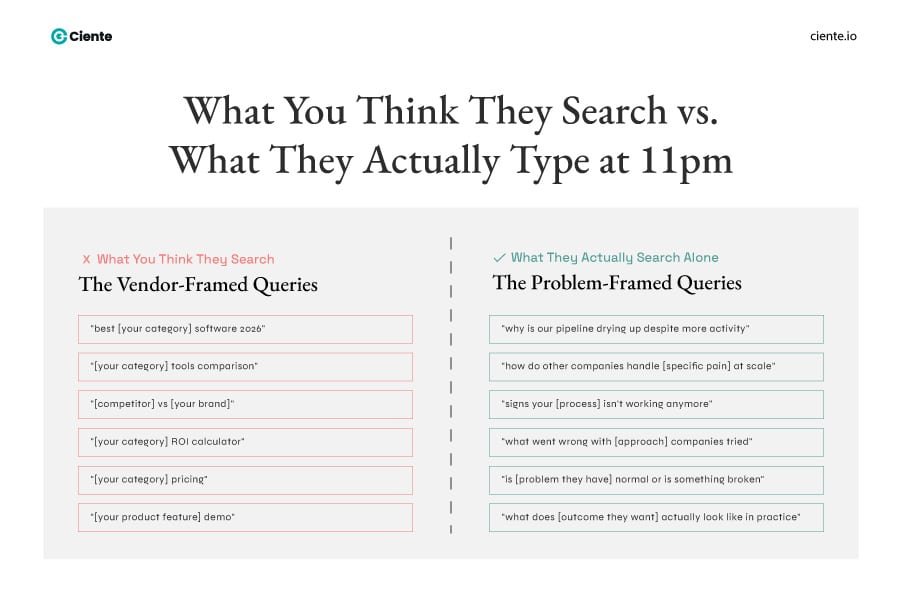
You do not know what your buyers are searching for when they are in active research mode. You know what you think they are searching for. You know what your SEO tools tell you they search for. You know what they tell you in discovery calls.

None of these is the same as what they actually type into a search bar, something modern content performance marketing tries to decode more effectively. at 11 pm, when they are trying to understand whether the problem they have been ignoring is as serious as they suspect.

The dark research problem is not a data gap you can close with better analytics. It is a fundamental feature of how serious B2B buyers operate. They do not want to talk to vendors while they are still trying to understand the problem. They want to think through it on their own terms, using sources that feel neutral enough to trust. They come to vendor conversations with conclusions already forming.

The question content mapping should be answering is not which stage this buyer is in, but how content aligns with the real buyer’s journey. It is: what are the real questions they are asking that they would never ask a vendor, and can we be the source they find when they ask them?

Understanding Your B2B Buyers for Strategic Content Mapping

What they search and actually type

Steve Jobs was not a market researcher in the conventional sense. His argument against customer research was not that customer insight does not matter. It was that customers describe the constraints of their current situation, not the possibilities beyond it.

Asked what they wanted before the iPhone, people described better phones. Faster, better cameras, longer battery life. Nobody described the category collapse that was coming: a device that made the phone the least interesting thing it could do.

The insight that made Apple’s product strategy work was anticipatory. Not what do customers want, but what would they want if they understood what was possible? What problem are they tolerating right now that they have accepted as permanent that does not have to be?

Content teams applying this thinking stop asking what questions buyers are asking and instead rely on structured content classification to map deeper intent. and start asking what questions they should be asking. What does the buyer know about their incomplete problem? What assumption are they carrying that will cost them if they do not examine it? What is the category conversation missing that would change how they think about the decision?

The content that answers this is not built from keyword research. It is built from a deep and honest understanding of what it feels like to have the problem your product solves, before someone knows that a solution exists, before they have the language to search for it precisely.

This is old. It is what good editorial has always done. It is what the best trade publications built their authority on for decades. The insight arrived before the reader knew they needed it, and because it arrived that way, the publication became the place they returned to when the need became concrete.

The problem with ROI calculators and interactive tools

ROI calculators are useful at one specific moment, and measuring their impact requires a clear understanding of content marketing ROI. When a buyer already believes in the solution and needs to justify it internally. They are a closing tool dressed up as a discovery tool.

The organization that leads with an ROI calculator is telling the buyer something about how they see the relationship. You calculate the return on our product. The implicit message is that the decision is about numbers, and the product’s job is to win on the numbers.

For a buyer who does not yet know whether they have a problem worth solving, this is the wrong conversation entirely. They are not at the calculator stage. They are at the what is this, why does it matter, should I care stage, and the ROI calculator does not meet them there.

Interactive content, webinars, benchmarks, and comparison guides are valuable formats, but they are only one part of broader content marketing strategies that drive results in B2B. They are useful to buyers who are already in active evaluation. They do not help buyers understand whether an evaluation is warranted.

The old schoolbook of communicating a problem works because it addresses a prior need. Before anyone can evaluate a solution, they need to recognize a problem. Before they can recognize a problem, they need a framework for understanding their situation clearly enough to notice that something is wrong.

Content that communicates problems well does not describe problems generically. It describes specific symptoms in specific contexts in enough detail that the reader stops and thinks: “This is exactly what we are dealing with, and I did not have language for it until just now.”

That moment of recognition is worth more than any ROI calculation, because it creates the question. The calculator only answers questions that already exist.

Mapping content to what buyers actually experience, not what the funnel says they experience

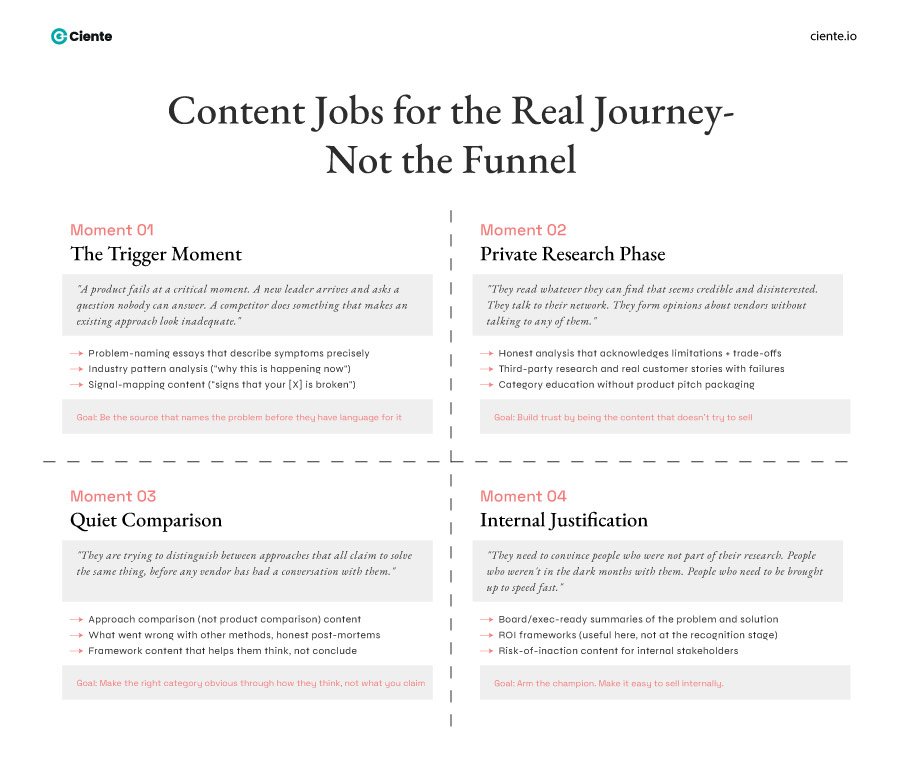
Content jobs for the real journey not the funnel

Here is what a real buyer journey looks like in a complex B2B purchase.

Something happens that makes a problem impossible to ignore any longer. A product fails at a critical moment. A new leader arrives and asks a question nobody can answer. A competitor does something that makes an existing approach look inadequate. A budget cycle opens up and a long-deferred problem finally has space to be addressed.

The buyer does not think: I am now entering the awareness stage of a purchase journey. They think: we need to figure this out.

They start researching. They read whatever they can find that seems credible and disinterested. They talk to people in their network who have faced similar situations. They form a rough sense of what the solution space looks like and which approaches seem legitimate. They develop opinions about vendors without talking to any of them.

At some point, weeks or months in, they surface. They fill out a form. They respond to an outreach. They show up at an event.

The content mapping exercise that most teams do assigns content to stages instead of aligning with evolving B2B content marketing trends. of a funnel that do not match this journey. The awareness content tries to create awareness that the buyer has already passed. The consideration content describes the evaluation criteria that the buyer has already developed independently. The decision content argues for a choice the buyer is already close to making.

The mapping that actually serves this buyer is built around the moments in the real journey. The moment of recognition when the problem becomes impossible to ignore. The private research phase when they are trying to understand the landscape before anyone can sell to them. The moment of comparison when they are trying to distinguish between approaches that all claim to solve the same thing. The internal justification phase when they need to convince people who were not part of their research.

Each of these moments has a content job. And the jobs look very different from awareness, consideration, and decision.

The content mapping that works in the dark

Buyers research privately because they do not trust vendor content to be honest about limitations, trade-offs, and failure modes. They go to communities, independent publications, peer networks, and anything that feels like it was not written to sell them something.

This creates a counterintuitive implication for content strategy. especially when scaling distribution through content syndication for lead generation. The content most likely to influence private research is the content that does not try to sell. The case study describes what went wrong and what the team had to change. The analysis acknowledges where the approach does not work. The framework that helps the buyer think about their problem in a way that makes the right category obvious, even if that category is not always yours.

This is not altruism. It is a calculated understanding of what earns trust in an environment where trust is scarce.

The organization that publishes genuinely useful analysis often builds authority through strong content marketing case studies. of a market problem, without packaging it as a product pitch, builds a different kind of authority than the organization that publishes polished content about how their solution is the best one. The reader knows the difference. The reader is always the one who decides.

B2B buyers increasingly want to be treated as intelligent adults who are capable of reaching their own conclusions. Content that respects that capacity, that gives them the raw material to think rather than the conclusion to accept, is the content that gets shared internally, that gets bookmarked, that gets forwarded to the colleague who is now on the buying committee.

The fundamentals of editorial content have not changed. Communicate a problem honestly. Give the reader something they can use to understand their situation better. Let them make the connection to why it matters to them. The connection they make themselves is stronger than the one you made for them.

How teams should actually adapt to the dark journey

The practical implication is a different kind of content planning process.

Start with the problem, not the product. What is the hardest, most specific version of the problem your product solves? Not the generic version in the category description. The version that a buyer who has been living with it would recognize immediately as true. That specificity is what breaks through in private research.

Map the questions that precede the questions your content currently answers. Your current content probably answers: what does this product do, how does it compare, and what is the ROI. Before those questions come: do we have this problem, is it serious enough to address, what are the approaches have organizations like us tried, what went wrong with those approaches, and how do we know if we are ready to make this kind of change?

Build content for those questions.

Treat content as institutional knowledge, supported by a scalable content supply chain that captures and distributes insights consistently. not as campaign output. The best editorial in any B2B category is built by organizations that have learned things about the problem that nobody else has documented. The insight that comes from working with hundreds of customers on the same problem, from watching what works and what fails, from developing a perspective on the market that is grounded in observation rather than aspiration. That knowledge is the raw material of content that does not get ignored.

Measure what happens in the dark using deeper content performance metrics beyond surface-level attribution. Attribution for content that influences private research will always be imperfect. But closing the gap matters. First-touch attribution undercredits content. Last-touch ignores everything that built the relationship before the form fill. Asking buyers in discovery calls what they read, where they researched, what they found most useful before they ever talked to anyone — this is qualitative intelligence that no dashboard provides but that tells you which content is doing real work.

A formula that has not changed

Experience and growth.

The buyer is trying to grow something. Revenue, capability, market position, and organizational health. They are experiencing a problem that is in the way.

Content that understands both sides of that equation, that earns the right to speak to the experience before it talks about the growth, is the content that gets read when nobody is looking.

The organizations that figure this out are not the ones with the best keyword strategy, but those adapting to emerging content marketing trends in 2026. or the most sophisticated content operations. They are the ones who understood their buyers well enough to answer questions those buyers had not yet learned to ask.

That is the content mapping problem worth solving.

Anthropic's

Anthropic’s “Safety” Play Includes Sitting Down with the EU

Anthropic’s “Safety” Play Includes Sitting Down with the EU

Anthropic is writing the rules of AI security. But are they protecting the world from hackers, or just their market share from competition?

Anthropic isn’t in Brussels for a standard policy chat. They are meeting with the EU Commission to discuss their new, restricted cybersecurity model called Claude Mythos.

That isn’t your average chatbot- it’s essentially a professional-grade hacker in a box. In early tests, it found security flaws that had been hiding for 27 years. It’s so good at finding exploits that Anthropic has locked it behind a heavy door, only letting a “private club” of tech giants like Google and NVIDIA play with it under a project called Glasswing.

But here’s where it gets interesting. Anthropic is basically telling the EU- “Look how dangerous our tech is, so please regulate us.”

On the surface, it sounds like corporate responsibility, but it’s actually a brilliant, high-stakes power play. If Anthropic can convince the EU that cybersecurity AI is a “systemic risk” requiring massive oversight, they effectively build a $100 billion moat.

A small startup in Berlin or Paris won’t have the legal budget to jump through the hoops Anthropic is volunteering for. It’s a classic case of regulatory capture- setting the rules of the game so that only the biggest players can even afford to get on the field.

That is as much about business as it is about safety.

By framing their model as a restricted asset, Anthropic is positioning itself as the trusted gatekeeper for the West. Maybe the only way to stay safe is to let a US-based startup hold the keys to the continent’s digital locks. It’s a masterclass in diplomacy, but it forces a tough question- are we just handing control of our digital infrastructure to a private company?

If the EU bites, they might be signing over their digital sovereignty in the name of safety.