Data Management Platform

8 Data Management Platform Alternatives Beyond Governance

8 Data Management Platform Alternatives Beyond Governance

Every data management alternative list covers the same ground: better governance, cleaner pipelines, smarter catalogs. This one covers those, then goes somewhere else entirely.

The governance conversation is settled.

Everyone agrees you need data catalogs, lineage tracking, access controls, quality pipelines, and compliance frameworks as part of building a modern data stack. The tools exist. The best practices are documented. If your organization is still arguing about whether to implement governance, that is a different problem, and this piece is not for you.

This piece is for the organizations that have the governance layer and are asking what comes next in building a future-first data foundation. What does data management look like when the AI workloads are real, the energy costs are showing up on finance’s radar, and the systems processing all of this information are starting to look fundamentally different from the systems they were designed to manage?

The first four entries are conventional. Established categories, strong tooling, clear ROI cases. The last four are not. They are where the conversation goes if you are willing to follow it.

The Conventional Four

1. Data Observability Platforms: Real-Time Monitoring for Data Pipeline Health

Governance tells you what data you have and who can access it. Observability tells you whether the data is behaving the way it is supposed to, right now, while it is moving.

The distinction matters because bad data does not always announce itself. A field that is suddenly arriving null at 3 am does not file a ticket. A table that stopped updating when the upstream schema changed does not send an alert unless someone builds one. Most organizations discover data quality problems when a downstream consumer, a report, a model, or a dashboard produces something obviously wrong. By then, the problem has been propagating for hours or days.

Data observability platforms like Monte Carlo, Bigeye, and Acceldata sit in the pipeline watching for anomalies in real time. Volume drops. Schema changes. Distribution shifts. Null rate spikes. Freshness failures. They catch these patterns before they reach the consumer and create an incident trail that makes root cause analysis possible instead of guesswork.

The value here is not just catching problems faster. It is changing the organizational relationship with data reliability through better data hygiene practices. A team that sees its data quality score on a dashboard behaves differently toward data quality than one that only hears about problems in retrospect.

For organizations running AI and ML workloads, this is not optional infrastructure, especially as data science continues to transform business outcomes. A model trained on silently degraded data is worse than a model trained on less data, because it is confident about the wrong things. Observability is the immune system of the data stack.

Data Mesh Architecture: Decentralizing Data Ownership Across Business Domains

The centralized data warehouse model has a scaling problem that most organizations discover after they have already committed to it, particularly when dealing with evolving data lake architectures.

All data flows to one place. One team manages it. Every consumer routes requests through that team. The team becomes a bottleneck. Business domains that need fast access to their own data wait in a queue. The data platform team works constantly and is still blamed for being slow.

Data mesh is the architectural response. The principle: data is owned and managed by the domain that generates it, not by a central platform team. The marketing domain owns its data. The sales domain owns its. Each domain is responsible for making its data available as a product to the rest of the organization, meeting shared standards for quality, discoverability, and access.

The central team shifts from being a data factory to being an infrastructure and standards provider. They build the platform that domains operate on. They define the interoperability rules. They do not build every pipeline.

The organizational requirement is real. Data mesh does not work in companies that are not willing to give business domains genuine accountability for data quality. It requires distributed expertise that many organizations have not built yet. But for enterprises at scale where the centralized model has already shown its ceiling, it is the architecture that reflects how work is actually done rather than how someone hoped it would be organized.

3. Unified Data Lakehouse Platforms: Combining Data Warehouse and Data Lake Capabilities

The data lake was supposed to solve the warehouse problem, but many organizations struggled with implementation and clarity. Store everything, schema on read, no up-front transformation. The reality was that data lakes became what people called data swamps: large volumes of ungoverned, poorly documented data that were technically accessible and practically unusable.

The data warehouse was structured and reliable, but expensive to put everything in and slow to adapt to new use cases.

The lakehouse collapses the distinction. An open table format layer, Apache Iceberg or Delta Lake being the dominant implementations, sits on top of cloud object storage and provides ACID transactions, schema enforcement, time travel, and the kind of reliability that warehouses offered without requiring all data to live in a proprietary format.

Platforms like Databricks, Apache Hudi, and the cloud-native implementations from AWS and Google have matured enough that the lakehouse is no longer an architecture conversation. It is a procurement decision.

The practical advantage for organizations running diverse workloads is significant, especially when data analytics drives informed decision-making across teams. Data scientists working in notebooks, analytics engineers building dbt models, ML engineers training models, and BI teams running dashboards can all operate against the same storage layer with the same data. The transformation layers and tooling differ. The underlying data does not.

4. Master Data Management Tools: Creating a Single Source of Truth for Critical Business Data

Revenue numbers do not match between sales and finance. Customer records that exist in three systems with three slightly different spellings of the same name. Product data that contradicts itself between the catalog and the ERP.

These are Master Data Management problems often rooted in inconsistent customer data across systems. And they predate cloud computing, AI, and every architectural trend of the last decade. They are organizational problems wearing a technological face.

MDM tools like Informatica, Semarchy, and Reltio provide the infrastructure to define, manage, and synchronize the data that the rest of the organization depends on being accurate and consistent: customers, products, suppliers, locations, and employees. The canonical records that every other system should be reading from, rather than maintaining its own version of.

The implementation challenge is always political before it is technical. MDM requires someone to own each data domain, to make decisions about which source is authoritative when sources conflict, and to maintain that standard over time as systems change and new data sources get added.

Organizations that get MDM right do not usually talk about it as an MDM project. They talk about it as the moment their organization stopped having arguments about which number is correct.

The Unconventional Four

This is where the list departs from what the category expects.

The following entries are not product categories with established vendor landscapes. They are frameworks, architectures, and ideas that reframe what data management means in the AI era. Some of them are emerging. One of them is rewriting the physics of what computing is.

5. Event-Driven Architecture as Data Management: Managing Data in Motion Instead of Data at Rest

The data management conversation almost always assumes data at rest. Data sitting in a warehouse, a lake, a database. Managed, cataloged, governed.

But an increasing share of the most valuable data in any organization is data in motion. Events. The customer clicked. The sensor reading changed. The transaction has been processed. The model produced an output. These events are happening continuously, and they carry information that batch pipelines, by design, capture late and incompletely.

Event-driven architecture treats every meaningful state change in a system as a first-class data artifact, enabling real-time data-driven strategies. Kafka, Pulsar, and the stream processing frameworks built around them create a persistent, replayable log of what happened, when it happened, and in what sequence. The data management layer shifts from managing records to managing events.

This matters for AI in a specific way, particularly as organizations increasingly rely on data-driven marketing trends to stay competitive. Models making real-time decisions need real-time context. A fraud detection model needs to know what happened two seconds ago, not what was in last night’s batch load. A recommendation system operating at the moment of customer decision needs the signal from that session, not the aggregated profile from last week.

The organizations building serious AI capabilities are increasingly discovering that their data architecture is the bottleneck, not their models. Event-driven architecture is the infrastructure answer to that problem.

The governance challenge is real. Events are harder to catalog and query than records. Schemas evolve faster. The volume is higher. But managing data as events rather than as tables is a more accurate model of how information is actually generated and how AI systems actually consume it.

6. Data Contract Frameworks: Enforcing Data Quality at the Source Through Producer-Consumer Agreements

Data quality is usually managed downstream, which often leads to inefficiencies in analytics processes. A pipeline runs, data arrives, a quality check catches the problem, and someone gets paged.

Data contracts invert this. A data contract is a formal agreement between the team producing data and the teams consuming it, specifying the schema, the quality standards, the SLAs, and the expectations on both sides. Before data moves, both parties have agreed on what the data will look like and what happens when it does not.

This sounds administrative. It is actually architectural.

When producers own quality at the source, the entire quality management burden does not fall on the platform team or the consumers. Problems get caught where they are cheapest to fix, before the bad data has traveled through five systems and is now embedded in a production model.

The practical implementation looks like versioned schema definitions, automated contract testing in CI/CD pipelines, and monitoring that alerts the producer when their data violates the contract their consumers depend on. Tools like Soda, Great Expectations, and dbt tests are the infrastructure. The discipline is organizational.

For AI specifically, data contracts are the mechanism that makes model retraining reliable and supports consistent data-driven outcomes. If the training data is governed by a contract, changes to the underlying data are surfaced as contract violations before they silently change model behavior. This is not a governance concern. It is a model reliability concern.

7. Hardware as Data Infrastructure: Why the Physical Layer of AI Computing Is a Data Management Problem

This is the entry that the conventional list skips entirely because it does not look like a data management problem from the outside. It is.

Every AI workload is a data problem at two levels simultaneously. The logical level: what data is being processed, how it is structured, where it lives, and who can access it. This is what DMP conversations usually address.

And the physical level: how is that data moving through hardware, at what energy cost, and what does the architecture of the hardware itself do to the efficiency of the computation?

These two levels are not independent. The hardware determines what data operations are efficient, which determines what AI architectures are practical, which determines what data management strategies make sense.

The dominant hardware paradigm for AI has been the GPU. GPUs were designed for graphics rendering, which turned out to share enough mathematical structure with deep learning to make them useful. Not designed for the job. Adapted for it. And the adaptation has a cost: enormous energy consumption, communication-heavy architectures where moving data between memory and compute is the primary energy expense, and deterministic processing that has to simulate probabilistic behavior rather than performing it natively.

GPU-based computing

Managing data in an AI organization without understanding the hardware constraints is like managing a logistics operation without understanding what the trucks can carry, especially when building a scalable data-centric stack. The physical layer shapes every decision above it.

8. Thermodynamic Computing: When Energy and Data Are the Same Management Problem

This is where the frame changes completely.

Extropic, a company building what they call thermodynamic computing hardware, made a bet three years ago: energy would become the limiting factor for AI scaling. They were right.

Almost every new data center today is experiencing difficulties sourcing power. Serving advanced AI models to everyone, all the time, at the scale the industry is imagining, would consume vastly more energy than humanity currently produces. The AI scaling problem is not a software problem or a data problem. It is an energy problem.

Extropic’s answer is hardware built on a fundamentally different principle. Instead of the deterministic computation model that GPUs inherited from graphics rendering, their Thermodynamic Sampling Unit operates probabilistically at the hardware level. It produces samples from probability distributions directly, using the physics of thermal noise as a computational resource rather than fighting against it.

The result, according to their published research, is orders of magnitude less energy per AI workload.

The connection to data management is not metaphorical. It is structural.

Data has thermodynamic properties. Information theory and thermodynamics are mathematically related in ways that physicists have understood for decades, but that the computing industry largely set aside when deterministic silicon became dominant. Claude Shannon’s measure of information entropy and Ludwig Boltzmann’s measure of physical entropy share the same mathematical form. Information, at a fundamental level, is physical. Moving it costs energy. Processing it costs energy. Storing it costs energy. The energy cost of a data operation is not separate from the data management problem. It is part of it.

When an organization asks how to manage data more efficiently in the AI era, the full answer has to include: what is it costing to process this data at the hardware level, and is that cost sustainable as the workloads scale?

Organizations that have invested deeply in data management at the logical layer: governance, lineage, quality, and observability, and have not yet asked this question, are managing half the problem.

managing half the problem

The hardware abstraction that has let software engineers ignore the physical layer is starting to fail. The energy wall that Extropic identified is real. And the response to it, whether through thermodynamic computing, photonic computing, neuromorphic architectures, or approaches not yet built, will change what data management means at a fundamental level.

The organizations that understand this early will not have to rebuild their thinking when it becomes unavoidable. The ones that treat data management as purely a software concern will find that the physical layer eventually makes its presence known in ways they did not plan for.

Data and energy flows. And at some level of the stack, they are the same flow.

Managing one without understanding the other is going to look, in retrospect, like an incomplete answer to a question that was always asking for more.

ROI-Focused Performance Marketing for SaaS

Own the Category with ROI-Focused Performance Marketing for SaaS

Own the Category with ROI-Focused Performance Marketing for SaaS

Everyone is obsessed with CPL, but the revenue graveyard is full of cheap leads. What happens when you stop buying clicks and build a sustainable SaaS moat?

Most SaaS performance marketing is just a high-speed way to burn through a Series C round.

Companies treat their ad spend like a box to check, much like they treat media production. They hire agencies to chase clicks, celebrate a lower CPL, and ignore the fact that their sales team is drowning in “leads” that have no intention of buying.

It is a distraction from the real problem.

The truth is that most companies choose the wrong path because they focus on the format instead of the actual outcome: revenue, rather than building a solid B2B SaaS market strategy.

The line between audio, video, and paid performance has almost vanished in your current market. If you want to leverage performance marketing to scale a SaaS company, you have to stop chasing vanity metrics and start building a system that drives trust at scale.

The Lead Generation Mirage

Why does traditional lead generation for SaaS often fail to convert into real revenue?

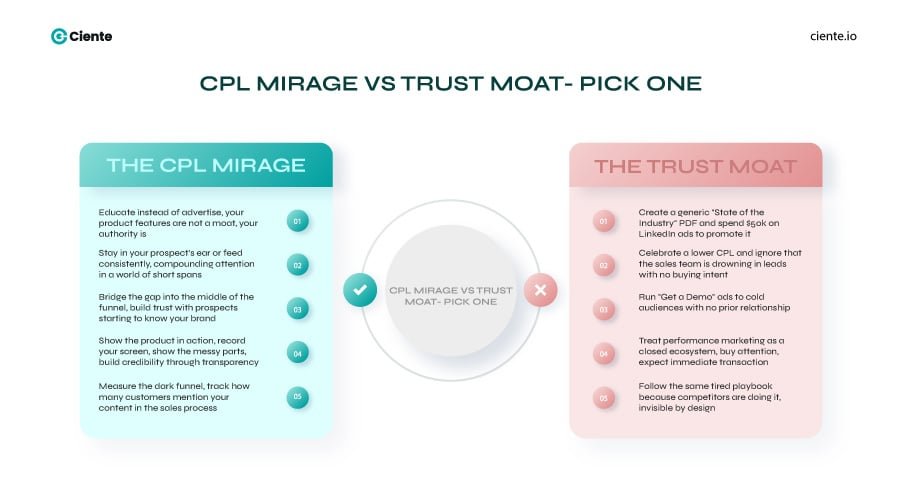
Most SaaS leaders are obsessed with the lead magnet. They create a generic “State of the Industry” PDF, spend $50,000 on LinkedIn ads to promote it, and then wonder why their pipeline is stagnant.

actually works

These companies are invisible. They are following a tired playbook because their competitors are doing it, recording generic content that offers the same “thought leadership” advice everyone else shares.

The problem with this approach is that it treats performance marketing as a closed ecosystem where you buy attention and expect an immediate transaction. But buyers don’t find solutions by clicking on a boring banner; they find them through trust and specific recommendations.

If you rely on a “Get a Demo” ad to find new leads without any prior relationship, you are going to fail.

Performance marketing should not just be about the top of the funnel but should align with smarter lead scoring methods in SaaS to qualify real intent. It is most effective when it bridges the gap into the middle of the funnel, building long-term trust with prospects who are starting to become familiar with your brand.

The real value is staying in a prospect’s ear or feed consistently, which is a massive advantage in a world where attention spans are measured in seconds.

Creative Strategy as the Only Real Targeting

In the world of ROI-focused marketing, video is the engine that solves the discovery problem, especially when integrated into a broader SaaS social media marketing strategy. Platforms like LinkedIn, YouTube, and TikTok have algorithms that push video content to people who don’t follow you yet.

A single sixty-second performance clip can generate more new awareness in one day than a hidden whitepaper can in a year.

However, the friction is much higher with video.

If your ad feels like a commercial- complete with stock music, generic graphics, and a robotic narrator- buyers will scroll away immediately.

To win with performance marketing, you must show the product in action.

Don’t just run ads talking about “streamlining workflows”.

Record your screen. Illustrate exactly how your software saves a user ten hours a week. Show the messy parts of the process. This transparency builds a level of credibility that polished marketing can never touch.

Buyers are tired of the “corporate” look; they want to see the tool’s reality.

Navigating the Enterprise Decision Loop

In enterprise SaaS, you aren’t selling to a single person.

You are selling to a committee of ten to fifteen people. Every decision-maker on that committee processes information differently. If your performance marketing only targets the “V.P. of Something,” you are ignoring the people who actually influence the check.

  • The end-user needs a quick two-minute video showing a specific feature that solves their daily headache.
  • The director might prefer a forty-minute deep-dive or a long-form discussion they can listen to during their commute.
  • The CFO doesn’t want to watch or listen to anything; they want a one-page summary of the financial results.

If you only produce one type of media or ad, you are ignoring a significant part of the buying committee.

You need a strategy that covers the entire spectrum. It doesn’t mean you need a massive team; it means you need an integrated production process. You record one high-quality conversation and use it as the raw material for everything else- long-form videos for YouTube, audio for podcasts, and short, punchy clips for your paid social feeds.

Why Educating for Free is Your Greatest ROI

The foundation of effective thought leadership in SaaS marketing. Your product features are not a sustainable moat; your competitors will copy them in months. Your pricing is not a moat either; someone will always be willing to go lower. Your only real moat is the trust you build with your market.

CPL mirage vs trust moat pick one

Performance marketing is the fastest way to build that trust at scale, but only if you shift from “marketing” to “education”.

When you use your ad budget to educate, you are the authority.

If you sell security software, don’t talk about your dashboard features; talk about how to prevent a data breach or how to audit a system.

When a buyer listens to you or watches your content for twenty hours over a year, they feel like they know you. They trust your philosophy. When they finally have the budget and the need, they won’t search for a generic vendor; they will go directly to the source of their education.

That’s why the “concise and direct” approach works. Stop trying to be “professional” and start trying to be useful. Talk like a human to other humans.

Escaping the Attribution Blind Spot

Stop looking at vanity metrics like downloads or impressions if those people don’t fit your ICP, and instead focus on meaningful marketing ROI for SaaS. You don’t need a million followers; you need the right five hundred people. The real ROI of performance marketing is often hidden in the “dark funnel”.

You must track how many customers mention your content during the sales process.

Ask your sales reps to document when a prospect says, “I saw that video you posted about X”. This is the qualitative data that proves your strategy is working. You will likely find that a buyer watches three videos and listens to two podcasts before requesting a demo.

That is the journey of a modern enterprise buyer.

The Low-Fidelity High-Impact Workflow

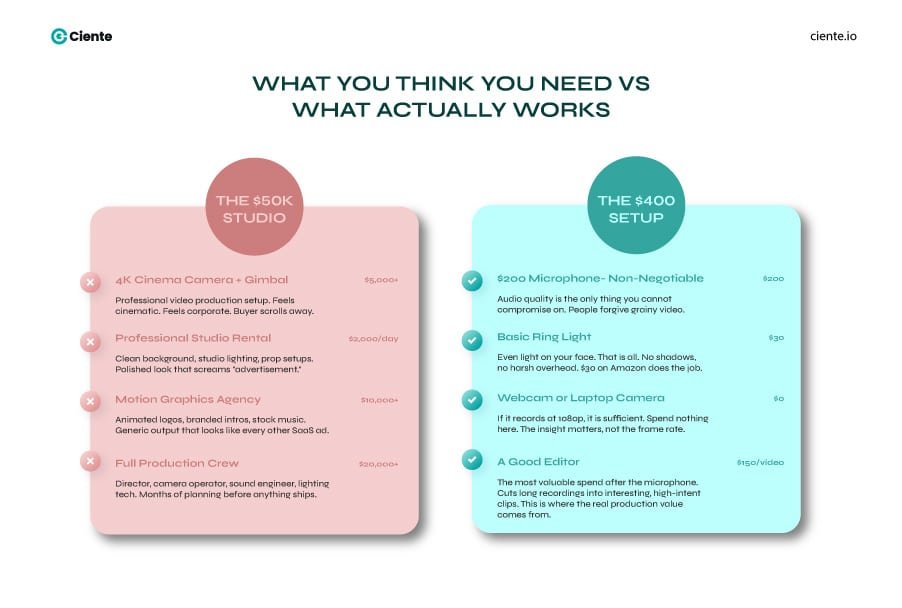
is a practical approach often overlooked in SaaS startup marketing. Many SaaS leaders hesitate to start because they think they need a professional studio with 4K cameras. It is a mistake.

High production value can actually make your ads feel cold and corporate. Some of the most successful creators use a simple webcam and a decent microphone.

The value is in the insight, not the frame rate.

However, you cannot compromise on audio quality. People will forgive a grainy video, but they will not listen to something with static or echoes. Buy a two-hundred-dollar microphone and a basic light- that is all you need to get started. Spend the rest of your budget on a good editor who can cut your long recordings into interesting, high-intent clips for your performance campaigns.

The choice isn’t between different ad platforms.

The actual choice is whether you will be a participant in your industry’s conversation or a spectator. Performance video gives you the reach to find new people; deeper content gives you the depth to convert them.

Begin with a video-first approach. Solve problems for free through your content. If you do this consistently, you won’t just grow your company; you will own your category.

How are you currently measuring whether your paid media is actually building trust with your target accounts?

AI

AI for Robots in Agenda for NVIDIA as It Partners Up with Cadence

AI for Robots in Agenda for NVIDIA as It Partners Up with Cadence

NVIDIA, Cadence collaborating seems like a natural progression in this AI-first world. But can AI truly parent its next generation of hardware? Seems questionable.

AI for design or design for AI- this is the question as NVIDIA enters into a partnership with Cadence Design Systems (CDS). The overview is that NVIDIA aims to create a virtuous cycle of AI design by breaking physical and computational bottlenecks.

Moore’s theory is a significant observation, a trend that the entire manufacturing industry operates on. And since 1965, the industry has been finding loopholes to shrink as many transistors as possible. But forcefully fitting several transistors together creates heat, and one cannot remove a single transistor without melting the chip.

And that was merely one of the many challenges that threaten to stall Moore’s law.

The NVIDIA-Cadence alliance is a strategic workaround to this dilemma.

Training inside simulations is obviously much easier than training robots in the real world. There are physical limitations (Moore’s law is one), and the training data is also readily available. Now Cadence is generating them through its physics engines- to train robots inside simulations.

But even that faces a conundrum. There’s little understanding of how real-world materials interact. However, this partnership might truly change that.

Cadence has designed a head agent, called the AgentStack, that’s fuelled by NVIDIA’s Nemotron models. This AI sifts through thousands of design possibilities to find the best one- it’s basically AI designing another AI.

It is the future of AI design.

Meanwhile, NVIDIA is using these head agents to design their own chips- it’s a loop: NVIDIA’s chips are being designed by AI running on NVIDIA’s chips.

It’s a dual-track strategy.

Cadence’s agents are basically expert copilots who can observe a design and suggest changes accordingly. AI is leveraging AI to build the next generation of AI hardware

– a feedback loop like this:

NVIDIA designs and builds a quicker GPU ⇒ Cadence leverages it to make their software more effective and speed up output ⇒ Software engineers use this to build faster GPUs.

Rinse and repeat.

The goal is to decrease the time needed to complete significant tasks- the focus is on building AI for robotic systems. And we’re beginning by actively zeroing in on the designs.

Adobe

Adobe’s Firefly AI is Here to Save the Day for Creatives- Is that the Whole Story?

Adobe’s Firefly AI is Here to Save the Day for Creatives- Is that the Whole Story?

Adobe’s Firefly AI leverages Creative Cloud apps on behalf of creators- to add finesse to their work. But to what extent does it promise to keep its hands off the creativity that shines from within?

There have been enough times that professionals, from tech leaders to creators, have circled the AI-creativity debate. Did AI add to creative prowess, or take away from it- that has always been the crux. And one thing is certain: AI will not replace human creativity as we know it.

It could become an amplifier of the abilities that humans already have- that’s for sure.

Adobe has recognized precisely that.

AI, not as a tool, but as an enhancer that will help creators unleash their hidden repository of creative capabilities. For this, it has launched Firefly AI, which it calls an assistant for creators that’ll help them edit and improve their designs.

This conversational AI model will edit images and PDFs using descriptive prompts. Adobe has made it easier by adding a conversational interface. While it’s not transforming the role that AI plays in the digital and creative realm, it’ll influence much smaller functions of the process, from fine-tuning the results to make them more personalized and consistent.

Of course, making even the smallest edits on creative assets isn’t as easy as it sounds. And Adobe has always ensured it’s there to help creatives push the boundaries of innovation, especially in the GenAI age.

Firefly will also offer presets for every creator under the “Creative Skills” tab, i.e., the AI can choose or execute from a library of pre-made skills. The assistant will also be able to learn from the creator to understand their aesthetics, workflow, and tools- and the context behind these choices.

Different departments won’t have to wait for different versions from creative teams; Firefly provides arms to speed up the overall process.

Firefly AI’s conversationality is a new addition- one that’ll take Adobe’s full-stack digital marketing ecosystem to a new height. Adobe’s suite of platforms is already a core part of the AI wave across three core segments- publishing and advertising, digital media, and digital experience.

In a perfect world, Firefly AI assistant is the glue for Adobe to maintain and develop their marketing ecosystem- not only in scale but also speed.

Erratic-ness of customer behavior has been a conundrum for marketers. While their traditional as well as current playbooks fail, Firefly can seize this opportunity to be the knight in shining armor.

And if speed and effectiveness are what marketing is lacking, Firefly might be their one and only savior.

Podcasts v/s Video Marketing for Saas Growth

Podcasts v/s Video Marketing for Saas Growth: Which Effectively Communicates You?

Podcasts v/s Video Marketing for Saas Growth: Which Effectively Communicates You?

Podcasts or video for SaaS? Most companies choose wrong. Stop chasing vanity metrics and learn how to turn content into a revenue engine. Here’s the truth.

The debate between starting a podcast or a video channel is usually a distraction from the real problem.

Content fails because they treat media as a box to check. They purchase expensive equipment and hire a host, but they don’t have a clear strategy for how that media drives revenue. They focus on the format instead of the outcome.

In the current market, the line between audio and video is almost gone.

Every successful podcast has a video component. Every successful video channel has an audience that listens while doing other tasks. But how your prospects interact with these formats is fundamentally different.

You must understand the specific mechanics of discovery and trust if you want to leverage media to scale a SaaS company, especially when building a sustainable lead generation strategy for SaaS.

The Problem with Podcasts

Most SaaS podcasts are invisible.

Companies launch them because a competitor has one. They record generic interviews with “thought leaders” sharing the same tired advice. These episodes on Spotify and Apple Podcasts have ten downloads each.

The biggest pain point with audio is discovery.

Podcasts operate in a closed ecosystem.

People don’t find new podcasts by searching on Google or browsing a feed. But through specific recommendations or by following a person they already trust. You are set up to fail if you rely on a podcast to find new leads.

Podcasts are meant for the middle-of-the-funnel.

Podcasts build long-term trust with prospects who are familiar with your brand, making them a powerful tool in thought leadership in SaaS marketing. It allows you to stay in a prospect’s ear for forty-five minutes a week. It is a massive advantage in a world where attention spans are measured in seconds.

But it only works if you have an existing audience to feed into the show.

Instead of using a podcast for reach, use it for access, an approach that aligns closely with account-based marketing for SaaS, where relationships matter more than scale.

The real value of a SaaS podcast is the interview itself. It is a legitimate reason to invite your biggest target accounts to a one-on-one conversation. You aren’t pitching them; you are learning from them. That builds a relationship that a cold email can never touch.

If you interview fifty potential customers a year, the podcast pays for itself regardless of how many people listen to the final edit.

Why Video Wins at Discovery

Video solves the discovery problem that podcasts have, which is why it plays a central role in modern SaaS social media marketing strategies.

YouTube is the second-largest search engine globally. LinkedIn and TikTok algorithms push video content to people who don’t follow you yet. A sixty-second video clip can generate more new awareness in one day than a podcast can in a year.

However, the friction in the video is much higher.

A buyer has to commit their eyes and ears to your content. If you are boring, they scroll away immediately. SaaS videos fail because they feel like commercials- with stock music, generic graphics, and a robotic narrator.

To win with video, you have to show the product in action.

something that aligns with effective SaaS product-market fit communication, where clarity beats abstraction. Don’t just talk about “streamlining workflows.” Record your screen and illustrate exactly how your software saves a user ten hours a week. Show the messy parts of the process. This transparency builds credibility. Buyers are tired of polished marketing.

Your buyers want to see the reality of the tool.

The Shelf-Life of Your Content

You must consider how long your content stays useful. especially when planning a scalable SaaS marketing strategy that compounds over time.

A majority of social media content is ephemeral. A video you post on LinkedIn today will be gone from the feed by Friday. You are on a content treadmill here.

Podcasts and YouTube videos are different.

They are library content. An episode you record today can still drive traffic and trust two years from now if the topic is evergreen. That’s how you build a content moat. You accumulate hundreds of hours of searchable, educational material that works for you 24/7 over time.

And when you compare the two? YouTube has the most effective long-term ROI because it combines discovery with longevity. A podcast has longevity but lacks discovery. Social video has discovery but lacks longevity.

The most efficient SaaS companies find a way to combine all three.

Serving the Buying Committee

In enterprise SaaS, you aren’t selling to one person. You are selling to a committee of ten to fifteen people. Every decision-maker in that committee has different learning processes.

The end-user wants a quick two-minute video showing them a specific feature. They want a quick answer to a problem they currently have. The director or manager might prefer a forty-minute podcast during their commute. They are thinking about strategy and long-term trends.

The CFO doesn’t want to watch or listen to anything; they want a one-page summary of the results.

If you only produce one type of media, you are ignoring a significant part of the buying committee. You need a strategy that covers the entire spectrum, much like a well-defined SaaS market segmentation approach that addresses different buyer personas. That doesn’t mean you need three separate teams. It means you need a better production process.

The Integrated Production Workflow

The most effective way to grow a SaaS company through media is a video-first approach. You record a high-quality video conversation. This single recording becomes the raw material for other content pieces.

From one sixty-minute recording, you get a long-form video for YouTube. You pull the audio for a podcast episode. You cut five short, punchy clips for LinkedIn. You can also transcribe the audio into a blog post or a series of newsletters- that’s how you hit 1400 words of output without wasting time.

This workflow ensures that you are present where your buyers are. reinforcing a strong digital marketing approach for SaaS companies. You are in their search results, social feeds, and ears. You aren’t choosing between a podcast and a video; you are creating a media ecosystem.

Trust is the New Moat

Your product features are not a sustainable moat. Your competitors will copy your new features within months. Your pricing is not a moat; someone will always be willing to reduce their prices.

Your only real moat is the trust you build with your market, which directly impacts your marketing ROI in SaaS over time. Media is the fastest way to build that trust at scale. When a buyer listens to you speak for twenty hours over the course of a year, they feel like they know you. They understand your philosophy. They trust your expertise.

When it comes time to buy, they aren’t searching for a generic vendor. They are going to look for the people who have been educating them for free. That’s why the “concise and direct” approach works. Stop trying to be “professional” and start trying to be useful.

Avoiding the High-Production Trap

Many SaaS leaders hesitate to start because they think they need a professional studio. which is one of the common mistakes in outsourcing SaaS marketing and production. They think they need 4K cameras and soundproof rooms. It is a mistake.

High production value can actually work against you. It can feel corporate and cold. Some of the most successful SaaS media creators use a simple webcam and a decent microphone. The value is in the insight, not the frame rate.

Focus on the audio quality first. People will forgive a grainy video, but they will not listen to a podcast with static or echoes. Buy a two-hundred-dollar microphone and a basic light. That is all you need to get started. Spend your remaining budget on a good editor who can cut your long recordings into interesting clips.

Measuring What Matters

Stop looking at vanity metrics and focus on meaningful indicators aligned with proven SaaS marketing benchmarks. The number of downloads or views you get is irrelevant if none of those people fit your ICP. You don’t need a million followers. You need the right five hundred people.

Track how many of your customers mention your content during the sales process. Ask your sales reps to document when a prospect says, “I saw that video you posted about X.” This is qualitative data that proves your media is working.

Use attribution software to see the journey of your buyers, which complements techniques like SaaS marketing lead scoring methods for better decision-making. You will likely find that they watch three videos and listen to two podcasts before requesting a demo. It’s the “hidden” funnel that drives enterprise SaaS growth.

The Shift from Marketing to Education

The best SaaS media doesn’t feel like marketing. It feels like education.

If you sell security software, don’t talk about your features; this aligns with the broader shift in content marketing vs sales for SaaS growth toward education-first approaches. Talk about how to prevent a data breach. Show people how to audit their own systems. Offer them the knowledge they need to improve their jobs.

When you educate your market, you become the authority. When the buyer finally has a budget and a need, they won’t even look at your competitors. They will go directly to the source of their education.

The Choice isn’t Podcasts vs. Video Marketing for SaaS Growth

The actual choice is whether you will be a participant in your industry’s conversation or a spectator.

Video gives you the reach you need to find new people, while also complementing broader paid vs organic marketing strategies in SaaS. Podcasts give you the depth to convert them into evangelists. Both are essential for SaaS growth in this competitive market.

Begin with a video-first approach. Be direct, be concise, and stop using jargon. Talk like a human to other humans. Solve their problems for free through your content.

If you do this consistently, you won’t just grow your company; you will own your category.

Bluefish

Bluefish Raises $43 Million Series B to Power Agentic Marketing for the Fortune 500 

Bluefish Raises $43 Million Series B to Power Agentic Marketing for the Fortune 500 

Bluefish is on the verge of an AI-powered breakthrough- helping organizations appear on search conducted on LLMs.

Recently, the organization raised $43 million in its Series B funding. This is a huge milestone for Bluefish.

“Having reached over 1 billion MAU within 12-months of launch, AI is clearly the next major marketing channel on the internet, just like search, social, or mobile before it,” said Alex Sherman, co-founder and CEO of Bluefish. “To manage this critical new channel properly, enterprise brands are looking for agentic marketing technology partners with the same enterprise-grade sophistication that they expect across their existing marketing stack. From day one, Bluefish has focused exclusively on building the most comprehensive agentic marketing suite in the category, and it is becoming the enterprise tool in Fortune 500 marketers’ arsenal.” 

This is a clear bet on the rise of the AI ecosystem, which is something every tech organization is betting on. Everything from search to other avenues of marketing is going through a huge shift- and brands can no longer stay out of this game.

Yes, SEO is important, but so is knowing how to maneuver LLMs and to consistently rank for, but as the COO Jing Feng puts it, “Some believe success in AI comes from gaming the system—but that approach won’t last. Marketers can’t out-compute LLMs, and while shortcuts may deliver momentary lifts, they don’t create a durable advantage. Bluefish is built to help enterprises earn their position in AI. You can keep chasing the algorithm—or you can become what it consistently chooses. Bluefish makes the latter possible at enterprise scale. And we’re just getting started.” 

This is a huge promise, but it also says a lot about why so many organizations gaming the system aren’t seeing tangible results. Bluefish hopes to change that and give narrative control back to the brands- a move that can make the future of search.