Everyone is obsessed with CPL, but the revenue graveyard is full of cheap leads. What happens when you stop buying clicks and build a sustainable SaaS moat?
Most SaaS performance marketing is just a high-speed way to burn through a Series C round.
Companies treat their ad spend like a box to check, much like they treat media production. They hire agencies to chase clicks, celebrate a lower CPL, and ignore the fact that their sales team is drowning in “leads” that have no intention of buying.
It is a distraction from the real problem.
The truth is that most companies choose the wrong path because they focus on the format instead of the actual outcome: revenue, rather than building a solid B2B SaaS market strategy.
The line between audio, video, and paid performance has almost vanished in your current market. If you want to leverage performance marketing to scale a SaaS company, you have to stop chasing vanity metrics and start building a system that drives trust at scale.
The Lead Generation Mirage
Why does traditional lead generation for SaaS often fail to convert into real revenue?
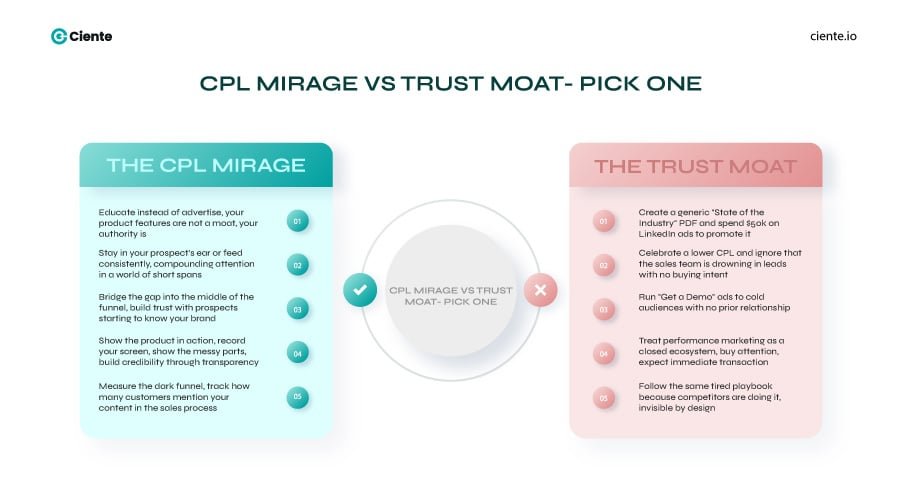
Most SaaS leaders are obsessed with the lead magnet. They create a generic “State of the Industry” PDF, spend $50,000 on LinkedIn ads to promote it, and then wonder why their pipeline is stagnant.
These companies are invisible. They are following a tired playbook because their competitors are doing it, recording generic content that offers the same “thought leadership” advice everyone else shares.
The problem with this approach is that it treats performance marketing as a closed ecosystem where you buy attention and expect an immediate transaction. But buyers don’t find solutions by clicking on a boring banner; they find them through trust and specific recommendations.
If you rely on a “Get a Demo” ad to find new leads without any prior relationship, you are going to fail.
Performance marketing should not just be about the top of the funnel but should align with smarter lead scoring methods in SaaS to qualify real intent. It is most effective when it bridges the gap into the middle of the funnel, building long-term trust with prospects who are starting to become familiar with your brand.
The real value is staying in a prospect’s ear or feed consistently, which is a massive advantage in a world where attention spans are measured in seconds.
Creative Strategy as the Only Real Targeting
In the world of ROI-focused marketing, video is the engine that solves the discovery problem, especially when integrated into a broader SaaS social media marketing strategy. Platforms like LinkedIn, YouTube, and TikTok have algorithms that push video content to people who don’t follow you yet.
A single sixty-second performance clip can generate more new awareness in one day than a hidden whitepaper can in a year.
However, the friction is much higher with video.
If your ad feels like a commercial- complete with stock music, generic graphics, and a robotic narrator- buyers will scroll away immediately.
To win with performance marketing, you must show the product in action.
Don’t just run ads talking about “streamlining workflows”.
Record your screen. Illustrate exactly how your software saves a user ten hours a week. Show the messy parts of the process. This transparency builds a level of credibility that polished marketing can never touch.
Buyers are tired of the “corporate” look; they want to see the tool’s reality.
Navigating the Enterprise Decision Loop
In enterprise SaaS, you aren’t selling to a single person.
You are selling to a committee of ten to fifteen people. Every decision-maker on that committee processes information differently. If your performance marketing only targets the “V.P. of Something,” you are ignoring the people who actually influence the check.
- The end-user needs a quick two-minute video showing a specific feature that solves their daily headache.
- The director might prefer a forty-minute deep-dive or a long-form discussion they can listen to during their commute.
- The CFO doesn’t want to watch or listen to anything; they want a one-page summary of the financial results.
If you only produce one type of media or ad, you are ignoring a significant part of the buying committee.
You need a strategy that covers the entire spectrum. It doesn’t mean you need a massive team; it means you need an integrated production process. You record one high-quality conversation and use it as the raw material for everything else- long-form videos for YouTube, audio for podcasts, and short, punchy clips for your paid social feeds.
Why Educating for Free is Your Greatest ROI
The foundation of effective thought leadership in SaaS marketing. Your product features are not a sustainable moat; your competitors will copy them in months. Your pricing is not a moat either; someone will always be willing to go lower. Your only real moat is the trust you build with your market.
Performance marketing is the fastest way to build that trust at scale, but only if you shift from “marketing” to “education”.
When you use your ad budget to educate, you are the authority.
If you sell security software, don’t talk about your dashboard features; talk about how to prevent a data breach or how to audit a system.
When a buyer listens to you or watches your content for twenty hours over a year, they feel like they know you. They trust your philosophy. When they finally have the budget and the need, they won’t search for a generic vendor; they will go directly to the source of their education.
That’s why the “concise and direct” approach works. Stop trying to be “professional” and start trying to be useful. Talk like a human to other humans.
Escaping the Attribution Blind Spot
Stop looking at vanity metrics like downloads or impressions if those people don’t fit your ICP, and instead focus on meaningful marketing ROI for SaaS. You don’t need a million followers; you need the right five hundred people. The real ROI of performance marketing is often hidden in the “dark funnel”.
You must track how many customers mention your content during the sales process.
Ask your sales reps to document when a prospect says, “I saw that video you posted about X”. This is the qualitative data that proves your strategy is working. You will likely find that a buyer watches three videos and listens to two podcasts before requesting a demo.
That is the journey of a modern enterprise buyer.
The Low-Fidelity High-Impact Workflow
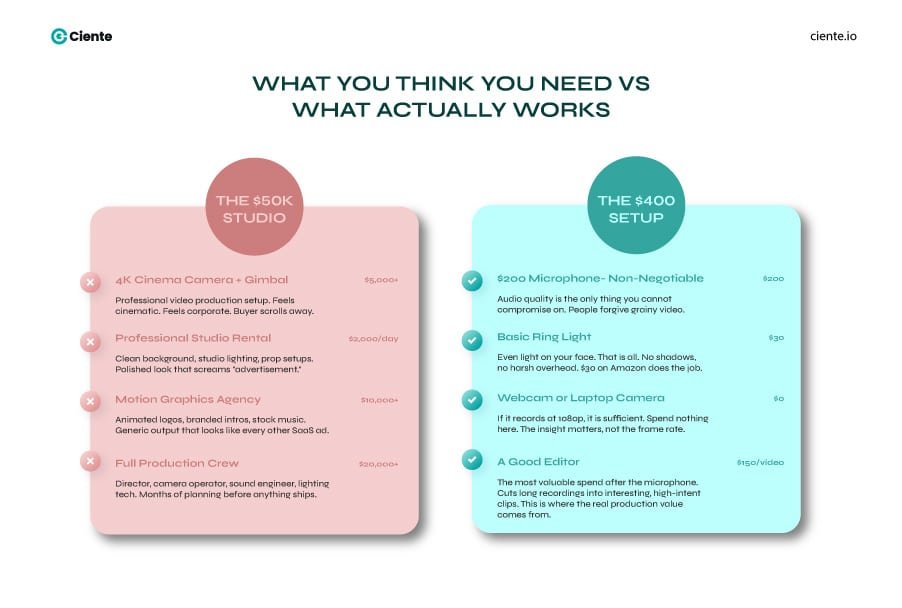
is a practical approach often overlooked in SaaS startup marketing. Many SaaS leaders hesitate to start because they think they need a professional studio with 4K cameras. It is a mistake.
High production value can actually make your ads feel cold and corporate. Some of the most successful creators use a simple webcam and a decent microphone.
The value is in the insight, not the frame rate.
However, you cannot compromise on audio quality. People will forgive a grainy video, but they will not listen to something with static or echoes. Buy a two-hundred-dollar microphone and a basic light- that is all you need to get started. Spend the rest of your budget on a good editor who can cut your long recordings into interesting, high-intent clips for your performance campaigns.
The choice isn’t between different ad platforms.
The actual choice is whether you will be a participant in your industry’s conversation or a spectator. Performance video gives you the reach to find new people; deeper content gives you the depth to convert them.
Begin with a video-first approach. Solve problems for free through your content. If you do this consistently, you won’t just grow your company; you will own your category.
How are you currently measuring whether your paid media is actually building trust with your target accounts?