Buyers are completing 70% of their research before talking to you. The content that wins is not the content that answers their questions. It is the content that answers the questions they have not formed yet.
The funnel model of content mapping is comfortable.
Awareness content at the top. Consideration content in the middle. Decision content at the bottom. Map each piece to a stage. Measure progression. Optimize. Track performance through defined content marketing KPIs rather than rigid funnel stages.
It is a clean framework built for a buyer behavior that no longer exists.
The modern B2B buyer does not announce their stage. They do not move through your funnel in the sequence you designed. They research privately, form opinions before they talk to anyone, and arrive at the first conversation already knowing things about your category, your competitors, and often your product that you did not know they knew. By the time they are visible to your sales team, 70% of the journey is done.
The content that influenced that journey, or failed to, was encountered in those dark months. In searches you did not know were happening. In conversations you were not part of. In comparison, pieces you could not see.
Content mapping in this environment is not about assigning assets to funnel stages. It’s about building a connected content ecosystem that surfaces when buyers search. It is about having something worth finding when a buyer’s research runs into the problem you solve.
The Truth About B2B Buyer Behavior
There is an uncomfortable truth at the center of this conversation.
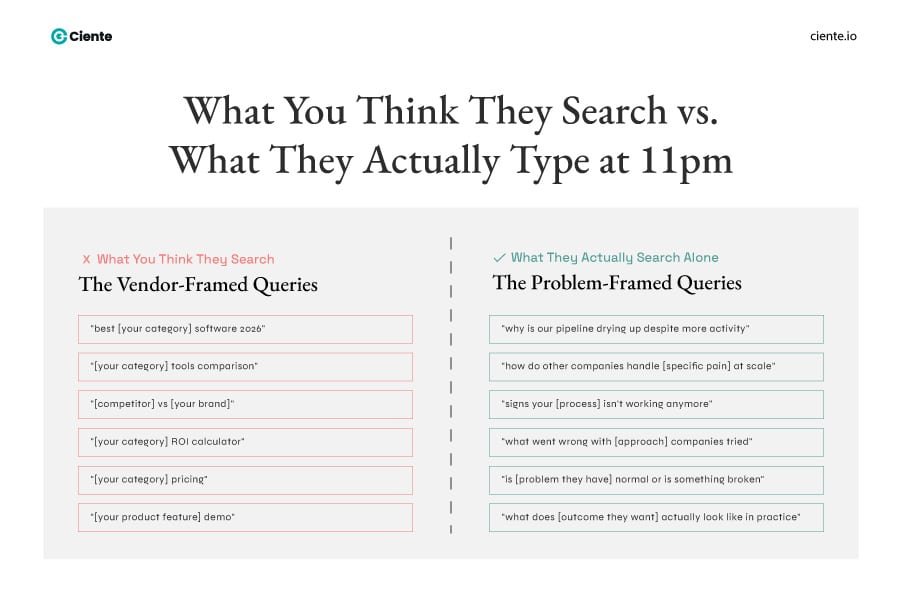
You do not know what your buyers are searching for when they are in active research mode. You know what you think they are searching for. You know what your SEO tools tell you they search for. You know what they tell you in discovery calls.
None of these is the same as what they actually type into a search bar, something modern content performance marketing tries to decode more effectively. at 11 pm, when they are trying to understand whether the problem they have been ignoring is as serious as they suspect.
The dark research problem is not a data gap you can close with better analytics. It is a fundamental feature of how serious B2B buyers operate. They do not want to talk to vendors while they are still trying to understand the problem. They want to think through it on their own terms, using sources that feel neutral enough to trust. They come to vendor conversations with conclusions already forming.
The question content mapping should be answering is not which stage this buyer is in, but how content aligns with the real buyer’s journey. It is: what are the real questions they are asking that they would never ask a vendor, and can we be the source they find when they ask them?
Understanding Your B2B Buyers for Strategic Content Mapping
Steve Jobs was not a market researcher in the conventional sense. His argument against customer research was not that customer insight does not matter. It was that customers describe the constraints of their current situation, not the possibilities beyond it.
Asked what they wanted before the iPhone, people described better phones. Faster, better cameras, longer battery life. Nobody described the category collapse that was coming: a device that made the phone the least interesting thing it could do.
The insight that made Apple’s product strategy work was anticipatory. Not what do customers want, but what would they want if they understood what was possible? What problem are they tolerating right now that they have accepted as permanent that does not have to be?
Content teams applying this thinking stop asking what questions buyers are asking and instead rely on structured content classification to map deeper intent. and start asking what questions they should be asking. What does the buyer know about their incomplete problem? What assumption are they carrying that will cost them if they do not examine it? What is the category conversation missing that would change how they think about the decision?
The content that answers this is not built from keyword research. It is built from a deep and honest understanding of what it feels like to have the problem your product solves, before someone knows that a solution exists, before they have the language to search for it precisely.
This is old. It is what good editorial has always done. It is what the best trade publications built their authority on for decades. The insight arrived before the reader knew they needed it, and because it arrived that way, the publication became the place they returned to when the need became concrete.
The problem with ROI calculators and interactive tools
ROI calculators are useful at one specific moment, and measuring their impact requires a clear understanding of content marketing ROI. When a buyer already believes in the solution and needs to justify it internally. They are a closing tool dressed up as a discovery tool.
The organization that leads with an ROI calculator is telling the buyer something about how they see the relationship. You calculate the return on our product. The implicit message is that the decision is about numbers, and the product’s job is to win on the numbers.
For a buyer who does not yet know whether they have a problem worth solving, this is the wrong conversation entirely. They are not at the calculator stage. They are at the what is this, why does it matter, should I care stage, and the ROI calculator does not meet them there.
Interactive content, webinars, benchmarks, and comparison guides are valuable formats, but they are only one part of broader content marketing strategies that drive results in B2B. They are useful to buyers who are already in active evaluation. They do not help buyers understand whether an evaluation is warranted.
The old schoolbook of communicating a problem works because it addresses a prior need. Before anyone can evaluate a solution, they need to recognize a problem. Before they can recognize a problem, they need a framework for understanding their situation clearly enough to notice that something is wrong.
Content that communicates problems well does not describe problems generically. It describes specific symptoms in specific contexts in enough detail that the reader stops and thinks: “This is exactly what we are dealing with, and I did not have language for it until just now.”
That moment of recognition is worth more than any ROI calculation, because it creates the question. The calculator only answers questions that already exist.
Mapping content to what buyers actually experience, not what the funnel says they experience
Here is what a real buyer journey looks like in a complex B2B purchase.
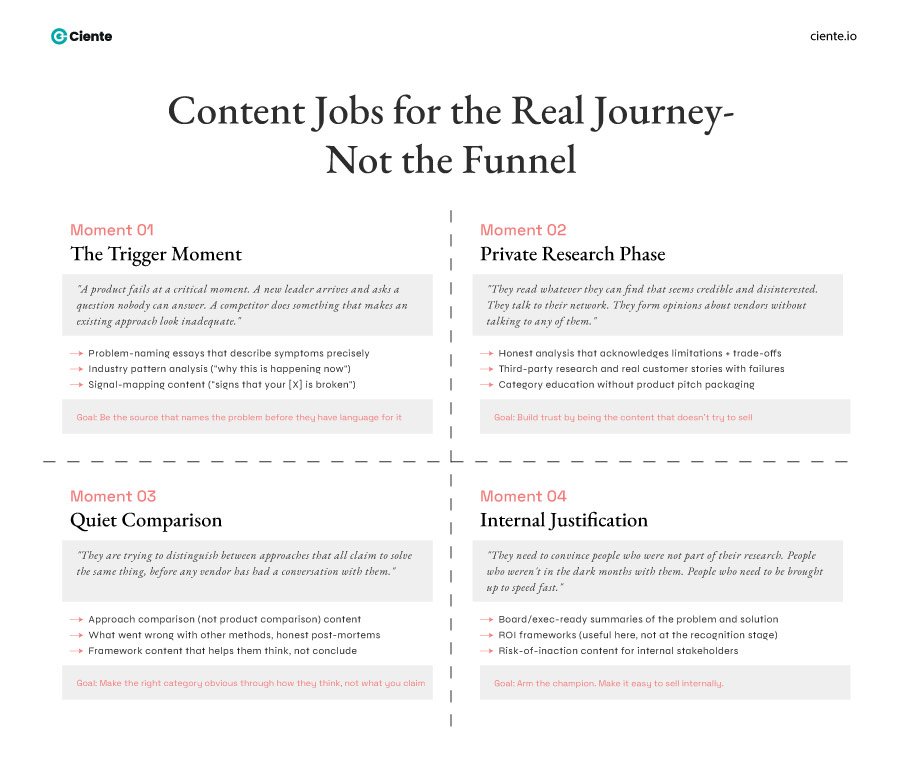
Something happens that makes a problem impossible to ignore any longer. A product fails at a critical moment. A new leader arrives and asks a question nobody can answer. A competitor does something that makes an existing approach look inadequate. A budget cycle opens up and a long-deferred problem finally has space to be addressed.
The buyer does not think: I am now entering the awareness stage of a purchase journey. They think: we need to figure this out.
They start researching. They read whatever they can find that seems credible and disinterested. They talk to people in their network who have faced similar situations. They form a rough sense of what the solution space looks like and which approaches seem legitimate. They develop opinions about vendors without talking to any of them.
At some point, weeks or months in, they surface. They fill out a form. They respond to an outreach. They show up at an event.
The content mapping exercise that most teams do assigns content to stages instead of aligning with evolving B2B content marketing trends. of a funnel that do not match this journey. The awareness content tries to create awareness that the buyer has already passed. The consideration content describes the evaluation criteria that the buyer has already developed independently. The decision content argues for a choice the buyer is already close to making.
The mapping that actually serves this buyer is built around the moments in the real journey. The moment of recognition when the problem becomes impossible to ignore. The private research phase when they are trying to understand the landscape before anyone can sell to them. The moment of comparison when they are trying to distinguish between approaches that all claim to solve the same thing. The internal justification phase when they need to convince people who were not part of their research.
Each of these moments has a content job. And the jobs look very different from awareness, consideration, and decision.
The content mapping that works in the dark
Buyers research privately because they do not trust vendor content to be honest about limitations, trade-offs, and failure modes. They go to communities, independent publications, peer networks, and anything that feels like it was not written to sell them something.
This creates a counterintuitive implication for content strategy. especially when scaling distribution through content syndication for lead generation. The content most likely to influence private research is the content that does not try to sell. The case study describes what went wrong and what the team had to change. The analysis acknowledges where the approach does not work. The framework that helps the buyer think about their problem in a way that makes the right category obvious, even if that category is not always yours.
This is not altruism. It is a calculated understanding of what earns trust in an environment where trust is scarce.
The organization that publishes genuinely useful analysis often builds authority through strong content marketing case studies. of a market problem, without packaging it as a product pitch, builds a different kind of authority than the organization that publishes polished content about how their solution is the best one. The reader knows the difference. The reader is always the one who decides.
B2B buyers increasingly want to be treated as intelligent adults who are capable of reaching their own conclusions. Content that respects that capacity, that gives them the raw material to think rather than the conclusion to accept, is the content that gets shared internally, that gets bookmarked, that gets forwarded to the colleague who is now on the buying committee.
The fundamentals of editorial content have not changed. Communicate a problem honestly. Give the reader something they can use to understand their situation better. Let them make the connection to why it matters to them. The connection they make themselves is stronger than the one you made for them.
How teams should actually adapt to the dark journey
The practical implication is a different kind of content planning process.
Start with the problem, not the product. What is the hardest, most specific version of the problem your product solves? Not the generic version in the category description. The version that a buyer who has been living with it would recognize immediately as true. That specificity is what breaks through in private research.
Map the questions that precede the questions your content currently answers. Your current content probably answers: what does this product do, how does it compare, and what is the ROI. Before those questions come: do we have this problem, is it serious enough to address, what are the approaches have organizations like us tried, what went wrong with those approaches, and how do we know if we are ready to make this kind of change?
Build content for those questions.
Treat content as institutional knowledge, supported by a scalable content supply chain that captures and distributes insights consistently. not as campaign output. The best editorial in any B2B category is built by organizations that have learned things about the problem that nobody else has documented. The insight that comes from working with hundreds of customers on the same problem, from watching what works and what fails, from developing a perspective on the market that is grounded in observation rather than aspiration. That knowledge is the raw material of content that does not get ignored.
Measure what happens in the dark using deeper content performance metrics beyond surface-level attribution. Attribution for content that influences private research will always be imperfect. But closing the gap matters. First-touch attribution undercredits content. Last-touch ignores everything that built the relationship before the form fill. Asking buyers in discovery calls what they read, where they researched, what they found most useful before they ever talked to anyone — this is qualitative intelligence that no dashboard provides but that tells you which content is doing real work.
A formula that has not changed
Experience and growth.
The buyer is trying to grow something. Revenue, capability, market position, and organizational health. They are experiencing a problem that is in the way.
Content that understands both sides of that equation, that earns the right to speak to the experience before it talks about the growth, is the content that gets read when nobody is looking.
The organizations that figure this out are not the ones with the best keyword strategy, but those adapting to emerging content marketing trends in 2026. or the most sophisticated content operations. They are the ones who understood their buyers well enough to answer questions those buyers had not yet learned to ask.
That is the content mapping problem worth solving.