
Fintech seems like it’s all technology. But it’s about imagination that transcends this limited perception. And here are fintech marketing campaigns that prove it.
At its core, fintech marketing is like any other industry-specific marketing. The tech complexity and nitty-gritty in fintech oscillate. But the shell framework remains the same.
What’s true for traditional financial institutions is true for fintech- reliability, trust, and credibility. These are essential requirements for even the earliest adopters. Because the to-and-fro of money isn’t mundane.
This automatically makes fintech marketing not about marketing a fintech, but about meeting your customers where they want you to. And transparency isn’t just a marketing trend.
Traditional financial institutions are going to catch up. Digital adoption is becoming imperative. Not a nice-to-have, but a must-have. Transparency or any other elements mentioned above can’t be used as value propositions by fintechs for the long term.
But fintech isn’t done. The revolution hasn’t ended. And that’s the sparkle.
However, this isn’t being leveraged correctly. There’s a dissonance because most customers belong to a non-financial background. They end up feeling disconnected from the brand’s vision. And overexplaining only makes them feel unintelligent. It’s challenging to connect with the audience because, honestly, no one gets up in the morning to feel enthusiastic about balancing their checkbooks. It’s tedious and not all that entertaining. But the demand’s there because it’s imperative to our living conditions.
How do you make your audience feel excited about something so acutely banal?
You build a truly innovative fintech marketing campaign.
You primarily focus on the different stages of your buyer’s journey, and design your fintech marketing campaign around that. similar to how a full-funnel marketing campaign aligns messaging across awareness, consideration, and decision stages.
The Three Growth Stages of an Enterprise Fintech Campaign
Enterprise fintech campaigns fail because a great idea gets deployed at the exact wrong stage of the buyer’s journey. Or worse, deployed like that, the journey doesn’t even exist.
In this space, there are three distinct levels of campaign maturity. Each has a highly specific job to do, and blurring the lines between them is exactly where your marketing budget quietly vanishes.
Level 1: Presence, i.e., Getting on the Radar Before the RFP Hits
In B2B fintech, the shortlist is largely written before a formal evaluation even starts. Decision-makers carry a mental map of the vendor landscape built from analyst briefings, industry chatter, and peer conversations.
If you aren’t on that map, no amount of hyper-targeted, bottom-of-funnel ads will save you.
Level 1 isn’t about generating leads; it’s about generating presence. something often overlooked in traditional lead generation campaigns that focus heavily on immediate conversions.
Nuvei nailed this.
They knew their target enterprise accounts were structurally immune to standard SDR cold-calling. Their Ryan Reynolds campaign wasn’t just a vanity play for brand awareness- it was a calculated strike to get onto the mental shortlists that cold outreach couldn’t penetrate. At this stage, you measure success through share of voice, brand recall, and the caliber of inbound conversations.
Level 2: Relevance, i.e., Winning Over a Skeptical Buying Committee
Once they know who you are, your campaign’s job pivots from presence to relevance. That is where most enterprise brands trip up. They’ll build presence with a bold, distinct campaign, but the second a buyer enters evaluation mode, they abruptly default to dry product sheets and ROI calculators.
That whiplash is jarring, and it tells the buyer you don’t actually understand their day-to-day reality.
Think: you have to speak to the people who feel historically ignored by financial marketing. In an enterprise, that’s your IT Director or the skeptical Operations lead. If you only pitch the CFO, you ignore the exact people who will quietly kill your deal.
Level 2 campaigns earn relevance by engaging the entire committee. An approach closely aligned with ABM strategies for fintech startups using AI and predictive analytics, where messaging is tailored to multiple stakeholders. That means running different messages across different channels simultaneously, solving specific headaches for specific stakeholders.
Level 3: Conviction, i.e., Unseating the “Good Enough” Incumbent
This is the stage most campaigns miss entirely.
By Level 3, the buyer already believes your product is superior. The barrier isn’t awareness or even preference- it’s the sheer dread of switching.
Enterprise buyers have learned to tolerate clunky legacy systems because the pain of change (migration nightmares, retraining costs, burning political capital) feels heavier than the promise of a better platform.
Here, you don’t need to sell harder; you need to de-risk the decision. something that can be strengthened by leveraging buyer intent data in ABM campaigns to understand readiness and hesitation signals. You need case studies from equally complex organizations, clear migration roadmaps that make the switch feel seamless, and peer validation that makes choosing you a safe, defensible bet.
Just like Monzo leverages consumer “love” to drive adoption, enterprise brands need reference customers, third-party audits, and implementation guarantees. It is the campaign content that turns a buyer who wants to switch into one who do.
It’s nothing new. There are brands out there that have mastered the art of fintech marketing campaigns. much like other successful SaaS marketing campaigns that broke through crowded markets.
And that’s precisely what we’re here to talk about. Fintech marketing campaigns that broke through the tradition with their bold moments. And made an impression on the industry.
Fintech Marketing Campaigns: Moments that Broke Through the Humdrum Routine of the Fintech World
Catching and engaging the attention of your ICPs is not a simple feat. which is why studying examples of great ABM campaigns can offer practical direction on what resonates with high-value accounts. Especially when it’s something so monotonous- you must be tactical enough not to rub them inappropriately. Or create more problems when you wanted to solve one.
What does that require? Positioning yourself as a credible and trustworthy fintech brand. something that strong B2B branding campaigns consistently reinforce across touchpoints. You can’t mix and match random marketing strategies and expect them to work. Fintech demands finesse and insight. It requires strategy and creativity along with the statistics and features.
We have five fintech marketing campaigns to inspire you. And to help you break through the insipidness of marketing such crucial tech-centric solutions.
1. Nuvei x Ryan Reynolds
Nuvei is a payments powerhouse based in Canada. It has an impenetrable audience base of large enterprise merchants- it’s very challenging to reach these accounts. But without a way to reach its potential customers, Nuvei knew it would lose its market positioning.
The company had to find a way out of this conundrum. And the solution was quite unorthodox.
Nuvei stepped into influencer marketing.
Yes, it seems ambitious for a fintech company. But the point is that it actually worked. Nuvei, a Canadian platform, would now have to choose an influencer who would be its poster child and propagate its brand story through the most impactful means.
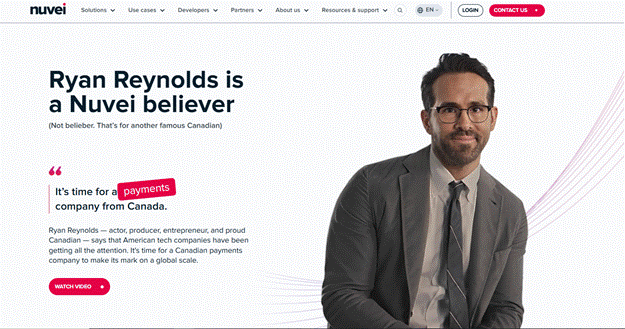
It chose a Hollywood A-lister: Ryan Reynolds. Known for his humour and quirky demeanor. Actually, it was Reynolds who invested in his homebound brand. As part of the deal, he became part of Nuvei’s ads.
Source: Nuvei
These ads became the talk of the fintech world. Because of its unique intersection of a B2B brand like Nuvei and Reynolds’ B2C storytelling method. He had complete control over the ads and the content, which allowed him to display his humor.
The impact?
“Huge. Especially on brand awareness,” shares Alexandra Bucur, Nuvei’s Head of Content Marketing.
They could reach publications that were difficult to receive unless you paid. SDRs’ job became a easier because now they could use Reynolds as the opener. And they had millions of views, that’s impossible without paid ad channels.
It didn’t come down to leads and sales for Nuvei. But the awareness that it brought? That had long-term effects on Nuvei’s brand positioning.
Maybe it’s not always about the numbers. But about creating memorable impact.
Nuvei made an unconventional call by borrowing a rather B2C tactic. But their logic was flawless- they knew that the business was struggling to get SDRs through the door. Engaging hard-to-reach enterprise accounts was challenging. Nuvei knew it was facing an awareness pain.
Unlike other B2B brands, it didn’t try to create more whitepapers and thought leadership content. It chose a lever that solved the specific problem of awareness and visibility. Ryan Reynolds gave them that leverage.
2. Your Way In by Revolut
Revolut is as ambitious as it was years ago. It aimed to become the leading digital banking platform globally.
In 2022, Revolut teased a special marketing campaign to “reach” each UK consumer wherever they were at home, outdoors, and online. It sought to meet its potential customers wherever they were. And that was quite a strategy.
Source: YouTube
Your Way In was Revolut’s most significant brand awareness omnichannel campaign. And it made substantial splashes because the brand hadn’t published campaigns across such a scale.
The marketing strategy revolved around a unique message: financial inclusion. It spoke directly to the financial underdogs, not experts. For example, one of the clips illustrated a woman trading on her phone in a bathroom. And then the wall breaks and collides with a room full of traders.
Revolut challenged financial stereotypes with this campaign. The rooms that were previously too difficult to crack? Cryptocurrencies? Trading? Investing? The most rewarding opportunities were only accessible to some segments.
Revolut wanted to show its audience that it was possible to enter these “closed off worlds of money.”
As ordinary characters (or regular people) crash through these barriers, the digital banking services platform illustrates them bursting through walls of financial arenas and through challenging financial situations by leveraging the Revolut app.
This campaign worked because the time was right. As the cost of living surges, ordinary people want more channels to gain confidence, financial advantages, and financial freedom.
Revolut understood the timing. And it delivered the campaign, full of relevance. An approach that aligns with broader B2B fintech trends for 2026, shaping customer expectations.
The impact? It resonated because users could enter a world they hadn’t been in before.
Look at what made this fintech marketing campaign truly successful- it included those financially excluded. Omnichannel was merely the means; it wasn’t the real genius. Revolut spotlights a new chasm- with this campaign, it tried changing the mundanity of how the messaging truly feels for end users, i.e., it’s not truly meant for them.
This maps to the enterprise context. Your campaigns also need to target the non-CFO stakeholders they’re actively ignoring.
3. Monzo: “Money Has Never Felt Better.”
The anxiety of money management plagues us all. And Monzo wanted to be relatable.
Its “Money Has Never Felt Better” campaign was a humorous juxtaposition- published across OOH and a 60″ hero film. This campaign focused on two sides of the same coin: the good and the bad.
In a consecutive series of shots, the video illustrates what managing money generally feels like and how it feels with Monzo. It’s creative and built to highlight Monzo’s value proposition. The former is cold, stressful, unsatisfying, and even painful. Meanwhile, using Monzo feels warm, peaceful, and zen.
Source: YouTube
The imagery is commendable.
In one part of the film, money management feels like the middle of your workday, and you keep on banging your head on the keyboard. Meanwhile, with Monzo, it feels like learning Kung Fu to break through a wooden board with your head.
That’s hope. And the power of learning. And that is propagated through a bunch of juxtapositions. Anxiety with celebration. Screaming match with a loving moment. Cold with warmth. Failure with success. The list goes on and on.
The idea is simple. And it requires no further explanation. The campaign delivers Monzo’s message straightforwardly. reinforcing how UX design for fintech plays a key role in shaping emotional and functional user experiences. It’s placing Monzo under a bright light, but also showcasing that it cares about its users’ feelings.
“Leveraging us will dispel the discomfort that you feel in your daily lives.”
The campaign promotes Monzo’s solutions for customers. Not about itself and what it can do for them. Monzo’s VP of Marketing puts it quite simply- “
Across the country, money evokes a variety of feelings, usually stress, anxiety, and avoidance. However, our customers tell us that on Monzo, money feels different, so much so that they’re seven times more likely to use the word ‘love’ when describing us than any other bank.”
The Gross Error Fintech Marketing Campaigns are Making
You learn specific things from these three fintech marketing campaigns.
The messaging comprises a similar authoritative and informative tone across all channels- even if the customers at the end of the day are humans, i.e., those who feel and partake in critical thinking.
But fintech companies must grasp that not all buyers are CFOs. CFOs, Controllers, and Treasurers have financial literacy. But they’re just one segment of the buying committee. Most of them are motivated by financial business and operational needs. IT Directors, Ops, or even end users don’t entail in-depth financial knowledge.
Talking in terms that only make sense to your own brand can drive your potential customers away.
Most buying decisions is meant for problem-solving. It’s not about having the financial or technical acumen. Even fintech companies orchestrate solutions with non-financial users in mind. It’s not about who the buyer is, but the end users who will leverage the solutions down the line.
That’s why fintech requires storytelling. moving beyond tactics into crafting memorable marketing campaigns beyond mindshare that truly connect with audiences. Clarity in what they offer and merely presenting the same information isn’t enough. Your fintech campaigns rely on financial jargon neatly packed with ribbons- “zero fees” or “instant loans.” A pitfall often addressed in a solid fintech ad mastery guide. But these copies only end up feeling spammy.
There’s no real value- A tempting yet bare minimum offer.
Do buyers remember these statistics? They don’t need more reasons to make a purchase. They are scared of the investment that could turn meaningless. Your buyers aren’t simply confident in their decision. And that’s what you need to help them weather this dilemma.
They need reasons they shouldn’t hesitate. Leaning into the uncertain is scary. How do they know if these solutions will reap rewards? They don’t. But they need to move past the hesitation. And feel safe in the decision they’re making. And that’s a problem that the market is struggling with, not merely fintech.
Fintech Marketing Campaigns: What They Should Be
In a far-fetched scenario, your competitors have it all figured out. The top to bottom of fintech marketing. It’s all about presenting valuable information for them.
The same message circulates in the industry like a single meme. You laugh at it again and again until it loses its essence. That’s what happens with marketing messages. Your fintech company requires its own unique storytelling to penetrate the complexity and oversimplification.
Beyond the financial tidbits, you must humanize your brand. The brand-building front isn’t the maturity of your marketing operations aligning with market structures. It’s merely a single part. In fintech marketing, the emotional segment is always neglected, even though thought leadership for fintech often emphasizes human-centric storytelling as a differentiator. because, honestly, which business leader needs emotional gibberish?
That’s incorrect.
If you don’t instill storytelling across campaigns, you lose your customers. Product differentiation in fintech is at an all-time low. And you need a truly disruptive product to stand out. There’s only an incremental or marginal difference in solutions, such as Stripe v/s PayPal. Fintech’s true worth gets lost in all of the noise.
Your fintech marketing campaigns should revolve around empowerment- that’s what this digital transformation trickles down to.
Traditional financial institutions have neglected financial inclusion for the longest time. Especially in the domain of asset and wealth management. It’s time for fintech to change that. And that should reflect in their messaging.
The Core Pillars of a B2B Fintech Marketing Campaign
Simply mentioning a product doesn’t offer a clear notion of what buyers truly expect from marketing campaigns, especially in fintech. The solutions themselves are so complex- and with an increasing dissonance in marketing comms, it’s not easy for fintech solutions to build mindshare quickly and with impact.
The market is crowded- every fintech marketer realizes that. However, reports assert that new contenders pop up even with tight funding. These newcomers influence investor interests towards something new, changing the industry’s momentum.
This is the market problem. Adding on to it is the buyer’s problem. Buyers are changing almost disproportionately with the market, so businesses must change how they market to them, riding the waves for their own sakes as well.
For this, we must question- to what extent is the tech, i.e., the solution, the focal point? If we must talk about marketing, we obviously spotlight the solution launches in perspective, but it doesn’t negate why some campaigns succeed, and some don’t. Because B2B fintech is an entirely different beast to tackle.
So, if we’re building some core pillars for B2B fintech marketing campaigns, the requirements change. What might those be?
- The buying reality
- Content that the buying committee resonates with
- A “good” campaign for an enterprise setting
- What has changed more- the buyer or the market?
- The priorities
And then there are the core pillars:
1. Institutional Trust
Enterprise fintech buyers don’t approach your brand by evaluating whether they like it. Even if they do, the question is whether they can defend the decision confidently.
The distinction is often framed around the campaign messaging. B2C fintech brands build trust through relatability- warm tone, funny ad, and a relevant moment. Meanwhile, enterprise fintech brands must earn trust through institutional credibility. You name it- from compliance posture to integration depth, it’s the tooling and infrastructure that’s at the crux of all fintech worries right now.
Storytelling still makes a difference- but in how these campaigns make a risk-averse buyer feel confident enough to progress further.
Every campaign asset must ask: Does this reduce the buyer’s perceived risk?
2. Committee Fluency
Individuals never decide B2B fintech purchases. The buying committee today spans a CFO evaluating ROI to an Operations leader focused on implementation timelines. And it’s the end users who ultimately decide on the tech’s adoption.
Almost every fintech campaign dilutes all these individual voices and writes exclusively for just one. It’s usually the CFO because the budget is in their hands. But today’s fintech marketing campaigns must diverge. They must focus on these different voices and each of their pain points. It’s not just the right account, the right message at the right time, but also the right stakeholder.
Marketing teams must become more proactive in understanding each stakeholder’s objection and address it before blocking the deal in the conversion stage.
3. Applying Playbooks with Intention
The consumer fintech wins in this blog aren’t standard enterprise plays. Yet, they offer vital enterprise lessons.
Revolut realized their buying committee wasn’t just financial pros; it included the excluded and the hesitant who felt the system wasn’t built for them. In an enterprise, the parallel is that non-financial stakeholders- the IT Director tasked with a platform they didn’t ask for, or the Ops lead skeptical of another integration. A campaign speaking only to “financial authority” misses the people who can quietly kill a deal.
Nuvei’s Reynolds campaign is the ultimate example of deliberate borrowing: a B2B brand that diagnosed a structural awareness gap and used a B2C tactic- not because it was trendy, but because the conventional approach wasn’t solving it.
4. Coherence
Enterprise fintech deals don’t wrap up in a quarter. They close over months or years, navigating multiple stakeholders and shifting internal budget cycles. That is where most fintech campaigns structurally fail- they’re built for short-term noise, not long-cycle coherence.
A message that bounces between a product launch, a thought leadership push, and a demand gen sprint mimics chaos to a buyer tracking you across a twelve-month procurement process.
The campaigns that win in enterprise are those where a buyer encounters the brand at month one and ten and leaves with the same clear, consistent understanding of your goals. That coherence isn’t just a creative luxury. it’s also measurable through the right ABM metrics to measure your campaign success.
In the world of enterprise fintech, it is a strict competitive requirement.
Marketing Campaigns as a Growth Lever for Fintech.
The Real Challenge is Surviving Internal Dilution
The biggest trap in enterprise fintech marketing isn’t a lack of know-how. It’s the internal tug-of-war. Product teams, legal, and leadership all drag the campaign toward their own agendas, often impacting execution across channels like optimizing ad campaigns with Google Display Ads. resulting in Frankenstein content that breezes through internal approvals but falls completely flat in the market.
Marketers often ship jargon-heavy features simply because it’s what gets signed off.
The core problem is having the organizational courage to build campaigns for the actual buyer at the right level, without letting internal politics water down the message. And no campaign framework can solve that on its own.
For most investors and newcomers, fintech remains a sparkling diamond. When combined with the promise of digital transformation, the spark becomes brighter. And that’s what fintech is trying to master now- A balance.
In the midst of chasing the tech fever, this up-and-coming industry has forgotten a crucial aspect- storytelling. Storytelling with emotions. Fintechs might be great at underlining the how, but they aren’t that good at explaining the why.
Underneath all the layers of security, complex features, and algorithms, the story loses its meaning.
Numbers are easy to explain. But this has erased the human story. Fintech must bring this back.
Because numbers may stale. But human experiences and their stories don’t.