
Why Content Classification Matters?
Value-driven content plays an important role in attracting the target audience. How can classification enhance search rankings?
Brands publish a series of content to help customers with relevant information for navigating through the complex digital landscape. But, if the content is not structured properly, it can hinder the performance. Classifying any content has the potential to boost search rankings. Structuring content with classification improves how search engines index web pages, helping brands get better visibility.
At its root, content classification allows companies to organize and categorize content into meaningful groups. You can integrate relevant tags and keywords here to give the audience a clear understanding of what each content illustrates.
When we talk about content classification platforms, they indicate the process of classifying a document into one or more classes based on its content. Brands can select classes from a pre-established list a hierarchy of categories.
Content classification eliminates the stress of manual decision-making and automates information management. Brands can leverage the process to filter out irrelevant content that does not hold any business/customer value. The essential materials are sorted into relevant categories that can be easily accessed.
The classification process analyses documents, distills the main crux, and assigns a category. So, you do not just search for a single word or phrase. It helps improve accuracy since the system adapts to the unique nature of your business. Blog content classification works by identifying different categories from the examples that you provide. When the system receives feedback, it adjusts in real time and implements any corrections made. Classification accuracy must be adjusted to the changes in your business.
Types of Content Classification
Brands can select among two main types of classification: rules-based and machine-learning automation. The choice depends on factors: content type, audience, and end goal.
Rules-based classification
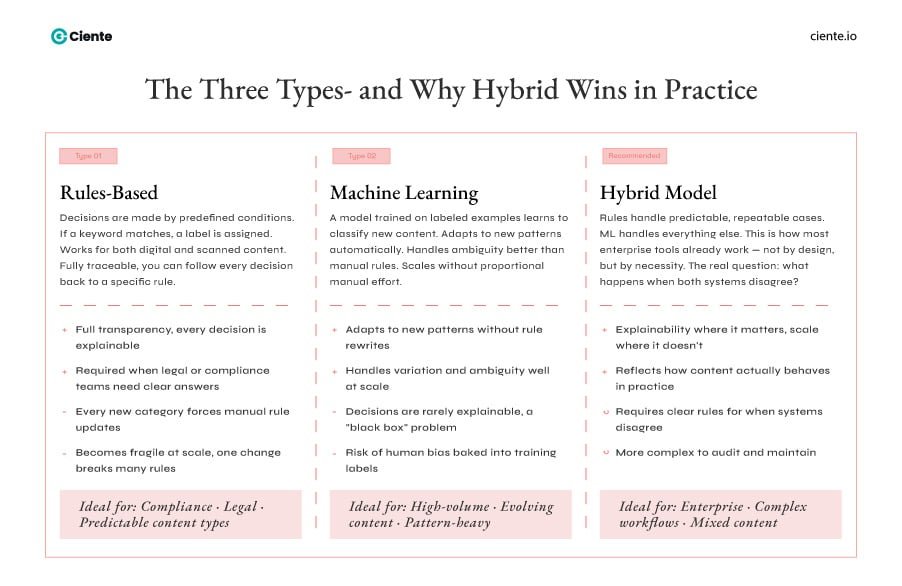
This type of document classification works for both digital and scanned content. Rules-based classifiers, as the name suggests, are rules-oriented for classifying content. It is based on predefined rules that analyze specific features within the content. For example, there could be a set of criteria to label certain services or offerings based on a keyword used to identify them. Although simple, rules-based classification could seem restricting and confusing. Brands need concrete plans to label and distinguish content, improving the structure of this system.
Machine Learning Automation
Machine learning is evolving rapidly, and its applications have extended to content classification. B2B companies can now harness the power of this technology for intelligent automated blog content classification. This approach focuses on developing a machine learning-based model involving collecting training data. Labeling data improves classification efficiency. However, there may be a risk of human judgments interfering with these labels. To avoid this interference, brands must use behavioral data to keep track of possible judgments.
The Third Content Classification Type That Goes Overlooked: Hybrid Models
Most articles explain content classification as a choice between rules-based systems and machine learning. That distinction sounds clean, but it rarely holds up in real workflows. Teams don’t operate at extremes- they combine both approaches, often without planning to.
Rules-based systems feel reliable because they make decisions visible. You can see what triggered a classification, and you can trace errors back to specific rules. That control matters when teams like legal or compliance need clear answers. But over time, this approach creates friction. Every update- new product, campaign, or category- forces someone to adjust the rules. At scale, teams spend more time maintaining logic than managing content.
Machine learning removes that burden. It adapts to new patterns, scales easily, and handles ambiguity better than manual rules. But it introduces a different problem. When the model makes a decision, it rarely explains why. That gap becomes an issue the moment someone asks for justification.
Most systems resolve this by using a hybrid approach. Rules handle predictable, repeatable cases. Machine learning handles everything else. This setup reflects how content actually behaves. If you evaluate tools, don’t focus only on whether they use rules or ML. Ask what happens when both systems disagree. That answer reveals how the system truly works.
Once decisions come from multiple systems, the next question becomes clear: which decisions should you trust?
Why is a Hybrid Content Classification Model Significant?
Most guides stop at rules-based and machine learning, but real systems rarely stay in either category for long. Teams start with rules because they want control. They know exactly why something gets classified a certain way, and that clarity helps early on.
But as content grows, rules start to stretch. Every new category, campaign, or content type adds more conditions. What looked simple at first slowly turns into something fragile.
One small change can break multiple rules, and maintaining them becomes a task on its own.
Machine learning solves that scale problem. It handles variation, adapts to new patterns, and reduces manual effort. But it introduces distance. When a model makes a decision, teams often cannot trace it back easily. That becomes uncomfortable when classification drives workflows like routing, personalization, or compliance.
This is where most systems land- somewhere in between. They use rules where clarity matters and machine learning where complexity takes over. It is not a theoretical approach; it is what most enterprise tools already do.
If you are evaluating or building a system, the important question is not which approach to pick. It is how the system behaves when both approaches produce different answers.
That decision point defines how reliable your classification will feel in practice.
The Part Most Teams Miss: How Decisions Actually Flow
Once classification starts running at scale, the real challenge is not labeling content- it is deciding what to do with those labels.
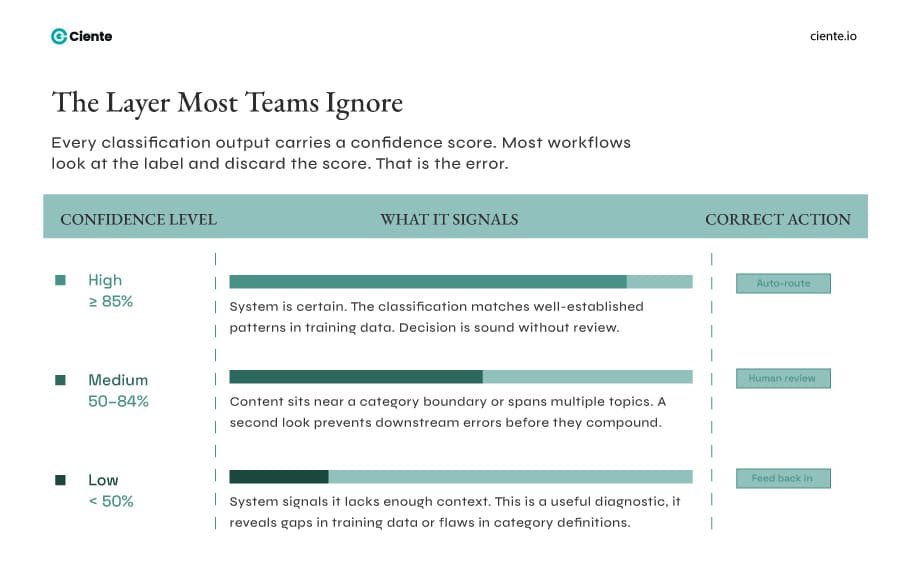
Every classification system produces a label and a confidence score. Most teams focus on the label and ignore the score. That limits the system’s effectiveness.
The score asserts how certain the system feels about its decision:
- When confidence is high: Move forward without hesitation.
- When confidence falls into the middle range: Pause and review the content.
- When confidence is low: System signals uncertainty. That signal highlights gaps in your data or flaws in your categories.
Many tools already provide this information, but most workflows misuse it. Teams that build processes around confidence levels catch errors earlier and improve faster.
Human review at low-confidence stages strengthens the system- it doesn’t weaken it.
Once you start using confidence to guide decisions, another limitation stands out. Sometimes the issue isn’t uncertainty- it’s forcing the system to choose only one category.
Every classification output carries a level of certainty, even if the system does not make it obvious. Treating all outputs the same creates risk. Some decisions are clear and can be made instantly. Others need a second look. A few signals that the system does not have enough context yet.
When teams start separating these cases, workflows become sharper. High-confidence outputs move automatically. Uncertain ones get reviewed. Low-confidence cases feed back into improving the system. That creates a loop where the system keeps getting better rather than repeating the same mistakes.
This approach also reduces friction between teams. Instead of questioning every classification, teams focus only on edge cases. Over time, trust builds- not because the system is perfect, but because it handles uncertainty in a visible way.
Ignoring this layer turns classification into a black box. Using it turns classification into a system you can actually manage.
why content classification is important.
We have enlisted some major points highlighting why brands must classify content-
- Enhanced User Experience: Well-structured content makes it easier for readers to find relevant insights.
- SEO Advantages: Search engines favor structured content, increasing the chances of higher rankings.
- Improved Engagement: Readers are more likely to explore your blog when they can easily navigate it.
- Automation: Categorize your content automatically.
- Flexible & Customizable process: A flexible system allows brands to comply with content classification requirements.
- Cost-efficiency: An advanced content classification platform will help avoid storage expenses by saving only necessary information.
Some tools that help with content classification
There are several tools available to assist in managing blog content classification. Content classification is managed with efficient tools that simplify categorization. For example, Trello is great for visualizing content plans and tracking progress. Google Analytics is another example that provides insights into how users interact with your content, helping you refine your strategy.
Then, there is Evernote, an all-in-one tool for capturing, organizing, and sharing notes related to your content.
The tool you choose to integrate will depend on the type of content you are dealing with and the content strategy you are implementing.
Step-by-step guide for acing the classification
Content classification offers the power to improve SEO to great lengths. But how do you ensure its effectiveness?
Follow these pointers to skip the hurdles and seamlessly navigate through this process.
Define Your Categories
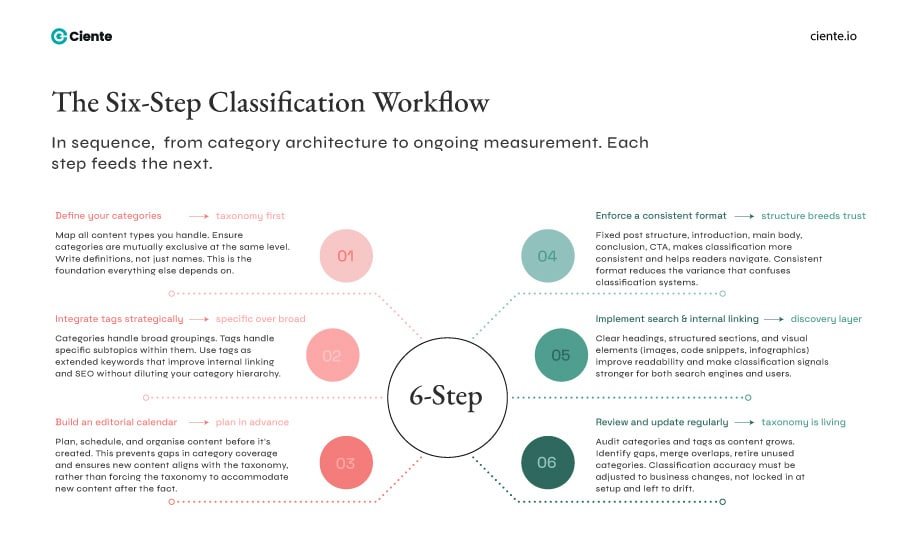
The first step to classifying content is to run through different categories that match the content you want to classify. It could be just blogs or include more than one form of content. Brands must ensure that they are open to including multiple posts while being specific to offer clear direction. For example, you could go for Digital Marketing: SEO, Social Media, Email Marketing, Content Marketing KPIs.
Strategically Integrate Tags
Although categories are about broad groupings, tags are best suited for more specific topics that fall under those categories. Many types of tags can be used on websites to improve classification and search ranking. When considering tags, use them as keywords that help further classify your posts.
For instance, while administering sites, you can typically add tags for meta, title, header, and blog post. You can tag single words or phrases. If words like news, events, awards, etc. are used for category headings, then tags should include the major industries you serve and the services you offer. Tags work best for projects, employees, recruiting, and anything else that may apply to multiple posts.
Here is another example- if you have content under the category of social media, tags like Instagram, FB advertising, and content strategy will be ideal. Using tags appropriately can help in internal linking, thus enhancing user experience plus SEO ranking.
Create an Editorial Calendar
Have you experienced a situation where you want to deliver different types of content but have been unable to execute your plans? Well, that’s why brands need an editorial calendar. An editorial calendar enables brands to plan, schedule, and organize content in advance. This streamlines content delivery and ensures consistency but also spans across various content over time. Either create using Excel or PowerPoint or use suitable software. Consider using Trello, Asan, and Google Sheets to prepare an editorial calendar.
Integrate a Consistent Format
Consistency goes a long way in aligning with your brand voice and setting the tone of communication through content. A consistent format helps readers connect with the brand and the message you are trying to convey. You can use a fixed structure for posts, like beginning with a robust introduction and main body, ending with a conclusion, and including a CTA. A systematic flow helps readers know what to expect, making it easier for them to navigate your content.
Implement a Search Functionality
Search functionality is boosted with elements that attract an audience and enhance engagement. It could involve adding visual elements like images, infographics, and code snippets to enhance readability. Alternatively, components like clear headings and sections can be used to make content more systematic, giving it a better flow and readability.
Regularly Review and Update Categories and Tags
The demand for new content is constant, new materials are bound to be released. As more content gets added to the database, categories and tags require a periodic review. In the absence of this check, it may become difficult to keep track of whether the new content aligns with the strategy. Updating categories and tags ensures that all content remains organized while enabling you to identify potential gaps.
Multi-Label vs. Single-Label Content Classification: Know What You’re Solving
Content rarely fits into a single category. A single piece can span multiple themes without losing clarity.
Single-label systems force one choice. Multi-label systems allow multiple categories.
This choice shapes how your entire system works. Multi-label classification facilitates you to ask a better question: “What is this, and where else does it belong?” That approach improves discovery, search, and analysis. Users find content through more paths, and teams measure performance with more context.
If your team often debates the “right” category, your system likely restricts content too much. Even with the right setup, weak data will break the system.
Content Classification Only Works If Your Structure Holds- and Taxonomy Design
Most teams focus on tools, models, and automation. Few spend enough time on structure. That is where most problems begin.
Content classification depends on how clearly categories are defined and how consistently teams apply them. If categories overlap or shift without control, even the best model will produce inconsistent results. The system fails because the structure underneath it keeps changing. The system isn’t always weak.
Classification is about making content easier to find, connect, and act upon at its core. That only works when categories reflect how users actually think and search, beyond how teams internally organize content.
Strong systems treat taxonomy as a living layer. They refine, audit, and adjust it as content evolves. Weak systems treat it as a one-time setup and slowly lose accuracy over time.
If classification starts breaking down, the issue is rarely the algorithm. It is almost always the structure behind it.
Taxonomy Design Comes Before Any Tool
Your taxonomy defines how the system classifies content. If the structure is unclear, the system will fail regardless of the tool you use.
Strong taxonomies remove ambiguity. Categories at the same level should not overlap. Each category demands a clear definition, hence teams apply it consistently.
Taxonomies also need to evolve. Teams must add, merge, or remove categories over time without breaking the system. Most classification problems come from weak taxonomy, not weak tools. When teams fix the structure, everything else improves.
Once the foundation is clear, teams can measure performance effectively.
Evaluating the Impact of Classifying Content Assets
Most teams rely on accuracy, but accuracy alone doesn’t tell the full story.
Precision shows how often the system assigns correct labels. Recall shows how much relevant content the system captures.
A system that prioritizes precision avoids mistakes but misses content. A system that prioritizes recall captures more but includes noise. Teams must decide which tradeoff matters more based on their goals.
F1 score balances precision and recall, making it a stronger overall metric.
Teams must also test performance on new, unseen data. Testing on training data creates misleading results, hiding real-world issues.
Summing up
Brands spend hours figuring out the best strategies for amplifying content performance. We often miss the significance of classifying content and the difference it can make. A well-organized content form is pivotal for its success and reach. These blog content classification tips will help enrich the user experience, improve SEO, and drive more traffic. That said, classification is not a one-time task but requires continuous attention and adjustment to remain effective.