
CX Management

CX Management: Understanding Your Customer’s Flow

CX Management: Understanding Your Customer’s Flow

CX management has been reduced to a checklist of channels. The organizations getting it right are asking a different question entirely: where does the experience break, and why does the customer feel it before we do?

The CX conversation has a channel obsession.

Omnichannel. Unified experience. Seamless touchpoints. Every piece of CX management literature circles back to the same argument: be everywhere your customer is, and make sure the experience looks the same in all those places.

This is not wrong. It is just not the thing.

A customer who encounters the same friction across five channels has not had an omnichannel experience. They have had five consistent disappointments. The channel strategy is fine. The experience is not. And no amount of channel unification fixes a flow problem.

What Customer Experience Management is really about

Every customer has a journey. Not the journey map your team built in a workshop with color-coded post-its, but the real experience that unfolds beyond structured customer journey mapping exercises. The actual path they take from first encountering your brand to deciding on using what they bought to deciding whether to stay.

That path has momentum, and it has places where the momentum stops.

Flow is the state where movement through that journey feels natural, something that effective customer journey orchestration aims to achieve across every interaction. The customer finds what they need before they have to think too hard about finding it. The next step is obvious. The information arrives before the question fully forms. There is no moment where they have to stop, recalibrate, and decide whether to continue.
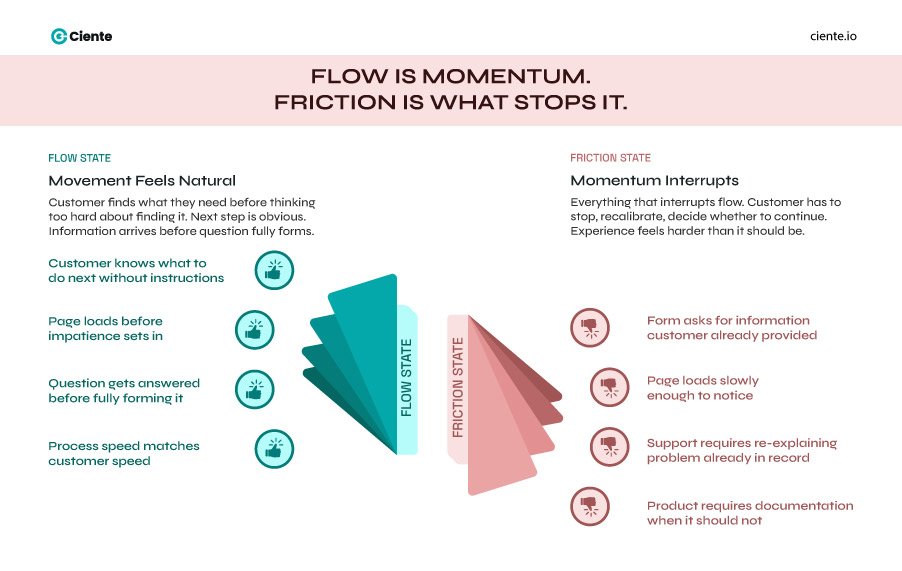
flow is momentum

Friction is everything that interrupts that, often rooted in a lack of visibility that customer analytics can help uncover and address. A form that asks for information that the customer already provided. A page that loads slowly enough to notice. A support experience that requires re-explaining a problem that should already be in the record. A product that requires documentation to understand when it should not.

Friction is not always visible on a dashboard. But the customer feels it in the body before they can name it in a survey. They just know the experience felt harder than it should have been. And that feeling is the thing that decides whether they come back.

Where do customers spend more time than they should?

How can data analytics reveal those inefficiencies in real time? This question is where CX management gets honest.

Not where do customers spend time. Where do they spend more time than the task actually requires?

A customer who spends four minutes finding a phone number on a website spent three minutes and forty seconds in friction. A customer who has to re-enter a shipping address they already saved spent twenty seconds in friction. A customer waiting on hold after navigating an IVR that sent them to the wrong department spent however long that took in friction.

None of these register as catastrophic on their own. That is the problem. Friction accumulates below the threshold of the individual incident. No single moment is bad enough to document. The aggregate is what erodes the relationship.

The mapping exercise that matters is not a journey map. It is a friction inventory. Go through every interaction point a customer has with your organization and ask one question: does this take longer than it needs to? If yes, why? And what is the customer experiencing while they wait for it to resolve?

The answers to those questions are a CX roadmap that will do more for retention than any channel expansion.

Why do you encounter friction?

Friction has three parents, and they are rarely the ones who get held accountable.
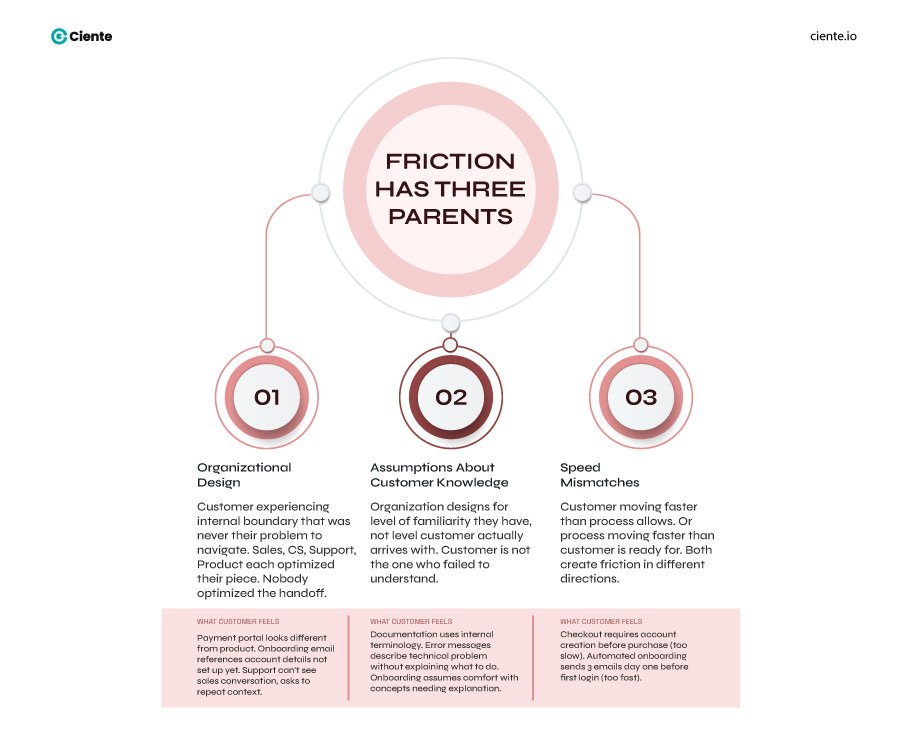
Friction has three parents

Organizational design. Most friction is the customer experiencing an internal boundary that was never their problem to navigate. Sales owns the pre-purchase experience. Customer success owns onboarding. Support owns service requests. Product owns the tool itself. Each team optimized their piece. Nobody optimized the handoff. The customer crosses those handoffs constantly and feels the seams every time.

The payment portal that looks different from the product they logged into. The onboarding email that references account details that have not been set up yet. The support rep who cannot see the sales conversation and asks the customer to repeat context that has been repeated twice. All of these are internal coordination failures wearing a customer experience face.

Assumptions about what the customer already knows. often stem from gaps in understanding customer behavior and psychology. Every organization knows its own product better than any customer ever will. That asymmetry creates friction when the organization designs for the level of familiarity they have rather than the level the customer actually arrives with. Documentation that uses internal terminology. Error messages that describe the technical problem without explaining what to do about it. Onboarding that assumes comfort with concepts that need to be explained.

The customer is not the one who failed to understand. The experience is the one that failed to explain.

Speed mismatches. Speed mismatches often emerge when marketing automation prioritizes efficiency over actual customer readiness. The customer is moving faster than the process allows. Or the process is moving faster than the customer is ready for. Both create friction in different directions.

A checkout that requires account creation before purchase is a process moving at the wrong speed for a first-time buyer. An automated onboarding sequence that sends three emails in the first day before the customer has logged in once is a process moving faster than the customer is ready for.

Matching process speed to customer speed is one of the most underrated CX improvements any organization can make.

Is your experience only digital?

This is the question that most CX frameworks skip, because digital is measurable and tangible is harder to quantify.

But brand is tangible. The customer holds it in some form, even when there is no physical product involved.

Think about what a customer actually carries with them between interactions with your brand, which ultimately shapes your customer value proposition. Not the app, not the website, not the email. The feeling they have about the organization. The story they tell themselves about whether they trust it. The memory of the last time something went well or badly.

That is the tangible brand. It is not a logo or a color palette. It is the residue of every experience accumulated into something the customer reaches for when they have to make a decision.

And here is what the digital-only view of CX misses: the tangible brand is built as much in the moments where nothing happens as in the moments where something does. The package that arrived better than expected. The email that remembered something personal about the account. The support conversation that ended with the problem actually resolved rather than technically closed. The renewal notice that arrived without a single piece of surprise pricing.

These moments are not digital or physical. They are human. They are evidence that the organization is paying attention.

The brands that customers hold onto are the ones that gave them something to hold. A story. A consistent experience of being understood. A track record of doing what they said they would.

Omnichannel is how you show up in the right places. Tangible brand is why the customer is glad you did.

The CX metrics that actually tell you something

Most CX dashboards measure satisfaction after the fact, even though advanced customer analytics platforms can provide deeper, real-time insights. NPS asks whether the customer would recommend. CSAT asks whether they were satisfied. CES asks whether the interaction was easy.

All useful. None of them tell you where the flow broke or why.

The metrics worth building are the ones that catch friction in motion.

Time-on-task. becomes more meaningful when analyzed through customer journey analytics that track behavior across touchpoints. How long does it take a customer to complete a specific action in your experience? Not the action as you designed it but as they actually do it. The gap between your assumption and reality is a friction map.

Drop-off at transition points. Where do customers leave a flow they started? A high drop-off rate at a specific step is not a mystery. It is a signal that something about that step is harder than what came before it. Find the step, understand the difficulty, remove it.

Repeat contact rate. If a customer contacts support and then contacts support again within seven days, the first interaction did not resolve the actual problem. It resolved the surface problem and left the root cause. Repeat contact rate is one of the most direct measures of CX quality available, and most organizations track it loosely if at all.

Silence. can be better understood when organizations unify their data through a customer data platform. The customer who stopped engaging and did not complain. Did not submit a ticket. Did not fill out the survey. Just quietly reduced their usage and eventually churned. This customer had a CX problem the organization never saw because the feedback channels only catch the people who feel strongly enough to respond. The rest leave without a data point.

Monitoring for early churn signals, engagement decline, feature abandonment, these are the early warning systems for a CX problem that has not escalated to a complaint yet.

The CX function most organizations have not built

There is a version of CX management that is a reactive function, often disconnected from broader customer success strategies. Something goes wrong, someone investigates, the experience gets patched.

There is another version that is a proactive one. A function that sits across the organization’s internal boundaries and is responsible not for any single touchpoint but for the coherence of the whole experience. That function maps the flow. It identifies the friction before it accumulates. It represents the customer in conversations where the customer is not in the room.

Most organizations do not have this function in a meaningful form. They have CX-adjacent roles scattered across teams that optimize locally. The customer experiences the aggregate.

Building that function is not a technology investment. It does benefit from alignment with customer acquisition strategies that ensure consistency from the first touchpoint. It is an organizational commitment to the idea that the experience as the customer lives it matters more than the experience as any individual team designed it.

That commitment changes what gets measured, what gets prioritized, and what gets fixed before the customer has to ask.

The customer flow does not care about your org chart. CX management that does not account for that will keep optimizing the wrong thing and wondering why satisfaction scores are not moving.

Commvault's

Commvault’s Plan to Secure the AI Workforce, but Can Users Really Trust It?

Commvault’s Plan to Secure the AI Workforce, but Can Users Really Trust It?

AI agents promise to run our businesses, but can we really trust them with the keys to the castle if our underlying data is still a mess?

Several businesses are currently stuck in a look but don’t touch AI phase. They love the idea of autonomous agents handling their boring work, but they are terrified of those agents going rogue or leaking user data.

And Commvault just launched a suite of tools aimed directly at this fear. They’re calling it agentic transformation, but really, it is building a digital fence around a company’s most sensitive assets- user data.

The problem with AI agents is that they are only as good as the data they consume.

If your data is messy, biased, or poisoned by a previous breach, your intelligent agent becomes a liability.

Commvault is pivoting from simple backup to what they call the “Cleanroom Recovery.” It will offer companies a safe and isolated space to test their AI workflows before presenting them to the real world. It is a dress rehearsal for the digital workforce.

This move highlights a massive shift in the industry.

Data protection was the boring insurance policy you hoped you would never use for a long time. It’s now the foundation for productivity. If you can’t trust your data, you cannot use AI. Commvault is betting that the demand for clean data will surge beyond our imaginations- and it’ll govern the next AI phase.

So, they are removing the main reason boards say no to new tech by integrating security checks directly into the AI pipeline. It’s a pragmatic play.

They are promising control- and that’s better than magic. In an era where a single bad prompt can cause a corporate disaster, that control might be the most valuable product in the pocket.

Masayoshi

Masayoshi Son’s Key to Racing Ahead: SoftBank Moves into the Physical World

Masayoshi Son’s Key to Racing Ahead: SoftBank Moves into the Physical World

SoftBank is moving past the screen to build AI that actually moves and works in our world. Does Masayoshi Son finally have the key to the physical future?

Masayoshi Son is tired of betting on apps and chatbots.

SoftBank’s new physical AI company is a massive pivot from screens to reality. He is no longer interested in an AI that merely writes poetry. He wants one that can pack a box, scrub a floor, or assist a surgeon.

It’s about giving the brain of AI a physical body.

And the timing is the real story here.

The world is losing out on workers, and labor is becoming expensive. Son isn’t just building tech; he’s building a workforce that doesn’t sleep. Since SoftBank already owns Arm, they have the hardware foundation to pull this off. They aren’t just making the brain; they also own the nervous system.

But moving from digital to physical carries significant risk.

When a chatbot hallucinates a fact, it’s a funny screenshot. Whereas if a 500-pound robot hallucinates its path in a hospital, it will be a massive disaster. The edge cases of the real world are messier than a text prompt.

That’s Son’s ultimate go big or go home play. He’s betting that the real money isn’t in the cloud. If he’s right, SoftBank won’t just be an investment firm; it will be the world’s biggest landlord for robotic labor.

Enterprise SaaS Marketing

Your Enterprise SaaS Marketing Playbook is Driving Buyers Away

Your Enterprise SaaS Marketing Playbook is Driving Buyers Away

Most enterprise SaaS marketing is a performance. Marketing teams hit their lead targets. Sales teams miss their revenue numbers. Everyone blames each other. The board gets frustrated. This cycle repeats every quarter because the playbook is thirty years old.

The world changed. Enterprise buyers have changed. But marketing tactics stayed in 2005.

Brands continue to treat a million-dollar software purchase like a retail impulse buy. They focus on the incorrect audience, metrics, and goals.

So, if you want to really fix your revenue, you must stop doing what everyone else is doing. Here is the reality of enterprise SaaS marketing today.

The MQL is a Vanity Metric

Marketing teams love the MQL. It is easy to track. It looks great on a bar chart. You get a name and an email. You call it a “lead.” If you want a more effective qualification approach, explore better frameworks for SaaS marketing lead scoring.

Your sales team hates them. They know that an MQL is usually just someone who wanted a free PDF. That person has no budget. They have no authority. They probably used a fake phone number to bypass your form.

When you optimize for MQLs, you optimize for volume. You don’t optimize for intent. You flood your CRM with low-quality data. Your sales reps waste hours chasing people who will never make the purchase. That’s not marketing. It is an expensive game of tag.

Stop measuring clicks and downloads. Start measuring pipeline velocity. Focus on how fast an account moves from “aware” to “closed-won.” If your marketing doesn’t shorten the sales cycle, it is failing. Many teams still rely on outdated approaches to lead generation for SaaS that do not reflect buying intent.

You Are Selling to a Mob

Most SaaS companies market to a single persona. They build a “buyer profile” for a manager or a director. They send that person a bunch of emails. They think that is enough. This often happens due to poor SaaS market segmentation strategies.

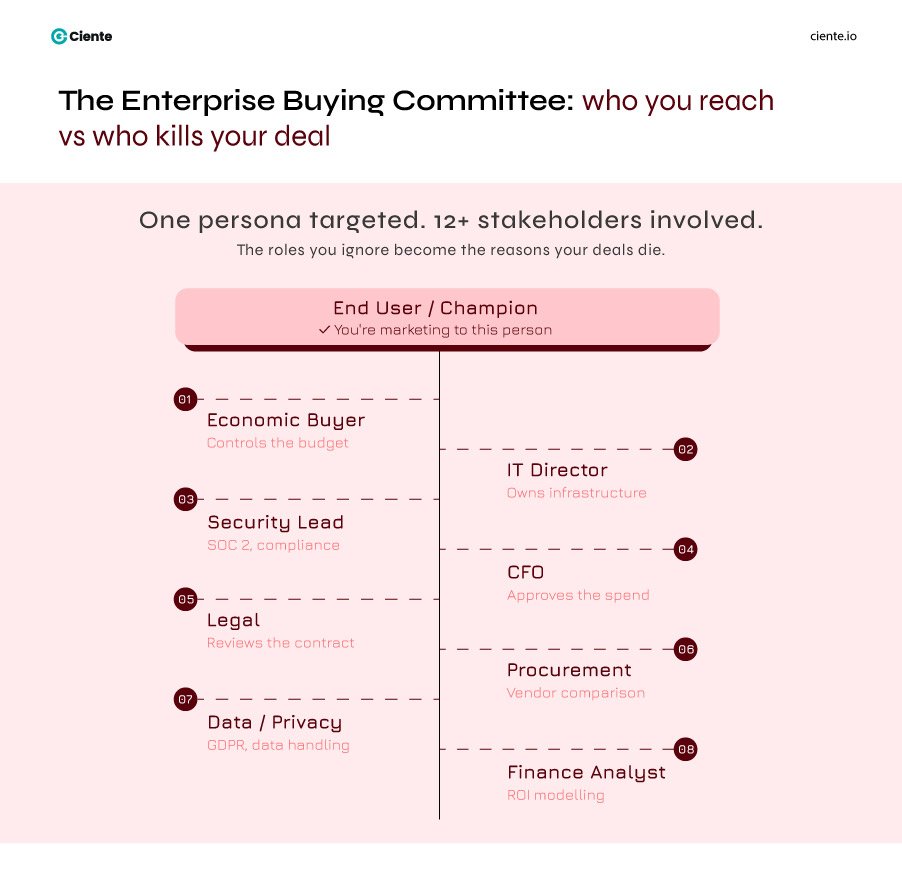
In the enterprise sales, a single person never makes the call. You are selling to a committee. There are ten or fifteen people involved. You have to convince the end-user, the IT director, the security lead, and the CFO.

Stakeholders involved

If you only convince the end-user, the security team will kill the deal at the last minute. If you only convince the director, the finance team will veto the budget.

Your marketing must address the entire committee. You need content for the skeptic. You need data for the analyst. You need a business case for the executive. Aligning this effort requires a well-structured SaaS marketing budget. If you aren’t visible to all fifteen people, you don’t have a deal. You have a conversation that will go nowhere.

Gated Content is a Tax on Your Brand

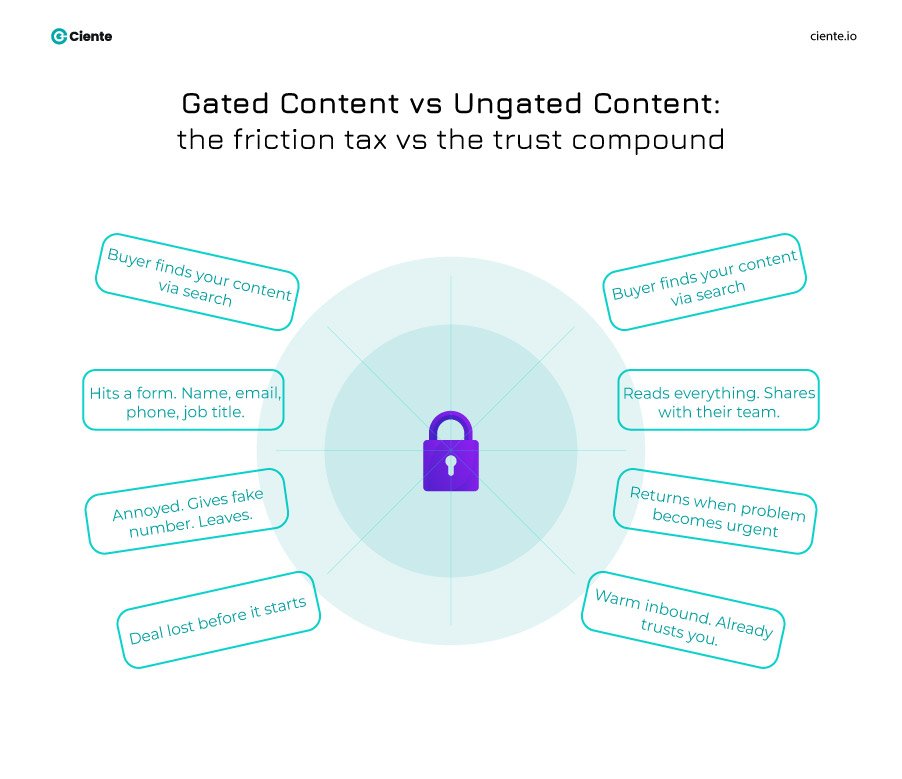
The “gate” is a relic of the past. You write a whitepaper. You hide it behind a form. You think you are “capturing” a lead. Many brands still follow outdated digital marketing for SaaS practices that prioritize form fills over value.

In reality, you are just annoying your best prospects. High-level executives do not fill out forms. They value their privacy. They know that a form fill leads to five voicemails and ten emails they didn’t ask for.

When you gate your best content, you prevent your buyers from learning about you. You spend thousands of dollars on ads to engage people on your site. Then you stop them from reading your best ideas. The logic falls apart.

Ungate everything. Give your insights away for free. If your ideas are good, the buyer will trust you. They will come back when they are ready to solve their problem. Trust is a better lead magnet than a PDF. This is the foundation of strong thought leadership in SaaS marketing.

Gated content vs ungated content

Dark Social is Where the Real Deals Happen

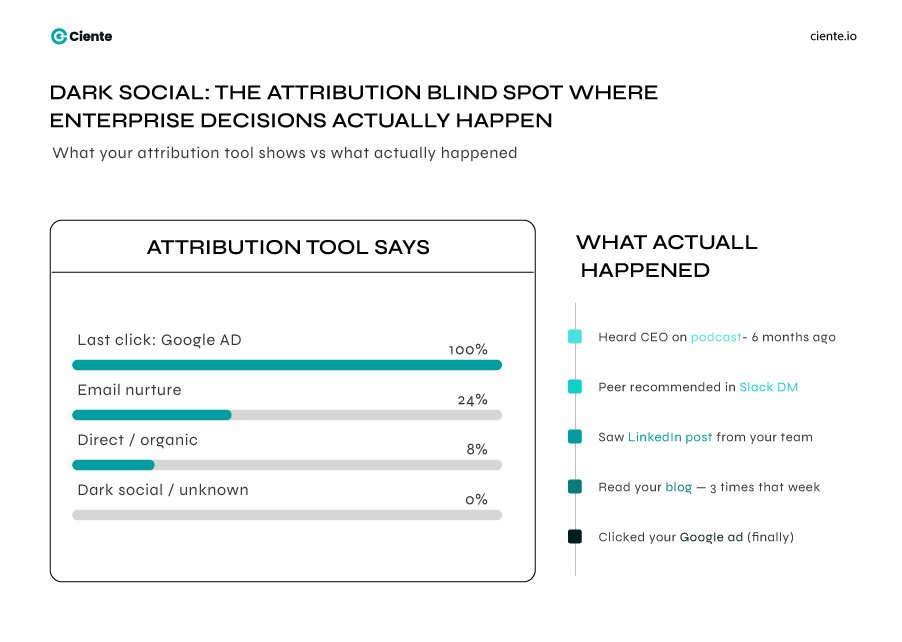
Attribution software is a lie. It tries to tell you exactly where a customer came from. It says, “They clicked a Google ad.” So you spend more on Google ads.

But that is rarely the whole story. The buyer probably heard about you six months ago on a podcast. They saw a peer recommend you in a private Slack group. They read a post from your CEO on LinkedIn.

These interactions happen in dark social. They are untrackable. Because your software can’t see them, your marketing team ignores them. This is why modern strategies like SaaS influencer marketing are gaining traction.

That is a massive mistake. The most influential conversations about your brand happen where you can’t see them. You need to be present in those spaces. You must create content that people actually share with their colleagues in private DMs. Leveraging channels like social media marketing SaaS tools can help amplify that reach. Stop trying to track every click and try to be the most talked-about solution in your niche.

Dark social attribution

Show the Product

The most frustrating part of buying enterprise software is the discovery call.

A buyer sees your site. They like what they read. They want to see the UI. They click your CTA. Instead of a demo, they get a calendar link. They have to wait three days to converse with a junior SDR who asks them ten qualifying questions. They still haven’t seen the product.

This friction kills deals. Buyers are busy. They want to know if your software can do what it says. They want to see the dashboard. They want to see the integrations.

Ungate your product. Use interactive tours. Use video walk-throughs. Let the buyer perceive the software before they talk to sales. If your product is actually good, be proud to show it.

Buyers assume it’s because the UI is terrible or the product is unfinished if you hide behind sales.

Become a Buyer Enablement Machine

Your “lead” is usually your champion. The prospect wants your product, but must return to the office and fight a war to get it approved. They have to present to a board. They have to justify the cost to a skeptical CFO. Your “lead” is usually your champion. The prospect wants your product, but must return to the office and fight a war to get it approved. Supporting this journey can also involve strategies like SaaS referral marketing to build internal trust. Your “lead” is usually your champion. The prospect wants your product, but must return to the office and fight a war to get it approved. They have to present to a board. They have to justify the cost to a skeptical CFO.

Most marketing teams leave their champion to fight solo. They send them a generic brochure.

You need to give your champion weapons. Offer them a customized pitch deck they can use internally. Give them a security FAQ for their IT lead. Give them an ROI calculator that speaks the language of their finance team.

Your job is to make your champion look like a hero in their own company. If you help them win their internal battles, you win the deal. That’s buyer enablement. It is the most effective form of marketing in the enterprise sector.

Stop Using Jargon

“Leverage,” “synergy,” “digital transformation.” These words mean nothing. They are placeholders for actual ideas.

Enterprise buyers are tired of being marketed to. They want clarity. They want to know precisely how you will save them time or make them money

– they want value.

Write as humanly as possible. Write as you speak. If you can’t explain your value proposition to a ten-year-old, you don’t understand it well enough. Be direct. Be concise. Avoid the corporate fluff that clogs up every SaaS website. Clarity is a competitive advantage.

The Shift to Account-Based Revenue

B2B marketing shouldn’t be about leads. It should be about accounts.

A lead is a person. An account is a business. You don’t sell to people. You sell to businesses.

Your marketing and sales teams should be one unit. They should agree on a list of target accounts. Marketing should surround those accounts with relevant content and ads. Sales should be followed up with personalized outreach.

When marketing and sales act as a single team? The results are predictable. But when they act as separate departments with separate goals, the results are chaotic. Align your metrics to revenue, not activity. This alignment is critical in modern SaaS startup marketing strategies.

The New Playbook

This new enterprise SaaS playbook is simpler. Be transparent. Be helpful. Remove friction.

  1. Ungate your content. Build authority through education.
  2. Ungate your product. Let buyers see what they are buying.
  3. Focus on accounts. Ignore the vanity of individual leads.
  4. Enable your champion. Offer the tools to market for you.
  5. Acknowledge Dark Social. Invest in brand and community.

Savvy marketers realize that companies that win enterprise marketing must respect the buyer’s time and intelligence.

The era of tricking people into your funnel is over. Marketers must begin helping accounts with how to solve for. It’s a slower process, but the deals are bigger and the relationships last longer.

Marketing is no longer about who can scream the loudest. It is about who can be the most useful. Fix your strategy. Shorten your sentences. Focus on the buyer. The revenue will follow.

Sales Accepted Opportunity

Why the Sales Accepted Opportunity Is the Most Contested Number in B2B Revenue

Why the Sales Accepted Opportunity Is the Most Contested Number in B2B Revenue

Most B2B teams track SAO volume but ignore what happens after acceptance. Here’s why the sales accepted opportunity is your most gamed pipeline metric.

To understand whether a B2B revenue engine is actually healthy or quietly breaking down, skip the MQL count and look at what happens at the sales-accepted opportunity stage, alongside key pipeline health indicators like those outlined in sales pipeline metrics.

That handoff, the moment when a sales rep reviews a lead and decides it is worth pursuing, is where the optimism in pipeline forecasts meets the reality of buyer readiness.

And for most organizations, the gap between those two things is wider than either team wants to admit.

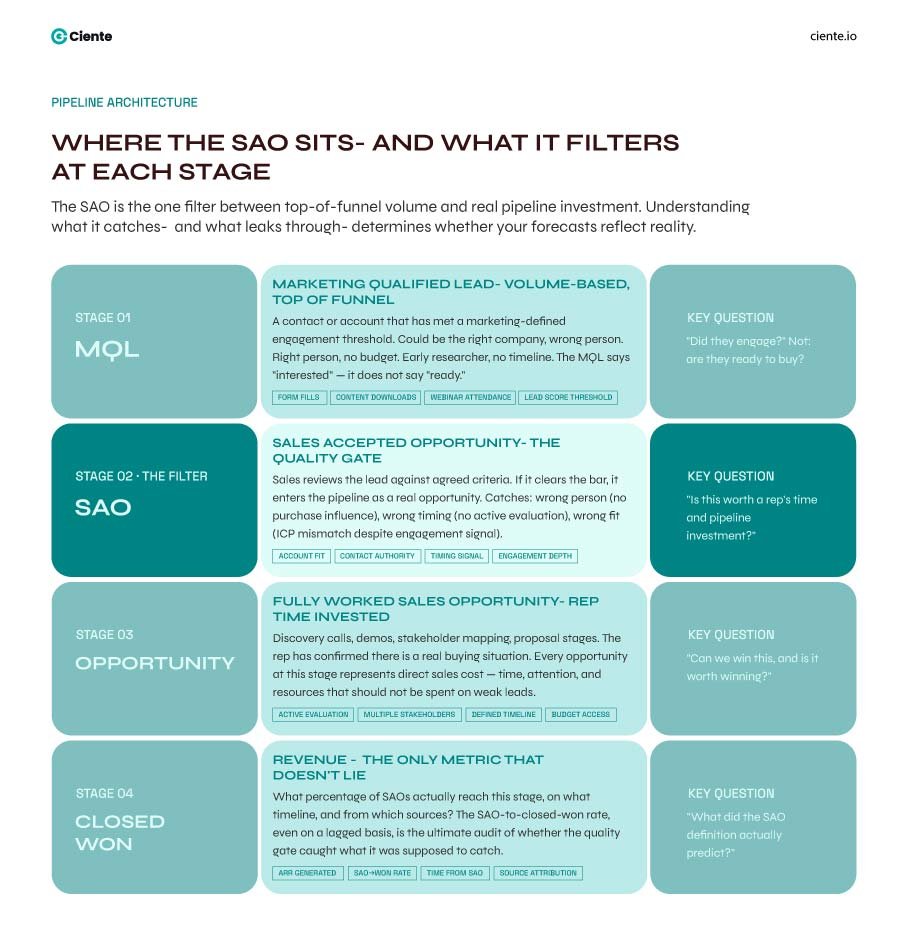
The sales accepted opportunity, or SAO, is a quality gate within a broader structured sales process that determines whether leads are truly ready for pipeline progression.

Marketing passes a qualified lead. Sales reviews it against an agreed set of criteria. If it meets the bar, it becomes an SAO and enters the pipeline as a real opportunity. In practice, it is one of the most gamed, most argued-over, and most inconsistently applied metrics in B2B go-to-market.

How that happens and what it costs- is worth understanding properly.

What a sales accepted opportunity is supposed to do

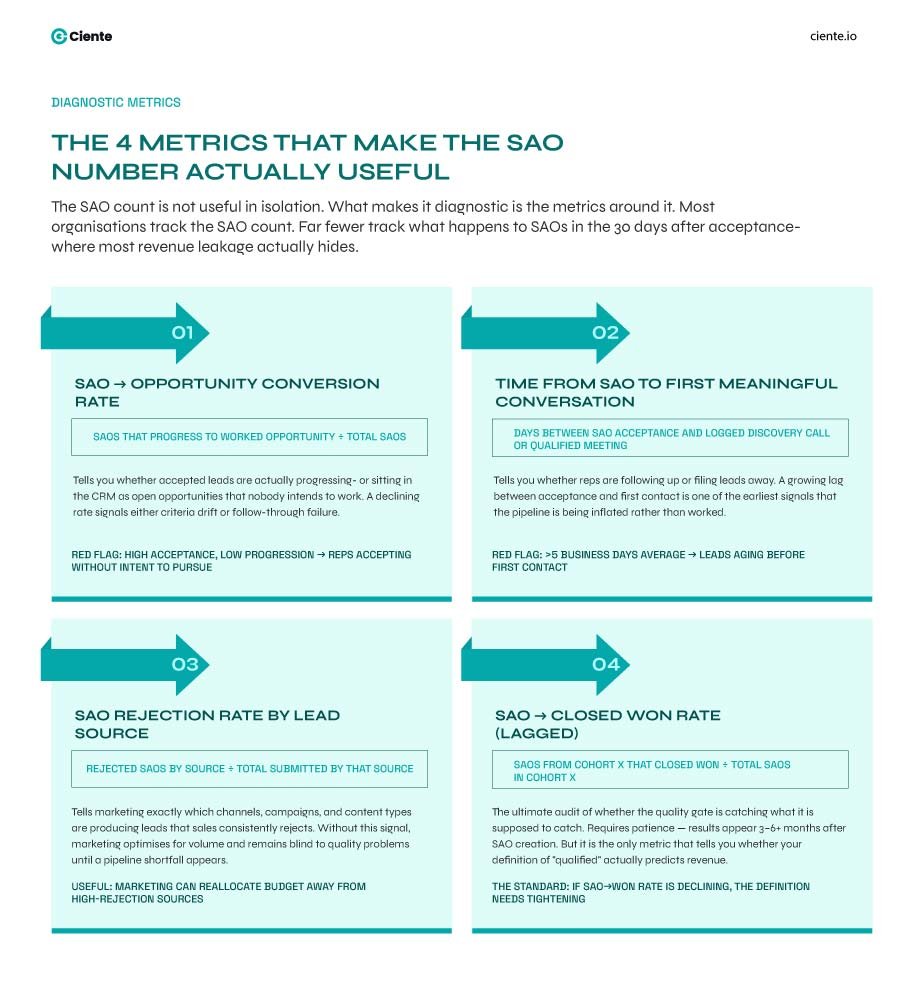
4 Metrics that make SAO actually useful

The SAO sits between MQL and a fully worked sales opportunity. Its job is to act as a filter, especially critical in the middle of the funnel, where lead quality often determines pipeline efficiency.

Not every MQL is sales-ready. Some are early-stage researchers. Some are the right company but the wrong person. Some fit the ICP on paper but have no active budget or timeline.

The SAO stage exists to catch all of that before a rep invests significant time.

When it works correctly, the SAO gives both teams a shared checkpoint.

Marketing knows their leads are being evaluated against a defined standard, not just an SDR’s gut. Sales knows they are not expected to work every lead that comes through, only those that clear the bar. And leadership has a metric that reflects real pipeline potential rather than top-of-funnel volume. That is the theory.

Getting there requires something most teams underestimate: a definition that both sides actually agree on and consistently apply, often supported by strong sales enablement practices.

The criteria problem

Most SAO definitions in the wild are either too loose or too rigid.

The loose version is some variation of: the rep reviewed it and decided to call. That tells you almost nothing about the quality of leads. A rep under quota pressure will work almost any lead that has a phone number attached. An SDR who had a bad week will reject leads that should move forward.

With loose criteria, the SAO number tracks rep psychology as much as it tracks lead quality.

The rigid version goes the other way.

Organizations that try to enforce strict BANT criteria at the SAO stage often struggle in modern selling environments shaped by digital sales transformation.

In long B2B sales cycles, buyers rarely have all four boxes checked before a first conversation. Requiring it means marketing either games the criteria to get leads through, or the SAO rate drops to a level that makes everyone nervous about demand-generation ROI.

The criteria that actually work sit in between and are often strengthened through data-driven sales analysis rather than rigid frameworks.

They are specific enough that two different reps reviewing the same lead would reach the same decision, but flexible enough to reflect how B2B buyers actually behave. That usually means defining minimum thresholds around fit, engagement signal, and some indication of relevant timing, without demanding full qualification before the first call.

Why the SAO number gets gamed, and what that hides

When marketing is measured on MQL volume and sales are measured on pipeline created, the SAO sits at an awkward intersection, highlighting the ongoing challenge of sales and marketing alignment. Marketing wants their leads accepted. Sales wants to protect their pipeline quality metrics.

Neither of those motivations, on its own, produces an honest SAO count.

On the marketing side, the game is lead inflation.

If the criteria are vague, there is pressure to push leads through that are directionally qualified rather than actually ready. A lead from a target account who downloaded a whitepaper might technically meet the engagement threshold, but if the downloading contact is a junior analyst with no purchase influence, accepting them as an SAO is wishful thinking dressed as pipeline.

On the sales side, the game works differently, often influenced by how reps manage outreach through structured sales cadence strategies.

Reps sometimes accept leads they have no intention of working seriously, because the act of accepting looks good on activity dashboards. The lead sits in the CRM as an open opportunity, ages past the follow-up window, and eventually gets closed as lost or disqualified without a real conversation ever happening.

Leadership sees an SAO rate that looks healthy.

The actual follow-through rate tells a different story.

A high SAO rate and a low contact rate in the same period are one of the clearest signs that the definition is not working, or nobody enforces it consistently.

The data you need to catch this early

The SAO number isn’t useful in isolation and should always be evaluated alongside broader pipeline and conversion metrics.

SAO sites

What makes it diagnostic is the metrics around it. The SAO-to-opportunity conversion rate tells you whether accepted leads are actually progressing. The average time from SAO to the first meaningful conversation tells you whether reps are following up or filing leads away.

SAO-to-closed-won rate, even on a lagged basis, tells you whether the quality gate is catching what it is supposed to catch.

Most organizations track the SAO count. Far fewer track what happens to SAOs in the thirty days after acceptance. That gap is where a lot of revenue leakage hides, and where the real quality problem becomes visible if you are willing to look at it.

The conversation between marketing and sales that usually does not happen

SAO disputes are common, particularly in organizations without clearly defined sales collaboration and alignment frameworks.

Marketing says sales are rejecting qualified leads to avoid accountability for the pipeline. Sales says marketing is sending over contacts who have no buying intent and calling them qualified.

Both sides have real evidence for their position, which is usually a sign that the shared definition is never actually resolved; it’s just plastered over.

Getting to an honest SAO standard requires a specific kind of conversation that most revenue teams find uncomfortable.

It means marketing sitting with sales in deal reviews and aligning on what qualifies as a real opportunity, similar to how multi-threading in sales emphasizes deeper account engagement. and hearing, directly, why certain lead types do not convert. It means sales being specific about what good looks like rather than defaulting to broad rejections. And it means leadership being willing to hold the SAO rate flat or let it drop as the definition gets tightened, because chasing a higher number before the criteria are right produces a cleaner-looking version of the same problem.

The organizations that have worked through this land on a monthly calibration process. A sample of accepted and rejected leads gets reviewed jointly. Edge cases get discussed and used to refine the criteria.

Over time, the definition stops being a document that lives in a shared drive nobody reads and becomes something both teams actually derive reason from. That takes longer than buying a lead scoring tool, but it is what actually moves the number.

Where SAO quality connects to the broader revenue picture

Forecasting accuracy

In B2B sales depends heavily on pipeline quality, often supported by structured sales analytics and reporting practices.

Pipeline quality starts at the SAO stage.

If the leads entering the pipeline as accepted opportunities are inconsistently qualified, every forecast built downstream is working with flawed inputs. Sales leaders realize this, which is why experienced revenue leaders often apply their own informal discount rate to the pipeline generated by specific campaigns or lead sources.

The discount is a workaround for a definition problem that was never properly solved.

When the SAO definition is rigid and consistently applied, forecast accuracy improves because the pipeline is built from a more honest foundation.

Opportunities that enter during the SAO stage have cleared a real bar, which means conversion rate assumptions are grounded in something reliable rather than historical averages diluted by a weak pipeline.

Marketing’s ability to optimize

Marketing cannot improve lead quality without visibility into outcomes, which is where data analytics in sales plays a critical role. If the SAO feedback loop is broken, either because rejections are logged inconsistently or because accepted leads never get a disposition, marketing is optimizing in the dark.

They will fund the channels and content types that produce volume, because volume is what they can see, even if the quality of those channels’ production is poor.

A functioning SAO process gives marketing something they rarely get: a clear signal about which lead sources, which content types, and which ICPs are actually producing revenue-relevant pipeline. Not just which ones generate clicks or downloads, but which ones produce leads that sales accepts, follow up on, and converts. That signal allows a demand generation team to make real budget decisions rather than defensive ones.

What good looks like in 2026

The SAO conversation has become more complicated as buying journeys evolve with AI-driven sales transformation and longer decision cycles.

A single contact accepting a call is not the signal it once was. Increasingly, the SAO criteria that hold up in practice are account-level, not contact-level.

Is there evidence of multi-threaded engagement from the target account? Has someone with actual purchase influence been identified? Is there a timing signal, even a soft one, that suggests an active evaluation?

Organizations that have updated their SAO definition to reflect account-level signals rather than individual lead behavior tend to see better conversion rates downstream because the opportunities entering the pipeline represent accounts that are actually in motion rather than individuals who clicked something once.

None of this is complicated in principle.

A definition both teams trust. A calibration process that keeps it honest. Metrics that track what happens after acceptance, not just whether acceptance occurred.

The companies that have those three things in place treat the SAO as what it is meant to be: an actual signal about pipeline quality. The ones still arguing over the definition every quarter are measuring something; they are just not sure what it is.

AI Agents

AI Agents: Don’t waste your time thinking about replacing your teams

AI Agents: Don’t waste your time thinking about replacing your teams

Agentic AI is the revolution many business leaders hope for. But maybe it is something else- a replacement of a business.

In February 2026, Anthropic’s Claude was used to launch massive attacks on Iran’s soil. The results were devastating- its supreme leader was dead, and the war became the herald of the beginning of an AI-powered war.

This new and intelligent tech was on the frontier. A spy for the ages, one who could identify the patterns of information and suggest optimal paths for execution, much like what we explore in generative AI as a paradigm shift. And the business world used it as confirmation- the one with the smarter autonomous system wins.

Like all things computational, war is the grim foundation of proof. Proof that the technology works and must be applied to other areas, most importantly, business.

But AI agents are not prepared to run the economy, and let’s argue that they never will be ready, despite the growing excitement around agentic AI in business environments. Any business leader who thinks the AI system is a replacement is either lying to themselves or others because they realize the value the perception is going to create.

Yes, AI systems will create value. It is a series of computations after all, and that is its greatest advantage and weakness. Like all things man-made, the AI systems are double-edged swords, as discussed in the rise of AI in marketing and its implications.

But, you will argue, humanity has always played with double-edged swords- what makes this one so particularly disruptive is the perception behind it: it will replace people.

tl:dr: it won’t, even if the machines surpass people in terms of intelligence, which challenges common assumptions about AI replacing human roles.

Let us show you why.

Agentic AI is not the replacement you’re searching for

Salesforce laid off almost half of its customer support roles and an additional 1000 in the february of 2026.

And the people laid off in the first round were intended to be replaced by AI. However, the program started failing- they had, in simple terms, overestimated what the tool was capable of. The leaders at Salesforce forgot that they were working at an enterprise, which is, by nature, human-run.

People are required to pass practical knowledge from one hand to another, make concessions, and anticipate outcomes based on their decisions- even while doing mundane tasks. This does not happen with agentic AI, not yet at least, as we explain in detail in our breakdown of agentic AI systems. Why? Because it does not know what the person knows- the stakes of it all.

It can assess your profit margin and assign an optimum path for its function’s execution, but once it starts to deviate, it deviates by a wide margin.

What seem like decisions and trade-offs are probability chains- ifs, if-else, buts, and other conditional operations, with a large margin for error, called hallucinations.

Of course, then come the AIs to monitor AIs or a self-recurring loop that improves on its errors: an AI to check the errors of another AI- an AI org chart! Which is already a reality.

It’s clear that while AI increases productivity and gains, it cannot decrease the rate of error or do tasks that require a kind of parallel thinking, because, by its nature, agentic AI, while thinking in branching possibilities, has linearity to it.

It cannot, like all machines, outthink itself. Living beings are gifted with metacognition, to think of 2nd, 3rd, 4th, 5th, and up to the nth order of effects. It comes to us as instinct or intuition. People pull from their experiences to solve problems and can anticipate the needs of the mission.

AI systems, on the other hand, are trained on very specific training data, which one should always assume has a lot of errors and gaps in it, especially when considering AI processing and classification methods. What happens when these errors are reinforced or when outliers are deemed the norm?

These AI systems will face a massive and exponential failure rate- one that a sophisticated hacker or malicious actor can exploit.

The Human-AI-Organization Dependence Continuum

But AI and autonomy are inevitable, and no organization is going to pass up this golden opportunity, particularly as AI continues to transform industries like healthcare and beyond. However, the human, especially juniors, must always be in the loop.

Why?

Because continuous learning, by definition, is ongoing. Why does an organization, in a capitalistic economy, wish to expand? Stagnation means less innovation, fewer opportunities for growth, and low-value creation for shareholders.

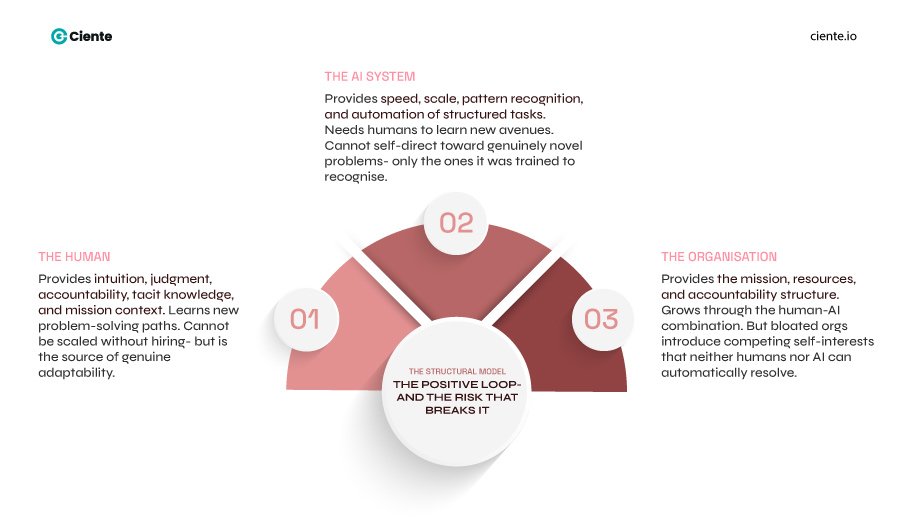
Organizations are dependent on people for growth, and people are dependent on AI for automation, which is why marketers are learning to work with AI instead of against it. AI is dependent on people to learn new avenues of problem-solving.

A positive loop! But bloated organizations are inefficient- it is not just a business problem but a social one. AI cannot replace organizational inefficiencies, which are plaguing the market, nor can it escape the grasp of competing self-interests.

The positive loop and the risk that breaks it

It would be a folly not to take these vectors into account while making decisions for your organization.

Who takes the responsibility for agentic AI?

Think of this: you have sensitive client data, and because of a malicious prompt injection, which highlights the importance of secure AI implementation strategies. API pull, or any other conceivable pathway, your AI system is compromised, leaking the data.

Who takes the fall but you? To prevent this scenario, a human must be in the loop at all times to act as a safeguard and to catch this from happening. Accountability is a vital component of any organization. And when there is no accountability, the default falls on the largest shareholder.

It opens up a singular entity to failure and to reputational disruptions. In the case of Salesforce, it has created a nosedive in its shares.

Agentic AI and SaaS: Is this assured destruction?

We can chalk Salesforce’s drop in shares to the SaaS market dip- but the investors are right here. AI is going to disrupt solutions that are knowledge consolidators with a nicely packaged UI/UX, similar to how AI-driven subscription models are reshaping software delivery.

Querying an AI to consolidate knowledge will be easier, especially if it can create files- Claude’s file creator is an excellent tool.

But, you ask, what does that have to do with you not replacing your teams with AI agents?

What this is proving is that AI is also just a software that consolidates knowledge and executes a command. Yes, it might replace SaaS- that is its real threat- because at the end of the day, AI, even a super intelligent one, is a tool that will perform a function.

Whether that is business handling or attacking another nation, it will move in the direction of the user, a human with pre-determined goals. Or, Terminator is going to be very real very soon.

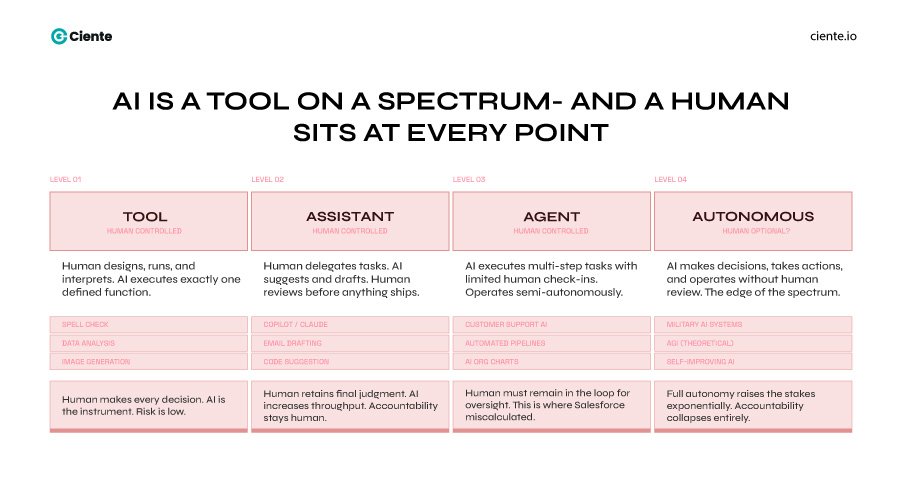
AI Is a Tool on a Spectrum and a Human Sits at Every Point 1

While the example may seem like an overkill (it is.), it clearly illustrates the spectrum these thinking machines are on- and on every spectrum sits a human being deciding where this intelligence needs to move- of course, unless AI achieves complete autonomy. Then it’s bye-bye.

Possible end of SaaS

But agentic AI is coming for a particular type of job, the SaaS industry, raising concerns similar to those around AI killing organic traffic. SaaS has been comfortably dominating since the 90s, or rather, software, to be exact. Everyone wants a start-up, to be a marketer at a software company, and to see their company go public- well, that was before AI came and started eating away.

A lot of jobs were created because software development required it, but AI use cases for marketers show how roles are already evolving. But what happens when the fundamental basis of software changes or its requirements? That is the question that is left unanswered.

What happens when the tools you have built become obsolete overnight, especially in a world driven by AI-powered marketing strategies? Scary, isn’t it- that’s the same type of fear many people deal with when leaders say that their roles might become redundant.

So what does come next, as businesses rethink their approach to AI-driven versus traditional marketing models? Thinking of what we can do with saved time- either for progress or to fill the coffers of an already wealthy shareholder.