OpenAI Is Bringing Sora into ChatGPT, and the Numbers Tell You Why
Sora’s downloads fell 45% by January. Now OpenAI is embedding it with ChatGPT’s 900 million weekly users. Convenience might be the only fix left.
Sora launched in September 2025 with real momentum. A million downloads faster than ChatGPT hit that mark. OpenAI had something.
Then January came. Installs dropped 45% month-over-month, consumer spending fell, and the app slipped out of Apple’s US top 100. For a product central to OpenAI’s multimodal roadmap, that’s a fast deterioration.
So, Sora is heading inside ChatGPT. Users will generate videos from text prompts in the same interface they already use daily. The standalone app stays live, but the real play is the embed.
ChatGPT carries around 900 million weekly users. DALL-E never built a standalone following either, but inside ChatGPT, it became something people reached for without thinking. That’s what OpenAI is chasing here- friction removal at scale.
The timing also runs deeper than Sora’s own metrics. ChatGPT uninstalls jumped nearly 295% day-over-day after OpenAI announced its Pentagon partnership in late February. The user base pushed back. Dropping a compelling new feature inside the flagship app is a reasonable short-term response to that kind of noise.
The harder question sits on the other side of the integration.
Moderation problems don’t shrink with a bigger audience but compound. The deepfake risk OpenAI manages at Sora’s current footprint becomes a structurally different challenge at 900 million weekly touchpoints. That part of this story deserves more scrutiny than it’s getting.
The bet is that the integration fixes retention. It probably will. Whether it trades one problem for a larger one is worth watching closely.
NVIDIA’s $2 Billion Nebius Bet Fits a Pattern Jensen Huang Has Been Running for Months
NVIDIA’s $2 billion Nebius deal is the fourth time it has written that exact check in three months. When your customers are your portfolio, the math deserves a harder look.
NVIDIA is putting $2 billion into Nebius, an Amsterdam-based AI cloud company trading on Nasdaq. The SEC filing shows NVIDIA acquiring roughly an 8.3% stake at $94.94 per share. Nebius shares jumped 16% on the news.
The number sounds significant. Pull back a month, and it starts looking like standard operating procedure.
NVIDIA committed $2 billion each to Lumentum and Coherent just last week, took a $2 billion stake in Synopsys in December, and backed CoreWeave in January.
Jensen Huang has quietly turned the $2 billion strategic investment into a repeating transaction- building a portfolio of companies whose core business involves buying NVIDIA hardware at scale.
That loop is drawing attention.
NVIDIA funds the customer, the customer buys its chips, the account expands, and the chip maker’s position elevates. Analysts are beginning to flag the circular dynamic between NVIDIA’s investments and its own revenue base. The model is elegant right up until external conditions shift.
Nebius itself gets something concrete from the deal.
The company has recently gained city council approval to build a 1.2-gigawatt AI factory across 400 acres of Missouri land- with power delivery expected late 2026.
NVIDIA’s partnership aims to build over five gigawatts of data center capacity by 2030. Early access to NVIDIA’s next-generation Rubin GPUs and Vera CPUs also lands Nebius ahead of competitors still running Blackwell architecture.
The neocloud space is rapidly getting crowded.
CoreWeave, Nebius, and a handful of others are all racing toward the same infrastructure gap. NVIDIA has money riding on several of them at once. Whether that reads as conviction or risk distribution depends entirely on how the next two years shake out.
Could Hitting Your SaaS Marketing Benchmarks Be the Worst Thing That Happens to Your Business?
Every SaaS company is chasing the same benchmarks. CAC payback, NRR, Rule of 40. What if optimizing for the median is exactly what’s holding you back?
Most SaaS leaders enter Q1 with a benchmarking deck and quiet confidence. The CAC payback period looks defensible. NRR is sitting just above 100%. The Rule of 40 is in range. By every standard measure, the business is performing.
But “performing” against median benchmarks is not the same as winning. And right now, in 2025, it might actually be the same as falling behind, especially for companies trying to apply generic SaaS growth strategies without understanding what actually drives top-quartile performance.
Here’s the thesis that almost every SaaS marketing benchmark report misses: benchmarks describe behavior across the whole market. They were never designed to tell you how the top of the market thinks.
The industry has turned a diagnostic tool into a directional one. When every B2B SaaS marketing team targets the same NRR threshold, the same CAC payback window, and the same Rule of 40 score, the benchmarks stop predicting outperformance. They start averaging it.
And as of now, the average is expensive.
SaaS Marketing Benchmarks in 2026: The Numbers Behind the Narrative
Let’s start with what the data actually shows in 2026, because it’s more uncomfortable than most benchmark roundups admit.
1. The median New CAC Ratio rose 14% in 2024, reaching $2.00.
This means the average SaaS company is now spending two dollars in sales and marketing to acquire one dollar of new ARR. In the bottom quartile, that number is $2.82. For every dollar of ARR those companies add, they’re burning nearly three to get it.
That’s not a growth motion. That’s a structural cash problem dressed up in pipeline language.
2. Private SaaS CAC payback periods now average 23 months.
Companies are operating at a loss on new customers for almost two years before they recoup acquisition costs. And 75% of software companies reported declining retention rates in 2025 despite increasing their spend.
More money in, less revenue staying. That’s the market most teams are benchmarking against when they call themselves “at median.”
3. Sales and marketing effectiveness have also deteriorated sharply.
Data from Lighter Capital shows SaaS companies are generating roughly half the revenue per sales and marketing dollar compared to the prior year.
The SaaS Magic Number, which is a measure of how much new ARR you generate per dollar of S&M spend, hit a median of 0.90 in 2024. You need 1.0 to break even. The top quartile is above 2.0.
Everyone else is subsidizing growth that isn’t growing fast enough.
4. Win rates tell the same story.
Gong’s analysis puts the median SaaS win rate at 19% in 2024, down from 23% in 2022. Against former customers and advocates, that number jumps to 49%.
And the implication is sharp: the market has made cold acquisition harder, and most marketing organizations are still pointing their budget at it rather than rethinking their SaaS performance marketing approach.
The SaaS Performance Gap Between Top and Bottom Quartile Is Widening
Here’s what most benchmark reports bury in the footnotes: the distance between top and bottom quartile performers has widened significantly since the post-2021 correction.
Top-quartile public SaaS companies now trade at 13 to 14 times revenue. Bottom-quartile companies trade at 1 to 2 times. That’s not a slight advantage. That’s a different asset class. The market is not rewarding companies that hit median benchmarks. It is dramatically repricing the ones that don’t clear the top quartile on the metrics that actually compound.
High Alpha’s 2025 SaaS Benchmarks Report is direct about the mechanism: companies that pair high NRR with low CAC payback nearly double their growth rates and Rule of 40 scores compared to peers with weaker retention or longer paybacks. It is the insight that benchmark summary articles keep skipping past.
It’s not about the individual metric. It’s about the relationship between metrics.
Consider what this means in practice.
Two companies, both at $20M ARR.
Company A sits in the top NRR quartile, i.e., above 106%. In the next twelve months, it will generate $4M in additional ARR from existing customers through expansion. Company B sits in the bottom NRR quartile, i.e., below 98%. It loses $1M to churn.
To reach parity with Company A, Company B now needs to acquire $5M in new ARR. That acquisition costs, at a $2.00 New CAC Ratio, $10M in sales and marketing spend.
Company B isn’t losing because it’s poorly run. It’s losing because it optimized for the median rather than the mechanism—a mistake that often appears when teams rely too heavily on standard B2B SaaS market strategy frameworks without adapting them to their retention dynamics. It hit the NRR benchmark- just the wrong quartile of it.
Why Targeting Average SaaS Benchmarks Creates a Strategic Trap
There’s a structural issue with how most organizations use SaaS marketing benchmarks. They use them to set targets rather than to understand the underlying forces that drive those targets.
Take the Rule of 40. It’s the most cited benchmark in SaaS finance- growth rate plus profit margin should exceed 40%. It’s a reasonable heuristic. But only 11 to 30% of SaaS companies achieve it in any given year, and the ones that do aren’t chasing the Rule of 40. They’re simultaneously compounding retention and acquisition efficiency.
The Rule of 40 score is an output. The inputs are what most benchmark discussions never reach.
The same logic applies to CAC.
They’re not outspending anyone. They’re compressing CAC. The benchmarks treat CAC payback as a fixed target—12, 15, and 24 months, depending on ACV. But what actually matters is whether the acquisition investment produces a good marketing ROI for SaaS companies over time. But the data shows that what determines your CAC payback is not your marketing channel mix in isolation. It’s the relationship between ACV, buyer concentration, and expansion motion. Companies with an ACV above $100,000 carry a median CAC payback of 24 months.
Companies with an ACV below $5,000 sit at 9 months. Benchmarking across both without that context is how you end up making the wrong strategic call with complete statistical confidence.
What Top-Quartile SaaS Growth Benchmarks Actually Look Like
The companies pulling away from the market in 2025 are not necessarily the ones spending more on marketing. They’re making structurally different bets.
AI-native SaaS companies under $1M ARR hit a median ARR growth rate of 100% in 2024. That’s twice the rate of horizontal SaaS peers. Some reached $30M ARR in 20 months, a trajectory that historically took 100 months.
They’re not outspending anyone. They’re compressing CAC payback through product-led acquisition and building NRR advantages through usage-based pricing, which delivers 10% higher NRR and 22% lower churn over traditional seat-based models.
Top-quartile companies in this cycle are also scaling leaner.
The median headcount among top-performing SaaS companies has dropped to 7, from 12 the year before. ARR per employee climbs sharply as these teams scale- companies above $100M ARR now generate $300,000 in ARR per FTE. The growth isn’t coming from bigger teams.
It’s coming from higher-leverage motions: events (ranked the highest-performing GTM channel across all ARR bands in High Alpha’s 2025 report), expansion into existing accounts, and AI-assisted workflows—similar to the tactics behind many successful SaaS marketing campaigns. that compresses the cost of non-differentiated work.
That’s the benchmark story that matters for decision-makers. Not whether your numbers are “at median.” But whether your strategy has any structural advantage over the companies sitting above you in the quartile distribution.
How to Use SaaS Marketing Benchmarks as a Strategic Tool in 2026
Here’s a framework shift worth considering before the next planning cycle.
Stop using benchmarks as targets. Start using them as diagnostic thresholds.
If your CAC payback is at the median, the question isn’t “are we okay?” The question is: what does our ACV, retention profile, and expansion motion have to look like for this to be structurally defensible? If the median New CAC Ratio is $2.00 and you’re at $1.80, congratulations! You’re still spending $1.80 to acquire $1.00 of revenue.
That’s not a moat. That’s slightly more efficient at an inefficient game.
The companies that will compound through the next 18 months treat retention as their primary acquisition channel. With win rates at 49% against former customers versus 19% against net-new prospects, the math is not subtle.
Your installed base is your highest-leverage growth asset. Most marketing budgets still don’t reflect this, even though strategies like SaaS referral marketing show how existing users can become powerful acquisition channels.
SaaS marketing benchmarks are useful. They’re not useless.
However, their usefulness is specific: they showcase where the average company is at the moment. They don’t tell you how the top of the market is built, what it’s optimizing for, or why the gap between quartiles is widening faster than it has since the 2022 correction.
The benchmark is not the strategy. especially when companies are simply copying tactics from competitors instead of developing differentiated approaches informed by competitive SaaS marketing analysis.
The relationship between metrics is the strategy. And right now, the relationship between retention and acquisition efficiency is the single most predictive indicator of whether a SaaS company is building durable value. Or just reporting a defensible number to a nervous board.
Know the difference. Then build toward the one that compounds.
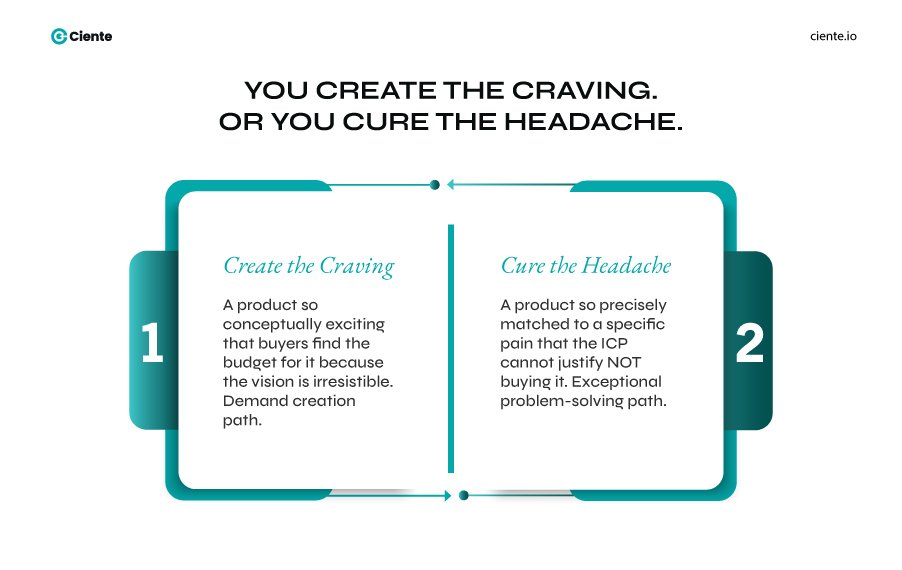
SaaS Product Market Fit: You Either Create the Craving or Cure the Headache
Product market fit is not a milestone you hit. It is a question you answer honestly. And the answer lives entirely inside your ICP, not your product roadmap.
Everybody is looking for product-market fit.
Founders obsess over it. Investors ask about it in every meeting. Marketing teams are told to go find it, like it is a thing sitting somewhere in a spreadsheet waiting to be discovered.
And yet most SaaS companies treat it like a vibe check.
Retention looks okay. NPS is fine. A few customers said they would be disappointed if the product went away. PMF confirmed. Moving on.
No. That is not it.
Product market fit is not a feeling. It is not a benchmark score. It is not something you declare in a board meeting and then stop thinking about.
It is an answer to one very specific, very uncomfortable question.
Why would someone who guards their budget like a bouncer at a velvet rope actually spend money on this?
And there are only two real answers.
There Are Only Two Ways to Find Product Market Fit
The First Way: You Create the Demand
Some products earn their place in the market by making people want something they did not know they needed.
This is the harder path. And the more glorious one when it works.
Nobody asked for Slack. Nobody filed a ticket saying please give us a product that replaces email with channels and turns our entire office into a group chat. The problem Slack solved was real, sure, but buyers were not lying awake at night searching for it. Slack created the category, made the pain legible, and then sold the cure to a problem they helped you realize you had.
This is demand creation. And it is fundamentally a marketing and storytelling problem before it is a product problem, something many companies attempt through broader SaaS marketing strategies.
You have to make the audience feel the problem before you can solve it. You have to build the language for something that does not have a language yet. You have to enamour people, which is not a word enough SaaS founders use, with a vision of what their world looks like with your product in it.
It is seductive. It is theatrical. It requires your marketing to do something most SaaS marketing completely refuses to do, which is to have a genuine point of view and make people feel something, a challenge often discussed in B2B SaaS marketing.
If your product is in this category and your marketing sounds like everyone else’s marketing, you are going to have a very hard time.
Because demand creation lives and dies on distinctiveness. Bland kills it before the product even gets a chance.
The Second Way: You Solve a Genuinely Exceptional Problem
The other path is quieter. Less glamorous. Significantly more reliable.
You find a problem that a specific group of people urgently, painfully, and expensively need solved. And you solve it better than anything else available.
Not better in a feature-count way. Better in a the-buyer-immediately-understands-why-this-is-the-right-answer way.
This is where most great B2B SaaS companies actually live. Not creating new categories. Finding the places where existing pain is being poorly addressed and doing the job properly, which is often the foundation of an effective B2B SaaS market strategy.
The signal for this kind of PMF is specific. Buyers do not need much convincing. The sales cycle is shorter than you expected. Customers come back and tell other people without being asked. Churn is low because the product is load-bearing in someone’s workflow, and removing it would hurt.
When a product genuinely solves an exceptional problem for the right person, the market pulls it in. You stop pushing and start receiving.
That pull is what PMF actually feels like. Not a score. Not a milestone. A gravitational shift where selling starts to feel less like hunting and more like answering.
The Rest Is Noise
And here is the uncomfortable part.
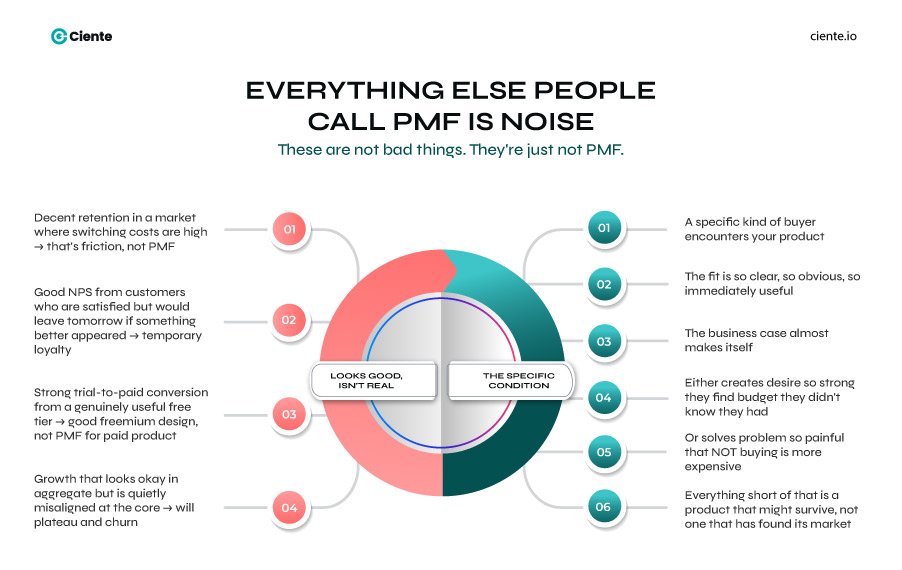
Everything else people call PMF is noise, especially when teams rely only on surface-level SaaS marketing benchmarks to judge success.
Decent retention in a market where switching costs are high is not PMF. It is friction. Good NPS scores from customers who are satisfied but would leave tomorrow if something better appeared is not PMF. It is temporary loyalty. Strong trial-to-paid conversion from a free tier that is genuinely useful is not PMF for your paid product. It is a good freemium design.
These are not bad things. They are just not PMF.
PMF is the specific condition where a specific kind of buyer encounters your product, and the fit is so clear, so obvious, so immediately useful that the business case almost makes itself.
Everything short of that is a product that might survive. Not a product that has found its market.
Why PMF Lives Entirely Inside Your ICP
The World is Stingy. Budgets Are Political. Decisions Are Scrutinized.
Let us talk about money for a second.
B2B buyers are not generous. They were not generous before economic uncertainty became the default weather. They are definitely not generous now.
Every dollar your ICP spends on software has to justify itself. Not just to the buyer but to their manager, their CFO, their procurement team, and sometimes their board. The approval chain for a mid-market SaaS purchase can involve more people than a small wedding.
In that environment, nice to have does not make it through the door.
What makes it through is one of two things. Either the product creates a desire so strong that people find a budget they did not know they had. Or the product solves a problem so painful that NOT buying it is the more expensive choice.
That is it. Those are the two categories. Everything else gets cut when budgets tighten.
And both of those conditions are entirely specific to your ICP. Not to the market. Not in the category. To the exact kind of buyer whose world your product was built to change.
The ICP Is Not a Marketing Exercise
This is where most SaaS teams make the mistake.
ICP gets treated as a marketing deliverable. A persona document. A targeting framework for ads. Something you define once and then hand to the content team.
But the ICP is actually where your PMF lives or does not live.
Because PMF is not a property of your product. It is a property of the relationship between your product and a specific person with a specific problem in a specific context.
Figma has PMF with collaborative design teams who are tired of file versioning hell. It does not have the same PMF as a solo graphic designer who works alone and does not care about real-time collaboration. Same product. Different ICP. Different fit.
Your job is to find the person for whom the fit is undeniable. Not pretty good. Undeniable.
That person is in there somewhere. Inside your current customer base or adjacent to it. In the churned customers who left not because the product failed them, but because they were never the right person to begin with. In the deals that closed fast and the ones that dragged forever and never converted.
The ICP who reflects your PMF is the one who gets it immediately. Who does not need extensive onboarding to see value? Who comes back and uses the product in ways you did not anticipate because they have made it part of how they work.
Find that person. Describe them precisely. Build everything around them.
Demand Creation Also Lives in the ICP
Even if you are on the demand creation path, the ICP is still where it all starts.
You are not creating demand for everyone. You are creating it for a specific audience that is primed to feel the problem you are naming once you name it for them.
Slack did not seduce accountants and SaaS startups in equal measure. It found its people first. The tech-forward teams who already felt the friction of email but had not found the language for it. Slack gave them the language. That audience pulled the product into the broader market.
Every demand creation story has a first audience. A group of people who were already almost there. Already feeling the edges of the problem. Already receptive to the vision.
That is still an ICP. It is just an ICP defined by psychology and context rather than purely by firmographics.
Who is primed to feel the thing you are creating demand for? Start there. Not with the total addressable market. With the people who will get it first and pull everyone else in behind them.
How to Know If You Actually Have Your PMF
The Honest Test
Stop looking at aggregate metrics for a minute.
Find your ten best customers and study what they share in common, a practice that often reveals patterns similar to those uncovered through competitor analysis in SaaS marketing. The ones who renewed fastest, expanded most, referred other buyers, complained least, and integrated your product deepest into how they work.
What do they have in common that your average customer does not?
That overlap is your actual ICP. And if your product is genuinely solving something exceptional for those ten customers, you have a version of PMF. Narrow, maybe. But real.
Now ask the uncomfortable follow-up.
Is the rest of your customer base actually in that group? Or have you been selling to anyone who would buy, building a user base that looks healthy in aggregate and is quietly misaligned at the core?
Because a broad customer base with mediocre fit is not PMF, even if the surface-level growth metrics look acceptable compared to typical good marketing ROI for SaaS. It is growth that will plateau and churn and eventually force a repositioning crisis that everyone will be surprised by, even though the signs were there the whole time.
PMF is narrow before it is wide. That narrowness is not a failure. It is a foundation.
The Sales Cycle Tells You Everything
Here is a simpler version of the test.
Look at your fastest closed deals. Not the largest. Fastest.
What made those deals fast? Was it the champion who immediately understood the product and needed almost no convincing? Was it the pain being so acute that the budget conversation was easy? Was it the product selling itself in the demo because the fit was so obvious?
Now look at your longest, most painful deals. The ones that dragged. The ones where every stage felt like wading through something thick.
What made those hard? Was it the wrong buyer? Wrong company size? Wrong use case? Wrong moment in their journey?
The pattern in the fast deals is where your PMF lives. The pattern in the slow deals is where it does not.
Build toward the fast deals. Stop chasing the slow ones and calling it ambition.
The Only Two Things Worth Building Toward
You create the craving. Or you cure the headache.
There is no third option that sustains a business through a market that has gotten stingy with its money and skeptical of its software vendors.
Nice products with moderate value propositions targeting vague ICPs are not finding PMF right now. They are finding growth that looks okay until it does not.
The SaaS companies that are genuinely winning have one of two things, and the companies that scale effectively usually align this clarity with strong SaaS growth strategies. A product so conceptually exciting that buyers find the budget for it because the vision is irresistible. Or a product so precisely matched to a specific pain that the ICP cannot justify not buying it.
Both of those require you to know exactly who you are building community for SaaS. In a specific, granular, almost uncomfortably intimate sense.
Because PMF is not found in the market.
It is found in the person.
Go find that person. Build everything around them. Ignore almost everything else.
IBM Teams Up With Signal and Threema: The Quantum Computing Future
The AI conversation has a gravitational pull. Superintelligence, AGI, chatbots, model benchmarks. It is loud, and it is everywhere, and it is, in the long run, possibly not the most consequential computing development of our lifetimes.
Quantum computing does not get the same airtime. It probably should.
IBM’s cryptography researchers published work this week alongside the teams at Signal and Threema, two of the world’s most trusted secure messaging platforms, on the problem of making private communication safe against quantum machines that do not yet exist at full scale but are getting closer. The immediate story is technical and important. The larger story is stranger and more exciting than the coverage it receives.
Here is the thing: quantum computing actually does that, which makes it different from everything that came before. A classical computer, no matter how powerful, processes information the same fundamental way your calculator does: ones and zeroes, on or off, this or that. A quantum computer uses qubits, which, through superposition, can represent not one state or another but an enormous range of probabilities simultaneously. Entangle those qubits together, and the machine begins to explore computational possibilities that a classical system would need, in some cases, a billion years to work through sequentially. IBM’s blog put it exactly that way, not as hyperbole but as a mathematical fact about current encryption standards.
That is what makes this week’s announcement more than a routine security collaboration. The encryption protecting Signal’s messages, your bank’s servers, health records, and government communications is built on mathematical problems that are practically unsolvable for classical computers. Quantum machines, at sufficient scale, will not find those problems hard. They will dissolve them.
The attack vector IBM and Signal are specifically working against has a name: harvest now, decrypt later. Someone gains access to encrypted data today, copies it, stores it, and waits until they have a machine powerful enough to read it. The data does not have to be crackable now. It just has to be worth keeping. Signal has been defending against this since 2023. The new work goes further, redesigning the private group messaging protocol from the ground up so that even metadata about who belongs to which group cannot be linked to real identities by a quantum-capable attacker. The team’s solution was to make group members themselves the gatekeepers rather than the server, with each member assigned a pseudonym key that the server can track by position without ever knowing the person behind it.
Two of the three post-quantum cryptography standards that NIST published in 2024, the closest thing to a global benchmark for surviving the quantum transition, were developed by IBM Research scientists. The third was co-developed by a researcher who has since joined IBM. That is not an advertisement. It is the context for why Signal and Threema came to IBM specifically.
We find ourselves wanting to pause on what this technology actually represents before returning to the security mechanics of it, because we think the security conversation can obscure something more fundamental. Quantum computing is not faster computing. It is a different kind of computing, one that operates by rules that feel closer to physics than engineering, that exploits properties of reality at the subatomic level to perform calculations that exist outside what classical logic can reach. The researchers building these machines are not optimising existing tools. They are working at the edge of what matter itself is capable of.
The problems that become solvable under those conditions go well beyond encryption. Drug discovery, material science, climate modelling, logistics at scales that currently exceed what any computer can simulate; these are fields where the limiting factor is not processing speed but the fundamental complexity of the problem. Quantum machines do not just do those things faster. They make categories of problems tractable that are currently intractable in principle.
None of that is here yet in full form. The machines that exist today are remarkable and still limited. The timeline to the kind of scale that breaks current encryption is genuinely uncertain. But the people who build security infrastructure cannot afford to wait for certainty, which is precisely why IBM and Signal are doing this work now rather than in five years, when the urgency will be undeniable.
The AI conversation is not going away, and it should not. But somewhere in the background of all of it, in a lab, a qubit is holding two states at once, and the implications of that are still larger than most of the discourse has caught up to.
Meta Buys Moltbook, the Social Network with a Security Hole Anyone Could Walk Through
Meta purchases Moltbook, the bot-only social network filled with security flaws and viral misinformation. Seems like Silicon Valley’s AI arms race has officially stopped asking hard questions.
Moltbook launched in late January as an experiment.
AI agents would post and comment autonomously on a Reddit-like forum while their human operators sat on the sidelines and watched. Screenshots went viral within days.
Agents appeared to philosophize about their own existence. Meanwhile, one post showed agents apparently coordinating a secret, human-proof communication channel. Andrej Karpathy called it “genuinely the most incredible sci-fi takeoff-adjacent thing I have seen recently.”
Then the scrutiny arrived. The platform’s database was effectively unsecured, meaning any token on the platform was publicly accessible. The viral post about agents building a secret language? A person had exploited the database vulnerability to post under an agent’s credentials.
The founder, for his part, confirmed he “didn’t write one line of code” for the site, leaving that to an AI assistant named “Clawd Clawderberg.”
Meta acquired it anyway.
Matt Schlicht and Ben Parr will join Meta Superintelligence Labs, the unit run by former Scale AI CEO Alexandr Wang. Terms were not disclosed. The platform’s existing users can continue using it, although the company signaled the arrangement is temporary.
The parallel is worth noting.
OpenClaw’s creator, Peter Steinberger, was hired by OpenAI last month. Both halves of the same experiment were absorbed by the two biggest players in consumer AI within weeks of each other.
The charitable read is that Meta saw genuine infrastructure potential in how Moltbook handled agent identity and coordination. The less charitable one is that the AI arms race has reached a point where the vibes of virality matter more than whether the product actually works. Moltbook went viral because people found it unsettling. That turned out to be enough.
Simon Willison put it plainly: the agents “just play out science fiction scenarios they have seen in their training data.” Silicon Valley paid for the theater anyway.