US’s DOD Didn’t Expect the AI Industry to Actually Have a Spine
Microsoft backed Anthropic in court after the Pentagon flagged it as a security risk. Now the entire AI industry is watching which party gets to set the rules.
The US Department of Defense designated Anthropic a supply-chain risk last week.
Microsoft had filed an amicus brief by Tuesday, urging a federal court to block it. And then, a judge in San Francisco was already considering Anthropic’s request for a temporary restraining order by Wednesday.
That escalated fast.
Anthropic’s 48-page complaint, filed Monday in federal court, argues the Pentagon’s move is unlawful and seeks to have the designation declared void.
The core dispute is about guardrails. The Trump administration wants Anthropic’s Claude deployed in military contexts without the safety constraints Anthropic insists on building into its systems.
Anthropic refused. The DOD responded by treating the company as a threat to the supply chain it relies on.
Microsoft’s intervention is the part worth watching closely. The company is not a neutral observer in this case. It integrates Anthropic’s products into solutions it sells directly to the US military, which means the DOD designation hits Microsoft’s own government contracts.
Its amicus brief makes this explicit: the Pentagon gave itself six months to phase out Anthropic, but gave contractors zero transition time. That is a real operational problem, and Microsoft named it as one.
What makes this moment significant is the breadth of the coalition forming behind Anthropic.
Thirty-seven researchers and engineers from OpenAI and Google filed their own amicus brief on Monday. These are companies that compete with Anthropic in the market. They still showed up.
The Pentagon framed this as a national security question. The industry is reframing it as a governance question, one about whether federal agencies can unilaterally punish AI companies for refusing to remove safety constraints from their systems.
We think that reframing is correct. And it may be the more consequential argument in the long run.
SaaS Marketing Funnels: The Linear Journey is a Lie.
The funnel is not wrong. It is just incomplete. Real buyers do not move in stages. They move in spirals, shortcuts, and leaps. Here is what that means for your SaaS marketing strategy.
The funnel is the most useful lie in marketing.
Useful because it gives you a framework. A visual. A way to talk about the buyer journey in a meeting without everyone losing the plot.
A lie because nobody actually moves through it the way the diagram says they do.
And SaaS marketing has been optimized around the diagram for so long that most teams have forgotten to look at what buyers are actually doing. Many modern SaaS marketing strategies are still designed around this simplified model rather than actual buyer behavior.
The Saas Marketing Funnel is Evolving
Let us be precise here.
TOFU, MOFU, BOFU. Awareness, consideration, decision. The funnel is not a bad idea. It is a useful abstraction. A way to organize thinking, allocate resources, and talk about where buyers are in their relationship with your product.
The problem is that it gets treated as a map when it is actually a legend.
A legend tells you what the symbols mean. It does not tell you the actual terrain. And the terrain of how real B2B buyers actually make decisions is far more chaotic, non-linear, and genuinely strange than the funnel acknowledges, especially in modern B2B SaaS marketing environments where multiple channels and stakeholders shape the decision process.
The flywheel tried to fix this. Made it circular. Added momentum as a concept. Better. Still incomplete.
Because the real issue is not the shape of the model. It is that both models assume stages. And stages imply sequence. And real buyers do not move in sequence.
What a Real Buyer Journey Actually Looks Like
Example: The Founder and the Design Tools Problem
Here is a scenario that is completely ordinary and completely breaks the funnel.
A founder hires a design team. Three people. They need tools. The founder knows Photoshop exists because it has been a cultural reference for thirty years. Beyond that, they are genuinely uninformed.
So they do what anyone does. They search.
Best tools for UI/UX design.
That is a single search query. But look at what it contains. The founder is simultaneously unaware of most of the category and urgently ready to make a purchasing decision. They are top of funnel and bottom of funnel at the same time.
The search returns Figma. Illustrator. Sketch. Canva. Gimp. A dozen others. The founder has never heard of most of them. They are aware of each product while being in decision mode for the category.
They click on a comparison article. They are now in consideration. But they are also, in the same browser session, looking at Figma’s pricing page. That is the bottom of the funnel. They have not finished the awareness stage, and they are already evaluating price.
They watch a YouTube video about Figma vs Sketch. Back to consideration, sort of. But the video has a comment saying their design team specifically should look at a tool they have never heard of. Now they are back in awareness for a new entrant.
Three hours later, they have made a shortlist. Not because they moved through stages. Because of the urgency of the problem, all the stages collapsed into a single chaotic research session.
This is how B2B buyers actually behave. Especially when the problem is urgent, the category is unfamiliar, and the internet is full of opinions—something that many SaaS market trends increasingly reflect as digital research dominates the buying process.
The Funnel Would Call This One Buyer Journey
The funnel would draw a neat line from that first search query to the eventual purchase.
It would miss everything interesting about what actually happened. It would not capture the moment the founder was simultaneously aware and deciding. It would not account for the new product entering their consideration from a YouTube comment. It would not explain why they chose Figma in the end, which had almost nothing to do with the comparison articles they read and almost everything to do with a designer on their team who had used it before and vouched for it.
That last part is not in the funnel at all.
The funnel has no stage for someone inside the organization who has prior experience and collapses the entire decision through the credibility of a personal recommendation. That happens in almost every B2B purchase. The funnel treats it as invisible.
Why This Matters for Your SaaS Marketing Strategy
You Are Optimizing for Stages That Do Not Exist
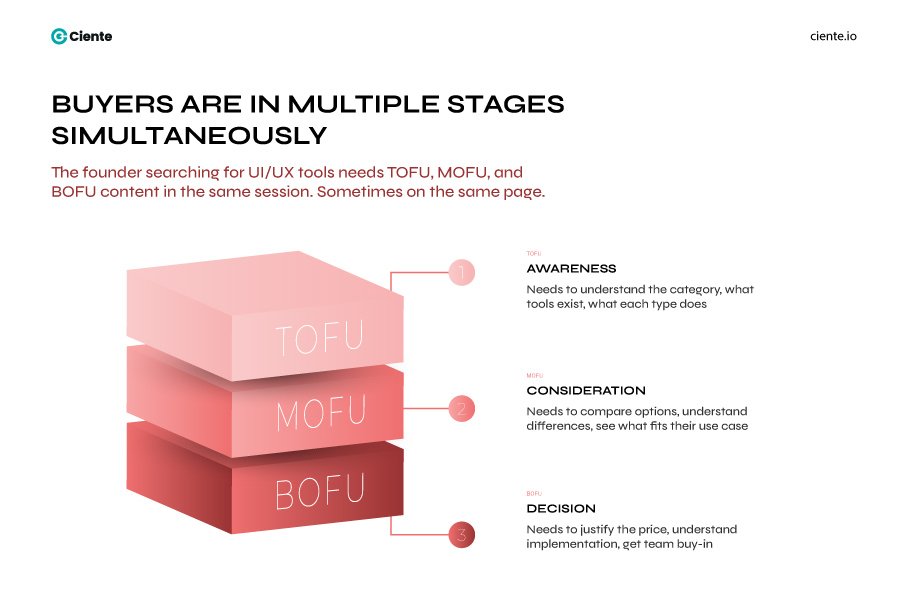
When you build marketing around a clean funnel, you build content and campaigns for buyers at discrete stages. TOFU content for people who do not know you yet. MOFU content for people comparing options. BOFU content for people ready to buy.
The problem is that a real buyer is often in all three simultaneously. And your content strategy has no answer for that.
The founder searching for UI/UX design tools needs TOFU content to understand the category, MOFU content to compare options, and BOFU content to justify the price. In the same session. Sometimes on the same page.
If your Figma comparison article is only optimized for the consideration stage, you lose the buyer the moment they realize they need to understand the category first. They bounce. They find a competitor who happened to write something that met them at multiple stages simultaneously.
This is not a content volume problem. It is a content intelligence problem, where the right content formats for SaaS marketing must address multiple buyer needs simultaneously.
The Handoff Assumption Is Where the Money Leaks
The funnel implies clean handoffs. Marketing owns TOFU. Then passes the buyer to MOFU content. Then passes them to sales at BOFU.
Real buyers do not respect handoffs, which is why many teams are rethinking how SaaS marketing lead scoring methods track buyer engagement across different touchpoints.
They read your most technical bottom-of-funnel case study before they have read a single awareness piece. They watch a product demo on YouTube before they have ever visited your website. They talk to someone who has used your product before they have filled in a single form.
When you build marketing operations around clean handoffs that buyers never actually make, you create gaps. Moments where the buyer is ready to move, and the machine has nothing to say to them because they are in the wrong stage according to the system.
That is where deals go quiet. Not because the buyer lost interest. Because the marketing motion had no answer for where they actually were.
How do you optimize the marketing funnel for the buyers?
Stop Thinking About Stages and Start Thinking About Moments
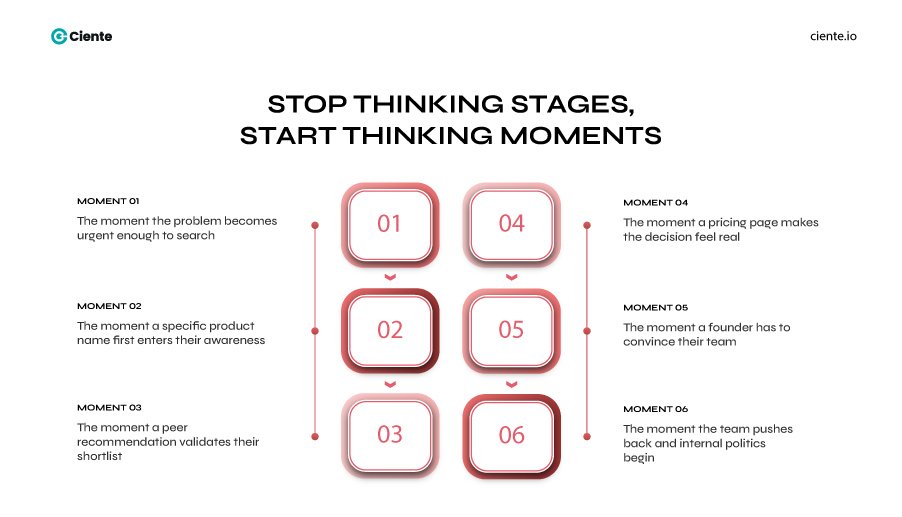
Real buyer journeys are not made of stages. They are made of moments.
The moment the problem becomes urgent enough to search. The moment a specific product name first enters their awareness. The moment a peer recommendation validates their shortlist. The moment a pricing page makes the decision feel real. The moment a founder has to convince their team. The moment the team pushes back.
Each of those moments is a marketing opportunity. None of them maps cleanly to a funnel stage, which is why modern SaaS performance marketing focuses more on intent signals than rigid funnel positioning.
If your content strategy is built around moments instead of stages, you stop asking what stage this buyer is in and start asking what this person needs right now to move closer to a decision.
Those are different questions. The second one produces better answers.
Build for the Complex Journeys
Buyers circle. They come back to things they have already read and read them differently because something changed in their understanding. They revisit a pricing page four times before they contact sales. They read a case study after they have already decided to buy, looking for confirmation that they made the right call.
This is not irrational. It is how decisions actually get made under uncertainty.
Your content needs to serve the buyer on the second, third, and fourth visits with something new to offer. Not just a different angle on the same message, but a deeper level of thinking that rewards the buyer for returning.
Most SaaS content is flat. It has one layer. You read it, you get the point; there is no reason to return, unlike the layered approaches used in many successful SaaS marketing campaigns.
The content that compounds in B2B is the content that rewards re-reading. That has something to offer at the awareness stage and something different to offer at the decision stage, without being two separate pieces. Because the buyer might be at both stages at the same time.
The Channel Is Part of the Journey, Not a Separate Decision
Where a buyer encounters you changes what stage they are effectively in.
A buyer who finds you through a Google search is usually earlier in their thinking than a buyer who finds you through a peer recommendation. A buyer who finds you through a LinkedIn ad is usually more passive than a buyer who comes directly to your pricing page.
The funnel treats all inbound as equivalent once it enters the system. The channel is just an acquisition source. That misses everything.
A buyer who arrives via a trusted recommendation is not aware. They are in late consideration before they have ever visited your website. The content and experience you show that person on their first visit should not be top-of-funnel content. You are wasting the trust that got them there.
Matching the entry point to the experience is where most SaaS marketing teams leave conversion on the table, which directly affects the marketing ROI for SaaS businesses. Because the funnel told them everyone enters at the top.
They do not.
So, do you throw the marketing funnel away?
Do not throw it away.
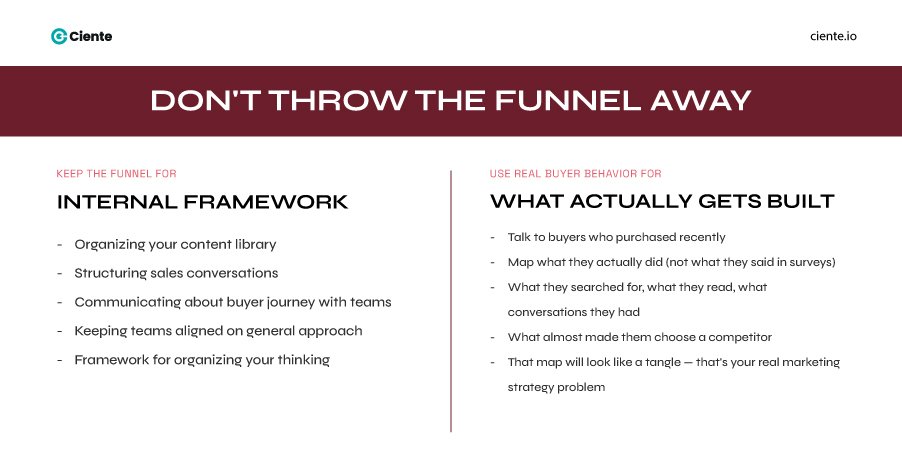
The funnel is a useful internal tool. It helps you organize your content library, structure your sales conversation, and communicate about the buyer journey in ways that keep teams aligned.
Just stop mistaking it for a description of reality.
Use the funnel as a framework for organizing your thinking. Use real buyer behavior as the input for what actually gets built, similar to how many teams refine their B2B SaaS market strategy based on real customer insights.
Talk to buyers who purchased recently and map what they actually did. Not what they said they did in a quick survey. What they actually did. What they searched for. What they read. What conversations they had. What almost made them choose a competitor.
That map will not look like the funnel. It will look like a tangle. And that tangle is your real marketing strategy problem.
The funnel is clean because it’s a concept that is easy to understand. But the buyers are messy, and their journeys are complex because that is how decisions actually get made – in urgency or some strong desire.
Build for the mess. That is where the opportunity is, because almost nobody else is looking there—a mindset that increasingly defines modern SaaS marketing insights for 2026.
Pricing Models of SaaS Marketing Agencies: What You’re Actually Paying For
The pricing model your SaaS marketing agency recommends says a lot about who benefits from the deal. Most buyers find out too late which side that is.
You get on a call with a SaaS marketing agency. The deck looks sharp. The case studies are impressive. The team seems to get your space. Then comes the pricing slide, and suddenly you’re nodding along to a structure you don’t fully understand, agreeing to terms you’ll regret in Q3.
It happens more than most SaaS leaders admit. Not because the agencies are dishonest, but because pricing models carry assumptions baked in, and nobody spells those out during the pitch. You sign on for “marketing support” and discover three months in that you’ve bought a reporting deck and a content calendar.
Before you write the first check, understand what each pricing model actually funds, and what it doesn’t.
The Four Pricing Models of SaaS Marketing Agencies
1. The Monthly Retainer
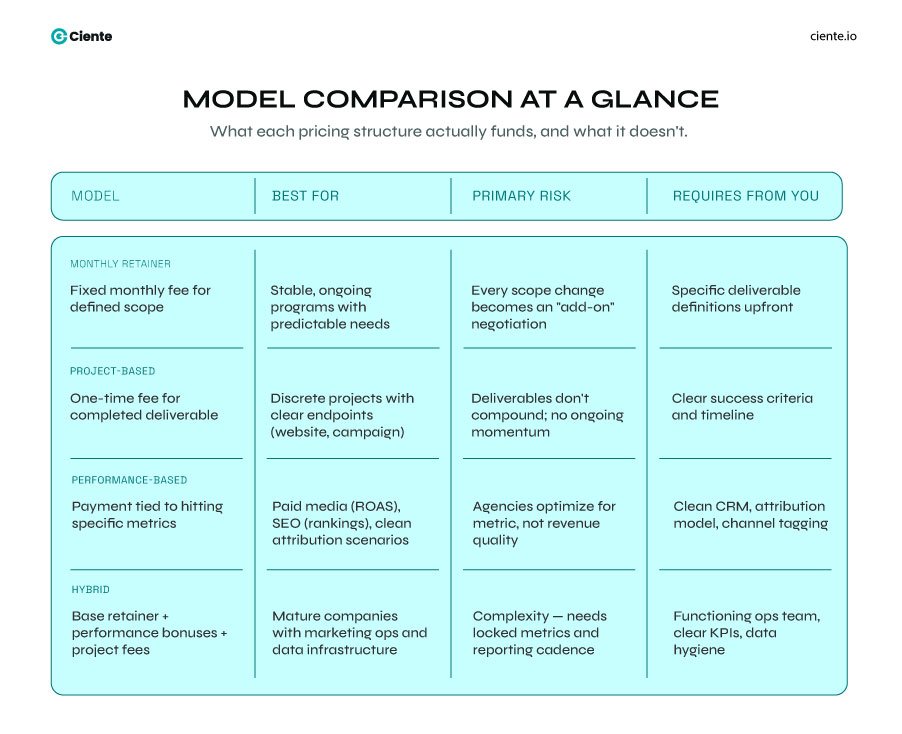
Talk to any SaaS marketing agency, and the retainer will be their default offer. You pay a fixed monthly fee, they deliver a defined scope of work, and both sides call it a partnership. Simple enough.
The word “defined” is where things get complicated.
Retainers look predictable on a spreadsheet. You know the line item, you know what the agency delivers, and the finance team stops asking questions.
But watch what happens when your priorities shift mid-quarter. A new competitor enters the market. Your ICP changes. Leadership now wants to do a campaign not included in the original scope.
Suddenly, every conversation with the agency includes the phrase “that would be an add-on.”
Agencies price retainers on perceived value, not on hours spent. That’s not inherently a problem, but you should be aware of it before the partnership.
A retainer built around a stable, predictable marketing program works. A retainer signed during a growth phase, when speed and flexibility matter most, starts feeling like a cage by month four.
When you evaluate a retainer, push the agency to be specific. What deliverables does the monthly fee actually cover? Who owns each one? What’s the process when you need something outside that scope?
Vague answers at this stage always become expensive arguments later.
2. Project-Based Pricing
Some SaaS companies aren’t keen on active agency relationships. They’ve a whole lot of marketing functions on their hands- whether it’s rebuilding a website, launching a campaign, or designing a content strategy from scratch.
Project-based pricing exists precisely for this.
On paper, it’s the cleanest model. Defined scope, defined timeline, defined cost. Once the project closes, the engagement ends. No retainer, no recurring dependency, no annual contracts.
The problem is that SaaS marketing doesn’t work like a construction project. A brand refresh doesn’t generate pipeline on its own. A messaging framework sitting in a Google Doc doesn’t acquire customers.
Project-based pricing buys you a deliverable, and deliverables don’t compound the way ongoing marketing does. Sustainable growth typically comes from long-term execution across channels, something many successful SaaS marketing campaigns rely on rather than one-off deliverables.
There’s also a practical issue with how agencies quote projects. Most of them build a buffer into the first number they give you. They’ve done enough engagements to know where scope shows up, and they price for it pre-emptively.
That buffer is a negotiation room that you must leverage.
Project-based pricing makes sense for discrete, time-bound requirements with clear success criteria. Use it for those. Don’t use it as a substitute for a real demand generation program. If you’re evaluating agencies for growth, it’s worth understanding how B2B SaaS marketing actually compounds through consistent demand generation rather than isolated projects.
3. Performance-Based Pricing
Every SaaS buyer, at some point, thinks performance-based pricing sounds perfect. The agency only gets paid when results come in. Aligned incentives. Shared risk. What could go wrong?
Quite a bit as it turns out.
Agencies operating on performance models optimize for the metric in the contract, full stop. This is why companies running SaaS performance marketing initiatives need clearly defined success metrics before entering a performance-based agreement. If you define success as MQLs, they’ll deliver MQLs. But without a structured qualification framework like a SaaS marketing lead scoring method, those leads rarely translate into revenue. Whether those leads turn into opportunities, whether sales can close them, whether they match your actual ICP- that’s outside the scope of their incentive.
They hit the number. You deal with the quality.
The other issue is attribution.
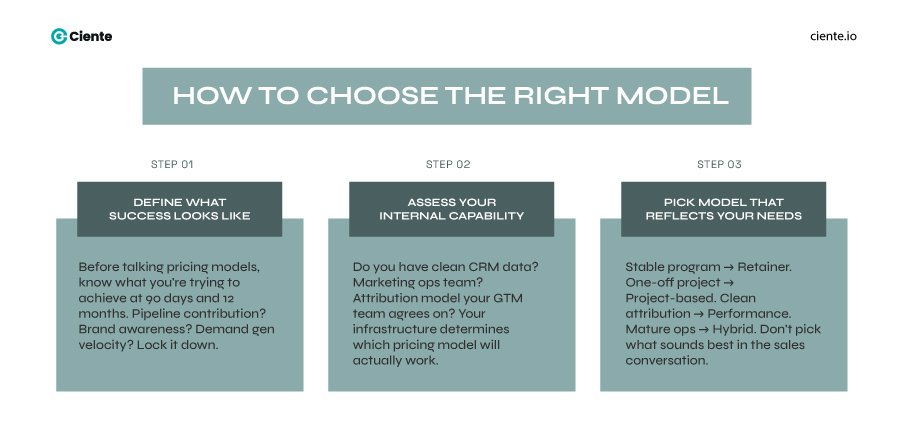
Performance pricing assumes you can cleanly trace outcomes back to the agency’s work. That requires solid CRM hygiene, clear channel tagging, and an attribution model your whole GTM team agrees on. Many companies also rely on modern SaaS marketing tools to track attribution and campaign impact accurately. Most SaaS companies aren’t there yet.
When attribution gets murky, performance-based engagements generate disputes and not results.
This pricing model works effectively only in specific situations. Paid media tied to ROAS. SEO work tied to ranking improvements on a defined keyword set. Demand generation with a pipeline contribution metric and clean tracking behind it.
In those narrow contexts, performance pricing creates real accountability. Outside them, it tends to create tension.
If an agency pushes performance pricing hard without asking how you track attribution, slow down. That enthusiasm usually means they know how to hit a metric, not how to grow your business.
4. Hybrid Pricing
Most agency relationships that last more than a year end up here, whether intentionally or not.
A base retainer funds the ongoing work. Performance bonuses activate when specific targets land. Project fees cover one-off needs that fall outside the core scope.
Hybrid pricing models exist because pure models break down at the edges. As SaaS businesses scale and diversify acquisition strategies, pricing structures often evolve alongside broader SaaS market trends. Retainers without accountability get complacent. Performance models without stability produce erratic behavior.
Hybrid structures try to solve both problems at once.
They mostly prove effective, but with specific complexities. You need clearly defined metrics, approved reporting cadences, and a shared understanding of what counts as a win.
If those things aren’t locked down in the contract? The performance component no longer works as a motivator and becomes a point of argument.
For SaaS companies with a functioning marketing ops team and clean data infrastructure, hybrid pricing is usually the right destination. Get there intentionally.
What the Pricing Structure Won’t Tell You
Every pricing model of a SaaS marketing agency is ultimately just a billing structure. It tells you how money moves. It doesn’t tell you whether the agency thinks clearly, understands your market, or will hold their own opinion when yours is wrong.
That last part matters more than most buyers realize.
The best SaaS marketing agency relationships work because the agency pushes back when the client is chasing the wrong metric or funding the wrong channel. That only happens when the agency has real conviction about the work. And conviction doesn’t show up in a pricing slide.
So before you spend time comparing pricing structures, evaluate the team:
Look at what they’ve built for SaaS companies at your growth stage.
Ask about client churn on their end.
Find out who actually runs the day-to-day on your account versus who ran the pitch. Those two people are rarely the same person.
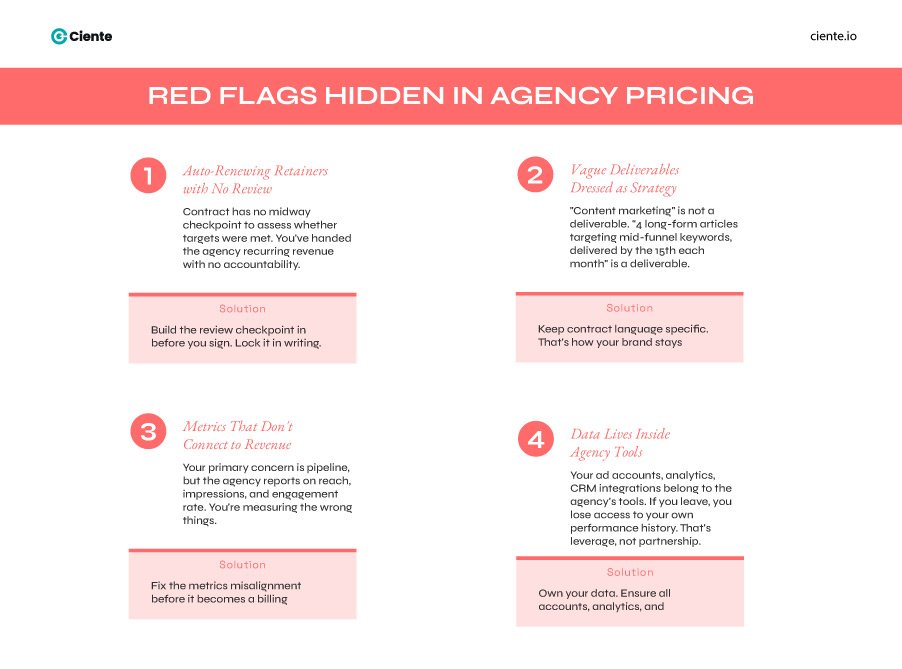
Red Flags Hidden in SaaS Agency Pricing
Some things to watch for, regardless of the model you choose.
1. Auto-renewing retainers with no performance review built in.
Your contract should include a midway checkpoint to assess whether targets were met. And if there’s no such thing? You’ve handed the agency a recurring revenue stream with no accountability attached.
Solution: Build the review in before you sign.
2. Vague deliverables dressed up as strategy.
Content marketing is not a deliverable. But you know what is?
“4 long-form articles that target mid-funnel keywords, delivered by the 15th of each month. And performance review within 90 days.”
Solution: Keep the contract language specific. That’s how your brand remains protected when things drift.
3. Metrics that don’t connect to revenue.
You’re measuring the wrong things if your primary concern is pipeline and the agency reports on reach, impressions, and engagement rate. Ultimately, SaaS leaders should align reporting with good marketing ROI for SaaS rather than vanity metrics.
Solution: Fix the metrics misalignment before it becomes a billing argument.
4. Data that lives inside the agency’s tools.
Your ad accounts, your analytics, and your CRM integrations should belong to you. Some agencies build pricing models that create data dependency, intentionally or not. This is one of the common mistakes in outsourcing SaaS marketing that companies only discover after switching vendors.
If you ever leave, you lose access to your own performance history. That’s not a partnership structure. That’s leverage.
Solution: Collate and exchange data points that align across the dashboard.
Getting Your Pricing Model for SaaS Marketing Agency Just Right: The Loophole
The pricing models of SaaS marketing agencies shape incentives, and incentives shape behavior. Pick the model that reflects your needs, not what sounds best in the context of a sales conversation. The right decision usually aligns with your broader B2B SaaS market strategy and long-term growth plans.
The SaaS companies that get real ROI from agency relationships share one trait: they dive into the engagement with more specificity than the agency expects. They know what success looks like at 90 days and at 12 months. They know how they’ll measure it.
And they hold the agency to both, in writing, from the first day.
That specificity matters more than which pricing model you choose. Get that right, and the billing structure is just a detail.
Yann LeCun Just Raised $1 Billion to Challenge the Way AI Is Being Built
LeCun thinks AI is being designed incorrectly. And he’s ready to act on what’s right.
The AI industry has spent the last few years chasing one idea: bigger models.
More data. More GPUs. Larger language models.
Yann LeCun thinks that path is wrong.
The former Meta chief AI scientist has launched a new startup called Advanced Machine Intelligence (AMI) and raised $1.03 billion to pursue a different approach to artificial intelligence.
The premise is simple. Current AI systems are effective at predicting text, images, and code. But that does not mean they understand the world.
LeCun argues that today’s large language models cannot produce truly intelligent systems on their own. They generate convincing responses, but they struggle with reasoning, planning, and understanding physical environments.
AMI is trying to fix that.
The company is building AI around what researchers know as “world models.” These systems try to understand how the physical world works rather than predicting the next word in a sentence.
The goal is actually practicality.
Manufacturing, aerospace, and pharma function on complex systems. AI that can reason in real-world environments would greatly manage factories, logistics, robotics, and develop scientific research.
Consumer applications may follow later. LeCun has already suggested that this kind of AI could eventually power hardware like domestic robots or smart glasses.
The timing of the startup is also interesting.
While most AI companies are doubling down on scaling language models, LeCun is betting the industry is heading toward a technical wall. His view? Real intelligence will require systems that understand space, physics, and cause-and-effect relationships. It’s not limited to generation- but a certain understanding of how the world truly operates. And how the world came to be.
In simple words, the next leap in AI will not come from making models bigger.
It might come from making them think differently.
Whether that bet pays off is still uncertain. And with more than a billion dollars behind it, AMI just ensured the AI race now has two competing visions of the future.
Anthropic Takes the Pentagon to Court as the AI Industry Watches.
After Anthropic backed out of making a deal with the Pentagon, the latter labeled it a risk. Did you think the AI powerhouse wouldn’t clap back?
AI companies have positioned themselves as builders of the future for years now. Ethical labs. Independent innovators. Firms that would guide how powerful technology entered society.
The narrative has now collided with reality.
Anthropic has filed a lawsuit against the U.S. Department of Defense. And it’s a clap back after the agency labeled it a supply chain risk. The designation could effectively push the company out of parts of the defense ecosystem.
Anthropic says the label is retaliation.
The real conflict began when the Pentagon wanted broader access to its AI systems. Anthropic refused to loosen safeguards that limit how its models can be used- especially around mass surveillance and autonomous weapons.
And soon after, the government flagged the company as a potential risk within the military supply chain.
That kind of label is serious. It’s usually for companies suspected of ties to foreign adversaries or security vulnerabilities. Applying it to a U.S. AI firm sends a clear signal to contractors: keep your distance.
Anthropic is now asking the courts to intervene. The company argues the government is punishing it for sticking to its own safety policies.
But the lawsuit reveals something deeper than a regulatory dispute.
It exposes the fragile balance between govts and the companies designing advanced AI.
The U.S. govt views AI as the strategic infrastructure. The logic? Systems that can influence intelligence analysis, cybersecurity, and military planning can’t be leveraged in national security frameworks.
Tech companies see the situation differently. Their credibility rests on safety commitments and public trust. If they bend those commitments too easily, they risk becoming extensions of the state.
Anthropic chose resistance.
Whether it wins the case may matter less than what the conflict represents. The AI industry has spent years debating alignment and ethics in theory.
Now the argument is becoming far less abstract: a courtroom.
And the outcome will quietly decide who ultimately sets the rules for the most powerful technology being built today.
ChatGPT 5.4 Is OpenAI’s First AI Model with Native Computer Use Capabilities
Just when you think AI’s next step would be better responses, there’s been a shift. The new era of tech is systems that actually do the work.
OpenAI has released GPT-5.4. The update points to a clear direction for the industry. AI systems are moving beyond answering questions. They are starting to execute tasks.
GPT-5.4 can interact with computers directly. It can read what appears on a screen. It can move a cursor. It can type commands. It can navigate software to finish a job. The model does not just suggest steps. It performs them.
This changes how AI fits into everyday work.
Until now, most AI tools have behaved like advisers. They produced ideas, code, or explanations. Humans still had to open applications and carry out the steps. GPT-5.4 begins to remove that gap.
That is why the industry keeps using the term AI agents.
An AI agent does not simply respond to prompts. It receives a goal. Then it plans the steps needed to reach it. It gathers information. It runs tools. It adjusts if something fails. The model becomes closer to a worker than a chatbot.
For companies building software, that shift matters.
Enterprise tools often require long workflows. A report might require data extraction, analysis, formatting, and presentation. Today, a human moves through each step. An agent can potentially run the entire chain.
That is the promise OpenAI is chasing.
The company also claims GPT-5.4 reduces hallucinations compared with earlier versions. That matters if the model will run real tasks. Automation without reliability creates new problems.
The broader takeaway is strategic.
The AI race is no longer just about building smarter models that give accurate outputs. This new phase focuses on building systems that act inside digital environments. Whoever solves that first will redefine how people interact with software.
GPT-5.4 does not complete that transition. But it pushes the industry much closer to it.