A Nuanced Playbook: Building B2B Media Partnerships for Sustained Growth

How To Build B2B Media Partnerships for Sustained Growth

How To Build B2B Media Partnerships for Sustained Growth

The right B2B media partnerships isn’t choosing one with the most numbers. But in conquering a rhythmic alignment that feeds into mutual growth.

Most advice about building B2B media partnerships sounds like it came from someone who’s never actually done it. You know the type. Generic tips. Surface-level strategy. Zero understanding of what actually happens when you sit across from a potential media partner.

And the truth gets messy.

Building B2B media partnerships involves nuance, psychology, and a fair bit of experimentation. It should feel less like a business transaction and more like figuring out if there’s long-term sustainability prowess here.

Why Do Most B2B Media Partnerships Fail Even Before They Begin?

Let’s talk about failure first. Companies treat building B2B media partnerships like dating apps. They swipe right on anyone with impressive reach numbers. They send templated pitches. They hope something sticks.

This approach fails consistently.

But what these B2B media partnerships require is strategic alignment. Most organizations never bother to investigate this alignment. They see 500,000 monthly readers and lose all critical thinking.

Think about hiring.

You wouldn’t hire a salesperson just because they have a huge LinkedIn network. You would want to know if they understand your product. Ask if they believe in your mission. And evaluate whether they can authentically represent your brand.

The same logic applies to B2B media partners. We merely forget it when we see huge traffic numbers.

And the second substantial failure point?

Companies confuse exposure with influence. A media outlet might have massive traffic.

But what if their audience doesn’t trust them? Then you’re merely buying billboard space on a highway where everyone drives past. Nobody is really stopping to look up at the billboard. And that’s a complete waste of time and resources.

Foundation of a Sustainable B2B Media Partnership: Strategic Compatibility Or Traffic Numbers?

Start building B2B media partnerships with the right filter. That filter isn’t reaching. It’s resonance.

Ask yourself this question: Does this media partner operate in the same philosophical space as your brand? The same industry matters, sure. But the same mindset about business matters more. Same perspective on problem-solving. And the definition of value.

Here’s a concrete example. Your company positions itself as a challenger brand disrupting an old-guard industry. You partner with a conservative, establishment publication. And the result?

Cognitive disconnection.

Their audience expects specific perspectives. Your message either gets diluted to fit their editorial voice or sticks out awkwardly.

Strategic compatibility doesn’t mean finding a clone of your brand. You want complementary values and overlapping missions. Your media partner should enhance your message and bring a perspective that adds dimension to your expertise.

Most guides on building B2B media partnerships stay superficial here. They tell you to check if the audience demographics match. Demographics are table stakes. Psychographics matter infinitely more-

  • What keeps their audience up at night?
  • What do they aspire to become?
  • What frustrations do they share with your ideal customers?

Answer these questions first.

How Do You Actually Evaluate the Potential of A B2B Media Partnership?

You’ve identified potential partners who pass the strategic compatibility test. Now the real work begins. Building B2B media partnerships requires a ton of detective work.

1. Follow their content proactively for at least a month.

Read their articles. Watch the videos, and listen to recent podcast episodes. Move beyond skimming headlines. Dive deeper. And be more attentive towards their social media activity and presence.

What is their audience doing- Are people engaging thoughtfully, or is it just promotional noise?

2. Look at how they treat existing partners.

The best B2B media partners integrate commercial content without compromising editorial integrity. The worst ones haven’t figured this out yet. And that’s something companies miss constantly. Does the sponsored content feel authentic, or does it scream skepticism?

Examine the media outlet’s own partnerships and collaborations-

Who are they choosing to work with? And if they’re indiscriminate and partner with anyone who writes a check? That will tell you all about their standards. But if they’re selective and their partners share similar values? That’s a green light.

3. Understand their content creation process.

  • Who writes the articles?
  • Are they staff journalists with industry expertise?
  • Or freelancers churning out SEO-optimized content?

Freelance writers aren’t inherently bad. But you need to understand quality control mechanisms.

You’re hitching your wagon to their credibility when building B2B media partnerships. Make sure it’s built on solid ground.

4. You need specific organizational capabilities if you’re serious about building B2B media partnerships as a core growth strategy.

Create internal processes for evaluating partners. Develop frameworks for structuring agreements and measuring success. Educate your executives about why media partnerships work differently from advertising or PR.

Build a portfolio approach. Putting all the eggs in one basket is where most brands make their first and most vital error. The most resilient strategies involve multiple partnerships at different stages of maturity. Different partners serve different strategic purposes.

This portfolio approach compounds your market presence. Meanwhile, isolated campaigns never achieve this effect.

The Starting Point (Pitch) to Build B2B Media Partnerships

You’ve done the homework. You’ve identified a genuinely compatible partner. But now, how do you initiate the conversation? Most companies falter here.

See, the standard approach is to send a formal proposal. It outlines mutual benefits, audience overlap, and potential collaboration ideas. It’s professional and thorough. But it’s also completely forgettable.

Every media outlet receives dozens of these pitches weekly. They blur together into beige corporate paste. So, what can your brand do differently? Lead with insight instead of opportunity.

  1. You must gauge their overall business model as well as their pain points.
  2. Try to subtly prove that you know their audience better than their competitors.
  3. Share a lesser-known insight regarding a gap in their content.
  4. Pinpoint a relevant trend in their industry that also demonstrates your expertise.

Remember that the objective isn’t flattery. But you’re proving you’ve done the work.

Building B2B media partnerships means signaling that you understand value exchange. It goes beyond simple promotion.

And here’s the framework that actually works-

  1. Start with a specific content idea that serves their audience first. Your brand promotion comes second.
  2. Skip “we would love to sponsor your newsletter.” And try this instead: “I noticed your readers struggling with X problem based on discussions in your recent article. We’ve developed a framework for solving X. Could we explore creating something together?”

This approach shifts the dynamic entirely. You’re bringing a gift instead of asking for a favor. That changes everything about the subsequent negotiation.

Structuring the B2B Media Partnership Strategy: The Nitty-Gritty of Co-Existence

You’ve got mutual interest. Now you need to translate enthusiasm into executable agreements. Many promising partnerships die right here.

Most companies immediately jump to contracts and deliverables. Stop right there. You need a shared creative vision first. What does success look like? Think about the actual content or experiences you’re creating together, beyond metrics.

1. Spend time in workshop mode.

Get your team and their team in a room. Brainstorm without constraints. What could you create together that would be genuinely valuable? What format would best serve the story? What would make their audience actually care?

This creative phase surfaces misalignments early. You’re imagining long-form thought leadership articles. They’re thinking of short-form social content. You may want customer success stories. They want industry trends.

These aren’t dealbreakers. But you need to reconcile them before signing agreements.

2. Get creative alignment first. Then structure the commercial arrangement.

Building B2B media partnerships requires more flexibility than most corporate procurement processes allow. Forget the standard “we’ll pay you X dollars for Y deliverables” model if you can.

The best media partnerships involve shared risk and shared reward. You can invest in a revenue share model tied to lead generation. Or create co-owned intellectual property that both parties can leverage. Or build something experimental where success means audience engagement rather than immediate ROI.

3. Create incentive alignment.

If your partner only gets paid for producing content regardless of quality or performance, their incentive is volume. If they benefit from the partnership’s success in meaningful ways, they become invested in making it work.

And then comes content creation– or co-authoring.

Building B2B media partnerships becomes genuinely difficult here. You’re creating content that satisfies your brand requirements, meets their editorial standards, and actually serves the audience.

That’s three competing priorities.

4. Respect editorial independence while maintaining brand integrity.

Your media partner needs freedom to frame the story authentically. It has to feel credible to their audience. But you need assurance that your core messages aren’t getting distorted or buried. And achieve this balance through iteration instead of control.

Focus on approving strategic framing and key messages. Give feedback that improves clarity and accuracy. Don’t rewrite their voice into corporate speak. Their audience trusts the publication’s perspective. They’re reading for that voice- etch this into the content strategy.

5. Another nuance: timing flexibility matters.

Most companies want content delivered according to their campaign schedules. But your media partner has their own editorial calendar. Their own priorities. Their own workflow.

Building B2B media partnerships means fitting into their ecosystem.

Establish a content creation rhythm that works for both sides. You can provide them with exclusive data or research findings a month early. This gives their editorial team time to develop a genuinely interesting story. Or you can make yourself available for interviews on their timeline.

And lastly, here’s something rarely discussed.

6. Be prepared for them to say no to some ideas.

Why does rejection matter? Your media “partner” must go to-and-fro on your content proposals. Because anything else is a bad sign. It’s a telltale sign that they’re merely executing what you’re giving them. They’re following commands.

But their insight is missing.

The best B2B media partnerships involve mutual creative tension. That’s precisely how both of you grow and sustain each other.

How to Measure the Success of Your B2B Media Partnerships Beyond Vanity Metrics?

Every article about building B2B media partnerships eventually discusses metrics. Most recommend tracking impressions, clicks, and engagement rates. These are significant data points.

But they miss what actually matters.

  • Ask the real question. “What happened because people saw our content?” Did perception shift? Did consideration increase? Did the right people start conversations with your sales team?
  • Set up attribution models before the partnership launches. How will you track whether someone who engaged with partnership content eventually became a customer? How long is your typical consideration cycle? Are you measuring across a timeframe that captures actual impact?

Here’s the uncomfortable truth. Most media partnerships don’t generate immediate ROI. They build a reputation instead of generating leads. They play the long game of becoming known and trusted in your market.

Expecting partnership content to drive demos and deals within weeks means you’re measuring the wrong things. So, what are the right facets you must essentially focus on?

  • The metrics that matter include share of voice across your industry.
  • Quality of inbound inquiries. The caliber of conversations your sales team is having.
  • Are prospects coming in more educated about your space?
  • Are they pre-qualified because they’ve consumed content that explains your approach?
  • Are they asking more intuitive questions?

These are harder to measure, but infinitely more valuable than click-through rates. And they require qualitative feedback from your customer-facing teams instead of just dashboard metrics.

Growing Your B2B Media Partnership Beyond Transactions

The most successful examples of building B2B media partnerships involve evolution. A single co-branded article becomes a recurring content series. That becomes a joint research initiative. Then it becomes a co-hosted event or community.

This evolution only happens when you treat the partnership as a relationship- Regular communication matters beyond project status updates. So, share insights about what’s happening in your business that might create content opportunities. Ask about their strategic priorities. Find ways to support them.

Here’s a practice almost nobody follows-

Create a partnership retrospective rhythm. Every quarter, sit down with your media partner and honestly assess what’s working. Not just “did we hit our numbers.” Ask questions, period.

Ask if you’re creating value for the audience. Are you learning anything? Are you proud of what you’re producing together?

These conversations surface opportunities for innovation. Written content isn’t resonating, but video would. Their audience is hungry for a particular topic that you’re uniquely qualified to address. Or a campaign you thought was successful actually annoyed their readers because it felt too promotional.

The willingness to have honest conversations separates transactional partnerships from relational ones. Transformation is what you’re actually after when building B2B media partnerships.

But When Do You Truly Walk Away From A Failed B2B Partnership?

Some partnerships don’t work. Knowing when to cut your losses matters as much as how to build momentum.

The signs of a failing partnership start subtly. Content consistently gets delayed. Revisions exceed what you initially scoped. Quality doesn’t meet the standards you discussed. Their team keeps turning over. You’re constantly re-explaining your business to new contacts who lack context.

Or maybe the partnership functions technically, but the results aren’t there. Engagement is flat. Your sales team reports that no one mentions the partnership content. The audience response feels lukewarm at best.

Building B2B media partnerships requires discipline to evaluate whether continued investment makes sense. Some partnerships need troubleshooting and iteration. Others need to end gracefully so both parties can redirect resources.

Make this assessment based on data and feedback. Give a partnership adequate time to gain traction. Usually, at least two quarters are required in B2B contexts where sales cycles run long. If leading indicators still don’t suggest it’s working, you’re probably better off moving on.

The Truth About Building B2B Media Partnerships

Most guides won’t tell you this.

Prestige and reach matter less than relevance and resonance when building B2B media partnerships. You’re trying to influence specific buyers who determine your business outcomes. You’re doing this work to create results, which means you’re not trying to impress your board with brand-name media placements.

This often means going niche. Going deep. Being patient.

It means investing in relationships that don’t look impressive on paper but deliver real value in practice. It means partnering with media outlets that are building their credibility alongside you.

Building B2B Media Partnerships isn’t A Quick Fix.

You can’t automate B2B media partnerships. You can’t outsource it to an agency that promises results with minimal involvement. It requires strategy, patience, creativity, and long-term investment.

And when done right, these B2B partnerships become force multipliers. They expose your brand to new audiences. They transfer trust from established media voices to your company. They position you as part of the industry conversation.

In B2B, buying decisions are driven by trust. Trust is built through association. When a respected media voice collaborates with you, they’re vouching for your credibility. That endorsement, repeated over time across multiple touchpoints, shapes perception in ways that traditional marketing simply cannot.

So, above all, treat media partnerships as genuine relationships built on mutual value creation. That mindset shift separates companies that dabble in partnerships from those that genuinely excel at conquering them.

Tencent AI Joins the Race, Hopes to Rival OpenAI's Sora

Tencent AI Joins the Race, Hopes to Rival OpenAI’s Sora

Tencent AI Joins the Race, Hopes to Rival OpenAI’s Sora

A Tencent AI veteran just raised $50 million to build a rival to OpenAI’s Sora. The move exposes both Tencent’s quiet AI progress and the cracks within its innovation machine.

A scientist who used to spearhead the development of Tencent’s flagship AI model has just helped raise US$50 million for a new startup- one that’s positioning itself as a rival not just to Tencent, but to OpenAI’s video-AI product Sora.

At first blush: bold move. It suggests Tencent’s AI talent isn’t simply locked up in the mothership. And it means the “old guard” inside Chinese tech is saying: maybe the next wave isn’t from the giants alone.

But let’s dig into the wrinkle: If Tencent nurtured that talent, why is the spin-out happening now? Because the terrain of generative AI, especially video, is shifting fast. According to external reports, Tencent claims its internal AI platform already boosted R&D efficiency by more than 20%, with one system finding a quarter of code-bugs via AI.

In other words, internally, Tencent is advancing. Externally, though, you have a hungry startup creeping in with seed capital and a stated mission: make video creation as intuitive as chatting with GPT. That’s a sign the “comfortable space” inside Tencent may feel too slow or too conservative for some innovators.

Now the critical arc: Should we worry that Tencent’s own AI stack (including its foundational model “Hunyuan” and others) is losing its edge, or is this spin-out simply a sign of Warren-Buffet-style diversification? The $50 m is modest compared to Tencent’s scale; it’s not a moon-shot yet. Also, the startup is still early- even described as “year-old”.

What I’m leaning toward: This reflects two truths.

  1. Tencent knows it’s in a race- pressure from the US & domestic competitors. So, letting talent spill out (even indirectly) may be a strategic gesture: “We own the ecosystem whether you stay inside or spin-out”.
  2. Talent exits and seed spin-outs often signal internal friction: speed vs scale, risk appetite vs bureaucracy. For you, writing the piece, that tension is rich.

The verdict: Keep eyes on how the startup executes (video-AI is still messy). But watch Tencent: if one of its own goes rogue and wins big, it will expose blind spots in big tech’s innovation machine. For now, $50 m is a shot across the bow- not yet full broadside.

The Ultimate Guide to Podcast Advertising

The Ultimate Guide to Podcast Advertising 2026

The Ultimate Guide to Podcast Advertising 2026

With advertisers keen to follow the trends, are podcast ads the ideal strategy to attract positive attention toward your brand?

We can perform a single task in multiple ways due to the onset of AI and other technological advancements today.

Remember newspaper advertisements? Feels like ancient history.

In this fast-paced digital era, we have conveniently moved to screens (at the cost of our eyesight!).

And as if screens were not enough, humans have found another way to consume content – listening. As much as we run towards convenience and comfort in this modern age, our senses are at maximum capacity.

Making us believe that listening and not watching is more comfortable is a marketing tactic. Today, there are over 546.7 million podcast listeners worldwide in 2024.

Podcasts are gaining momentum

Podcasts mix education with audio entertainment to elevate your mindfulness while you continue with your daily tasks, propelling a significant transformation in the advertising landscape.

Yes, we do commonly associate advertisements with visuals. But you can elevate your storytelling by utilizing multiple formats for driving a niche and an unfamiliar audience base.

That’s where advertising works itself into podcasts. And this is precisely what we’ll help you grasp.

Podcast Ads are an underrated but rapidly growing advertising front. They allow you to boost your brand awareness and establish trust when speaking to potential buyers.

Podcast advertising revenue is projected to reach $2.6 bn in 2026. That’s 36% up from 2023.

These sponsored ads communicate through (or during) a podcast episode, an uncommon form of paid marketing. But gradually, podcasts are turning into a must-have.

You might wonder whether podcast advertising works the same as radio advertising. Yes, both advertising channels use digital audio ads delivered by the host, and some personal experience with that product or service.

But podcast advertising is undeniably different from radio. Also, check Programmatic Advertising Strategies.

How Does Podcast Advertising Work?

Radio ads reach a broad audience, are irrelevant to the radio show content, and may seem vaguely random. However, podcast ads centralize targeting. They are placed intuitively within an episode to reach a targeted audience for deeper engagement.

The advertisement aligns with the contents of the podcast episode such that its placement seems natural. In podcast advertising, the target is an interested audience. The only objective is to create purchasing intent.

According to Spotify 2024 Podcast Trends, over 45% of Gen-Z and millennials and 62% of total study respondents stated that they trust the promoted brand during a podcast due to the easy-going relationship the host shares with them. This resulted in talking and searching.

Podcasts take engagement one step further. They offer interactive features such as polls, real-time Q&As, comment sections, anonymous stories, questions of the week sessions, video podcasts, etc., underscoring a personal and one-to-one relationship with the host.

Podcast advertising takes advantage of this easy-going mode of communication between the host and his audience.

Consider the most popular podcast platforms – Apple, YouTube, or Spotify. To listen to a podcast, users log into their accounts. Hence, advertisers gain in-depth insight into who is watching and listening to their content, guiding them toward curating more targeted ads.

Different Podcast Ads: By Placement

As an advertiser, you have to consider where to place your ad. Placement is a significant component of advertising. The main objective of advertising is to boost your brand’s visibility and to help you how to market your brand.

How do you catch the attention of your audience? By providing them with a distraction-free environment.

The approaches you use – how – to place or insert an ad into a podcast episode decides the where. You can occupy the spot in an episode in two ways:

Baked-in Ads

This ad placement is permanent, added to the podcast audio file beforehand, appears anywhere within an episode, and is available as long as the episode is on the chosen platform.

Every unique listener hears the same ad. And even when a new listener goes back to listen to an old episode, they can still hear the ad embedded within.

Dynamic Ads

This form of ad insertion is an ad placed in a chosen spot to reach a targeted audience.

Through dynamic ad insertion strategy, you can offer a better listening experience by personalizing ads to help maximize the effectiveness of the client campaign.

Here, the ads remain updated because older podcasts are embedded in new ads. When a listener reverts to an old podcast episode, they listen to the ads, monetizing the back catalogs.

Dynamic ads are inserted by matching the brand with the relevant episode across the category collections – inserting ads with the relevant podcast discussion topics.

Following the ad insertion into a podcast, there are three types of ads according to the placement:

Pre-roll Ads

These are ads placed at the very beginning of a podcast episode.

While reading a novel, we rarely drop it in the beginning. We often DNF it as we cannot read beyond the middle mark.

Are placing ads at the beginning of a podcast effective? Most listeners hit play and linger near the device to listen to the episode, boosting the chances they hear the ad. Consequently, if the podcast listener is listening to one of their favorite podcast series, they might be inclined to let the ad play, as it eventually leads them to the podcast audio.

Initially, listeners are more patient, so they remain concentrated on the ad content, showcasing minimal interest in the services.

Mid-roll Ads

If the ads are banded together one after another at the beginning of the episode itself, your listeners could suffer from ad fatigue. As an advertiser, you place them strategically throughout the podcast episode, figuring out the perfect placement where the listener pays the utmost attention.n.

Mid-roll ads are placed in the middle of 10-minute or longer podcasts. Is this a lucrative spot?

When podcast listeners reach the middle mark of an episode, they are already engaged in a side activity such as cooking or exercising. The strategy is that by being engrossed in physical activity, they are less likely to pause the ad, allowing them to play through.

What a way to monetize our distractions!

Post-roll Ads

Post-roll ads witness the lowest possible audience.

Readers likely DNF a novel before they reach the second half. This also applies to podcasts.

Most listeners directly skip to the next episode before the current one ends. If this is the last episode of the podcast, they are also most likely to close the app before they have heard the last few words.

An ad placement may seem effective at the end of a podcast when the listeners are busy with another task, so they let the ending play. This is beneficial when the episode is the last one in the series or the next episode is yet to be published.

A risk you have to take!

A Deep Dive into Different Podcast Ad Formats

Which podcast ad format would generate the most interest and create a lasting impact on the audience?

We explore the three distinct ad formats after learning how to insert podcast ads in the different placements or spots.

One-size-fits-all is not the right approach here. You need to focus on ad delivery at this junction.

Pre-Recorded Ads

These ads are also pre-produced or announcer-read, targeting a specific audience demographic.

They are commercial messages relayed to the audience by, generally, a voice-over artist and not the host themselves. These are pre-recorded audio ads by the advertiser beforehand and then offered to the podcast host to play during an episode.

They run for over 15 to 30 seconds and are insertable across different slots.

Pre-recorded ads are dynamically inserted into the podcast to target a specific audience.

A targeting campaign helps the advertisers decide which audience should hear the ad based on demographics, geographic location, campaign dates, podcast categories, etc.

Host-Read Sponsorships

Have you ever heard of a live-read during live podcast episodes? Let me break it down for you.

A brand offers the podcast host a messaging brief and also provides sponsorship for the specific episode. After this, the podcast host puts this brief into their own words, changing its tone and fine-tuning it into more native, authentic, and creative content.

They blend it into the contents seamlessly to make it seem more natural. A connected shift in the ad entails more engaged listening from the audience, lasting over 60 seconds to a couple of minutes. It makes the audience think the ad is just another part of the episode.

Host-read ads are commercialized, edited into editorial messages, and recorded by the host. The benefit of host-read ad sponsorships is an improved listening experience resulting in deeper engagement.

In sponsor ads, the priority is driving engagement by blending relevant ads with native podcast content.

Long-Form Branded Episodes or Series

What does branded mean? It entails a sense of loyalty and responsibility.

A brand that wants to advertise on your platform sends a promotional message curated themselves. This could be a branded segment, episode, or entire podcast series.

The focus here is to be non-intrusive and centralize the tonality and voice of the message. The promotional message blends into the editorial content – a middle ground between the advertisers and the podcast host.

One content should not overpower the other, so the curated organic content that resonates with listeners should align with the ad message.

It has to utilize the loyalty and trust built between the podcast host and their listeners. It feels like a personal recommendation from a close friend.

The Benefits of Leveraging Podcast Advertising

It’s a known fact in the market that the slashing of ad and marketing budgets is taking a toll on teams. Stakeholders want ROI justification even before they’ve given the opportunity for the campaign to reach halfway. It’s a conundrum that marketers are stuck in.

But in this chaos, podcast ads are turning out to be the saving grace. It’s known to increase purchasing intent by times- and that’s no simple thing. Honestly, because podcast as a comms channel recognizes a crucial balance between creativity and business jargon.

It draws a bridge to where the users are already interested, without breaking the privacy borders. That’s what makes it so popular. And the podcast ad market is only set to grow.

And with it, the benefits it can afford brands.

By engaging and being invested in specific content, the audience sometimes develops an on-sided emotional connection with influencers, celebrities, athletes, etc.

This is what podcast ads take advantage of. And this is something that they monetize on.

It has become commonplace for brands to deliver their products or services to the host so that their talk regarding the experiences is more sincere.

According to a survey by the Guardian, 51% of respondents had a positive ad experience while hearing it on a podcast and even intended to purchase it.

2. In podcast advertising, listeners learn something new about a brand.

Its appealing and informative content attracts attention from prospects, boosting purchasing intent and improving your performance across the overall marketing board.

It is not only helpful in lead generation but also in expanding your audience demographics. Podcast ads target a unique audience pool that is younger and has moved away from consuming traditional broadcast media channels.

By targeting younger audiences through podcasts, advertisers can target other audience pools through TV and radio advertisements without worrying about duplicate content.

3. Another benefit of podcast ads is their ability to have a multiplier effect

This works on different ad formats, increasing the effectiveness of an ad campaign by offering new information about the brand and improving the authenticity of the brand experience.

And when combined, visual cues make podcast ads more memorable, i.e., boost memory retention.

YouGov Research backs this by stating that the majority of their research participants felt more deeply connected when they heard a voice, a crucial element in personalized communication.

4. Podcast ads are a great medium to showcase your brand’s creative abilities, especially storytelling, in a positive light.

Podcasts create a halo around your brand. And most of the reception that your brand receives is centered on the podcast shows you choose to advertise on. That’s what makes your strategy a tad bit more flexible.

You can take creative risks and target a new niche audience- one that would be interested in your solutions. Even the ad content doesn’t have to follow a traditional route. You can ask the host to play around with the ad, especially if it’s the host reading. It’s basically all about instilling intent.

This allows you to experiment across podcast genres- getting your brand out of its comfort zone.

And the conclusion is simple-

Podcast ads combined with sponsorships are the ultimate gateway for businesses of all sizes to boost their brand awareness. The diverse targeting methods, such as interest targeting and first-party integration, help advertisers reach the right audience at the optimal time.

How to Develop A Podcast Advertising Campaign?

Every business has an ideal audience pool. And podcast advertising has made it possible for advertisers to reach them.

But how precisely can you advertise on a podcast- where do you start?

1. First, start with the basics that kickstart every marketing campaign.

Because your campaign won’t flow without these tidbits:

  • Campaign goals- What do you want to do with podcast advertising- boost monthly listeners, launch a new offering, or elevate web traffic?
  • Audience research- Which demographics are listening to the podcast, and where? Podcasts are designed for niche audiences, and your content must be curated for them.

Over 43% of podcast listeners are between 35 and 54 years old. They are old enough to make purchases and have disposable income. This’ll give you an idea of what your potential ICP could be listening to.

Brands now have an idea of how to curate ad content. The buyer personas you cater to must match the podcast’s niche audience. That’s the first connect.

And then you decide on:

Ad content- What is your ad regarding, and what is its theme?

Appropriate podcast- the relevant ad should blend with the native podcast. You may find podcasters’ contact information on social media and websites or reach out to the parent company.

But ensure that the host’s values align with your brand values. Because they’ll end up as your brand representative, and any hitch could land on your brand. You must trust them as the voice of your organization.

2. Finalize ad placement and insertion beforehand to land on the final quote for your podcast advertising.

How much does podcast advertising generally cost?

This will help you outline the overall ad spend, which in turn will determine how many listeners your ad can effectively reach. So, basically, how big the podcast is on which your ad will be placed is. And the number of active listeners determines that.

The cost of placing an ad depends on different factors, such as the audience reading your ad, the number of spots booked, podcast popularity, the ad length, placement, and overall campaign duration.

Podcasts levy a fixed fee or place a charge per 1000 listeners – the cost per mile (CPM). The industry benchmark for podcast advertising is $8 CPM for 30-second ads and $25 CPM for 60-second ads.

  • The period/duration for which the ad will remain in the podcast.
  • How do you know you have chosen the right podcast? Track your ROI through vanity URLs, surveys, promo codes, and pixel-based attribution.

3. Choose the appropriate ad placement and length.

You’ve decided which podcast show to advertise on, so now you pinpoint the ad spots. The highly recommended ones are 10, 30, and 60-second spot ads.

The market’s favorite are generally pre-roll ads because they believe the audience is more attentive in the first 25% of their listening. Meanwhile, others go for mid-roll ads because listeners might be occupied with other tasks and won’t have a chance to skip them.

The placement should be intuitive and strategic.

4. Most podcast ads today are host-read ones. So, if you wish to leverage this podcast ad type, you must offer the host a clear framework- an ad script.

This script must highlight the key talking points, offering features, and a testimonial, if required. All the details that you find on a traditional ad. But anything more could derail the host.

Let them read the ad they think might resonate with their audience. And that’s what it amounts to. It could be humorous or direct- it totally depends on the host’s usual way of interacting.

5. Leverage social media platforms in your digital ad strategy.

Podcast works in tandem with other advertising platforms. And including those in your overall campaign can boost your ad’s reach.

Your ad now not only reaches thousands of listeners on the platform. But also subscribers and followers through email newsletters, social media, and even the website. You can talk through with the podcast show to co-develop a strategy that promotes their podcast and your offerings.

This could be the podcast episode’s notes, co-branded social cards on LinkedIn, or weekly newsletter blasts.

6. Finally, this is a simple suggestion- you could also purchase ad places in back catalogs, i.e., old podcast episodes that have already aired.

Some listeners still listen to and share old episodes. So, why not make the most of it? These ad spaces are often up for grabs, but no one realizes that. Brands assume that just because the episode has aired, it doesn’t hold any opportunity.

But honestly, it has immense ROI potential, specifically due to less competition for ad space.

The only tip? Choose episodes that you know will remain evergreen and relevant in the long run.

Measuring Podcast Ad Campaign Success: Justifying the Spend

Podcasts are a cookie-less audio medium measured through listens rather than clicks or scrolls. So, there are specific podcast ad metrics that help outline whether your campaigns drive your business growth.

1. First, for basics, you may track the number of unique listeners who listened to your podcast at least once, comprising streams and downloads.

2. Second, there are specific attribution requirements mentioned beforehand that you can effectively measure depending on the ad content and funnel structure:

  • Discount or promo codes: A unique redeemable promo code provided by the podcast host used during the checkout stage of the purchase. It helps track the number of purchases and the number of new buyers.
  • Pixel-based attribution: How do marketing channels that use content marketing measure the success of their strategies? Through downloads.

3. Track ad exposure and overall website activity, i.e., every user action. However, how do you track user activity and web traffic once the user activity is taking place offline? The ways to track post-download engagement are complicated and limited.

While the RSS feed makes podcast distribution, i.e., downloading, streaming, and subscription easier, it complicates tracking. The user activity (listening) takes place offline once the podcast is downloaded onto the listener’s device.

4. How do we track the web traffic then? Pixel-based attribution.

This podcast measurement technique uses the available user data point to match the listener’s unique identifier with the purchaser’s unique identifier even when online cookies are absent.

  • Surveys: In marketing and advertising, it is crucial to assess whether the channels are effective. It is not easy to analyze or anticipate the exposure, response, and effectiveness, hence, post-conversion surveys help outline the elements influencing the customer‘s decisions.
  • Vanity URLs: Vanity URLs are unique, easy to remember, and shorter versions of longer podcast links. It mentions where the link will guide the listeners.

It is as easy to assess podcast traffic as other digital media.

Podcast advertisers depend on insights that illustrate podcast delivery and outcome, such as impressions, frequency, and reach, to accurately and reliably analyze traffic.

But these fundamentals could change as AI clouds the marketing landscape. But amid these transforming market currents, podcast advertising will only grow in popularity as more brands adopt podcasts into their marketing mix.

This begs the question- Where will podcast advertising land? What’s the direction it’ll take? Will it undergo any drastic changes? Let’s see what’s happening and what’s yet to come-

Podcast Advertising Trends and Statistics 2026

It’s 2026, and marketing budgets are still being slashed. Marketers are being asked to do more, while other C-suites are still catching up on marketing’s impact on the bottom line.

But 2026 is nearly over. The attitudes and mindset we adopt now will outline how our 2026 turns out. From the tech we adopt to the playbooks we curate, podcast ads could either become one of the primary marketing channels or fade away into a one-hit wonder.

It’s all just hearsay.

Let’s get into the trends and statistics for 2026, which is already marking a new era for podcast ads.

1. Podcast ad spending has gotten smarter, but more intent-driven. There’s a noted inclination towards niche podcasts due to the personalized audio experience they deliver.

And an amplification in mobile phone usage has made on-the-go content that aligns with listeners’ lifestyles a new want. It’s owing to this that listener engagement continues to climb. The overall user penetration is projected to increase to 9.50% by 2030.

2. Podcast ads’ growth rate, which witnessed an exponential growth rate, is set to stabilize in 2026. Global podcast ad spend is projected to reach $5.5 billion by next year. While this is substantial, the overall annual growth rate is expected to slow down. This signifies a more mature pace- the market is going to settle down.

3. The unique trust between hosts and listeners will continue to drive ad effectiveness, especially as the listener pool grows more receptive. That’s precisely what the data shows- 81% of listeners are more attentive to podcast ads as opposed to TV and radio. And among this, over 57% agree that they are more likely to purchase a product after listening to a podcast ad.

4. Podcast ads are evolving beyond audio-only. And it has actively curated new opportunities and channels to elevate revenue streams. With platforms such as YouTube and Spotify powering the video renaissance, there’s a surge in mid-roll ad placements and high-impact video ads.

5. The view time of podcasts on YouTube’s TV app is around 400 million per month. And this is quite a popular trend amongst Gen-Z audiences. And the overall viewership is around a billion for 2026.

What does this mean? A new podcast format is introduced ⇒ A new podcast ad format is in demand.

6. Podcast isn’t the only comms format affected by AI. This modern tech is being leveraged everywhere to enhance today’s ad experience. It’ll not only help personalize ad content in real-time but also make recommendations. And with AI creating positive waves across other channels, it could dramatically increase podcast ad impressions, too.

What do these trends illustrate?

Podcasts are set to be a permanent fixture in the media mix. And affords premium engagement pathways that are only getting easier to scale and measure.

Podcast advertising is all about engaging the audience, and not merely reaching them.

Margaret Moe in “Podvertising: Podcast Listeners’ Advertising Attitudes, Consumer Actions, and Preference for Host-Read Ads” published in the Journal of Economics and Behavioral Studies outlines how listeners engage, interact, and react to podcast ads, especially host-read ads.

The research outlines the correlation between podcast advertising attitudes, the authenticity of the host, and the preference for host-read ads. They prefer ads from regular contributors due to the authenticity and trust between them and their favorite podcast(er) host.

With a staggering increase in podcast listeners, advertisers can build more opportunities to nurture engaged listeners interested in listening to host-read ads and purchasing the services discussed.

OpenAI Signs $38bn Cloud Computing Deal with Amazon.

OpenAI Signs $38bn Cloud Computing Deal with Amazon.

OpenAI Signs $38bn Cloud Computing Deal with Amazon.

OpenAI’s deal with AWS cements Amazon as the AI era’s infrastructure kingmaker. But also exposes how dangerously centralized and power-hungry the race for intelligence has become.

So here’s the thing: OpenAI has signed a $38 billion deal to use Amazon’s infrastructure. Yes, billions- granting them access to AWS datacentres and hundreds of thousands of Nvidia chips.

At first glance, this is the kind of muscle move that says, “We mean business in AI.” But dig a little, and you see something both bold and a little worrisome.

Bold because scaling frontier AI does, in fact, demand massive, reliable compute. OpenAI’s own CEO says this partnership “strengthens the broad compute ecosystem that will power this next era.”

Good, push the bounds, build the backbone. But what about the “worrying” part?

OpenAI simultaneously says it’s committed to 30 gigawatts of computing resources, enough to power about 25 million U.S. homes.

Now, compare that to revenue: OpenAI reportedly made around $13 billion annually (publicly, at least), yet has committed to a $1.4 trillion infrastructure binge.

Let the imbalance sink in. If you’re backing an AI war-machine, you’d better have a war budget, or the cash-flow won’t hold.

And then there’s Amazon. By taking OpenAI on this deal, Amazon becomes essentially the backbone- the pipes, the powerhouse. AWS is now deeply entwined with one of the most ambitious AI players. That’s smart for Amazon, no doubt. But for the broader ecosystem? This centralization raises vital questions about power, risk, and lock-in.

In short, OpenAI’s move is ambitious and deserves respect. But it may also be placing a staggering bet on a future where compute equals dominance. And AWS? They’re playing the infrastructure kingmaker. The risk is not just for the companies, but for the tech ecosystem:

When one deal holds this much sway, who watches the watcher?

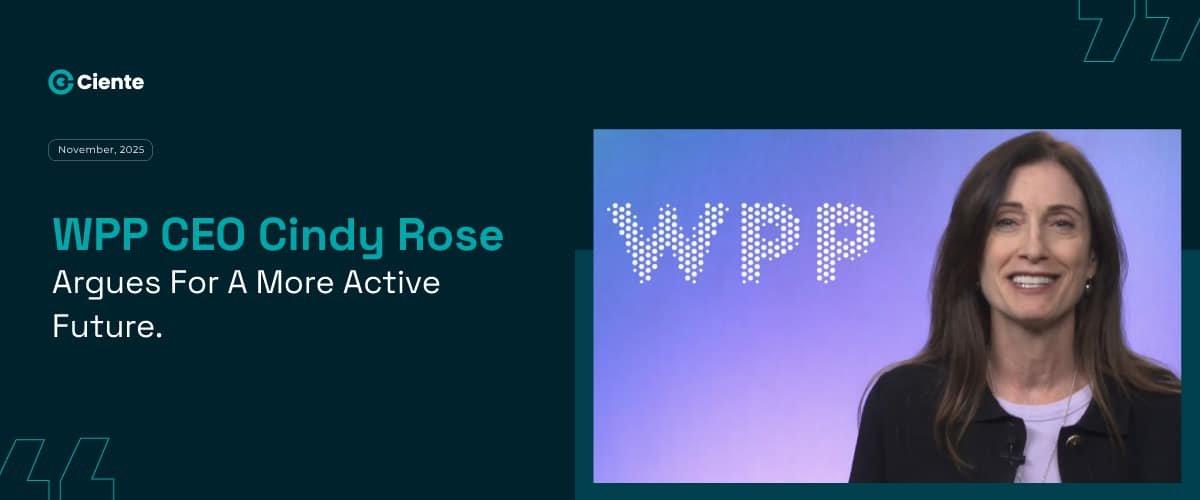
WPP CEO Cindy Rose argues for a more active future.

WPP CEO Cindy Rose argues for a more active future.

WPP CEO Cindy Rose argues for a more active future.

WPP is staring at a hard truth: as their new CEO, Cindy Rose, put it, their recent performance has been “unacceptable.”

WPP might still be a global media and advertising monolith, but increasingly it seems like its empire-state is crumbling from within.

Let’s start with the numbers. Q3 saw a like-for-like revenue decline of 5.9 % year-on-year. For 2025, they’re forecasting a full-year decline of 5.5%-6 %. Those are not the figures you plaster on a “turnaround underway” banner.

They’re red flags.

Rose is trying to shift the culture and structure: “less holdco, more co” is her mantra. Translation: WPP wants to stop acting like a giant parent company that collects agencies and start acting like a single lean operator. Clients reportedly found WPP’s end-to-end proposition confusing. That’s costly feedback for a “world-class” agency group.

And yet, here’s the twist: while the fundamentals are dire, WPP bets heavily on the future by leaning into AI and data-driven services. Rose highlights that WPP’s acquisition of InfoSum, the launch of its “Open Pro” self-serve AI platform, and a substantial partnership with Google LLC are meant to set them up for the next wave. But, and this is the crux, the question isn’t whether they say the right things. It’s whether they can do them, when execution has been, well, lacking (Rose admitted as much).

So what gives? The advertising world is changing fast: client budgets are tightening (thanks to macro risks and tariff spats) and tech is giving marketers more DIY tools. WPP is both under pressure and perhaps late to pivot. With major client exits and fierce competition (especially from nimble players) on one side, and an ambitious strategy pivot on the other, the firm is walking a tightrope.

Here’s how I’d frame your thesis: WPP isn’t just in financial trouble but a structural conundrum. It’s not enough to proclaim “AI golden age” when the clients are rattled, the message is muddy, and the operational guts haven’t kept pace.

The actual shift will come when WPP becomes the “Co,” it says, rather than the “holdco” it’s been.

And only then will those strategic bets pay off.

The Strategic Value of Using Email Marketing for Your Content Distribution

The Strategic Value of Using Email Marketing for Your Content Distribution

The Strategic Value of Using Email Marketing for Your Content Distribution

Novices assume that content distribution ends at hitting ‘publish.’ So, at the nucleus of content that doesn’t fall on deaf ears is email marketing.

A close scrutiny of the market will draw out patterns. There’s an astute observation to make- marketers keep on skipping back to traditional marketing channels after sheepishly declaring them dead.

Marketing’s been a constantly swinging pendulum. This frantic to-and-fro has blinded even the savviest marketers to the strategic and foundational value of their frameworks. First, it was cold calling, and now, it’s email marketing.

Even after crafting more and more engaging content, there’s been a hitch. The engagement rate isn’t what marketers presumed it would become. Shouldn’t it be easier to reach your target audience, irrespective of their geography?

That’s well-wishing.

The clutter of digitization has overwhelmed consumers and clamored the market with content that says nothing new. Getting through to your audience is as challenging as ever.

The old content distribution system isn’t getting in as many eyeballs as brands need- especially to stand apart from competitors. It’s been a tough nut to crack. Hitting publish is only part of the overall mechanism; it adds nothing new.

So, how precisely does your brand get content in front of the right eyes?

Content distribution guided by intent, where email marketing could prove to be your secret weapon. But before we jump into how email marketing works as a content distribution channel, let’s first grasp what precisely content distribution is.

What is Content Distribution, precisely?

It’s a strategic framework- one that informs your brand’s awareness and reputation. Because that’s how your audience reaches you through your content.

As Mailchimp defines, content distribution is-

“The process of publishing, sharing, and promoting content on various platforms. It’s all integral components of your brand’s content strategy. And the right content distribution strategy allows creators and brands to bring their content visibility.”

Content distribution guides prospects from the awareness stage to a sales conversation. That’s the objective- to turn content into a dialogue.

Yes, social media also goes all the way. But sometimes it feels like broadcasting messages that don’t really resonate outside of a viral moment. And when that hype dies down?

Virality is honey, but it’s poison too. It also gets quite hectic and expensive to keep on creating social media content. And then adding on regular, consistent posting? That requires a lot of patience and effort. It’s increasingly taxing to remain visible in this digital world.

And for content creators, that’s the bang for their buck (efforts).

But these investments don’t really reap benefits unless your audience knows that your content exists. It’s like throwing darts in the dark without a proper framework.

The right framework that we’re talking about here is a content distribution framework.

And at the nucleus of an effective content distribution strategy is email marketing.

Email Marketing for Strategic Content Distribution: How Does it Work?

Email marketing is a direct chain of communication to your target audience. Given the one-on-one comms line it affords brands, the channel is a market favorite. And its market size is projected to grow by a whopping $24.19 billion in 2033.

The only question now is, why has email become a goldmine for content marketing?

Basically, when your content is delivered through email, there’s no distraction or clutter. Your post isn’t competing with your competitors or hidden amidst social media posts, publications, or only reachable through search engines.

Why is email considered the GOAT in content distribution?

1. Direct Access

Algorithms play favorites, and SEO takes a long while to build traction. But with email, there’s no guesswork or a waitlist. You skip the line to reach your targeted inbox.

And when the receiver opens your emails, there are no pop-up ads or banner ads.

The experience is straightforward, focused, clean, and personalized.

You can share a specific blog piece with accounts that have interacted with similar content before. While you can forward product guides and how-tos to existing customers. You create emails that tactically align with your target audience’s interests, preferences, and demographics.

And the bottom line?

Your emails don’t compete with other formats or channels. It instead works alongside your other campaigns- social media, SEO, or paid ads.

2. Algorithmic Independence

Imagine you wrote a blog on “Key Trends in Marketing Automation.” You can share it on LinkedIn, get it optimized for SEO, and then forward it to your email subscribers.

But why?

Because email gives you control. It gives you ownership of your channel. And relieves you from depending on your algorithms. There are no fleeting trends you must consider. This makes email marketing a highly reliable and measurable mode of reaching your audience and building trust.

It’s personal and it’s direct. And it’s strategic. There are no blasting messages.

The entire process is guided by automation and segmentation tools. Those who ensure that the message offers value, the timing is tactical, and the recipient is right.

You aren’t spamming inboxes. You are developing a more intelligent system to engage with your audiences.

3. Easy Measurement and Trackability

AI-powered platforms and analytics today offer tremendous opportunities to keep a detailed eye on your email campaigns. Nothing’s a mystery with email.

All the tangible data is transparent- email opens, CTRs, unsubscribes, sign-ups, and downloads. And how these link to the bottom line.

And you can tweak and optimize the campaigns. Experimentation- A/B or multivariate, and split testing is easy with email marketing. You can gauge which content actually works and what you can improve upon.

4. Integration Capabilities with Other Distribution Channels

To elevate the effectiveness of your content distribution, try mixing and matching. Integrate other channels alongside emails in an omnichannel content distribution strategy.

Email goes well with any other channel, whether it’s LinkedIn, blogs, or podcasts. Such multichannel strategies extend your reach three times that of a single channel. That’s why platforms such as LinkedIn newsletters are directly tied to emails.

It boosts visibility and drives engagement. And one channel complements the other.

Your email can lead a prospect to your blog post. Meanwhile, a social media piece can encourage the prospect to sign up for your email newsletter for exclusive information.

Emails have the potential. You must merely recognize it.

For example, take cross-platform content promotions. And tie them together like:

  1. Embed podcast snippets and teasers to instill interest and build demand. Remember to maintain CTRs throughout campaigns that lead to tailored landers.
  2. Offer incentives to encourage active engagement, such as first-looks and early access to live events.

Email Marketing is A Treasure Trove, But Only When Done Right.

The experience and ROI from email marketing are unmatched. You get $36 for every dollar spent on your email campaign. That’s how consistently emails outperform other channels.

But accessibility and convenience it affords aren’t without their own challenges.

Most often, it’s email deliverability. Your content ends up in spam. And open rates don’t really convert into interest.

Here, rethinking age-old email marketing strategies is a requisite. Your brand needs a revamp.

And that’s what differentiates emails that actually hit the mark from those in spam folders. Every step is imperative- from content development to delivery optimization.

You focus on the nitty-gritty. It’s an amalgamation of granularity and a bird’s-eye view of why email marketing matters in the first place.

And the thing is that we can outline a list of rules you must follow to master effective, ROI-churning email marketing practices.

But it won’t cut it.

There Are No Rules to Email Marketing.

Just a few basics you must follow- from the subject line and CTAs to the design and clear messaging. Email is still content after all. The only two fundamentals you have to polish are email list segmentation and delivery optimization.

Remember, Buzzfeed’s Dog A Day newsletter? It’s one of the popular email content marketing playbooks– one that got Buzzfeed an impressive CTR of 20-30%. All because it was light-hearted and simple.

That’s what the future of email marketing demands- simplicity to bypass the content chaos.

Honestly, that’s where it’s heading: interactive email marketing that’s personalized. And transforms the mundane and passive process of reading emails into an immersive experience.

And this is what’ll help marketing remain on its tippy toes with its content distribution.

To proactively ensure that any of the content pieces doesn’t fall on deaf ears.