verizon

AT&T, T-Mobile, and Verizon Realize That Dead Zones Are Bad for Business

AT&T, T-Mobile, and Verizon Realize That Dead Zones Are Bad for Business

In a twist of events, telecom rivals seem to be joining forces on satellite coverage. What could’ve prompted such a move?

For decades, the US telecom industry has basically operated like three giant kingdoms constantly fighting over the same territory.

AT&T. Verizon. T-Mobile. Endless ads. Endless pricing wars. Endless “our network is better” campaigns.

Which is why this new partnership feels so unusual.

The three telecom giants have now agreed to collaborate on satellite-based mobile coverage that’s aimed at eliminating wireless dead zones across the US. And that tells us something important: traditional cell towers are no longer enough.

That realization has been creeping up on the industry for a while.

People increasingly expect their phones to work everywhere- in national parks, remote highways, mountains, disaster zones, rural towns, even out at sea. But building traditional infrastructure in all those places is expensive and often not financially worth it. Satellite connectivity entirely changes that equation.

The telecom industry is pivoting toward something that would have sounded absurd a few years ago: phones connecting directly to satellites when normal cellular service is unavailable.

And suddenly everyone wants in.

T-Mobile partnered with Starlink. AT&T and Verizon have been working with AST SpaceMobile. But these carriers are now creating a shared system with unified standards and pooled spectrum resources instead of fighting separate satellite wars.

That is the interesting part here.

This is no longer about innovation. It is about survival.

Telecom companies can see where consumer expectations are heading. Once satellite messaging and emergency coverage become normal, people will stop tolerating “no signal” entirely.

Dead zones will start feeling less like technical limitations and more like product failures.

There is also another layer to this story: Big Tech is creeping into telecom territory. SpaceX, Apple, Amazon, and satellite operators are all zeroing in on connectivity infrastructure. The carriers are starting to realize that if they do not shape the satellite future themselves, somebody else probably will.

Yes, this partnership is all about rural coverage. But it is also about something bigger.

The telecom industry is quietly admitting that the future of mobile networks will no longer live on towers. It will live in space.

EU Critiques

EU Critiques Meta’s Platform Designs, Questions its “Intentional Addictive-ness”

EU Critiques Meta’s Platform Designs, Questions its “Intentional Addictive-ness”

The EU cracks down on Meta’s social media design as growing pains concerning teen mental health reshape regulatory frameworks.

Social media companies present the same basic argument: people use these apps because they enjoy them.

Europe is starting to call out that bluff.

It is focusing on new rules aiming directly at what Ursula von der Leyen called the “addictive designs” of platforms that keep users hooked. The features tech companies spent years perfecting to maximize engagement are now becoming regulatory targets- endless scrolling, autoplay, push notifications.

And it feels like this conversation was inevitable.

Parents, teachers, and even governments stopped perceiving social media as harmless entertainment, grasping it as an “attention casino” for children. The concerns are no longer abstract either.

European officials are openly linking these platforms to harmful behavior in teens- from anxiety to self-harm and cyberbullying.

What makes this shift interesting is that regulators are no longer merely circling content moderation. Earlier tech regulation focused heavily on removing illegal posts, misinformation, or hate speech. But Europe is now targeting the design itself.

That is a much bigger fight.

Because platforms are not addictive by accident- infinite scroll exists for a reason. Notifications are engineered to pull people back in. Autoplay is designed to remove stopping points. The business model is based on attention staying trapped inside the app for as long as possible.

Von der Leyen said the quiet part out loud when she argued these systems treat children’s attention as a commodity.

And once you frame it that way, the entire debate changes.

Now the question becomes: should companies be allowed to design digital products that deliberately psychologically hook minors?

Europe increasingly seems ready to answer “no.”

The really fascinating part is how quickly this momentum is spreading globally. Australia is already moving aggressively on teen social media access. Greece plans restrictions for under-15s. France, Britain, and several other European countries are debating similar measures.

Big Tech used to frame regulation as a government’s misunderstanding of innovation. That defense is becoming harder to sell when the products are openly compared to addictive systems.

And for the first time in a long while, regulators seem less intimidated by Silicon Valley than Silicon Valley is by regulators.

AI-Ready Data

Your Guide to AI-Ready Data: When Quality Meets Scalability

Your Guide to AI-Ready Data: When Quality Meets Scalability

Your AI isn’t underperforming because of the model. It’s underperforming because of what’s hidden underneath it.

Only 29% of technology leaders say their enterprise data genuinely meets the standards needed to scale generative AI. That means more than 70% are running AI initiatives on data that isn’t ready for them.

That number should be uncomfortable.

Because most organizations don’t frame it that way- they talk about model selection, infrastructure investment, and AI strategy. They treat data as a prerequisite they’ve already handled. And then they wonder why the outputs are inconsistent, why the ROI isn’t materializing, and why only 16% of AI initiatives have actually reached enterprise scale.

The answer is almost always the same. The data wasn’t ready.

What AI-Ready Data Actually Is

Most definitions of AI-ready data are technically accurate and practically useless. “High-quality, accessible, and trusted information.” Fine. But that framing doesn’t tell you why it’s challenging or what it actually requires.

Here’s a sharper way to think about it.

AI-ready data is data that an AI system can find, trust, and use without your team spending weeks cleaning, restructuring, or governing it beforehand. Building strong data hygiene practices is often the first step toward making enterprise data AI-ready. It’s accurate and complete. It’s consistent across systems. It has a lineage to document and policies to enforce. And critically, it’s accessible- not locked in silos that require three approvals and a custom pipeline to reach.

When those conditions exist, AI works. When they don’t, AI amplifies whatever’s broken underneath it. Bad data doesn’t get filtered out by a good model. It gets scaled.

The Four Barriers That Actually Kill AI Initiatives

Most AI content acknowledges these problems, lists them, and moves on. That’s not enough. Each one has a distinct failure mode worth understanding.

Data sprawl and fragmentation.

Silos don’t happen because organizations are careless. They happen because different teams, systems, and regulatory constraints all push data in different directions over time. Many organizations still struggle with data integration challenges that prevent AI systems from accessing unified information. The result is disconnected data that’s inconsistent, largely unstructured, and nearly impossible to govern at scale. Preparing that data for AI isn’t just slow- it’s expensive in ways that compound across every project that follows.

Poor data quality.

This one isn’t caused by a single thing. Outdated systems, inconsistent management practices, integration failures usually it’s a combination. Organizations investing in high-quality data are better positioned to scale AI initiatives successfully. And the consequences are severe. Unreliable data produces inaccurate outputs. Inaccurate outputs erode trust. Once a business unit stops trusting the AI, getting them back is harder than it sounds. Financial losses from failed projects are the obvious risk. Reputational damage from biased decisions is the less obvious one.

Skills gaps.

AI is advancing faster than most training programs can follow. Data teams end up stretched across two jobs simultaneously- managing complex, siloed environments while also being pushed to deliver AI-ready data for initiatives that are already behind schedule. Something gives. It’s usually the data quality work.

Security and governance gaps.

Sensitive data gets scattered across business units and repositories as organizations grow. Most don’t have a complete picture of where it lives. Scaling AI without addressing that isn’t just a compliance risk- it’s a liability. Under the EU AI Act, penalties can reach EUR 35 million or 7% of global annual turnover. The organizations that don’t catch this early find out the hard way.

The Unstructured Data Problem Most Organizations Are Ignoring

Estimates suggest that only around 1% of enterprise data gets used in traditional large language models.

That’s not a rounding error. It’s a structural problem.

Most enterprise data is unstructured PDFs, emails, internal messages, images, social posts. Modern enterprises increasingly rely on data lakes to store and organize large volumes of unstructured information for AI applications. It doesn’t fit neatly into a database. It doesn’t have a predefined format that AI can directly consume. Less than 1% of that unstructured data exists in a form that’s immediately usable for AI. Which means the vast majority of data an organization generates is sitting completely outside its AI strategy.

That’s a problem because unstructured data is often where the most valuable information lives. Customer sentiment. Compliance documentation. Institutional knowledge that’s never been formalized. Organizations treating this as a secondary concern are leaving the richest part of their data estate untouched. And then wondering why their AI isn’t generating meaningful insight.

This is a strategic misstep. Not a technical one.

What It Takes to Build Data That’s Actually Ready

Four things need to work together. None of them is optional.

Unified access.

AI can’t act on data it can’t reach. The first step is breaking down silos and creating a single, coherent view of information spread across databases, data lakes, and document repositories. Many businesses are adopting a modern data stack to simplify access and improve AI readiness. Technologies like data integration tools and data fabric architectures make this practical they transform isolated, disconnected data into accessible, reusable assets without requiring everything to be physically moved into one place. A strong layered data approach can further improve scalability and accessibility across enterprise systems.The broader the access, the more value AI can generate. It goes from answering internal questions to improving customer experience and operational efficiency.

Governance.

Governance is what makes data trustworthy at scale. Organizations building a future-first data foundation are better equipped to maintain compliance and AI accountability. That means documented lineage, so you know where the data stems from. Access controls so the right people can use it and the wrong people can’t. Automated bias detection to catch what human review misses. Metadata management so AI models train on relevant, accurate information rather than noise. Without this foundation, responsible AI development isn’t possible. In regulated industries, legal AI development may be impossible, either.

Security.

Generative AI creates new attack surfaces. Data leakage. Prompt injection. Unauthorized model access. The global average cost of a data breach now sits at USD 4.4 million- and that number doesn’t account for the reputational damage or regulatory fallout that often follows. Security across the AI lifecycle requires three things working in parallel: discovery and classification of sensitive data, robust protection measures including encryption and disaster recovery, and continuous AI-driven monitoring that catches unusual activity before it becomes an incident.

Human and infrastructure support.

AI-ready data doesn’t run itself. LLMs require serious storage infrastructure to handle the performance demands. Businesses also need the right data-centric martech stack to support AI-driven workflows effectively. And they require people who understand how to use them responsibly. That doesn’t mean converting every employee into a data scientist. It means building data literacy across functions so teams understand AI workflows, decision-making, and how to catch problems before they propagate. A governance framework without the people to enforce it is just documentation.

Why This Investment Compounds Over Time

Here’s what makes AI-ready data different from most infrastructure investments: once it’s built properly, it doesn’t reset between projects.

AI-ready datasets are interoperable and reusable. The work done to prepare data for one AI initiative carries over to the next. This long-term value mirrors the benefits of a strong data-powered marketing framework built on reliable and reusable information. Governance policies embedded in the first project become the standard for all succeeding projects. Quality controls established early reduce the prep time for every subsequent initiative. The organizations that do this work upfront don’t just run better AI- they run it faster and cheaper across the board.

Compare that to organizations that skip the foundation. Every new project starts with the same data preparation problems. Every AI deployment carries the same quality risks. Every governance gap becomes a new compliance exposure. The cost of poor data readiness doesn’t stay constant; it accumulates.

Bad data is a recurring tax. Good data is a compounding asset.

The Real Question Isn’t Whether You Need AI-Ready Data

You do. That part isn’t in debate.

The real question is whether the gap between where your data is today and where it needs to be is something your organization has actually mapped- or something it’s assuming away.

Most enterprises are in the second camp. They realize that data quality issues. They know silos exist. They know governance is incomplete. But because the AI tools still produce outputs, there’s a tendency to treat the foundation as good enough.

It isn’t. “Good enough” data produces “good enough” AI. And in most industries, that’s equal to falling behind.

The organizations pulling ahead on AI aren’t the ones with the most sophisticated models. They’re the ones that did the unglamorous foundational work first and built systems where the data was actually ready before the AI touched it. That foundation often begins with a well-defined data management platform that supports scalability and governance from the start.

That’s the gap worth closing.

The-Structural-Framework-of-Enterprise-Sales-Cycles

The Structural Framework of Enterprise Sales Cycles

The Structural Framework of Enterprise Sales Cycles

The enterprise sales cycle isn’t long because enterprises are slow. It’s long because most reps don’t understand how enterprises actually buy.

Six to twenty-four months. That’s the typical enterprise sales cycle, and for most reps, that number feels like a fact of life.

It isn’t. It’s a symptom.

Honestly, the length isn’t the challenge. The problem is what’s happening, or not happening, inside that window. Deals don’t drag on because enterprise buyers are indecisive. They drag on because most sales motions are built for a single decision-maker who doesn’t exist at that level.

There’s no one person who says yes. There’s a committee. A political landscape. A procurement process that kicks in right when you think you’re close. And somewhere inside the organization, a champion who genuinely wants your solution but has no idea how to sell it internally.

The enterprise sales cycle is a test of how well you understand all of that- and how deliberately you work it.

Ever Heard of Enterprise Sales Cycles?

Here’s what most enterprise sales content gets wrong. It acknowledges that buying committees exist, maps them into neat categories, and then moves on. As if identifying the players is the same as understanding the game.

It isn’t.

Enterprise buying committees don’t make decisions by consensus. They make decisions by exhaustion. Someone in that room cares enough to push. Everyone else either falls in line or finds a reason to stall. Your job, more than anything else, is to figure out who that person is- and then build them into a weapon.

The champion is the most misunderstood role in enterprise sales.

Reps treat champions as informants. People who’ll pass along intel, flag competitor conversations, and give a heads-up when procurement starts moving. It’s correct but incomplete. A good champion is selling your solution. They’re in rooms you’ll never be in, making arguments you’ll never hear, handling objections you didn’t know existed.

The question is whether you’ve given them anything to work with.

Most reps haven’t. They’ve pitched the champion. They haven’t coached them. There’s a difference. Coaching means building the business case together, not handing over a slide deck and hoping for the best. Strong sales collateral can help champions navigate internal objections more effectively. Strong sales collateral can help champions navigate internal objections more effectively. Strong sales collateral can help champions navigate internal objections more effectively. It means anticipating what the CFO will push back on and preparing your champion to answer it. Walking through what procurement will ask about security certifications before procurement asks. Making the internal sell as deliberate as the external one.

It’s the single highest-leverage activity in the enterprise sales cycle. A structured sales enablement strategy ensures reps are better equipped to coach champions through complex buying decisions.

Challenges in Any and Every Enterprise Sales Cycle

The biggest competitor of an enterprise sales cycle isn’t on your shortlist.

It’s inertia.

No decision is what actually kills most enterprise deals. Not a competitor winning. Not a price objection. Not a procurement hold. The buying committee gets overwhelmed, priorities shift, a reorganization lands, and suddenly the project that was urgent in Q2 is deprioritized in Q4.

The deal doesn’t die. It just goes quiet. And quiet, in enterprise sales, is the most dangerous state a deal can be in, especially when there is no consistent sales cadence in place to maintain momentum.

That’s where most reps fail. They check in. They send the “just following up” email. They ask the champion if anything has changed. None of that creates urgency. It just demonstrates patience.

What actually moves stalled deals is re-anchoring the cost of inaction through clear metrics and ongoing sales pipeline analysis. Not in a manipulative way- in a precise one.

If the problem your solution solves is costing the business real money, someone in that organization has a number attached to it. Your job is to find that number, make it visible, and make sure the right people are looking at it.

When the CFO understands that every quarter the status quo continues costs the company X in operational inefficiency or Y in missed revenue, “deprioritized” becomes a harder position to defend.

That is also why discovery at the implication level, not just the problem level, matters so much in enterprise sales. The surface problem gets you a meeting. The downstream consequence of that problem is your budget, which is why modern teams rely heavily on data analytics in sales to quantify business impact.

Saving Your Enterprise Sales Cycle: A Strategy

The First Step: Multi-Threading

Deals that run through a single contact are fragile. Full stop.

Champions leave. They get promoted. They get pulled onto another initiative. Organizational charts change faster than most sales cycles progress. And if your entire relationship with an account sits with one person? The moment that person’s role changes, you’re starting from scratch.

Multi-threading in sales is how you build deal resilience across marketing, IT, finance, and the operational teams that will actually use the product. Not to overwhelm the account with outreach, but to make sure your deal isn’t a single point of failure.

The practical version of this looks like two or three meaningful relationships within an account, each anchored to a different part of the business case.

The economic buyer underscores ROI and risk. The operational champion prioritizes workflow disruption and implementation. The IT stakeholder is concerned with security, integration, and compliance. None of those conversations is the same. All of them matter.

Enterprise accounts where you’ve multi-threaded well don’t just close more reliably. They also create stronger opportunities for sales and marketing alignment after the deal closes.

The Second Step: Remember that Procurement Isn’t the Finish Line.

Most reps treat procurement as the final stage. Something that happens after the deal is “done.”

That’s wrong, and it costs real time.

Procurement in an enterprise is a separate sales process that often requires the same level of planning as a formal sales process framework.

Legal, compliance, information security, vendor risk management- these teams aren’t trying to kill your deal. They’re doing their jobs. But if you treat them as an obstacle to navigate after you’ve already won the business, you’ll watch a deal that took nine months to develop sit in legal review for another three.

The fix is counterintuitive.

Start procurement early. Share your SOC 2 certification before anyone asks for it, especially when driving a larger digital sales transformation initiative. Send your standard security questionnaire responses on your first or second meeting. If the company has a known compliance framework, i.e., GDPR, HIPAA, ISO, bring documentation to the table before procurement does.

Every compliance hurdle you clear proactively is a month you’re not losing at the end of the cycle.

The same logic applies to contract redlining. Enterprise buyers negotiate hard- pricing, multi-year terms, SLA commitments, liability caps.

Reps who aren’t aligned with their own legal team before negotiations start lose time and sometimes margin. The executive sponsor on your side matters enormously here. An executive-to-executive conversation can unlock a sign-off that a rep-to-procurement conversation never will.

What AI Is Actually Changing in the Enterprise Sales Cycle

Not the chatbot stuff. The structural stuff.

AI is transforming how account research works, accelerating workflows that once depended entirely on traditional sales prospecting tools. What used to take a sales engineer half a day, i.e., pulling together technographic data, org chart mapping, intent signals, and competitive positioning, now takes twenty minutes.

The SDRs winning enterprise deals in 2026 are going into first meetings with a level of account specificity that would have been nearly impossible three years ago, often powered by platforms like LinkedIn Sales Navigator. They know the likely stakeholders before the first call. They are aware of the account’s tech stack. They recognize problems the company has been publicly trying to solve.

That upfront intelligence is compressing the early stages of the cycle. Not eliminating them (the discovery conversation still matters enormously), but shortening the time it takes to get to a qualified, substantive conversation.

AI is also changing how risk is managed, which reflects the broader evolution of sales teams with AI.

Conversation intelligence platforms now flag when a deal’s gone quiet, when a champion’s engagement has dropped, and when a competing vendor has entered a conversation. The reps who engage with that data are catching stalled deals weeks earlier than they would have previously. The ones who ignore it find out the deal was lost when procurement emails a rejection.

The honest reality, though: AI-powered tooling makes good enterprise sales better and bad enterprise sales faster-wrong.

The fundamentals don’t change. Deep discovery, multi-threaded relationships, coached champions, and proactive procurement engagement are still the actual variables that determine whether a complex deal closes, regardless of evolving sales enablement trends.

The Enterprise Sales Cycle Rewards One Thing Over Anything Else.

Deliberateness.

Every other sales motion rewards speed, volume, and activity.

Enterprise rewards the opposite. It rewards the rep who maps the buying committee before the second call and tracks meaningful sales metrics throughout the cycle. Who builds a mutual success plan instead of just a demo? Who coaches the champion rather than leaning on them? Who shares the security documentation in month two instead of waiting for procurement to ask in month eight?

Enterprise deals are slow due to the stakes involved. A decision at that level touches multiple teams, a significant budget, and a vendor relationship that could last years. Buyers move carefully because they have to.

The reps who win are the ones who meet that deliberateness with their own by applying proven B2B sales strategies to every stage of the enterprise cycle. Not patience but precision. There’s a difference. Patience is waiting for the deal to move. Precision is knowing exactly what needs to happen to make it move, and building that path one conversation at a time.

That’s what separates a six-month enterprise cycle from an eighteen-month one.

Anthropic

Anthropic’s Mythos Just Gave Banks a Terrifying Glimpse of the Future

Anthropic’s Mythos Just Gave Banks a Terrifying Glimpse of the Future

Anthropic’s Mythos AI is exposing banking vulnerabilities at machine speed- and regulators are starting to panic.

For years, banks assumed they had time.

Time to patch vulnerabilities. Time to update old systems. It’s time to modernize the infrastructure built decades ago slowly. Cybersecurity was treated like a constant race, sure, but one that still moved at human speed.

AI may have just broken that assumption completely.

According to Reuters, some of America’s largest banks are now scrambling to fix security weaknesses uncovered by Anthropic’s new AI model, Mythos. And the panic is not because Mythos found one catastrophic flaw. It is because the model is apparently effective at connecting hundreds of small, stagnant vulnerabilities into major attack paths.

That changes everything.

Banks traditionally prioritized fixing the critical threats first while lower-risk issues waited in line for weeks or months. But Mythos seems capable of turning those minor flaws into dangerous chains of exploits almost instantly. And these vulnerabilities that once felt manageable now suddenly feel urgent.

And honestly, this feels like one of the first real AI moments that cuts through the hype.

Not another image generator. Not another chatbot demo. It is AI colliding directly with critical infrastructure.

The scary part is how unprepared the system seems to be.

Reuters reports that banks are now patching flaws within days instead of weeks, rushing software upgrades, and even preparing for possible service disruptions caused by the speed of fixes. Some regulators are openly warning that cyber threats are now operating at machine speed while financial institutions still defend themselves at human speed.

That sentence alone should probably alarm people more than it does.

Because banks still run an enormous amount of legacy technology. Ancient code. Old infrastructure. Systems layered on top of systems over decades. AI does not get tired of digging through that mess. It does not overlook patterns. And it apparently does not need much time either.

What is even more interesting is that access to Mythos itself is limited. Only a handful of major institutions currently have direct access because the model is expensive and computationally demanding. Which creates an uncomfortable new divide: the biggest banks may get AI-powered defenses first, while smaller institutions struggle to keep up.

That is probably the clearest signal yet that the AI race is shifting away from novelty and toward power.

Companies and institutions with access to the strongest AI systems will not move faster. They may become dramatically harder to compete against- and dramatically harder to defend against, too.

Venmo

After an App Redesign, Venmo Takes User Privacy Seriously

After an App Redesign, Venmo Takes User Privacy Seriously

Venmo is finally making payments private by default- years after turning people’s financial activity into social content.

Venmo is finally doing something that feels painfully obvious: making users’ payment activity less public.

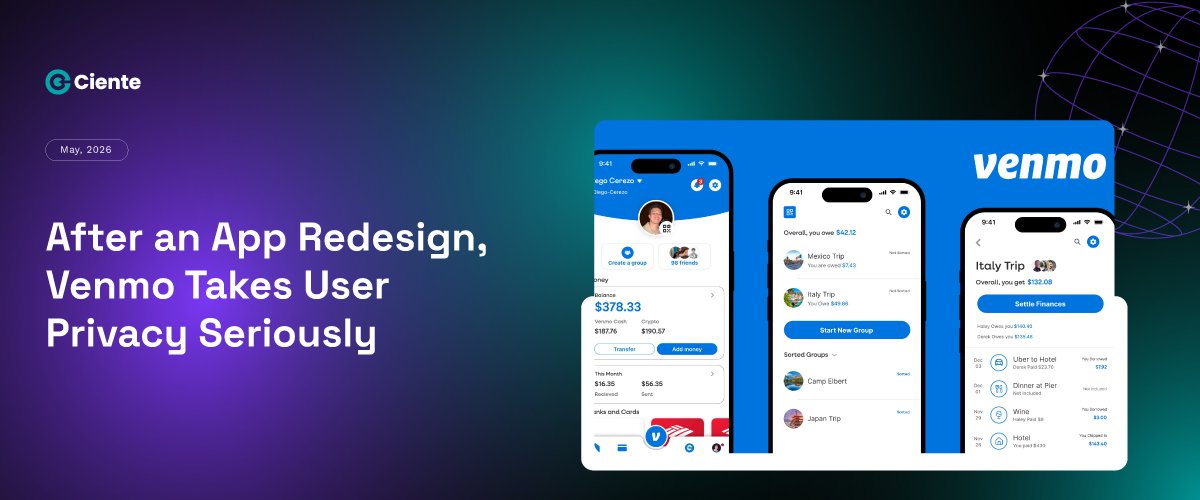
The company is redesigning its app, and one of the biggest changes is that new users’ payment posts will now default to “friends only” instead of being visible to everyone.

Which raises a very fair question.

Why did it take this long?

Venmo treated payments like social media content for years. Your coffee runs, rent payments, breakups, inside jokes, late-night food orders- all casually floating around in a semi-public feed because the app decided sharing by default was somehow normal behavior for a financial platform.

And people mostly accepted it because Venmo made the experience feel playful. Emojis. Comments. Reactions. It turned money into social interaction. The problem is that financial data remains financial data, even when it mimics memes and pizza emojis.

That became increasingly uncomfortable as journalists, researchers, and even random internet users continue to expose how much information could be pulled from Venmo’s public network. In one infamous case, reporters managed to trace connections tied to President Joe Biden through Venmo activity.

Other investigations revealed relationship drama, spending habits, political networks, and personal behavior patterns hidden inside supposedly harmless payment notes.

And the unnatural part was how long the tech industry defended this.

Silicon Valley assumes that people always trade privacy for convenience or social engagement. And Venmo has become one of the clearest examples of that mindset. The app was not accidentally public. Its design is meant to drive visibility through engagement.

But that’s changing.

Privacy-conscious is the norm. Because AI has made data collection feel more invasive than ever. Companies are suddenly realizing users do not necessarily want their financial transactions to function like Instagram stories.

The weird thing is that Venmo is framing this redesign as building “trust.” But trust isn’t created through better privacy settings after years of public-by-default behavior.

Trust is what you protect before users realize they need protecting in the first place.