
Thought Leadership in SaaS Marketing

Authority Over Noise: Thought Leadership in SaaS Marketing

Authority Over Noise: Thought Leadership in SaaS Marketing

Thought leadership in SaaS marketing is the norm, but only a fraction of it moves buyers. What truly separates content that builds authority from one that just fills calendars?

Most SaaS companies say they practice thought leadership. Few actually do.

That’s not a hot take. It’s what the data shows.

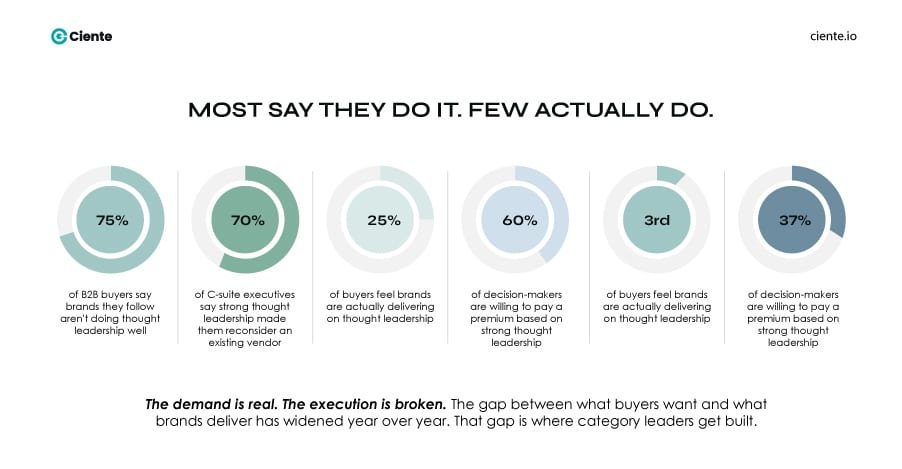
75% of B2B buyers say the brands they follow aren’t doing thought leadership well. While 70% of C-suite executives say strong thought leadership has made them reconsider an existing vendor relationship.

The demand is real; it’s the execution of your lead generation services strategy that’s broken.

So, if you’re a SaaS marketer trying to figure out where to put your energy- this one’s for you. Not a framework. Not a checklist. But a nuanced insight into the space thought leadership holds, especially in B2B SaaS marketing.
Ciente.io

Thought Leadership in SaaS Marketing Is More Challenging Than It Looks

Every brand has blogs and a LinkedIn presence. All of them are “sharing insights.”

And that’s the conundrum.

When thought leadership became a recognized growth lever, it also became a template for marketers. The result? A flood of content that looks like thought leadership but functions like noise. SEO-optimized posts with no real opinion. Founder stories that follow the same vulnerability arc. Frameworks that repackage common sense.

Buyers, especially senior ones, see through it in a go.

The B2B International 2024 Superpowers Index found that being a genuine thought leader jumped from 20th to 3rd place as a decision-making driver globally. For millennial and Gen Z buyers, it ranks second. But only 25% of buyers feel brands are delivering on it. That gap has progressed year over year.

What this tells you: the bar isn’t just being present. It’s being genuinely useful to someone making a hard decision. That’s a higher bar than most content teams can clear.

And it’s getting harder.

AI has made mediocre content essentially free to produce. That’s raised the floor, but it’s also made the ceiling more valuable. a shift already reshaping AI SaaS trends in 2026. Undifferentiated content isn’t merely ignored- it actively erodes trust. When buyers can’t tell your insight from a GPT output, you’ve lost the game before it started.

The challenge for SaaS marketers isn’t volume. It’s intellectual courage. something often missing even in well-documented B2B SaaS marketing principles. Most content is optimized to offend nobody. That’s precisely why it moves nobody.

What Buyers Actually Respond to in B2B SaaS Thought Leadership

Let’s be specific about what moves people, because “authentic and human” isn’t the answer.

That framing is everywhere right now, and it’s mostly a distraction. Authenticity has become its own performance. The vulnerable LinkedIn post. The “lessons I learned the hard way” thread. These formats were differentiating once. Now they’re a genre.

What actually drives buyer behavior is rigor. Specificity.

A point of view that’s hard to fake. Over 60% of decision-makers say strong thought leadership makes them more willing to pay a premium. That’s not happening because a founder seems relatable. It’s happening because something they read made them think differently about a problem they have.

A few things that consistently work:

Proprietary data and perspective

If your product is part of a workflow, you see patterns your buyers can’t. That’s primary research they can’t get elsewhere. Gong‘s revenue intelligence reports. Carta’s equity benchmarks. That isn’t content but evidence. It has scarcity value.

Genuine contrarianism

Not manufactured edginess. An actual position that costs you something. That means some readers will disagree with your perspective. That’s the point.

Thought leadership that tries to appeal to everyone says nothing useful to anyone.

Practitioner-level specificity

There’s a readable difference between content written by someone who has lived a problem and content written about a problem. Senior buyers, the ones making vendor decisions, are sophisticated readers. They can tell. Write for people who know more than they think you do.

Sustained investment in one territory

Authority compounds over time. A single brilliant piece rarely builds a category. What builds categories is consistent, deepening engagement with a specific domain over months and years.

None of this is about tone. It’s about substance. The tone follows from actually having something worth saying.

The SaaS Content Trap: Volume Over Intellectual Commitment
The SaaS Content Trap

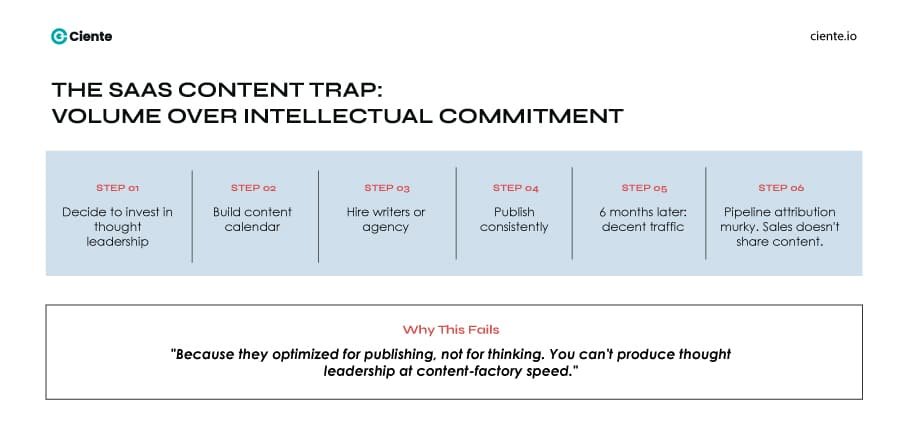
Here’s a common pattern in SaaS marketing-

A company decides to invest in thought leadership. They build a content calendar, often guided by a SaaS content marketing playbook. They hire writers or an agency. They publish consistently. Six months later, traffic is decent, but pipeline attribution is murky, and the sales team doesn’t share the content.

Why? Because they optimized for publishing, not for thinking.

You can’t produce thought leadership at content-factory speed. It requires people inside the organization, i.e., executives, product leaders, practitioners, to actually develop and defend a point of view.

That’s slower. It’s messier. It often can’t be delegated entirely to a content team.

The research backs this up.

According to B2B International, 37% of B2B companies with thought leadership programs describe them as “minimal,” meaning fewer than 5% of their internal experts actively contribute. Nearly everyone claims to practice thought leadership. But almost no one structures their organization to really support it.

The fix isn’t hiring more writers. It’s integrating content into how your company thinks, not just how it publishes. That means:

  1. Your subject matter experts must be part of the ideation process.
  2. Editorial decisions should be driven by “what’s true and interesting,” not just “what will rank.”
  3. Being willing to take positions in public that your competitors won’t touch.

It’s more challenging than a content calendar. It’s also the only version that works.

How SaaS Marketers Can Build Thought Leadership That Actually Compounds

Want to build something that compounds — something aligned with a long-term B2B SaaS growth marketing strategy that makes your brand the reference point in a category? Here’s where to focus.

1. Start with a narrow territory.

Don’t try to lead thought on the entire industry. Choose a specific pain point your buyers face and dive deep. the same focus required to define a strong SaaS product-market fit. Category authority comes from depth, not breadth.

2. Mine your product data.

What does your product see that nobody else does? Aggregate it. Anonymize it. Publish it. That’s the most defensible form of thought leadership because nobody can replicate your data set. Even small datasets are valuable if they’re specific and honest.

3. Anchor ideas to real people.

B2B buyers don’t follow brands. They follow people who think interesting thoughts.

Your thought leaders within your organization- the CEO, product head, and other customer-facing experts. Offer them the platform, nudge them to develop a perspective, and make it simpler to publish consistently.

4. Set a bar for positions, not just topics.

Before publishing anything, ask: Does this say something a competitor couldn’t or wouldn’t say? If the answer is no, it’s not thought leadership. It’s content marketing, and there’s nothing wrong with that, but don’t confuse the two.

5. Measure differently.

Thought leadership is notoriously hard to attribute in a last-touch model.

Track it through pipeline influence, deal velocity in accounts where prospects engaged with content, and qualitative sales feedback. and supporting SaaS metrics that reflect long-term impact. Is your sales team using the content in conversations? That’s a signal. If they’re not? Something’s off.

The compounding effect is real.

The compounding effect is real — especially when thought leadership is integrated into your broader SaaS growth strategies rather than treated as a standalone initiative.

The only hiccup? It takes 12-18 months of consistency to deliver clear returns. That’s a hard sell to a quarterly-focused revenue team. Make the case anyway.

Thought leadership in SaaS marketing isn’t dying. The generic version of it is.

Buyers want it more than ever. They’re just better at differentiating the real thing from its performance. That’s actually good news for marketers willing to do the harder work. Why? The field of genuine intellectual contribution is less crowded than the field of content production.

The opportunity is real.

The distance between what buyers want and what brands deliver has been the same even after two years. That gap is where category leaders get built.

The question is whether your organization is willing to invest in the substance of thought leadership, not just its format.
CrowdStrike and Datadog Stocks Take a Hit After Anthropic Launches Its Own Security Tool

CrowdStrike and Datadog Stocks Take a Hit After Anthropic Launches Its Own Security Tool

CrowdStrike and Datadog Stocks Take a Hit After Anthropic Launches Its Own Security Tool

If AI starts automating code scanning and patch suggestions, will the cybersecurity sector shrink? Or will it grow because enterprise risk still needs humans and hardened systems?

Cybersecurity names like CrowdStrike and Datadog slid sharply this week after investors reacted to a new AI-powered security tool from Anthropic. Shares of both dropped around 10–11 % as traders weighed the implications.

Other defenders, such as Zscaler, Fortinet, and Okta, also lost ground. The market’s mood was clear: AI might eat into the cybersecurity pie. Even stalwarts like Palo Alto Networks and SentinelOne saw their stocks soften.

The trigger was Claude Code Security, a feature built into Anthropic’s AI that scans open-source code for vulnerabilities and suggests fixes. That sounds useful. But critics assert that it doesn’t replace real-time protection or operational security. It’s not catching active attacks or spotting live intrusions.

Here’s the conversational takeaway: the sell-off feels more fear-driven than fact-driven.

Analysts stated that companies like CrowdStrike and Datadog still run real-world security systems that customers pay for daily. The AI tool is cool on paper, but it doesn’t yet do the heavy lifting required across enterprise firewalls and networks.

Investors often move before fundamentals change. When a shiny AI story hits headlines, traders tend to sell first and ask questions later. It seems to be exactly what happened here.

It’s worth noting that cybersecurity demand isn’t going away. If anything, digital threats escalate. AI might add tools to the defender’s toolkit, but it also gives attackers new ways to probe systems and exploit vulnerabilities. That could increase the need for services from established vendors rather than reduce it.

The punch?

The market is punishing stocks based on potential future disruption, not actual erosion of sales or customer base.

If today’s drop is the fear of AI, the real test will be whether customers keep spending on tried-and-true cybersecurity products. Investors should assess earnings and enterprise contracts more than hype around new tools.

Data centers

While Data Centers Hamper Quality of Life, Amazon Plans to Invest $12 billion in Another Buildout

While Data Centers Hamper Quality of Life, Amazon Plans to Invest $12 billion in Another Buildout

AI’s future could depend on massive physical infrastructure as much as clever algorithms. Who wins (and who gets left behind) may come down to who builds the backbone, not just writes the code.

Amazon just announced it will spend $12 billion on new data center campuses in northwest Louisiana. These facilities will host cloud services and support artificial intelligence workloads.

The investment is real and heavy.

The campuses will be built in Caddo and Bossier Parishes. Amazon says this will create over 540 full-time data center jobs plus around 1,700 roles tied to operations, such as electricians and technicians.

This money isn’t about small upgrades.

It’s part of Amazon’s massive expansion of AI and cloud infrastructure that includes an expected $200 billion in capital spending this year. That’s more than any other big cloud rivals as they race to handle AI demands.

Here’s what Amazon is selling: growth, jobs, and local investment. The company also suggests sustainability moves such as using surplus water and natural air to cool equipment and pledging funds for local water infrastructure.

But there’s another side. Wall Street has been uneasy about big tech capital spending. Amazon’s shares have dipped after revealing these hefty outlays, asserting that investors prioritize immediate returns as much as long-term infrastructure plans.

There’s also an economic angle beyond Amazon.

Often seen as outside the main tech hubs, Louisiana will now become a key node in U.S. AI infrastructure. It has it all- reliable power, a competitive business environment, and local workforce incentives.

Here’s the punch: this isn’t just cloud sprawl.

It’s a physical backbone for the next pulse of AI services. Whoever controls compute at scale will shape how AI is deployed across industries. Amazon isn’t politely joining that race.

It’s investing in major capital with a long-term vision.

UK’s Data Centre

UK’s Data Centre Boom Could Break the Grid, and That’s a Big Problem

UK’s Data Centre Boom Could Break the Grid, and That’s a Big Problem

Is Britain ready to power the future of AI if that future also risks overwhelming the grid and slowing down the clean energy transition?

A new warning from the UK’s energy regulator, Ofgem, is turning heads.

Around 140 proposed data centres could demand about 50 GW of electricity at peak times. That’s more than the entire country currently uses at once. That means these facilities could almost double Britain’s peak power demand.

Data centres aren’t small.

They house vast banks of servers that power cloud computing, streaming, and increasingly, AI workloads. These machines need constant electricity supplies. That’s where the stress hits home. The UK grid was not built for this kind of load surge.

Ofgem is now worried about the grid’s ability to keep up while still supporting other national priorities.

This push isn’t just theoretical.

Ofgem says many grid connection requests from data centre developers might not be financially sustainable. That raises a real question: who pays for upgrades? The regulator is considering stricter rules and upfront connection costs to help companies build and fund their own links to the grid.

Why does this matter beyond power bills? Because it touches on two significant national goals simultaneously-

  • keeping the lights on without big power cuts
  • hitting climate goals by 2030

And half of the UK’s electricity comes from renewables. But they need time and space to expand. If data centre demand swamps the grid first, there’s a real chance the country relies on fossil fuels to meet spikes in consumption.

That threatens the decarbonization effort and could potentially slow down the rollout of renewable projects.

There’s also political friction. Some lawmakers and industry voices now say the UK needs a national conversation about data centre growth before it outpaces infrastructure planning. Others push for smarter grid pricing and effective use of AI and storage to manage demand.

This isn’t a simple tech problem. It’s about energy security, climate commitments, and where the UK’s economy chooses to grow, fast or sustainably.

The Saaspocalypse Is Upon Us, And OpenAI’s Latest Enterprise Push Might Be the Trigger

The Saaspocalypse Is Upon Us, And OpenAI’s Latest Enterprise Push Might Be the Trigger

The Saaspocalypse Is Upon Us, And OpenAI’s Latest Enterprise Push Might Be the Trigger

Enterprise AI adoption has been quite slow. It’s the lack of tangible returns that to blame. Would OpenAI’s direct to enterprise pipeline change that?

The AI powerhouse (which has been struggling for quite some time now) announces multi-year partnerships- the Frontier Alliances. But unlike the B2B tech partnerships making the rounds, this is quite a 180-degree pivot.

It’s not another tech company. But four global consulting groups we’re all aware of: BCG, McKinsey, Accenture, and Capgemini.

For a spectator, it might just be a strategy for rebuilding. And it might as well be. But for those who witnessed the slippery slope the AI lab has been walking on? It’s a silver lining. OpenAI is invested in experimenting with different approaches to adopt its own tech.

But it’s not merely about adoption. It’s about consulting clients to revamp their strategies in and around AI- because it’s obvious OpenAI isn’t interested in just coaxing enterprises to attach AI to their existing stack.

These consulting giants are designing practices dedicated to OpenAI. To pitch AI, not as a feature, but as the lead architect? It’s a calculated move.

But it’s also a realization: AI alone isn’t enough. Transformation demands a strategy led by a vision.

And with the Frontier Alliance, OpenAI might be keen on becoming the vehicle to turn that vision into a reality.

B2B SaaS marketing

How to stand out in crowded B2B SaaS marketing

How to stand out in crowded B2B SaaS marketing

Marketing is saturated, especially SaaS. And the market is in a downturn- troubles everywhere. Can B2B marketers step up and stand out?

The Current State of B2B SaaS Marketing

The B2B SaaS industry is currently standing on dangerous ground. We have entered an era where visibility has become a mirage. You might see your impressions climbing or your “engagement” metrics ticking upward, but for the average buyer, your brand is becoming increasingly invisible. It is buried under an ever-growing mountain of “slop”-that low-grade, AI-generated content that provides zero nutritional value to the person reading it.

We are living through what is now recognized as the SaaSpocalypse. This isn’t just a catchy term; it’s a clinical description of a market where trust in software has completely eroded because the marketing surrounding it has become deceptive. Silicon Valley, in its race to automate everything, hedged its bets on arbitrary solutions that have lost the plot to AI. The result is a landscape populated by self-same solutions, all screaming for attention with the same cookie-cutter webinars and stock-footage videos.

To stand out in this crowded market, you must stop trying to be the loudest voice and start being the most useful one. This shift requires a structured approach grounded in a clear growth framework rather than reactive campaigns. Standing out isn’t about “hacking” a new algorithm or finding a shortcut through Answer Engine Optimization (AEO). It is about returning to a fundamental truth that most marketing teams have abandoned in their desperate race for immediate ROI: your job is to solve the customer’s problem, a principle deeply rooted in strong B2B SaaS marketing fundamentals. Not just talk about it.

The Challenges of AI-Generated Content and “Marketing Slop”

Marketing is perhaps the most misunderstood function in the modern organization. Professionals within the field often wonder why their playbooks die every few years, only to be resurrected under a new name. The core issue is short-termism. We have created a deadlock where marketing is expected to influence the buyer but is rarely allowed to influence the organization itself.

This has led to what many are calling the “en-shittification” of the internet. Marketing, once a bridge of communication, is now equated with noise. Our first point of contact with information is rarely the information itself but some lossily compressed derivative that has been processed through a dozen layers of reinterpretation. AI has magnified this, transforming content into “slop.”

Who is this content actually for? It isn’t for the buyer. It’s for Google’s ranking systems. It’s for Large Language Models (LLMs). This focus has made marketing teams less buyer-centric and more spammy. When you produce volume for the sake of volume, you aren’t building a brand; you’re building a landfill. If the internet becomes a desolate and untrustworthy place, marketing as a function will eventually cease to exist. To avoid this, we must reclaim the quality of information. We must move away from being “slop” producers and become strategic pillars that bridge the gap between the brand and the human on the other side.

Why Solving Customer Problems is the Ultimate Marketing Strategy

To stand out in a crowded B2B SaaS landscape, the answer is deceptively simple: solve the problem.

Most SaaS marketing today is a performance of empathy without any actual relief. Brands write blogs about “pain points” but never offer the aspirin. They talk about “efficiency” while their own onboarding process is a nightmare for the user. This disconnect is exactly why revenue lags even when “engagement” is high. There is a fundamental gap between the organization and the people it was created to serve.

Solving the problem is not just a “content strategy.” It is a philosophy that must permeate every aspect of your business, especially your SaaS product marketing strategy. It requires judgment and taste-the only skills marketers will truly need in an age of total automation. Judgment is the ability to discern the real-world impact of your work. It’s knowing that a $1 ad campaign that brings in a new, unthought-of segment is infinitely more valuable than a predictable email campaign with a stagnant ROI.

Applying the 4 Ps of Marketing to Modern B2B SaaS

If we want to solve problems rather than just talk about them, we have to look at the traditional Marketing Ps through a lens of utility.

1. Product Strategy: Utility Over Hype

In the world of SaaS, the product is the marketing. However, we have devolved into a world of “wrappers”-tools that simply put a thin UI over an LLM and call it a revolutionary solution. If your product doesn’t solve a core pain point better than a manual process or a generic AI prompt, no amount of marketing spend will save it.

Standing out starts with product-led utility. This means marketing teams need to be in the room when the product is being built, ensuring early product-market alignment instead of retroactive positioning. They must be the voice of the Ideal Customer Profile (ICP), ensuring that the features being developed aren’t just “cool” features, but are actually alleviating the “nightmares” your customers face.

Think about the technical anxieties of your buyer. If you sell security software, don’t just use platitudes like “peace of mind.” Show them the specific vulnerabilities you are patching. Explain why a printer or a coffee machine on their network is a backdoor to their proprietary data. When you solve a technical anxiety through your product, you build more brand equity than a thousand “thought leadership” posts ever could.

Pricing Strategy: Transparency as a Competitive Edge

B2B pricing is often a game of “hide the ball.” Forcing a buyer to book a demo just to see a price range is a friction point that many marketers ignore, but it’s a prime area for problem-solving. Transparency is a form of trust, and trust directly impacts retention, advocacy, and long-term revenue growth. In an era where trust is manufactured and cheap, being the company that is honest about its costs, its limitations, and its trade-offs is a radical, stand-out act.

Solve the “budgetary anxiety” of your buyer. Provide calculators that show real-world impact, not just “potential ROI” sugar pills. If your solution is expensive, explain the engineering cost behind it. If it’s affordable, prove it’s not because you’re cutting corners on security or data privacy. Remember, once data leaks and you find yourself in the crossfire, trust is the first thing that goes. It’s always better to have no PR than negative PR.

Distribution Strategy: Building an Anti-Fragile Network

Where you show up matters as much as what you say. The SaaSpocalypse has taught us that traditional channels are saturated. Google is increasingly favoring sponsored content, and organic traffic is dipping-not just because of AI, but because the results are skewed.

To stand out, you need to create an “anti-fragile” network supported by strong inbound marketing systems rather than short-term traffic hacks. This is a system that thrives under chaos and uncertainty. Instead of trying to “hack” your way into an LLM’s response through AEO, focus on being where the real conversations happen. The next generation of knowledge comes from lived experience and experimentation.

This means showing up on Reddit, LinkedIn, and niche communities not to “sell,” but to provide answers a strategy that aligns with modern SaaS social media marketing. When a user asks a question about a technical hurdle in their workflow, don’t just link to your homepage. Give them the solution. Provide the code snippet. Offer the template. This builds “frequent mentions” across the web, which is how you actually win in the new age of search. Fresh, recent mentions on trusted domains move the needle. But those mentions must be earned through actual utility.

Promotion Strategy: SEO as Knowledge Sharing

We need to rethink SEO. It isn’t just about bot readability; it’s about sharing knowledge and building sustainable visibility through strategic SEO for SaaS. The most powerful use case for AI in marketing isn’t writing blogs; it’s auditing systems and data to provide predictions. Use AI to understand how your website stacks up against competitors based on audience behavior. Use it to break out of conventional thinking and find the “what if?” scenarios that your competitors are ignoring.

Your promotional content should be built on problem-solving. This involves:

  • Understanding the buyer through direct observation and data backed by structured customer segmentation frameworks.
  • Getting real objections from your sales team and solving those pain points in real-time through your content.
  • Covering niche, technical topics that address specific hurdles.

If your content is meant to convert but not educate, you are contributing to the sludge. True SEO saves SaaS from itself by focusing on what it actually is: a way to build relationships through shared value. Stop chasing past successes and start bridging the gap between your brand and the customer through strategic means.

The Importance of Human Judgment and Taste in Marketing

AI can provide you with past answers, but it can never give you what can be created. This is why judgment and taste are the ultimate competitive advantages. You cannot automate the vision required to understand your market and influence it.

New marketers often find themselves lost for vision because they are too focused on the machines. They want the “pre-built pipeline, cleaned and hand-delivered.” But the market has little patience for this anymore. It demands a partner that can quell its anxieties about the future.

Your campaigns won’t survive without a moral backbone. In an age of apprehension, buyers are looking for a “right” or moral side. They want to know that your machines are guided by a philosophy to improve lives, not just to extract revenue. Marketing plays a gargantuan role in driving this culture. You can either keep buyers in a loop of consumption, or you can take a new route as a strategic partner.

Measuring Marketing Success: Proving Tangible Financial Impact

If a marketing function doesn’t bring in money and prove its tangible impact, why does it even exist? That’s why tracking the right SaaS marketing metrics becomes non-negotiable. To stand out to the board and the CEO, you have to move beyond vanity metrics. You need to speak the language of finance.

This means being clear about what action yields which financial outcome. It means showing how your efforts in solving customer problems-whether through better product features, transparent pricing, or educational SEO-lead to Y-o-Y growth and compounded value.

Don’t let the numbers fool you; the path to revenue is built on problem-solving, optimized through strong B2B SaaS funnel benchmarks. It takes time, yes. But it compounds. And in the middle of a SaaSpocalypse, compounding trust is the only thing that will keep an organization alive. Marketers must stop chasing more data and more dashboards in the hopes of recreating past success. Instead, they must do what they were hired to do: bridge the gap between the brand and the customer by strategic, human means.

How to Thrive Beyond the SaaSpocalypse

The “nightmare” of an AI-integrated world is already here. Perception is breaking, and trust is the new currency. Organizations that try to “hack” their way to visibility using the same old “cookie-cutter” methods will be wiped out or absorbed.

Standing out in B2B SaaS isn’t about being more “AI-powered” than your competitor. It’s about being more human. It’s about using your judgment to see the second-order effects of your actions. It’s about choosing to be a herald of a new experience rather than burying a great technology under a pile of useless dashboards.

Solve the problem. Don’t just talk about it. That is the only way to reclaim the internet from the “en-shittification” we’ve allowed. It’s the only way to stand on ground firm enough to play the game. And most importantly, it’s the only way to ensure that when the dust of the SaaSpocalypse settles, your brand is the one people still trust.