
Tech trends in 2026

Predicting the Future: Tech Trends in 2026

Predicting the Future: Tech Trends in 2026

Every December, technology publishes the same genre of fiction. Lists that mistake novelty for inevitability. Let’s reframe tech trends.

The Trends that will shape 2026

Every year, the same circus. Tech publications roll out their predictions like they’re revealing scripture. Ten trends that will change everything. Five technologies you can’t ignore. The future, neatly packaged in listicles.

And every year, they’re half-right at best.

Why? Because trend forecasting has become a genre exercise rather than an analytical one. The incentive is to sound visionary, not to be accurate. To rank for “tech trends 2026” before it’s even November.

The result? Predictions that are either:

  1. So obvious they’re meaningless (AI will keep growing!)
  2. So speculative they’re unfalsifiable (Web3 will revolutionize… something!)
  3. Recycled from last year’s list with updated numbers

But here’s the thing: 2026 isn’t about what’s new. It’s about what breaks.

Why Most Tech Predictions Fail

The predictions industry suffers from three structural problems that make it almost useless. It mirrors how many organizations still rely on traditional B2B marketing engines that no longer reflect modern buyer behavior.

First, there’s the time horizon problem. Most predictions focus on a single year because that’s the editorial calendar. But meaningful technology shifts don’t operate on annual cycles. They compound over 3-5 years, then accelerate suddenly. By the time something appears on a trend list, it’s either too early (pure speculation) or too late (already deployed at scale).

Second, there’s the visibility bias. Trend lists favor what’s visible: product launches, funding rounds, conference keynotes. What they miss is the invisible infrastructure shifting beneath. The cost structures are changing. The assumptions are eroding. The technical debt is accumulating. These are the forces that actually determine what succeeds or fails, but they don’t photograph well.

Third, and most damaging, there’s the incentive misalignment. Publications need pageviews. Vendors need positioning. Analysts need differentiation. Nobody gets rewarded for saying “this will be incrementally better” or “this won’t matter as much as people think.” The incentive is always to oversell, to make everything sound transformational.

So, you get predictions that read like press releases. Breathless coverage of capabilities without any discussion of constraints. Features without economics. Possibilities without probabilities.

The Real Pattern Nobody Discusses

If you look at the last three years, there’s a pattern that trend lists consistently miss.

The tech industry has been operating under the assumption that more capability equals more value. More compute, more data, more models, more tools. The logic was simple: build it and they will pay.

But something shifted. The capability kept scaling. The value didn’t.

Organizations adopted AI tools that promised 10x productivity and got 1.2x improvement with 3x complexity.

They invested in infrastructure that was supposed to reduce costs, but instead created new dependencies. They bought into platforms that were supposed to simplify operations but added more surfaces to manage.

The gap between promise and delivery widened to the point where belief itself became the constraint.

This is why 2026 is different. The assumptions that held for the last decade, that representation can be trusted, that scale creates efficiency, and that capability drives adoption, are collapsing under their own weight.

Why the next phase of technology is about limits, not breakthroughs

If 2023 and 2024 were defined by acceleration, 2026 is defined by reckoning.

We overbuilt. Overpromised. Optimized for possibility instead of durability. Artificial intelligence was framed as a lever. But practically? It became loud. Compute load, cognitive load, and financial load.

What breaks next isn’t innovation. It’s a belief.

The defining shift of 2026 isn’t expansion but contraction. Systems tightening around scarcity: scarce trust, scarce capital, scarce attention, scarce certainty. The winners won’t be those who build the most. They’ll be those who decide what **must be protected**.

The Tech Trends that will affect 2026 and beyond

Why “seeing is believing” quietly collapsed

For over a decade, digital systems relied on an unstated assumption: representation could be trusted by default.

A video implied presence. An email implied authorship. A dashboard implied ground truth.

That assumption? Invalid now.

We aren’t operating in an information environment anymore. We’re operating in a probabilistic one. Content isn’t evaluated on authenticity but on likelihood. Truth has become a statistical output.

This matters because most institutions—companies included—were never designed to function without baseline epistemic agreement. Contracts, onboarding, approvals, compliance, even branding: they all rely on shared reality.

Once that collapses, systems don’t fail loudly. They fail subtly. Through friction, delay, verification overhead, defensive behavior.

That’s the soil from which the real trends of 2026 grow.

1. AI and the Verification Tax

The most valuable capability in 2026 isn’t intelligence. It’s *provable authenticity*.

The cost curve is inverted. Generating content now costs less than verifying it. That inversion forces every organization to answer a question they postponed for a decade: How do we prove that what we say, show, and send is real?

Not philosophical. Operational.

Once customers assume deception by default, marketing claims require evidence. Support communications require authentication. Sales material requires lineage. Every step adds friction.

You can optimize for speed or for verifiability. Not both.

Most organizations will try to bolt verification onto growth systems built for volume. That fails. Verification doesn’t scale linearly; it compounds.

The strategic consequence

Verification becomes a pricing lever.

Companies that absorb the cost internally will win trust but bleed margin. Companies that externalize it transparently will charge more and lose volume.

No neutral option exists.

This is why “human-in-the-loop” stops being a comfort phrase and becomes a commercial boundary. You aren’t selling intelligence. You’re selling *accountability*.

What changes operationally:

Content now requires provenance—who created it, under what conditions, and whether it was altered. Communications require authentication beyond sender addresses or brand logos. “Human-in-the-loop” shifts from marketing language to contractual necessity.

This introduces a new form of cost: the Verification Tax. Every interaction now carries overhead. Proof isn’t free. It requires infrastructure, standards, and friction.

Organizations that treat verification as a compliance checkbox will lose. Those that integrate it into their value proposition gain pricing power.

The question isn’t “Can we scale content?” anymore. It’s “Can we certify reality at scale?”

If you can’t prove origin, you’ll be filtered out by sheer exhaustion.

2. Deepfakes and the End of Passive Trust

Deepfake capability didn’t merely improve—it crossed a threshold: accessibility.

It no longer takes specialized skill or significant cost to convincingly impersonate an individual. Public images, short audio samples, and scraped text are sufficient.

This ends what can be called **passive trust**: the assumption that identity doesn’t need continuous verification.

Where this breaks first

Financial authorization workflows. Executive communications. Remote hiring and vendor onboarding. Media and crisis response.

When video and voice are no longer authoritative, the burden shifts from perception to verification systems.

The cost curve is inverted. Generating content costs less than verifying it now. That inversion forces every organization to answer a question they postponed: How do we prove that what we say, show, and send is real?

Not philosophical. Operational

Once customers assume deception by default, marketing claims require evidence. Support communications require authentication. Sales material requires lineage.

Every step? Friction.

You can optimize for speed or for verifiability. Pick one.

Most organizations will try to bolt verification onto growth systems built for volume. Doesn’t work. Verification doesn’t scale linearly. It compounds.

Verification becomes a pricing lever.

Companies that absorb the cost internally will win trust but bleed margin. Companies that externalize it transparently will charge more and lose volume.

Theres no neutral option.

Second-order effects most miss

Speed decreases. Every approval loop lengthens.

Liability increases. Mistakes now look negligent, not unlucky.

Physical presence regains disproportionate value.

This is why in-person interactions, closed-door events, and non-scalable trust signals regain importance. Not as nostalgia. As fraud resistance.

3. Quantum Computing as a Present-Day Risk

Quantum computing is still immature. That’s precisely why it’s dangerous.

The dominant threat isn’t immediate decryption. It’s deferred decryption. Data stolen today doesn’t need to be readable today—it only needs to remain valuable when cryptography breaks.

This creates a time-delayed vulnerability across intellectual property, long-term contracts, identity data, and strategic communications.

What this reframes

Quantum is no longer an innovation discussion. It’s a data longevity discussion.

If your encryption assumes today’s limits will hold indefinitely, your security posture already has an expiration date. Quantum risk is misunderstood because it’s framed as immediacy. The real danger? Latency.

Data has a lifespan. Encryption has a lifespan. Those lifespans no longer align.

Anything encrypted today under current assumptions may become readable within the useful life of the data itself.

The trade-off

Backward compatibility versus forward resilience.

Post-quantum cryptography breaks systems. Delaying it breaks trust.

Security stops being about breach prevention and becomes about **future-proofing exposure**.

If your vendors aren’t quantum-ready, neither are you. This isn’t paranoia—it’s timeline math.

4. The AI Bubble

The last two years saw historic capital expenditure into compute infrastructure. Data centers, GPUs, energy contracts. The assumption was simple: capability would create demand.

That assumption is under strain.

Where the mismatch appears

Model improvements are incremental, not transformational. Agentic systems require constant supervision. Operational complexity rises faster than productivity gains.

This is the Capex Trap: fixed costs harden before variable returns appear.

Consequences that cascade

SaaS pricing increases as providers push costs downstream. Free tiers disappear—subsidized experimentation ends. Tool sprawl becomes financially visible instead of hidden.

5. Wearables, Interfaces, and the Rise of Cognitive Defense

Why the “cyborg” isn’t aspirational, but protective

The next wave of wearables isn’t about tracking the body. It’s about regulating the mind.

EEG-enabled devices, attention monitoring, adaptive filtering—these aren’t enhancements. They’re coping mechanisms.

The human nervous system is saturated.

What this signals

Attention becomes a managed resource, not an open surface. Perception itself is mediated by software. Reach can no longer be assumed—it must be granted.

The Unifying Pattern: Agency Over Growth

These shifts look disconnected. They aren’t.

Verification, deepfakes, quantum risk, capital discipline, and cognitive filtering all point to the same correction.

We confused information with wisdom. Connectivity with coherence. Capability with control. The project of 2026 is reclaiming agency: over truth, over security, over economics, over attention.

Technology stops being a growth engine and becomes a **constraint management system**.

The Strategic Questions That Actually Matter

Not: What should we adopt next? How fast can we scale?

But: Can our customers prove we are real? Does our data remain secure beyond current assumptions? Which parts of our stack exist only because they were cheap? Are we valuable enough to be consciously allowed into someone’s filtered perception?

Final Position

The future doesn’t belong to the loudest systems or the most generative ones. It belongs to systems that are verifiable, coherent, economically grounded, cognitively respectful.

In a synthetic environment, signal beats volume.  That’s not optimism. That’s strategy.
A New AI Milestone or Yet Another Stint? Data Center Investments Reach $61 bn in 2025

A New AI Milestone or Yet Another Stint? Data Center Investments Reach $61 bn in 2025

A New AI Milestone or Yet Another Stint? Data Center Investments Reach $61 bn in 2025

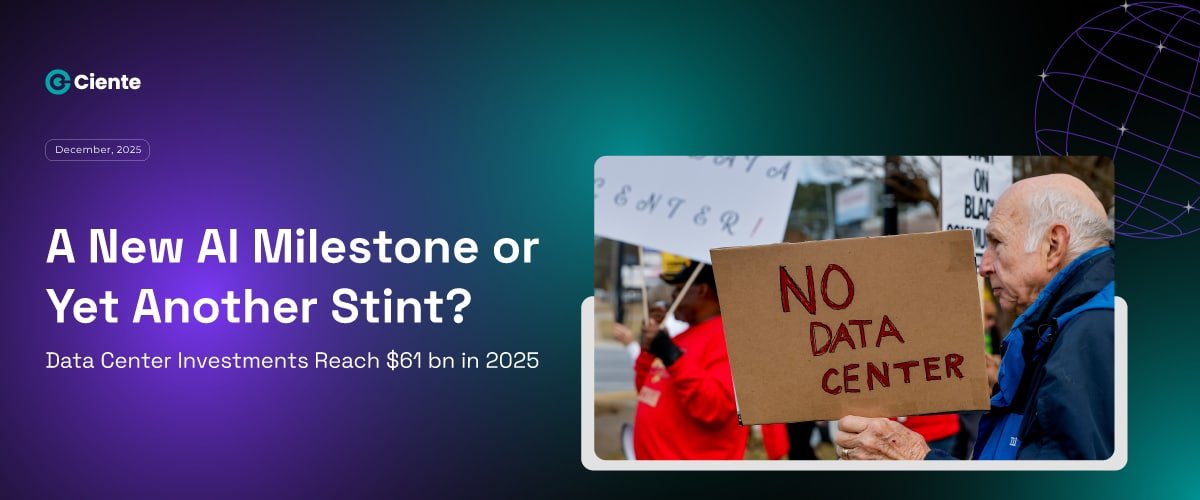
As Open AI floats through uncharted territory, could the $61 bn data center market actually reach profitability as promised?

ChatGPT now lets you adjust your email’s warmth levels. Alphabet acquired a new data center company. “The AI bubble is about to burst,” economists warn. Google announces new Gemini Flash 3 for speed. Everyone’s losing money on AI.

These are some of today’s headlines on AI. And they aren’t all enthusiastic. The response to AI has suddenly become quite diverse. And largely disappointing. It’s as if a veil has been removed, and the public perceives AI as more of the same high-level tech that’s supposed to cater to the chosen few.

Beyond this curtain? AI’s significance is dismissive.

However, that and countless warnings from economists haven’t stopped the AI enthusiasts. As the echo of the AI bubble burst makes the rounds every other day, another company ends up investing a few billion dollars in related infrastructure and hardware.

The disconnect is apparent.

The global data center market reached $61 billion this year. First, it was the chip frenzy that sent NVIDIA’s worth skyrocketing. And now, it’s the construction frenzy. The insatiable demand for AI isn’t nearly as evident as the demand for hardware, real estate, and energy. The nitty-gritty.

As an increasing number of data centers pop up, the market is questioning the returns. According to HBR, there are high variable spending, but low variable returns when it comes to AI.

The money movement is also apparent as all the tech and AI powerhouses hold hands to accelerate their AI roadmaps. It’s a well-thought-out strategy. But the returns are the real facet in question.

There’s not much to show.

Last week, the Wall Street Journal published a report on Notion. Its AI helps generate content, search, take down meeting notes, and research. It ate into 10% of Notion’s profit margin. And truly, it’s the actions that any user can carry out within meetings.

AI was equated with efficiency and cheaper labor costs. But it’s adding on- more than ever. Unproven returns. But enthusiastic overspending.

OpenAI will burn through approximately. $150 billion between 2024 and 2029, according to analysts. But it’s only in 2029 that the AI powerhouse could potentially turn a profit. Then it will have something to show for all its investments. To justify all the billions.

The global AI bubble may or may not pop, but investors and analysts have noticed a pattern-

The money movement is circular, and the entire US economy rests on that.

Google News Launches Innovative Audio Briefings with a New Listen Tab

Google News Launches Innovative Audio Briefings with a New Listen Tab

Google News Launches Innovative Audio Briefings with a New Listen Tab

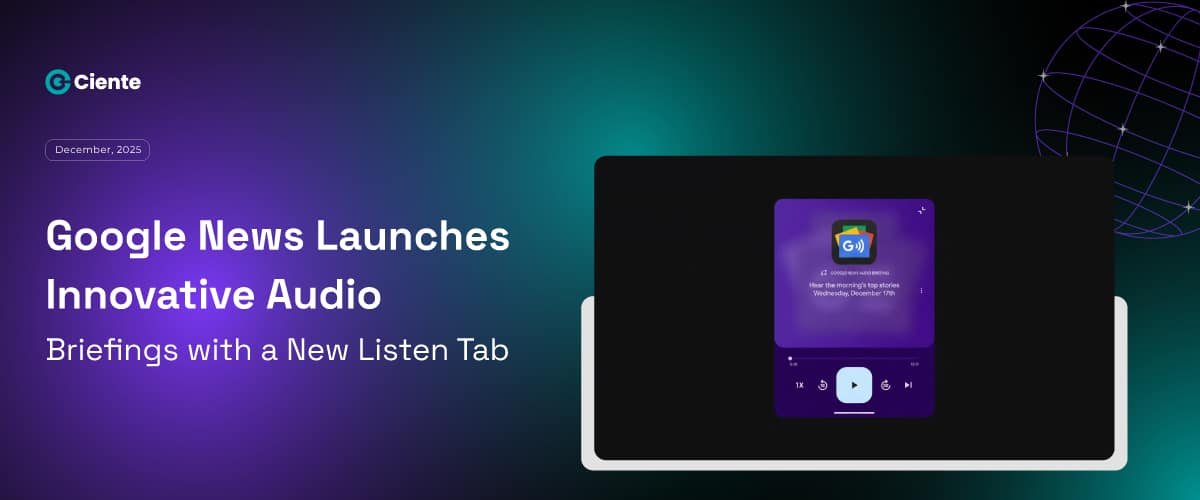
Google News adds an AI-powered Listen tab with audio briefings for hands-free updates, clear source links, playback controls, and region-limited rollout.

Google is no longer asking you to read the news.

With its new audio briefings feature, Google News is stepping into podcast territory. Quietly. Intentionally. And with more care than most AI news experiments so far.

The update introduces a Listen tab on Android. You will get short, AI-generated briefings you can do anything- play, pause, rewind, skip, or speed up. It’s not meant to be a robotic readout of headlines. It feels closer to a daily news digest, minus the host banter.

The significant detail is attribution. Every audio briefing links back to the original articles. Sources are visible. Stories aren’t dissolved into a single AI soup. Google is clearly trying to avoid the highest form of criticism of AI summaries: stripping publishers of traffic and context.

It matters.

Audio is not a novelty anymore. People already listen to the news while doing chores. Until now, Google has significantly pushed users outward- toward podcasts or Assistant briefings. This feature pulls them inward. News stays inside the Google News ecosystem, but publishers still get credit and potential clicks.

That balance is deliberate.

There are limits, though. The rollout is restricted, mainly to the US. Other users may only see it after switching their region settings. Google has not committed to a global timeline. That hesitation suggests testing, not confidence.

The feature also avoids personalization hype. These briefings are topical, not deeply tailored. No grand claims about knowing what you want before you ask. That restraint is refreshing. It keeps expectations grounded and reduces the risk of algorithmic overreach.

From a strategy lens, this is Google defending attention. Text feeds are crowded. Video is expensive. Audio is efficient. It fits into dead time and keeps users engaged without demanding all the focus.

Still, the real test is durability. If this turns into another half-promoted experiment, it will fade. If Google invests in consistency, regional expansion, and publisher trust, the Listen tab could become a daily habit.

This is not Google reinventing news. It is Google adjusting the format. And sometimes, that is the intelligent move.

The Shortcomings of Poor Branding for B2B Businesses

The Shortcomings of Poor Branding for B2B Businesses

The Shortcomings of Poor Branding for B2B Businesses

Most B2B brands don’t lose deals because of product gaps. They lose them because no one can tell what they truly stand for; that’s poor branding 101.

Most businesses think that branding is all about being visible. But that’s a missed assumption. They invest in multiple, disconnected channels at once and fail to develop a roadmap. Or even a coherent brand strategy.

That’s the first and most prominent mistake they make.

It becomes an ill-directed overreliance on brand building. But without a clear understanding of what branding means in the first place. Even though a brand is something extremely crucial for companies. It’s a valuable asset.

A brand’s value stems from “its power to elicit a connection in the minds of consumers to the products or services that the brand represents.” There are specific emotions that a brand induces in its customers’ minds. And that’s precisely why they’re repeat v customers or even end up becoming one.

It’s about recognition of who can solve their problem.

Branding is about being the first one that comes to mind. Especially as a company that solves a problem another is stuck with. Or your voice gets lost amidst the sea of “better” and louder brands. Good branding does something specific: it makes choosing your business inevitable.

This isn’t just handed over, especially if you aren’t a product-led business.

It comes from a sharp point of view. From repetition, unless the market hears your message clearly. From brand maintenance. And from positioning.

Each of these elements boils down to one paramount facet: consistency. It’s consistency in voice. Niche. And aesthetic.

Branding as Perception-Building: A Hit or Miss?

Consistency amplifies a brand’s value. So much so that the business thinks twice before altering or scraping a name or even an image that customers have grown familiar with. That’s branding done right. And consistency that hit the nail on the head.

Why is consistency significant? That’s the main question. The logic behind it is simple. But we’ll dive into how this need for consistent branding ties to the “human” element within it- how the “humanity” reassures a customer’s purchase. And directly leans into their emotions.

In the 1880s, mass-producing products gradually became the norm. You look at Campbell or Heinz. But the companies were anxious as to the customer response- what would they think of mass-produced products? So, mass production was merely a stint. It wasn’t familiar to customers. Because unconsciously within, personalization was still a want then. Customers wanted to feel special and valued. The companies didn’t know what the response would be.

That’s when branding was introduced. It was to tackle the blow. The human faces on the ketchup bottles to soothe anxious customers. Branding was the logo, the design of the banner attached to the products, and the face of a company and its products.

Consumers were supposed to place their trust in the smiling faces. In Quaker Oats’ case, the faces of Uncle Ben’s and Aunt Jemima.

Branding would save the day then. But today, when the solutions falter, it’s the brand that has to take the blow. All the responsibility falls on it. It’s the image. That’s what marketing has made it- branding as a perception-building strategy.

But perception is momentary. It can change and shift overnight. And the consequences? Falls on the brands over the physical assets. So, today, branding isn’t a medium to avert failure. It’s the essence of a company that can make or break a company, at least to a certain extent.

Poor branding example: When rebranding didn’t go quite as planned.

Let’s take X (or Twitter).

The rebrand is one of the best examples of poor branding or branding fails. Recognition and market positioning in the garbage. It killed Twitter’s ability to communicate its value to the market. Because of the market perception that Twitter held? Gone when it became X.

But there’s more to unpack here. The rebrand wasn’t just a name change. It was an identity crisis played out in public. Twitter had spent nearly two decades building brand equity. The bluebird. The verb “tweet.” The cultural shorthand of being “on Twitter.”

All of it, recognizable instantly.

Then came X. Generic. Unmemorable. Stripped of meaning.

Poor branding doesn’t always mean having no brand. Sometimes it means destroying the brand you already built. X threw away billions in brand value for a letter that means nothing to anyone. No clear repositioning. No compelling reason for the change. Just confusion.

And confusion kills conversion. Advertisers pulled back. Users hesitated. The market questioned the strategy. Because when your rebrand creates more questions than answers, that’s poor branding at its most visible.

It’s a masterclass in how not to evolve a brand. You don’t tear down recognition. You build on it.

Poor Branding Turns Omnichannel Marketing into Chaos

It is where poor branding becomes expensive for B2B companies.

Being everywhere is mistaken for being strong. LinkedIn, email, webinars, paid ads, events, podcasts- presence multiplies, but meaning doesn’t.

Poor branding doesn’t improve when you spread it across channels. It fractures.

One channel sounds corporate. Another sounds casual. Sales decks contradict the website. Event booths feel like a different company altogether. The issue isn’t execution. Its identity. A brand without a unified core creates different versions of itself everywhere it appears.

B2B buyers encounter an average of ten touchpoints before committing- ten moments where the brand must feel identical in intent, tone, and conviction. Poor branding turns those ten moments into ten disconnected impressions.

And buyers don’t assemble coherence on your behalf. Confusion accelerates exits. Competitors with clearer narratives win by default.

A major poor branding pitfall in B2B: Trust erosion

B2B decisions are not transactional. They’re reputational.

There are multiple stakeholders evaluating risk simultaneously in a B2B setting- legal, finance, IT, leadership, and end users. All of them are asking the same question from a different angle: Can we trust this company to deliver what it promises?

Poor branding weakens that trust before product or pricing enters the conversation.

When messaging shifts across touchpoints, it signals instability. A company unsure of itself. And if a business can’t articulate who it is, it cannot be trusted to deliver consistently.

Branding is not visual decoration. It’s behavioral evidence. Repeated signals that a company understands its role, its buyers, and its responsibility within its ecosystem.

Poor branding breaks that signal. It introduces doubt. And in B2B, doubt doesn’t stall decisions but redirects them.

How Does Poor Branding Affect Your B2B Customers?

Here’s the brutal reality- without a clear brand, differentiation collapses.

Products start to resemble each other. Messaging flattens into identical claims about efficiency, outcomes, and value creation. Buyers struggle to distinguish one vendor from another because none have taken a definitive position.

Poor branding makes businesses sound interchangeable. Interchangeable companies compete on price.

B2B buyers don’t want vendors that appeal to everyone. They want specificity. A point of view. Proof that a company understands its exact constraints and trade-offs.

Poor branding communicates the opposite. It suggests generality. And generality removes leverage.

Once differentiation disappears, the margin follows. The business attracts price-sensitive customers, loses negotiating power, and builds a growth model that cannot sustain itself.

The consequences of poor branding go beyond your customers.

Poor branding doesn’t stop at the market. It destabilizes the organization itself.

Sales teams rotate value propositions. Marketing campaigns shift tone every quarter. Product teams build without a clear user anchor. Customer success improvises definitions of “success.”

There is no shared narrative- only fragmented interpretations.

Brand clarity is operational clarity. When it’s absent, execution becomes guesswork. Each function compensates independently, creating misalignment that compounds over time.

Customers feel that inconsistency long before leadership does.

Poor branding makes scaling impossible for B2B businesses.

Early-stage companies can survive ambiguity. Scale cannot. You can’t scale confusion. And that’s precisely what poor branding creates.

As teams grow, clarity must replace proximity. New hires need a coherent story. Partners need language they can reuse. Campaigns need repeatability.

Poor branding provides none of this.

Onboarding slows. Messaging drifts. Go-to-market efforts reset repeatedly instead of compounding. And growth stalls not because of demand, but because the brand cannot carry additional weight.

Strong brands scale through systems. Poor brands rely on constant correction.

What Poor Branding Really Costs B2B Businesses

Let’s get concrete. Poor branding costs you opportunities you’ll never see.

The prospect who visited your website got confused by mixed messages and bounced. The enterprise deal that stalled because your brand didn’t feel “enterprise enough.” The partnership that fell through because your brand couldn’t stand next to theirs. The press feature you lost to a competitor with sharper positioning.

Poor branding is death by a thousand invisible cuts. Each one is small enough to rationalize. Together, fatal.

And here’s the thing.

You can’t fix poor branding with more marketing spend. You can’t use more budget to cure a weak foundation. Throwing money at ads, events, and content when your core brand breaks? It just amplifies the problem. You’re spending more to confuse more people.

The fix isn’t volume. It’s clarity. It’s the fundamentals- who are you? Who do you serve? What do you stand for? What makes you different? What’s the promise you can keep relentlessly?

Answer those, and you have a foundation. Ignore them, and you have poor branding. And poor branding, as we’ve seen, is the slow poison that kills B2B businesses from the inside out.

A Nuance Dive into How Omnichannel Marketing Will Help Brands Grow in 2026

A Nuance Dive into How Omnichannel Marketing Will Help Brands Grow in 2026

A Nuance Dive into How Omnichannel Marketing Will Help Brands Grow in 2026

Everyone wants omnichannel marketing. But very few teams are ready for the operational friction it creates.

Marketing has lost its way.

Brands are performing instead of connecting. They’re chasing trends that die before the campaign even launches. And somewhere between privacy regulations gutting their data and AI becoming the answer to questions nobody asked, they forgot the basics.

Customers want coherence. They want you to remember them. They want experiences that feel frictionless and seamless to move through.

That’s omnichannel marketing. Not the sanitized conference talk version. The messy, complex, and necessary version that actually works.

Here’s what it looks like when you’re not stuck checking boxes.

Why Omnichannel Marketing Will Matter in 2026

The buyer’s journey has fragmented into numerous smaller components. It’s scattered across platforms, devices, and moments you’ll never track.

Your customer starts on Instagram. Jumps to your website. Reads Reddit threads at midnight. Watch comparison videos. Downloads your PDF. Ghosts you for a month. Then shows up ready to buy as if nothing happened.

Modern B2B buyers progress through 27 of these before making a purchasing decision.

How do marketers deal with this?

Most brands respond by adding even more touchpoints. More channels. More content. They’re making the problem worse. Because volume isn’t a strategy. Presence isn’t experience.

Omnichannel marketing is the opposite of that chaos. It’s about showing up with context. Remembering what your customer already told you. Creating experiences that flow instead of fracture.

The problem? Most companies are terrible at it. They’ve got marketing in silos. Sales doesn’t know what marketing promised. Customer success is working with different data than everyone else. The customer ends up repeating themselves six times to get a mundane question answered.

That’s not omnichannel. That’s multichannel with delusions.

Impactful omnichannel marketing signifies that your customer can start a conversation on one platform and pick it back up on another without explaining themselves. It means your messaging acknowledges their previous interactions. It means not having to ask them to fill out forms for information you already have.

Brands that figure this out in 2026 won’t win by shouting louder. They’ll win by actually listening.

Omnichannel Marketing Components that Will Matter in 2026

A. AI-Powered Personalization

Marketing teams slapped “AI” on their deck last year. Most of it was lies wrapped in buzzwords.

Here’s what AI does in omnichannel marketing: it connects the dots that humans (or users) can’t see. It spots behavioral patterns across channels that would take your team months to notice. Then it acts on those patterns in real-time.

But there’s a line between helpful and horrifying.

Hyper-personalization crossed that line years ago. You know the feeling when an ad follows you around the internet referencing something you only thought about? That’s not personalization. That’s surveillance cosplaying as service.

AI-powered personalization done right feels like good service at a restaurant where they remember you. The truth is that they’re paying attention.

In practice, this means recognizing patterns without being invasive. Someone’s been reading your content for three months. They’ve watched webinars. Downloaded resources. They’re clearly interested. Your AI should recognize this pattern and serve up the logical next step. A demo invitation. A case study from their industry. A conversation with someone who can actually help. Not another generic email blast.

AI’s role in omnichannel is orchestration.

It ensures that the LinkedIn ad connects to a landing page, to the email sequence they’re in, and the conversation they’ll have with sales.

Each interaction builds on the last.

Your customer shouldn’t feel like they must explain themselves from scratch every time they change channels. It is AI’s job to remember.

But here’s where most brands stumble. They leverage AI to optimize individual tactics rather than orchestrating full-funnel experiences. They’ve AI-tweaking subject lines while their customer experience remains fractured across departments. That’s not a strategy. That’s putting a smart lock on a house with no walls.

AI works when it’s connected to clean data. When it’s serving a strategy bigger than conversion rate optimization. When it’s actually thinking about the customer experience instead of just the next click.

B. Video and Authentic Engagement

Video stopped being a content type. It’s become the language customers actually speak.

For example, think of the creator economy. People trust creators over brands. Why? Because creators show up as humans. They’re not reading legal-approved scripts. They’re not presenting some polished version of reality that feels focus-grouped to death.

They’re just real.

Brands have noticed this. Most responded by trying to manufacture authenticity. They hired Gen Z consultants. They posted “candid” behind-the-scenes content that was staged within an inch of its life. They tried to seem relatable while still maintaining corporate distance.

Customers saw right through it. Because authenticity isn’t a tactic you deploy. It’s a posture you commit to.

Real video in omnichannel marketing looks different than what most brands are doing. It’s your product manager recording a 90-second explanation of why they built a feature that way. It’s your support team sharing actual customer wins. It’s your engineers walking through a technical problem without dumbing it down.

What matters to build authentic engagement is showing up.

It’s showing up as the actual people running your company instead of the brand persona you were designing for six months.

The omnichannel part happens when these videos aren’t isolated content pieces. When they’re part of a conversation that spans channels. When the person in your LinkedIn video is the same person hosting your webinar, it is the same person your customers might talk to in a sales call.

Consistency builds trust. Familiarity breeds connection. Video is how you create both at scale.

However, here’s the truth: B2B brands are terrified to post authentic video content. What if they say the wrong things? Or look too casual? Or don’t seem “professional” enough? So they sand off every rough edge and end up with content that says nothing to no one.

Meanwhile, their competitors are building actual relationships through video that feel human. Through content that admits when things are hard. And personalities that customers can connect with.

Having the highest production budgets won’t matter. So, what will? Willing to show up with honesty and authenticity. To let their people be people. To trust that authenticity creates a connection better than polish ever will.

C. Mastering Data and Attribution

Marketing teams might have data. But it’s severely disconnected from the insights.

They’ve got metrics everywhere. Dashboards multiplying like rabbits. Reports nobody reads because everyone’s too busy generating more reports. And when someone asks the simple question of “what’s actually working,” the room goes quiet.

Attribution is marketing’s most crucial unsolved problem. Maybe it’ll stay that way. Because customer journeys don’t follow the models we built to measure them.

Here’s what data mastery actually means in omnichannel marketing: understanding how channels work together instead of fighting over which one gets credit.

Your LinkedIn ads might not directly convert anyone. But they consistently introduce prospects who later engage through other channels and gradually purchase. That’s valuable. Your content hub might never show up in last-click attribution. But customers who engage there have higher retention and lifetime value. That matters.

The old attribution models assumed linear journeys. First touch. Last touch. Some weighted combination that still pretends customers move in predictable lines. None of it captures reality.

Reality is messy. A prospect might see your ad six months before they’re ready to buy. They might engage heavily with content, go silent for weeks, then suddenly convert through a completely different channel. They might be influenced by something you’ll never track, like a conversation with a colleague who loves your product.

Your data should align with the on-ground reality.

Data mastery in 2026 means accepting this messiness while still extracting significant insights. It means building systems that show patterns without claiming certainty. It means asking better questions than “which channel converted this customer.”

Questions like: What sequences of touchpoints commonly precede conversions? Which channels amplify each other’s effectiveness? Where do prospects consistently get stuck? What happens when we increase investment in channels that don’t show last-click attribution but clearly play supporting roles?

This requires unified customer data. Not data that lives in marketing automation over here and CRM over there, and analytics somewhere else. Data that actually travels across your tech stack. That recognizes the same person across devices and channels. That builds a coherent picture of customer behavior.

Most companies don’t have this. They’ve data silos protected by departmental turf wars and technical debt they can’t untangle. So they make decisions based on incomplete pictures. They optimize channels in isolation. They miss the bigger patterns that would actually move the business forward.

Getting data right is hard. Expensive. Politically complicated. But there’s no omnichannel marketing without it. You’re running disconnected and very spray-and-pray campaigns and hoping for the best.

The Fractal Approach for Omnichannel Marketing Beyond the Funnel

The marketing funnel died.

It was always a simplification that didn’t match reality. The idea that customers move in neat stages from awareness to consideration to decision was convenient for PowerPoint decks. Less substantial for understanding actual human behavior.

1. The fractal app roach acknowledges that customers aren’t moving through your funnel. They’re having multiple micro-journeys simultaneously. Each one is unique but follows similar patterns. Like fractals repeating at different scales.

A customer might be in awareness mode about one feature while actively deciding about another. They might be a power user who suddenly needs beginner content because they’re exploring a new use case. They might loop back to educational content right before buying because they need ammunition to convince their boss.

This doesn’t fit in traditional funnel thinking. So most marketers either ignore it or try to force it back into the old models. Both approaches fail.

2. The fractal approach creates multiple entry points into your experience. Multiple paths through it. Several ways to loop back, jump ahead, or engage sideways. It is designed for non-linear journeys while still guiding customers forward.

Netflix figured this out years ago.

They’re not pushing you through a funnel. They’re creating an environment where you can engage however makes sense for you right now. Browsing. Binging. Taking breaks. Coming back to finish something weeks later. The experience adapts to your behavior instead of forcing you into theirs.

B2B brands can learn from this. Build content hubs that serve awareness and decision-stage customers simultaneously. Create email campaigns where subscribers choose their own adventure. Design product experiences that work for day-one users and year-three power users without treating them identically.

3. The fractal approach also recognizes that growth isn’t just new customer acquisition. It’s expansion within existing accounts. Reactivation of dormant customers. Turning users into advocates. Each of these requires different omnichannel strategies. Different success metrics. Distinct ways of measuring progress.

Most importantly, the fractal approach permits you to stop obsessing over the perfect linear journey. Your customers aren’t following a linear journey. So, why not design for the chaos rather than pretend it doesn’t exist?

How These Pillars Work for a Cohesive Omnichannel Marketing Strategy

Here, theory meets reality.

The four pillars mentioned above don’t work in isolation. They’re interdependent. When they connect properly, they create something bigger than their parts.

  1. AI-powered personalization requires data mastery to function. Your AI is optimizing in the dark without clean, unified customer data. But AI can orchestrate experiences that feel seamless across every touchpoint when your data infrastructure is solid.
  2. Authentic engagement makes personalization feel helpful rather than invasive. Customers are more receptive to tailored experiences when they feel connected. They know you’re trying to help and not manipulate.
  3. The fractal approach provides the framework for everything that operates. It permits you to design non-linear experiences. To meet customers wherever they are. To create coherent journeys that don’t force everyone through the same path.

But let’s get concrete.

A real-world example of omnichannel marketing

A prospect discovers your company through a LinkedIn video. Your founders are talking about why traditional project management fails remote teams. The recording feels authentic. It addresses a real problem they’re facing. They click through.

AI recognizes this is a first visit from LinkedIn. Serves a landing page designed for video traffic. Related content. A light next step that doesn’t ask for their life story.

Over the next month, this prospect will engage sporadically. Reads a blog post. Watch another video. Downloads a guide. AI is quietly building a profile. This person prefers video content. Engages most on Tuesday afternoons. Your data system is tracking all of this across channels. Recognizing it’s the same person on mobile and desktop.

The fractal approach offers multiple paths forward. An email campaign where they choose what to explore next. A retargeting ad featuring a capability they seemed interested in. A webinar invitation matching their industry.

A month in, they book a demo. Your sales rep has context from all these interactions. The conversation picks up where the digital experience left off. It’s informed. Relevant. Personal without being invasive.

That’s omnichannel marketing working. Personalized without being creepy. Data-driven without being robotic. Authentic without sacrificing strategy. Flexible without losing coherence.

Most brands can’t pull this off.

Because they’re missing at least one pillar. Usually more. They’ve the AI but not the data. The video, but not the authenticity. The attribution, but not the unified systems. The channels, but not the strategy.

All four pillars have to work together. Miss one and you’re back to disconnected campaigns pretending to be strategy.

The Path Forward: What’s in for Omnichannel Marketing in 2026?

Omnichannel marketing in 2026 isn’t about being on every platform. It’s not about sending more messages, creating more content, or buying more ads.

It’s about bringing coherence back to marketing. Creating experiences that flow instead of fracture. Remembering your customers across every touchpoint rather than treating them like strangers every time.

The brands that figure this out won’t be the ones with the highest budgets. They’ll be the ones willing to do the hard work. Breaking down silos. Investing in infrastructure. Building systems that serve customers instead of internal org charts.

It takes time. Money. Political capital to fight turf wars. Patience to build something sustainable instead of chasing quarterly wins.

But look at the alternative. Keep operating in disconnected channels. Keep treating customers like they should remember you while you forget them. Keep wondering why loyalty is dead, and acquisition costs keep climbing.

The choice isn’t complicated. The execution is.

Omnichannel marketing is when you stop the performance and start to connect. How do you stop chasing trends and start understanding customers? How do you build experiences that actually work in 2026 instead of trying to force 2016 strategies into a world that’s moved on?

The question isn’t whether you need omnichannel marketing. It’s whether you’re willing to do it right.

AI-Driven v/s Traditional Marketing: Optimization Over Intention?

AI-Driven vs Traditional Marketing: Optimization Over Intention?

AI-Driven vs Traditional Marketing: Optimization Over Intention?

AI is often seen as a black box—probabilities mixed with potential. But it works. Explore AI-driven vs traditional marketing and whether AI will fully take over the future of marketing.

For most B2B, SaaS, and fintech teams, the debate between AI-driven marketing and traditional marketing doesn’t happen in theory. It often occurs in dashboards, budget reviews, pipeline calls, and post-mortems that quietly sidestep the real question.

The real question is not whether AI works.

It clearly does.

The question is whether marketing teams still understand what is working, why it is working, and what they are trading away in the process.

Because the moment you move from traditional marketing systems to AI-driven ones, the center of gravity shifts. And most teams underestimate how deep that shift goes.

Traditional Marketing Was Built for Imperfect Information

Traditional marketing in B2B and fintech wasn’t inefficient by accident. It was inefficient by necessity.

You dealt with:

  1. Partial attribution
  2. Long sales cycles
  3. Multiple decision-makers
  4. Inconsistent intent signals
  5. Offline influence you could never fully track

So, you built processes around approximation.

Campaigns were planned quarterly. Messaging stayed stable long enough to be remembered. Funnel performance was interpreted, not continuously recalculated. Attribution models were blunt instruments, but at least everyone understood their limitations.

Most importantly, decision-making was explicit.

A human decided:

  1. Which segment mattered
  2. Which narrative to lean into
  3. Which channel deserved patience
  4. Which metrics were directional, not definitive

That slowness wasn’t elegant. But it kept marketing legible.

Why Traditional Marketing Still Works in Complex Buying Journeys

In B2B and fintech, buying is rarely linear. Traditional marketing survived because it respected that messiness, even if it couldn’t model it.

You optimized around:

  1. Category credibility
  2. Brand reassurance
  3. Repeated exposure
  4. Sales enablement
  5. Trust accumulation over time

You couldn’t prove, in real time, that a whitepaper moved a deal forward. But you knew that removing it hurt later-stage conversations. So, you kept it.

This created a kind of institutional memory. Marketing teams remembered why certain things existed, even if they couldn’t defend them perfectly in a spreadsheet.

That memory is one of the first casualties when teams shift fully to AI-driven marketing.

What AI-Driven Marketing Changes at a Systems Level

AI-driven marketing does not simply make traditional marketing faster. It changes how decisions are made.

Instead of planning, waiting, and interpreting, AI-driven systems:

  1. Observe behavior continuously
  2. Test variations simultaneously
  3. Adjust spend and messaging in near real time
  4. Optimize toward defined outcomes without needing explanation

In isolation, this appears to be progress.

But the shift isn’t about speed. It’s about authority.

Decision authority moves:

  1. From marketers → models
  2. From campaign plans → feedback loops
  3. From strategy documents → objective functions

Marketing becomes less about choosing direction and more about managing optimization engines.

The Hidden Trade-Off: Clarity for Performance

AI-driven marketing excels at improving visible metrics:

  1. CTR
  2. MQL volume
  3. Cost per lead
  4. Engagement rates
  5. Short-term pipeline contribution

What it quietly deprioritizes are the things that don’t resolve quickly:

  1. Brand memory
  2. Message coherence across quarters
  3. Sales trust in marketing signals
  4. Category positioning that compounds slowly

Traditional marketing struggled to quantify these. AI-driven marketing often ignores them entirely unless they are encoded upfront.

This is where many B2B teams get blindsided.

Attribution: From Imperfect Models to Invisible Assumptions

Traditional marketing lived with flawed attribution models and talked about them openly.

First-touch, last-touch, linear, time-decay—everyone knew these were approximations. made decisions around their limitations.

AI-driven marketing replaces those visible flaws with opaque inference.

Multi-touch attribution driven by machine learning doesn’t ask whether attribution is philosophically correct. It asks whether predictions improve.

This creates a dangerous illusion: attribution feels solved because it’s no longer debated.

But when attribution logic becomes unreadable, so does accountability.

In B2B, AI Learns Faster Than Sales Can React

One of the most practical tensions shows up between marketing and sales.

AI-driven marketing systems quickly learn which behaviors correlate with downstream conversion:

  1. Certain job titles
  2. Certain content sequences
  3. Certain interaction frequencies

Leads get scored higher. Outreach accelerates. SDR teams are told to trust the model.

But B2B buying intent is contextual. It fluctuates with budget cycles, internal politics, compliance reviews, and risk tolerance—none of which surface cleanly in behavior alone.

Traditional marketing and sales alignment relied on shared judgment.

AI-driven marketing relies on statistical confidence.

When those two drift, friction follows.

Personalization at Scale vs Narrative Coherence

AI-driven marketing promises personalization. And it delivers—sometimes too well.

Messages adapt dynamically:

  1. Different headlines
  2. Different value props
  3. Different CTAs
  4. Different sequencing

Over time, this creates fragmentation.

Prospects in the same account may encounter:

  1. Slightly different positioning
  2. Inconsistent promises
  3. Over-optimized messaging that feels transactional

Traditional marketing enforced narrative discipline because changing things was expensive. AI-driven systems change things because not changing looks inefficient.

The result is often higher engagement with weaker recall.

Funnel Optimization vs System Understanding

In traditional marketing, funnels were conceptual tools. They were simplifications meant to guide thinking, not control behavior.

AI-driven marketing treats funnels as live systems to be continuously tuned.

Top-of-funnel conversion improves, and mid-funnel velocity increases. But the model doesn’t know which stages matter disproportionately in your category.

In fintech, especially, friction isn’t always bad. It often signals seriousness. AI-driven systems tend to remove friction wherever it reduces drop-off, even when that friction played a qualifying role.

What looks like optimization can be silent dilution.

Budget Allocation: Human Judgment vs Model Confidence

Traditional marketing budgets were political and imperfect—but transparent.

You knew why specific channels got funding:

  1. Leadership belief
  2. Historical performance
  3. Strategic importance
  4. Competitive presence

AI-driven marketing reallocates budget dynamically based on performance signals.

This sounds ideal until you realize:

  1. Models optimize for recent performance
  2. New channels struggle to get exposure
  3. Long-term bets are deprioritized by default

Without deliberate constraints, AI-driven systems narrow exploration over time.

Traditional marketing wasted money.

AI-driven marketing risks narrowing ambition.

The Fintech Constraint: Trust Moves Slower Than Models

Fintech marketing carries an extra burden: risk perception.

Users don’t just evaluate features. They evaluate:

  1. Stability
  2. Compliance posture
  3. Brand seriousness
  4. Longevity

AI-driven marketing optimizes around engagement behaviors that may not map cleanly to trust formation.

A message that increases click-through may also increase skepticism if it feels opportunistic or overly tailored.

Traditional marketing’s restraint—often criticized as conservative—functioned as a trust signal.

Speed isn’t always neutral in regulated environments.

Why Many Teams Feel Busy but Less Certain

One of the most consistent symptoms teams report after adopting AI-driven marketing is this:

Activity increases. Confidence decreases.

More dashboards. More experiments. More outputs.

But fewer people can explain:

  1. Why is the system favoring some messages over others?
  2. What assumptions are embedded in optimization?
  3. What would break if the model were turned off?

Traditional marketing was slower but narratable.

AI-driven marketing is faster but harder to reason about.

That matters when results flatten or reverse.

The False Comfort of Continuous Improvement

AI-driven marketing systems almost always show improvement—until they don’t.

Because optimization is incremental, degradation rarely looks dramatic. It looks like:

  1. Lead quality is slowly declining
  2. Sales cycle lengthening
  3. Trust erosion surfacing anecdotally
  4. Brand is becoming harder to articulate

Traditional marketing failed loudly.

AI-driven marketing fails quietly.

By the time leadership notices, the system has already adapted around the wrong objective.

Where Traditional Marketing Still Matters Operationally

Despite the momentum, traditional marketing logic remains critical in B2B, SaaS, and fintech for specific reasons:

  1. Category creation cannot be optimized in the short term
  2. Enterprise trust does not emerge from micro-variants
  3. Sales enablement requires narrative stability
  4. Long-cycle deals need consistency more than novelty

AI-driven execution works best inside a clearly defined strategic envelope.

Without that envelope, optimization becomes drift.

The Real Distinction Marketing Leaders Need to Internalize

The difference between AI-driven marketing and traditional marketing is not intelligence.

It is who holds intent.

Traditional marketing embedded intent in plans, narratives, and people.

AI-driven marketing embeds intent in objectives, constraints, and data selection.

If leadership does not actively define those constraints, the system will define them implicitly.

And implicit intent is rarely aligned with long-term brand health.

What Mature Teams Are Learning the Hard Way

The most effective teams do not choose sides. They are separating roles.

They use AI-driven marketing to:

  1. Optimize execution
  2. Surface patterns humans miss
  3. Scale proven messages

They rely on traditional marketing discipline to:

  1. Define positioning
  2. Maintain narrative coherence
  3. Decide what should not be optimized

This split is intentional. And it requires resisting the urge to automate judgment.

The Mistake to Avoid

The mistake is not adopting AI-driven marketing.

The mistake is assuming that better performance metrics equal better marketing.

Metrics reflect behavior, not belief.

Optimization reflects response, not resonance.

Traditional marketing understood that distinction intuitively. AI-driven marketing requires it to be enforced.

Closing: A Practical Reality Check

AI-driven marketing will continue to outperform traditional marketing in terms of efficiency. That’s settled.

But efficiency is not the same as effectiveness in complex, high-trust buying environments.

For B2B, SaaS, and fintech leaders, the question is no longer whether to use AI-driven marketing.

The question is whether your team still knows:

  1. What it is trying to stand for
  2. Which signals it is willing to ignore
  3. And where optimization must stop

Because the most dangerous outcome isn’t failure.

It’s marketing that keeps improving while slowly losing its grip on what made it work in the first place.