SaaS Market Trends

SaaS Market Trends: The SaaSPocalypse or how to avoid it

SaaS Market Trends: The SaaSPocalypse or how to avoid it

Why the companies that survive 2026 won’t be the ones with the best AI. They’ll be the ones with the best instincts.

Let’s start with what happened.

Between February 3 and February 5, 2026, approximately $285 to $300 billion in software market value evaporated. Not slowly. Not with a warning. In 48 hours. The iShares Expanded Tech-Software Sector ETF, IGV, entered a technical bear market, falling more than 20% from its late-2025 peaks. Salesforce lost nearly 40% of its value over twelve months. ServiceNow dropped 28% year to date. Workday announced layoffs attributed directly to AI efficiency gains. SAP missed cloud backlog targets.

Wall Street traders coined the term. “SaaSpocalypse.” The analysts called it. The executives disputed it. Jensen Huang called the entire narrative “the most illogical thing in the world.”

He might be right. He might be wrong. But neither answer tells you what you actually need to know.

Which side of this crash are you on?

The Numbers Tell One Story. The Real Story Is Somewhere Else.

Here is what the consensus view gets right: public SaaS growth rates have declined every single quarter since the 2021 peak. Not because AI broke something this year. The deceleration started years ago. AI gave the market permission to finally reprice what the numbers had been communicating since 2022. Price-to-sales ratios compressed from 9x to 6x, levels not seen since the mid-2010s. Morgan Stanley flagged that nearly 50% of the $235 billion software loan market is rated B- or lower.

Here is what the consensus view gets wrong: it frames this as a technology problem.

It isn’t.

It’s a substance problem.

Gartner predicts that by 2030, 35% of point-product SaaS tools will be replaced by AI agents or absorbed into larger ecosystems. Notice what that number means. 65% survive. That’s not apocalypse math. That’s a sorting exercise. The question isn’t whether SaaS dies. The question is: what decides who gets sorted into which pile?

And the answer is sitting right there in the earnings reports, in the trading desk chatter, in the CIO surveys, and almost nobody is naming it directly.

The Seat Count Model Was Always a Symptom

The argument Wall Street is having right now centers on seats. If 10 AI agents can do the work of 100 sales reps, you don’t need 100 Salesforce licenses anymore. You need 10. Revenue collapses. Model breaks. The per-seat subscription business, engineered for human headcount, encounters a world where headcount shrinks. forcing companies to rethink their SaaS metrics and revenue architecture.

That’s true. That analysis is correct. But it diagnoses the mechanism, not the disease.

The disease is this: for a decade, SaaS companies built products that were useful but forgettable. Sticky because of switching costs, not because of love. Many brands scaled revenue without strengthening positioning fundamentals outlined in our guide to sustainable SaaS growth. The content marketing that surrounded them was worse. Take any SaaS company and look at its YouTube channel. It’s webinars and stock footage. Their blogs are constructed for keyword ranking, not for thinking. Same topics. Same structure. Same tone. An 85% AI score on a piece that could have been written by anyone, for anyone, about anything.

This eroded something that doesn’t show up in quarterly earnings until it’s too late.

It eroded the relationship between the product and the people it was supposed to serve.

And AI didn’t create that erosion. AI just made it impossible to ignore.

“AI Is Eating the Software Budget.” Yes. But Whose Software?

The FinancialContent analysis from February 2026 put it plainly: the industry has shifted from “software is eating the world” to “AI is eating the software budget.” Hyperscalers alone plan to spend $660 to $690 billion on AI infrastructure in 2026, nearly double 2025 levels. That money comes from somewhere. And a significant portion is coming from enterprise software budgets.

But here is the part of the rotation that deserves more attention: IT budget growth is decelerating to 3.4% in 2026. aligning with broader SaaS marketing budget shifts in 2026. Not collapsing. Decelerating. The money isn’t disappearing. It’s getting more deliberate.

CIOs are in a rationalization phase, reevaluating vendors through ROI scrutiny and measurable B2B SaaS marketing performance. After two years of frantic AI experimentation, they are now asking harder questions. Which of these tools actually changed anything? Which vendors actually know us? Which companies have been giving us something we couldn’t get elsewhere?

That last question is the real sorting mechanism.

Bain’s analysis found something that should make every SaaS marketer stop cold: customers say they would prefer to buy AI-enabled solutions from their incumbent vendors. They trust them. They believe they’re secure. They believe they’ll be around.

But most incumbents have yet to deliver compelling offerings or prove they can win this new spending.

Read that again. The trust exists. The relationship exists. And it’s not being leveraged because the incumbents have been so focused on seat count, on retention metrics, on growth rates, that they forgot to keep being interesting. They forgot to keep being distinctive. They optimized so hard for predictable revenue that they lost the one thing that makes revenue predictable long-term.

A reason to matter.

What the Survivors Have in Common

Look at the companies not getting sorted into the “at risk” pile.

Palantir is trading at a staggering 229x P/E ratio. Not because the market has lost its mind. Because Palantir has spent years being aggressively, almost uncomfortably clear about what it is, what it stands for, what kind of organizations it works with, and why. Love them or hate them, nobody confuses Palantir for someone else.

Datadog is being watched as a likely survivor because it provides what the analysts are calling “digital plumbing.” The infrastructure layer that monitors the AI systems is disrupting everything above it. That’s a product argument. But it’s also a clarity argument. Datadog knows what it does. It does it better than anyone. And it has spent years building the authority that makes that claim credible.

Palantir and Datadog are not the same company. They serve different markets. They have different cultures. But they share something: a distinct point of view on the problem they solve and the world they’re operating in. Their marketing is not interchangeable with their competitors. Their voice is their own.

Now look at the worst performers. Intuit is down more than 34% year to date. Salesforce is down roughly 40% over twelve months. ServiceNow, down 28%. These are good companies with genuinely useful products. But somewhere in the race to scale, they became interchangeable in the minds of buyers in a way that left them exposed the moment a credible alternative appeared.

The story is not about technology. It’s about perception. And perception is built by something that doesn’t appear in any product roadmap.

The Creativity Problem That Everyone Is Pretending Is a Technology Problem

SaaS marketing is in a particularly strange place right now. The teams that replaced their writers with AI systems to save money are now discovering that their content is indistinguishable a mistake many brands are now correcting through structured thought leadership in SaaS marketing. from every other company’s content. Which was already indistinguishable. Which means they have now achieved perfect invisibility at scale.

The buyers noticed before the companies did.

B2B buyers complete 80% of their buying journey before engaging a vendor. which makes lead generation services critical to capturing attention early in the SaaS buyer funnel, which is why optimizing the B2B SaaS funnel is no longer optional. They have a preferred vendor list already. They know their requirements. The job of marketing is not to catch them mid-journey. The job is to be the company they thought of when the journey started.

That is a mindshare problem. And mindshare is not built through volume. It is built through distinctiveness. Through having something to say that nobody else is saying in the same way. Through a perspective on the problem that feels like yours alone.

Alex James, one of LinkedIn’s more clear-eyed voices on B2B, puts it simply: your perspective is your product.

This is not a thought-leadership platitude. It is a structural description of what differentiates the companies that get called from the companies that don’t make the shortlist. Paul Graham says it differently in his essay on great work: find the gaps in the knowledge you’re interested in. Most SaaS companies are not doing this. They are covering the same ground the same way, hoping volume and optimization compensate for sameness.

They don’t. They never did. AI just made the sameness more obvious.

The Practical Reality of 2026 and What It Demands

Here is where this lands in practical terms.

The market is repricing software. That repricing will continue. Companies whose value came primarily from switching costs and seat lock-in are genuinely exposed. Companies whose value comes from something harder to replicate are not.

What’s harder to replicate? Relationships. Authority. A track record of actually solving problems. A content ecosystem that has been answering real questions from real buyers in your niche, supported by strong SEO for SaaS, is what creates defensible authority. for long enough that you own that space in their minds. A brand that feels like it was made by people with opinions, not optimized by a committee.

Jason Lemkin, SaaStr’s founder, makes the bear case cleanly: the 2026 crash is not AI killing SaaS next quarter. It’s the market finally pricing in the deceleration that started in 2021. The growth re-acceleration that investors were betting on never arrived. exposing weak B2B SaaS growth marketing strategy foundations. The companies that don’t adapt will be starved of budget, growth, and eventually relevance.

But adapt to what, exactly? The answer is not “adopt AI faster.” Every company is adopting AI. That’s not the adaptation.

The adaptation is this: in a world where the functional gap between software products compresses, mastering modern SaaS product marketing becomes the real moat. And relationships are built on trust. And trust is built on consistent, authentic, genuinely useful engagement over time.

Not webinars. Not stock footage. Not 85% AI-scored blogs that define B2B marketing in seven steps.

Something people would actually read if they had a choice.

The Buyers Are Running the Math Too

Here’s the thing about the CIO survey showing budget rationalization: those CIOs are not just asking “which tools are redundant?” They are asking a harder question.

Which vendors have actually been worth it?

Worth it is not purely functional. People don’t purely function. Edelman’s 2025 Trust Barometer found that only 44% of global respondents are comfortable with businesses using AI. In B2B, where buying committees average 11 to 13 members with competing agendas, trust becomes the primary sorting mechanism for everything else. The CTO wants security assurance. The CFO wants ROI proof. The CMO wants a vendor who understands the problem well enough to teach them something new.

A vendor who has been teaching them something new, consistently, for two years, supported by consistent SaaS marketing case studies, does not get cut in a rationalization cycle. A vendor whose entire content operation could have been run by a chatbot? Different story.

This is not an argument against AI in marketing. It is an argument for what AI should be doing. Your AI should be doing the parts of the work that don’t require a point of view. Research, formatting, distribution mechanics, SaaS segmentation, A/B testing at scale. The parts that require a point of view, the argument, the perspective, the genuine take on what your buyer is dealing with right now, and what it means, that part cannot be outsourced. The moment you outsource it, you become background noise.

And background noise gets cut first.

A Final, Uncomfortable Thought

Goldman Sachs strategist Ben Snider drew a comparison to newspapers. Share prices declined by an average of 95% between 2002 and 2009. The multi-year decline ended only as earnings estimates bottomed. By the time profits recovered, most of the equity value was gone.

That is the bear case. It is worth taking seriously.

But here is what the newspaper analogy misses: the newspapers that survived, the ones that are still here and still profitable, are not the ones that automated fastest. They are the ones who figured out what only they could say. The New York Times. The Financial Times. The Atlantic. They survived because they developed something irreplaceable: a perspective that readers sought out by name.

The software companies that survive the SaaSpocalypse will not be the ones with the most features or the fastest AI adoption. They will be the ones their buyers think about first when the problem appears. The ones whose content their buyers actually read. The ones whose brand feels like it was made by humans who understood the work, not assembled by a process optimized for impressions.

That is what the market is searching for right now.

The companies that understand this will make it through.

The ones still asking how to automate their way out of the problem will not.

NVIDIA Beats Wall Street Expectations, Again

NVIDIA Beats Wall Street Expectations, Again

NVIDIA Beats Wall Street Expectations, Again

NVIDIA reported a record $68 billion quarter, showing its grip on AI demand. But even stellar results don’t erase questions about the sustainability of the AI boom.

This week’s earnings from NVIDIA Corporation were supposed to be the moment of truth on the AI boom. And the numbers delivered.

Revenue jumped past $68 billion, beating Wall Street’s hopes and proving, for now, that demand for AI compute isn’t cooling. The company’s data centre business covered a bulk of that growth. That says a lot, especially how entrenched NVIDIA has become at the centre of modern AI infrastructure.

If you squint at the headlines? That looks like a victory lap, but context matters.

NVIDIA is not just outpacing expectations this quarter. It’s doing so even as scepticism about the wider AI investment wave hangs over markets. After months of talk about an “AI bubble,” it’s tempting to read these results as definitive proof that the boom was real all along. But the nuance here is important.

The strength in NVIDIA’s reports comes from raw demand- big cloud providers, hyperscalers, and enterprise customers are still buying chips to train and run AI systems. That’s not speculative, that’s capital actually spent.

Yet investors didn’t jump up and down after the numbers. Stock moves were modest. That tells you expectations are already sky-high, and any hint of future slowing or margin pressure gets amplified.

There’s also a bigger question few CEOs can answer in a quarterly call: what happens when this build-out phase ends?

NVIDIA’s boss has leaned into the idea that AI compute isn’t just a fad- it’s the backbone of a broader productivity shift. But long-term use cases that generate reliable revenue beyond selling chips remain a bet.

So yes, this quarter looked strong.

Yet the measured reaction suggests the market is telling a simple truth: strong earnings don’t erase deeper debates about how durable the AI economy really is. That’s the real story behind NVIDIA’s numbers.

Anthropic's COBOL Claim Sends IBM's Stocks Plummeting

Anthropic’s COBOL Claim Sends IBM’s Stocks Plummeting

Anthropic’s COBOL Claim Sends IBM’s Stocks Plummeting

IBM shares slid sharply after Anthropic claimed its AI can modernize COBOL systems. The selloff reveals deeper anxiety about legacy tech models in an AI-first world.

When International Business Machines shares tumbled after an announcement from Anthropic, it wasn’t because IBM missed earnings. It was because the market suddenly questioned something more structural.

Anthropic said its AI tools can help modernize COBOL code- the decades-old programming language that still runs core systems in banks, insurers, and governments. That might sound niche. It isn’t. COBOL modernization has long been slow, complex, and expensive. IBM has built a durable business around supporting and upgrading those legacy environments.

So when an AI firm suggests it can compress years of manual migration work into something far faster, investors don’t wait for proof. They react to the possibility.

IBM’s drop was sharp.

The scale of it says more about market psychology than immediate revenue risk. COBOL systems are deeply embedded. Enterprises don’t rip out mission-critical infrastructure overnight. AI can escalate parts of modernization. But oversight, compliance, and risk management still demand human involvement.

But here’s the nuance.

IBM’s strength has always been stability. Predictable enterprise contracts. Long-cycle infrastructure. Recurring services revenue. Anthropic’s pitch introduces uncertainty into that predictability. If AI tools reduce the labor intensity of modernization, margins in consulting and legacy support could tighten over time.

That doesn’t mean IBM is obsolete. It means the competitive terrain is shifting.

The real issue is perception. AI firms are now positioning themselves not just as product innovators, but as efficiency engines for legacy transformation. That reframes the value chain. Suddenly, AI isn’t just additive. It’s potentially deflationary for traditional service models.

IBM has navigated platform shifts before. Mainframes to services. Services for hybrid cloud. It understands reinvention. But the speed of AI iteration differs. Markets are pricing that speed, not today’s fundamentals.

This episode isn’t about COBOL alone. It’s about what happens when generative AI starts targeting the most entrenched corners of enterprise IT. Investors are asking a simple question: if AI can rewrite the past faster than consultants can bill for it, who captures the value?

Right now, the market isn’t sure IBM will.

retail media strategy

As Buyers Move on From Basics, Retail Media Strategy is All About AI-Led Execution in 2026

As Buyers Move on From Basics, Retail Media Strategy is All About AI-Led Execution in 2026

Retail media strategy has outgrown the retailer’s walls. So why are most brands still thinking inside those walls?

All your retail media networks (RMNs) operate in different languages. There’s no standard guideline for measuring campaigns across multiple platforms and retailers. It makes any form of comparison impossible for brands to assess.

Retail marketers usually leverage 3-5 RMNs simultaneously- it’s the norm. Amazon reports ROAS in one way, Criteo and Walmart report it in another. You can’t compare apples to oranges.

The lack of a standardized framework induces fragmented campaigning for retail marketers. It’s a growing frustration- even in 2026.

And in today’s environment, relying on instinct instead of structured planning is risky — especially when building a long-term data-driven marketing strategy.

Without the precise data, marketers have no reliable answers. Especially when their CMO questions incrementality, “Are we actually driving new sales, or am I just paying to reach people who would’ve bought anyway?”

Without an accurate picture, your teams can’t gauge the impact of the spending, and neither allocate any more of it.

That’s precisely why retail media is gaining momentum in market conversations. “What is retail media” and “retail news” leaped 4% and 1300% on Google Trends in the past year.

Marketers want answers. Solutions to these fragmented networks.

And it’s exactly why we’re here.

What is Retail Media?

If you put the retail media landscape in a single picture, this is what it’ll look like:

image 13

Source

Last year, Dentsu projected that the future of retail media “will be in data and audiences.” And they were correct. The marketplace might still focus on commoditized ad formats, but the influx of digital channels is changing this quite rapidly. Sponsored search and banner ads are rampant- and sadly, still receive the majority of dollars and attention.

But it isn’t a sustainable model. In simple words, we must grasp what retail media truly is:

The ads are placed on a retailer’s e-commerce site or app by a brand to influence the customer at the point of purchase. This model enables brands to boost their visibility on the ‘digital shelf’, similar to an endcap or special in-aisle feature in a physical store.”

This retail media definition illustrates why brands are attracted to retail media, from its targeting capability to closed-loop attribution. Especially in a day and age where the attribution equation has a gaping hole due to dark social.

And since last year, buyer confidence and trust have died on the edge of the hill. Blame inflation or geopolitical tensions- marketers are left adjusting strategies and creatives at the blink of an eye. But the hope in retail media has remained constant- or rather, seen an upward climb.

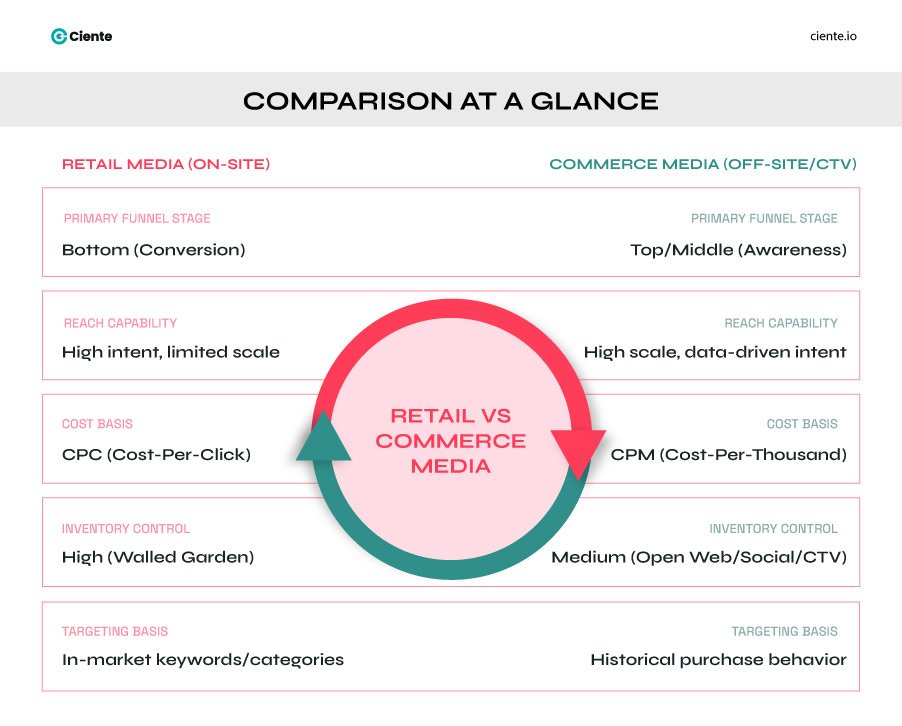
So, is retail media also commerce media?

It depends on who you’re asking. It’s actually the most critical thing to understand about these terms.

They’re used interchangeably in several marketing conversations. And at the surface level, that makes sense. Both are about reaching people close to a purchase decision, using data that’s grounded in actual buying behavior.

The overlap is real.

But there is a meaningful distinction worth making. One that’s become more relevant as the industry has matured.

Retail media, specifically

Retail media is advertising that lives within a retailer’s owned ecosystem, i.e., their website, app, and in-store screens. It runs on “that” retailer’s first-party shopper data- Amazon Ads, Walmart Connect, Target’s Roundel, Kroger Precision Marketing.

The defining characteristic is that the media and the data both belong to the retailer. You’re advertising inside someone’s store, using their knowledge of their customers.

That’s a specific thing. It has a clear boundary.

Where commerce media means something different

Commerce media, when used distinctly, refers to a broader approach. That means applying purchase-intent data and transaction signals to advertising across platforms that aren’t necessarily retailers. Financial services platforms, travel booking sites, food delivery apps. These aren’t retailers, but they neglect behavioral and transactional data that’s just as commercially rich.

This expansion mirrors what’s happening across the broader ecosystem of retail media advertising and adtech companies, where boundaries between retail, commerce, and media continue to blur. It’s worth knowing it carries commercial framing.

But the underlying concept is legitimate: the logic of retail media, i.e., use real purchase signals, not paradoxes, can exist outside of retail environments.

Retail media is defined by its ecosystem. Commerce media is defined by its data logic.

Why brands and retailers are both leaning into retail media

US advertisers spent $60.32 billion on retail media in 2025 and plan to allocate $71.09 billion in 2026, according to eMarketer. And three-quarters of them plan to increase their retail media spend.

Brands and retailers have found their moat.

It’s because retail media is perceived as a more reliable line item. Especially owing to the erratic shifts in consumer behavior and e-commerce growth. More marketers are trusting everything data- it’s the source of all truth. A single point of stability.

For marketers, media planning strategy has become a holy grail.

It realizes the full potential of first-party data, granting the opportunity to optimize their bottom line. Moving beyond the traditional transactional value perspective, retail media comes down to creating incremental growth for customer lifetime value. And while creating a flywheel of the retailer’s own business.

Retailers become a platform.

But the hiccup here is: what if retail brands are underestimating the prowess of their own data ecosystem?

RMNs are less confident in their ability to differentiate amidst the crowded marketplace. The heap of first-party data vendors and media providers adds to the competitive set. As data sources and ad tech stack diverge- there’s a lack of compatibility.

How do RMNs measure, access, and scale their offerings as data silos persist due to a lack of an omnichannel identity framework?

The Three Foundational Philosophies of a New-Era Retail Media Strategy

If anything, retail media should sit inside a broader B2B marketing strategy that defines long-term growth, not just quarterly performance.

But that’s all non-negotiable. That’s where we make the error of judgment- tactics aren’t strategy.

We offer the backbone of a true retail media strategy- the three philosophies that should guide you from the get-go, not when you’re already halfway through the race.

1. Proximity

First, it’s all about the thinking. Traditional media focuses on GRPs, impressions, and the market as its sea. That’s their first mistake. It’s never about how many accounts you reach.

What makes the actual difference? How close to the purchasing decision do you reach these accounts? Purchase proximity.

Guide every strategic decision of your retail media strategy through that lens- why one shopper searching for exactly what you sell is better than five passive scrollers.

2. Retailer is Your Partner

Marketers still approach retail media the way they do billboards- at arm’s length. That’s what differentiates champion retail media from those who remain at the bottom of the barrel.

Retailers are your strategic partners- an extension of your brand. Not publishers. This is where structured B2B media partnerships become a competitive advantage rather than a transactional relationship.

And it includes sharing that first-party data.

3. Campaigns are Just Levers

This ties directly to the measurement fragmentation pain point.

Optimizing within each platform is a tempting opportunity. You chase ROAS on Amazon, CTR on Walmart, and so on. But those metrics are siloed and generally self-reported by the same networks selling the inventory.

It’s misleading.

Measurement maturity like this doesn’t happen in isolation. It’s part of aligning creative execution with analytics — where creative strategy meets data.

Here’s the Retail Media Strategy That Moves Beyond Fancy Labels- And What to Actually Do About It

Most retail media “strategies” I see are just media plans with a fancier label. A spreadsheet of placements, some budget splits, and a kick-off call with the account team.

But that’s not a retail media strategy.

1. Real strategy starts before the brief.

It starts with an honest answer: where is our customer closest to saying yes? That’s the only moment that actually matters in retail media.

Find that moment in your funnel and build your entire retail media strategy around it.

That means conducting a purchase journey audit before you allocate a single dollar.

Map the path- Retail media doesn’t operate in a silo; it should support a full-funnel marketing strategy that connects awareness, consideration, and conversion seamlessly. Where are people searching? What keywords are they using at high-intent moments? That’s your priority inventory.

Sponsored search placements on high-intent keywords should almost always come before display, before off-site, before anything. Start there. Then expand.

And don’t spread budget across six networks because your agency suggested “diversification.” Pick two or three networks where your category actually has purchase momentum, go deep, and prove the model before you scale horizontally.

More RMNs means more fragmented data, more account management overhead, and a measurement nightmare you won’t untangle until the budget’s already spent.

2. Look at your retailer relationships with honesty.

Are you showing up as a partner or just a line item in their ad revenue report? Because the brands getting early access to new inventory, richer shopper data, and joint business planning aren’t necessarily the biggest spenders.

They’re the ones bringing something to the table beyond a media budget.

Tactically, this means requesting and actually using the retailer’s first-party audience data.

Most brands pay for sponsored listings without a conversation about shopper segmentation. That’s leaving serious value on the table. What can you do here?

  1. Push for a quarterly business review with your retail media account team.
  2. Bring your own category data.
  3. Ask what they notice in search trends that you don’t.

Make the relationship bilateral.

Also: negotiate for measurement access upfront. It shouldn’t be an afterthought.

Know exactly what data you’ll receive, in what format, and on what timeline before you sign off on the campaign.

Too many brands discover post-campaign that the reporting doesn’t offer them what they need to make the next decision. That’s a commercial conversation, not a technical one. Have it early.

3. Set up your measurement framework before you scale.

This won’t work after your Q3 spend has been spent.

Here’s a simple way to think about it: run a small incrementality test before committing your full budget to any single network.

Most major platforms, such as Amazon, Walmart Connect, and Criteo, offer holdout testing in some form. Leverage it. Even a rough incrementality read is more valuable than a polished ROAS number generated and reported by the platform.

Know your baseline conversion rate. Know what “normal” looks like without the media running. Then you have something real to compare against.

Beyond that, build a cross-network scorecard that you own- not one stitched together from three different platform dashboards. It doesn’t need to be sophisticated.

It needs to answer: which network drove genuine incremental sales, at what cost, and does that justify the spend relative to the alternative? That’s it. If you can answer that cleanly every month, you’re already ahead of most marketers operating in this space.

Because if you can’t answer “did this actually grow our business,” you’re just funding a retailer’s P&L and calling it marketing. That’s not a position anyone wants to be in, especially when you’re in a room with your CFO- trying hard to justify the spend.

How AI Is Transforming Retail Media Strategy: Opportunity or Overwhelm?

Here’s the honest truth: most B2B brands are sleeping on AI in retail media. They hear “AI-powered bidding” and assume it’s an Amazon feature someone else is managing.

That’s a mistake. B2B brands should care more about AI’s intersection with retail media than they presently do.

Why?

It’s not automated bidding- that ship has sailed. The platforms already do that whether you ask them to or not.

The real opportunity is in what AI lets you do with your own data. That means synthesising performance signals across five different networks, modelling incrementality, and simulating budget allocation scenarios — which is exactly where a modern AI marketing strategy begins to redefine competitive advantage.

It’s a win for B2B brands across 3 cases:

  • Where sales cycles are longer
  • Attribution is messier
  • Buying committees don’t exactly impulse-buy

AI-driven measurement isn’t a nice-to-have. It’s the only realistic way to prove that retail media is has vitality beyond generating impressions nobody can link to revenue.

It’s your workaround from the fragmentation conundrum- the goldmine.

The brands that figure this out first will have a defensible argument for why retail media deserves a bigger slice of the budget.

And in a room full of stakeholders asking hard questions, that argument is worth more than any ROAS figure a platform ever handed you.

The bottom line is that retail media has officially leveled up.

AI-driven attribution has pushed traditional retail media strategies to pivot. And the brands still chasing CPC efficiency will get left behind.

The question your CMO is already asking, i.e., “are we driving new sales, or just reaching people who would’ve bought anyway?” is now the defining question of the entire industry.

Leaders like Thomas Hanel at Mars are no longer optimizing for media efficiency. They’re demanding iROAS, sales per click, and proof of genuine incremental growth. That’s the shift.

And with AI finally making real-time incrementality measurement possible without a six-week analytics detour, there’s no excuse not to hold your retail media to that standard.

The next time a platform hands you a shiny ROAS number? Ask the harder question. Did it actually move the needle or just the numbers in your PPT?

Orange and Samsung aim to grow European Open RAN networks

Orange and Samsung aim to grow European Open RAN networks

Orange and Samsung aim to grow European Open RAN networks

The agreement between Orange and Samsung to scale Open RAN deployments across Europe in 2026 is being reported as a partnership announcement. We think it is something with higher stakes than that.

Orange has committed to a RAN renewal tender covering all its European country sites this year, requiring every submitted solution to carry Open RAN support. The addressable scope is approximately 10,000 sites. That is not a pilot. That is a procurement posture that will force every vendor operating in European telecoms to respond to it.

The technical architecture is worth understanding. Samsung’s AI-powered vRAN solution runs on Intel Xeon 6 processors, deployed on single commercial off-the-shelf servers from Dell and managed through a Wind River cloud platform. The design compresses what previously required significant physical infrastructure into a single server, reducing power consumption and operational footprint simultaneously. For operators facing European energy costs that have not returned to pre-2022 levels, the efficiency argument is not secondary to the performance argument. It may be primary.

The two companies have been working together in live environments since 2023, completing their first 4G and 5G calls on a virtualised Open RAN network in southwestern France last July, following laboratory testing in Lyon. The groundwork was laid quietly. The announcement this week is the acceleration.

Open RAN’s original promise was a political and economic one as much as a technical one: give European operators a credible path away from dependence on a small number of dominant infrastructure vendors. That promise has taken longer to materialise than anyone publicly admitted it would. Integration complexity, multi-vendor management challenges, and the sheer inertia of existing network contracts kept most operators in a cautious holding pattern.

What Orange is doing by writing Open RAN support into a continent-wide tender is changing the terms of that holding pattern for everyone. Carriers that were waiting to see who moved first now have an answer.

The second-order effect is on the vendors who are not Samsung. The tender is open. The requirement is set. The question is whether Europe’s network infrastructure market is about to get meaningfully more competitive, or whether the complexity of Open RAN at scale simply consolidates around a new short list of winners.

The field will tell us. The timeline is this year.

Full-funnel marketing

Full-Funnel Marketing

Full-Funnel Marketing

Full-funnel marketing is not a campaign. It is how B2B teams win before the meeting is ever scheduled, and most companies are only working the bottom half of it.

The sales team is losing deals it never knew it was in

Somewhere right now, a buying committee of ten people is building a shortlist. They are reading comparison articles, watching demos on YouTube, asking peers on LinkedIn, and forming opinions about which vendors understand their problem and which ones are just selling. They will not call anyone until they are roughly 60 percent of the way through that process. When they do make contact, the vendor they call first wins the deal about 80 percent of the time. The vendors who did not make the shortlist will never know the conversation happened.

This is not a sales problem. It is a marketing problem. Specifically, it is the problem that happens when a company treats marketing as communication rather than what it actually is: the management of people, at scale, across time, in ways that determine whether the company is profitable or not.

Full-funnel marketing is the structural answer to that problem. Not the buzzword version, not the agency deck version with the colorful funnel graphic and three tiers labeled awareness, consideration, and decision. The real version, which is considerably less tidy and considerably more valuable. If you want a deeper breakdown, here’s a detailed guide to building a full-funnel marketing strategy that aligns marketing with revenue outcomes.

The Numbers Behind the Problem No One Wants to Name

Here is what the data says is actually happening. The average B2B win rate sits around 20 to 21 percent, a number that becomes more concerning when compared against industry B2B SaaS funnel conversion benchmarks. Sales cycles are 38 percent longer than they were in 2021. The typical buying group spans 10 to 11 stakeholders, and in enterprise deals that number can reach 17. Eighty-four percent of sales reps missed quota last year.

Full funnel marketing

These are not numbers from a down market. Many of the companies behind these reps are growing revenue. The reps are missing quota inside growing companies because the pipeline they are working is structurally broken upstream.

The touchpoint problem most marketing leaders underestimate

The average B2B buyer engages in 62 or more touchpoints before signing a deal, spanning at least three channels and involving multiple members of a buying committee. Most marketing organizations are actively managing perhaps a third of those touchpoints. The rest are happening without them, in spaces they are not present, in conversations they are not part of, among stakeholders they have never tried to reach.

That is the gap the full-funnel strategy closes. It requires intentionally designing each stage of the journey, similar to how you would build a B2B sales funnel from awareness to revenue. Not by being everywhere randomly, but by being specifically present at the moments that shape how a buying group thinks about a category before they think about vendors.

What Full-Funnel Marketing Actually Means, and What It Does Not

Full-funnel is not a synonym for doing more marketing. It is a structural commitment to being present, credible, and useful at every stage of a buyer’s journey, not just when that buyer is ready to talk to sales, which is where many lower-vs-upper funnel marketing misunderstandings begin. It is a structural commitment to being present, credible, and useful at every stage of a buyer’s journey, not just when that buyer is ready to talk to sales.

In B2B, buying decisions are not made by individuals. They are made by groups, typically six to ten stakeholders with different priorities, different vocabularies, and different definitions of risk. A champion inside the organization may love your product. The CFO has not heard of you. The IT lead has concerns about integration that no one has addressed yet. Full-funnel strategy is the discipline of reaching all of them, with the right message, before any of them is formally in a B2B buying process.

By the time a prospect fills out a form or takes a sales call, the majority of their evaluation has already happened. If your brand was not part of that informal research phase, you are walking into a conversation where someone else has already shaped the criteria.

The shortlist is built before the search begins

94 percent of buying groups rank their shortlist in order of preference before initiating contact with sales. The vendor ranked first wins about 80 percent of the time. Read that slowly. The rank ordering is done before anyone picks up the phone. The deal is largely won or lost in a process that most sales teams have no visibility into and most marketing teams are not deliberately influencing.

Buying authority, the condition in which your brand is assumed to belong on the shortlist, is not awarded on the day someone fills out a form. It is accumulated over months of consistent presence, relevant content, and the kind of thought leadership that answers the question a buyer has before they know how to ask it publicly.

Why the Sales and Marketing Tension Is a Funnel Problem in Disguise

Sales loses

The tension between sales and marketing in B2B organizations is almost always a funnel problem. Sales says the leads are not ready. Marketing says sales is not following up. Both are usually right, and both are symptoms of a pipeline that was built without coordination across the full journey.

What changes when marketing works the whole funnel

When top-of-funnel investment is creating genuine awareness and category education, middle-of-the-funnel content is addressing the specific concerns of different buyer personas, and bottom-of-the-funnel assets are arming champions with materials to build internal consensus, the prospect who reaches sales is a different person. They have self-qualified. They have done some of the internal selling work because the content they consumed gave them the tools to do it.

86 percent of B2B deals stall before crossing the finish line, which is why structured lead nurturing strategies become critical to maintaining momentum across long buying cycles. A buyer who arrives with trust already built stalls at a very different rate than one who arrives skeptical and under-informed.

The frictionless experience is a revenue number, not a UX metric

97 percent of B2B buyers say a fast, easy digital experience is a key part of vendor evaluation, reinforcing why SEO for SaaS and digital discoverability are no longer optional in competitive markets. Buyers are also consumers. They are accustomed to experiences that anticipate their needs, and when a B2B buying process is opaque or misaligned with where they actually are in their thinking, they do not wait. They move toward the vendor who makes it easier. Friction at any stage of the funnel is not a design problem. It is a revenue leak.

What Leaders Should Actually Demand From Their Marketing Teams

The organizations that will win the next decade of B2B competition are not the ones with the biggest campaign budgets. They are the ones who understand marketing as the discipline of managing buyers profitably across time. That means measuring influence across the full cycle, not just the last click. It means investing in awareness even when the return is not immediately attributable. It means aligning marketing and sales around a shared definition of what a ready buyer actually looks like.

The compounding advantage most teams are leaving behind

Compounding advantage

Full-funnel marketing asks more of teams and more of leadership. It requires patience for the investments that compound quietly, and discipline to protect them when quarterly pressure arrives. What it returns, in pipeline quality, deal velocity, and customer lifetime value, is not a soft promise. These improvements are often visible when teams track the right SaaS metrics across acquisition, activation, and retention.

The company that has educated the CFO about ROI frameworks, addressed the IT lead’s integration concerns through well-placed technical content, and given the internal champion the language to build internal consensus, that company is not competing on the same terms as the vendor who showed up with a cold outreach sequence in month nine of a ten-month buying journey.

None of this requires an unlimited budget. It requires a different orientation. The companies that compound their competitive advantage are not necessarily the ones with the most sophisticated technology stacks. They are the ones that understand a simple thing clearly: a customer relationship begins long before a contract is signed, and the value of that relationship, its length, its depth, its profitability, is determined largely by what happened before the first sales call.

Marketing is not the department that explains what the product does. It is the function that manages how people think, feel, and decide profitably, across the entire arc of their journey.

The funnel has always been there. Most companies are only working the bottom half of it. That is the gap, and it is solvable. Not with more campaigns. With a strategy built around the buyer’s full journey, from the moment they develop a problem to the moment they sign a contract, and every quiet, decisive moment in between.

That is not a brand story. That is a business model.