
Your MQL-to-SQL Conversion Rate is Falling- and It's All Your Fault

Your MQL-to-SQL Conversion Rate is Falling- and It’s All Your Fault

Your MQL-to-SQL Conversion Rate is Falling- and It’s All Your Fault

MQL to SQL conversion rate often looks definitive, but it rarely is. More than a verdict on performance, it reflects how severely misaligned your marketing and sales are.

B2B teams talk about MQL to SQL conversion rate as if it were a verdict. High means marketing is working. Low means something is broken. Sales complaints. Marketing defends. Leadership asks for fixes. Dashboards light up. Playbooks come out.

And yet, despite years of optimization, tooling, and alignment meetings, the number remains stubbornly unstable.

That is not because teams are incompetent. It is because the metric itself is misunderstood.

MQL to SQL conversion rate is not a performance score. It is a diagnostic signal. When treated as a target, it distorts behavior. When treated as information, it reveals where the system is misaligned.

This distinction matters more now than ever.

B2B buying has slowed, buying committees have expanded, and intent has become harder to gauge. In this environment, forcing leads through rigid qualification stages creates false confidence. The pipeline looks healthy until it’s not- Deals stall, sales cycles stretch, and forecasts miss.

The problem is not the handoff. The problem is what the handoff is assumed to represent.

What MQL to SQL Conversion Rate Was Meant to Measure

The core of MQL to SQL conversion rate measures merely one thing: how often marketing-generated demand survives first contact with sales.

It never signified a growth lever. It was meant to be a temperature check.

A marketing-qualified lead indicates behavioral signals. Content consumption. Form fills. Repeat visits. Surface-level engagement that suggests curiosity or problem awareness.

A sales-qualified lead indicates something else entirely- readiness for a conversation that involves time, risk, and internal justification. The MQL-to-SQL conversion rate was meant to show how well those signals aligned.

In other words, it answers a narrow question: when marketing says, “this is worth a sales conversation,” how often does sales agree after speaking to the human behind the data?

That is a subtle but vital framing.

The metric does not exist to prove marketing’s value. It exists to test marketing’s interpretation of intent. Once you forget that purpose, optimization starts working against reality.

Why Teams Try to Inflate the MQL-to-SQL Conversion Rate

In theory, everyone agrees that MQL to SQL conversion should reflect quality. In practice, the number becomes a reflection of competence.

Marketing is evaluated on it. Sales leadership uses it to justify pipeline skepticism. Revenue teams use it as a proxy for alignment. When a metric becomes political, it stops being diagnostic.

Marketing teams respond predictably. They tighten scoring thresholds. They gate more aggressively. They label fewer leads as MQLs to protect the ratio.

The number improves. The system weakens. Why?

Because qualification is happening earlier, with less information. Marketing substitutes certainty for learning. Sales sees fewer leads, but not necessarily better ones. Feedback loops shrink. What seems as improvement is often contraction.

It’s the first paradox of MQL-to-SQL conversion: optimizing for the rate often reduces the organization’s ability to understand its buyers.

The False Assumption Behind Low MQL-to-SQL Conversion Rates

A low MQL-to-SQL conversion rate reflects failure. Marketing sourced bad leads. Sales wasted time. Something needs fixing. This interpretation assumes that most buyer intent is legible before a conversation happens.

That assumption no longer holds.

Modern B2B buyers research continuously, often without urgent needs. They read to understand, not to buy. They download assets for internal discussions. They explore vendors to map the landscape, not to shortlist immediately.

Much of this behavior reflects intent in analytics tools. Very little of it translates cleanly into readiness.

When sales speak to these leads and disqualify them, it is not rejecting marketing’s work. It is clarifying the context that data cannot capture. Low conversion, in many cases, is not a quality issue. It’s a timing mismatch.

Treating it as failure drives teams to suppress early signals rather than understand them.

How Can You Improve Your MQL-to-SQL Conversion Rate?

Timing Is the Variable Most Teams Ignore

Conversion discussions often revolve around scoring models, enrichment data, and qualification criteria.

Timing receives far less attention- two identical leads, with similar behaviors, can convert very differently depending on when sales reach out. One is contacted while the problem is active. Budget conversations are happening. Internal pressure exists. The conversation moves forward.

While, the other is contacted weeks later. The urgency has passed. Priorities have shifted. The same lead is now “unqualified.”

On paper, both were MQLs. In reality, only one had momentum.

MQL to SQL conversion rate collapses these differences into a single number. Teams then argue about quality when the real issue is responsiveness and sequencing. It’s precisely why speed, context, and continuity matter more than score thresholds.

A fast, relevant conversation often rescues leads that would disqualify. A slow or generic one kills even strong intent.

Conversion is not only about who you pass to sales. It is about how and when the handoff happens.

When Does a High Conversion Rate Become a Warning Sign?

A consistently high MQL-to-SQL conversion rate might feel reassuring, but it can also turn out to be quite misleading.

Very high conversion often indicates over-filtering. Marketing is only passing leads that are already sales-ready. Everything’s optimized to avoid rejection. That creates three long-term problems.

  1. First, it starves sales of learning. Rejected leads offer insight. They reveal objections, internal constraints, and market readiness. When those conversations never happen, messaging stagnates.
  2. Second, it hides demand creation gaps. If marketing only captures late-stage intent, it becomes dependent on existing market awareness. Growth plateaus quietly.
  3. Third, it shifts marketing’s role from interpretation to gatekeeping. The team stops exploring ambiguity and starts protecting metrics.

In healthy systems, some friction exists. Not all MQLs should convert. Rejection is not a waste. It’s a signal.

A conversion rate that never fluctuates is often a sign that the system has stopped listening.

Sales Rejection Is Not Sales Resistance

Another common misreading of MQL-to-SQL data is assuming that sales rejection equals sales resistance. This creates unnecessary tension.

Sales teams disqualify leads for reasons invisible to marketing: internal conflict, contradicting priorities, budget freezes, and lack of executive buy-in. These factors rarely show up in intent data.

When marketing treats rejection as opposition, alignment breaks down. When rejection works as information, something else happens.

Patterns emerge. Particular industries stall at the same stage. The matching job titles consistently lack authority. Specific use cases sound compelling in content but collapse in conversation.

These insights refine positioning, not scoring. The purpose of the MQL to SQL conversion is not to minimize rejection. It’s to understand it.

Why Benchmarks Can’t Solve Your MQL-to-SQL Conversion Rate Problem

Industry benchmarks for MQL-to-SQL conversion are popular. They are also context-poor.

A SaaS company catering to enterprises isn’t comparable to a PLG tool targeting SMBs. Sales cycles, risk tolerance, and buying committees differ fundamentally.

Chasing an external benchmark enables only surface-level fixes. Adjust the score. Change the definition. Move the goalposts. None of these addresses whether your interpretation of buyer behavior is accurate.

The more substantial question is internal and comparative: how does conversion change when we alter timing, messaging, or handoff structure? Trends matter more than targets.

Reframing MQL to SQL as a Feedback Loop

Mature revenue teams treat MQL to SQL conversion as a learning mechanism.

They expect fluctuation. They analyze rejection reasons. They review call notes alongside campaign data. They look for narrative breaks between what content promises and what sales conversations reveal.

In this model, marketing does not aim to predict sales outcomes perfectly, but surface meaningful conversations. Sales, in turn, does not expect every conversation to progress. It expects marketing to send signals worth investigating.

The metric becomes a bridge, not a battleground. When conversion drops, the question is not “how do we fix the number?” but “what changed in buyer reality?”

Market conditions shift. Budgets tighten. Risk tolerance declines. Messaging that worked six months ago loses relevance. Conversion rates reflect these shifts earlier than closed revenue does, if teams are willing to listen.

That’s when they stop treating conversion as proof of success. Because when these brands do, they unintentionally create blind spots. Marketing focuses on defensible leads instead of exploratory ones. Sales conversations narrow. Innovation slows.

The funnel becomes efficient but brittle. And in volatile markets, brittleness is dangerous.

But healthy systems tolerate ambiguity. They allow imperfect signals to surface so human interaction defines them. MQL-to-SQL conversion rate, leveraged correctly, supports this adaptability. Use it poorly? And you suppress it.

What a Healthy Relationship with the MQL-to-SQL Conversion Rate Looks Like

A healthy approach to analyzing MQL-to-SQL conversion rate doesn’t obsess over a single percentage. It asks better questions.

  • Which campaigns generate the most crucial sales conversations, even if they do not convert immediately?
  • Where do leads stall after initial contact, and why?
  • What objections repeat across disqualified leads?
  • How does response time affect qualification outcomes?

These questions turn the metric into a diagnostic tool.

Over time, patterns inform strategy. Messaging sharpens. Handoffs improve. Conversion stabilizes naturally, without coercion. That’s the real purpose of the MQL-to-SQL conversion rate.

The metric was never a promise. It doesn’t guarantee revenue. It doesn’t validate strategy on its own or predict the future with certainty. However, it exists to expose how well marketing understands buyer intent and how effectively sales engage with it.

In uncertain markets, that understanding matters more than clean ratios.

Organizations that treat MQL to SQL conversion rate as a signal, not a score, gain something more valuable than a benchmark. They gain clarity.

And clarity, not certainty, is what sustains growth when playbooks fail.
Adobe Acrobat's AI Push: Turn Sticky PDFs Into Slides, Podcasts, and Chatty Helpers

Adobe Acrobat’s AI Push: Turn Sticky PDFs Into Slides, Podcasts, and Chatty Helpers

Adobe Acrobat’s AI Push: Turn Sticky PDFs Into Slides, Podcasts, and Chatty Helpers

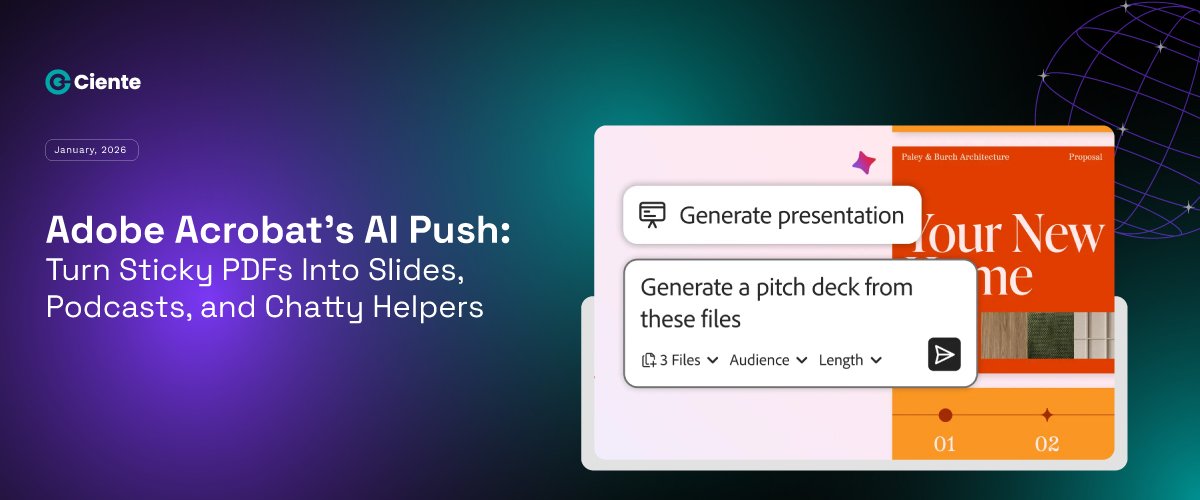
Adobe Acrobat’s AI update makes PDFs more than static files. It now spits out slides, audio summaries, and responds to chat commands. Stance: game-changer or fluff?

Adobe just dropped a huge update for Acrobat. It’s not just about reading PDFs anymore. Now Adobe’s AI can turn your documents into slide decks and podcasts. It will even edit your PDFs when you talk to it.

At first glance, these features sound exciting. Who wouldn’t want a slow annual report turned into a podcast while they walk? Or an instant pitch deck from a messy dump of files? But we should pause before we label this the future of work.

The Generate Presentation feature is slick.

You feed Acrobat your files, ask for a presentation, set the tone and length, and AI does the rest. Adobe taps Express for design styles, so you get a draft fast. You can still tweak fonts, images, and videos. For busy teams, that can save time.

But here’s the catch: creativity and insight don’t come from automation alone. Real strategy still demands a human brain.

The Generate Podcast feature is the wild card. Feeding a 500-page doc and getting an audio summary feels like progress. It’s THE answer for digesting long reads on the go. But AI summaries often overlook nuance and context. Relying solely on an AI summarizer can severely risk oversimplification.

Then there’s chat editing. You describe what you want, and Acrobat adjusts your PDF. It’s a real productivity boost for routine fixes. But this also blurs the lines between tool and collaborator. Users will need discipline to check the AI’s work.

Adobe’s move is bold. It pushes PDFs out of their static box. But convenience isn’t always quality.

Treat the output as a head start, but not the final answer.

B2B Sales Outsourcing: What Drives a B2B Brand’s Intention to Outsource?

B2B Sales Outsourcing: What Drives a B2B Brand’s Intention to Outsource?

B2B Sales Outsourcing: What Drives a B2B Brand’s Intention to Outsource?

Is B2B sales outsourcing a shortcut or a strategy? Renting agility isn’t just about cost savings but about protecting your brand’s purpose in a turbulent market.

B2B businesses are torn between two stark realities they can’t take for granted- first, the urgency to predict and act on fluctuating customer demands, and second, maintaining efficient structural costs.

These realities must coexist. But it has to be a sustainable practice- not a quick fix. A system like that would never prove beneficial for the long haul. Your foundation will lose its momentum, pushing your business to perish or struggle for a way out.

That means transforming the mere survival tactics into an agile success protocol- your brand’s modus operandi. By minimizing your potential for failure.

But how? Augmenting your capabilities.

What most companies do is level up their tech infrastructure, execute inter-organizational synergies, or outsource crucial business processes- ones where the rust-ridden playbooks offer very little support.

B2B sales is one such domain.

Significance of B2B Sales Outsourcing: Nudging A Static Pipeline

It’s paramount to think of sales as a core business function. And the current customer-first, value-driven market demands it. Those who realize its vitality are pivoting to B2B sales outsourcing.

Their primary motivation? Sales complexities, a lack of expertise, and market turbulence. In simple terms, B2B sales outsourcing offers you an in- a new market with a new service. It empowers you to experiment and get out of your comfort zone.

That’s what B2B sales outsourcing can afford your business. It’s, of course, about the simple stuff- experience and past sales successes of the third-party. But it’s all about the networking skills and existing network threads that they bring to the conversation.

It’s an extended arm. Not a siloed third-party app that functions in the background. B2B sales outsourcing has to be your bridge into a newer market- and move your solutions through a market that has little or no awareness of you.

That’s precisely why B2B businesses embrace it. It’s both viable and profitable.

You waste three times the amount on an in-house sales team. However, a small business doesn’t even require that huge a sales team. They would rather push all their cash inflow to an expert agency that would focus all the limelight on managing customer relationships, while staying on top of cyclical sales trends.

If you take the above three factors as the threshold for why businesses outsource sales, you’re restricting yourself. The gap in expertise is filled by hiring seasoned professionals in-house. Then, does that mean sales outsourcing becomes a purely cost-based decision? Again, not really.

Outsourcing sales teams turned into a trend in the B2B space. But there’s still little on why companies make the switch, from owning sales teams to renting them.

Assessing Your B2B Sales Outsourcing Performance: What Matters?

The decision to outsource isn’t just about the balance sheet. It’s about strategic orientation. It’s about your business’s “reason for being.” Research by Adam Rapp asserts the same notion- your internal philosophy dictates your outsourcing success.

  1. If your purpose is production orientation, you care about efficiency. You want the lowest cost. You outsource because it’s cost-efficient and quick. You treat the sales force like a utility.
  • If your purpose is selling orientation, you are in the business of aggressive “pushes.” You have a product, and you need it sold now. This is where the “mercenary” shines. They are hired guns. They come in, hit the numbers, and leave.
  • What if your purpose is brand focus? That’s where the real tension starts. If you invest heavily in your brand image, you fear the mercenary. You worry they won’t represent your values. You worry they are just “renting” your brand for a commission.
  • The same goes for competitor orientation. If your work is built on outmaneuvering rivals, you need intelligence. Internal sales teams are your scouts. They bring back the secrets from the field. A mercenary might not. They might be selling your competitor’s product tomorrow.
  • Then there is the learning orientation. If your company’s work is based on shared knowledge and organizational memory, a revolving door of outsourced reps is a nightmare. You lose the “institutional know-how” every time a contract ends.
  • But let’s take technological orientation. In high-tech, things move fast. You don’t have time to hire and train a team for a six-month product cycle. You rent the expertise. You use the outsourcing agency to scale up for the launch and scale down for the maintenance.

The bottom line? It all boils down to agility.

The Shift to Out-tasking: The Much Agile Layer to B2B Sales Outsourcing

We need to stop perceiving sales as one giant, immovable block. Modern B2B sales is a series of interconnected tasks. The latest trend isn’t outsourcing the whole department- it’s out-tasking.

You keep the “closers” in-house. You sustain the relationship managers. But you outsource the most “rust-ridden” part of the pipeline: Prospecting.

As Taina Riepponen’s research shows, prospecting is the bottleneck. It’s the “grunt work.” It requires high tech, high persistence, and very little “firm-specific” knowledge. An external agency can do it better because that is all they do.

This is how you nudge a static pipeline. You remove the friction of lead generation. You let your internal experts focus on the high-value work- work that requires deep company knowledge.

The Success Protocol for B2B Sales Outsourcing

You can’t just throw a contract at an agency and expect a “success protocol.” Most systems fail here. They treat the partnership as a transaction.

For the “extended arm” to function, you need four determinants:

  1. Customer Understanding

The agency must know your customer better than they know you. If they are only reading a script, they are failing. They need to understand the pain points. The nuances. The “why” behind the buy.

  • Proactivity

You don’t want a vendor. You want a partner. A partner who sees a shift in the market and tells you about it. They shouldn’t wait for your instructions. They should be developing operations independently.

  • Active Dialogue

The “silo” is the enemy of success. You need a constant flow of information. Feedback loops. CRM integration that isn’t just a weekly CSV export. It has to be real-time.

  • Resource Management

The agency must manage its own “mercenaries” well. If their internal culture is a mess, it will bleed into your sales calls. You are outsourcing the management of the people, not just the results.

The Vehicle to Navigate Market Turbulence and Complexity

Why does this matter now? Because the market is turbulent. Product complexity is through the roof.

In a stable market, you can own your team. You have time. In a turbulent market, “owning” is a weight around your neck. You can’t pivot fast enough.

But there is a catch. If your product is highly complex, i.e., if it takes six months merely to understand how it works, outsourcing is a risky choice. A “mercenary” won’t put in the hours to master a complex technical solution if they can make an easier commission elsewhere.

This is where your success protocol must be rigid. If you have a complex product, your “extended arm” needs more than a script. They need deep training. They need to be integrated into your engineering and product teams.

The True Success Lies in Moving Beyond the “Hired Gun” Mentality

We need to rethink the “mercenary” label. While Rapp uses the term to describe the independent nature of the outsourced force, the goal should be integration.

The “mercenary” is efficient. They are specialists. Results drive them. These are good things. But without any purpose, they’re all part of the clamor.

What is then that successful B2B companies do differently? They align their strategic orientation with their outsourcing model.

  • Are you a high-speed tech firm? Out-task the prospecting to maintain velocity.
  • Are you a cost-leader? Leverage a full outsourced force to keep overhead low.
  • Are you a high-touch service brand? Keep the closing in-house, but use an agency to “warm up” the market.

This is how you transform survival into success. You stop trying to do everything poorly. You start doing the core work exceptionally well and augmenting the rest.

The Final Argument: With B2B Sales Outsourcing, You’re Renting Agility

B2B sales outsourcing isn’t a sign of a failing internal team. It’s a sign of strategic, agile leadership. It’s about recognizing that the old ways (the “rust-ridden playbooks”) don’t work in a market that moves at the speed of light.

You aren’t just “renting” a sales force. You are renting agility. You are renting networks. You are renting the ability to fail fast and scale faster.

But your foundation needs momentum. A static pipeline is a dying business. Don’t let your business perish because you were too proud to hire a “mercenary.” Don’t let your structural costs drown your innovation.

Build your bridge. Extend your arm. Nudge that pipeline. Transform your sales function from a cost center into an agile success protocol. That’s the work, the purpose.

The move from “owning” to “renting” isn’t just about the money. It’s about who you want to be in the market. It’s about having the “success protocol” to act while your competitors are still reading their old playbooks.

If you want to win in the B2B space, you need to understand the realities of the market and have the guts to outsource the tasks that are holding you back. Focus on the relationship. Focus on the value. The specialists handle the nudge. And that’s precisely how you ensure your business thrives.

You create a brand that’s ready for whatever the market throws at it next. You minimize the potential for failure and maximize your strategic capabilities. That’s the significance of B2B sales outsourcing.

It’s not just a trend. It’s a necessity.

A Modern B2B Lead Scoring Criteria: Measuring the Momentum of Change

A Modern B2B Lead Scoring Criteria: Measuring the Momentum of Change

A Modern B2B Lead Scoring Criteria: Measuring the Momentum of Change

As buyers move in stealth mode, can traditional b2b lead scoring criteria truly separate the signal of genuine intent from the noise of casual browsing?

Traditional B2B lead scoring criteria are faltering, through no fault of their own. But because their cultural vitality has come to pass.

Most of these models, Recency, Frequency, and Monetary (RFM) or its B2B counterpart, Recency, Frequency, and Fit, were designed specifically for e-commerce and direct mail. It was when transactional yield was the precursor of growth, and these systems aptly catered to profit-first demands.

But circumstances have changed, and that’s merely an understatement. Marketing has been hit by waves from every direction, in and out- it needs a new perspective to adapt to the current buyer needs and expectations. Not jargon and superfluous words packed into lacklustre promises.

The missing factor, many have come to realize, is connection. What can reconnect marketers to their buyers, especially in this attention-deficit economy? This dilemma has been buried, without realizing that this is where the gap lies.

And that’s why your old lead scoring models are losing their momentum.

At the nucleus of which is the RFM model. The contrast between traditional and predictive approaches is already visible in traditional vs predictive lead scoring models.

While you can continue to treat it as the DNA of your database management, the focus is surface-level. It’ll tell you whether a lead is active, but not their intent or capacity for change in purchasing intent. That’s a significant lack.

In 2026, buyers have completed 80% of their research and are closer to making a decision, way before reaching out to your SDRs. Did you really assume that such traditional models- operating more like vanity filters- could offer you the grounded picture that you need? Sales conversations drag on precisely because the leads end up going nowhere.

You need a B2B lead scoring model that works as a predictive engine because the game is all about intent.

However, before we dive into painting a savvy, inclusive B2B lead scoring criteria that functions solely based on modern buying behavior, we spotlight why diverging from traditional criteria is imperative.

Why the Traditional B2B Lead Scoring Criteria is Just Not It

The point here isn’t to forsake traditional B2B lead scoring criteria altogether. They’re stumbling away from what they’re designed to offer, but have they lost all their significance? Not quite.

Take the RFM model, for example.

Recency and frequency matter for basic hygiene- of course, you’re not going to call a lead that hasn’t interacted with your brand in over two months, let alone two years. They can’t operate as accurate scores for intent, but you can leverage them as a threshold- a basis for designing a B2B lead scoring criteria that truly gauges buyer intent and conversion potential.

Why is this a problem?

First, because frequency can be misleading.

There could be a researcher who downloads all your PDFs or a student who visits all your blogs within the first 10 days of visiting your website. The traditional criteria would mark them as “hot.” And score them positively.

The point is to outline the intensity, i.e., depth of research rather than its breadth. Not “how many pages on our website the lead is visiting?” but “how many times is the lead returning to our high-value pages, such as pricing or services?”

Second, time decay only responds to linearity.

B2B cycles are jerky and, often, exhaustively long. Your lead might go ghost for about 2-3 months. But it’s not because they’ve lost interest. It could be because they’re trying to secure the budget. And after three months? They show up sales-ready. But the old scoring criteria would score this a zero, failing to account for the same.

Lastly, there’s a silent buyer phase that goes overlooked.

Most potential buyers read your content, but in stealth mode. This is a modern problem. Prospects consume your LinkedIn posts or podcasts, but no traceable or clickable link to document this behavior.

Traditional lead scoring models gauge only the 20%- the tip of the iceberg. The remaining 80% often lives in the dark funnel and requires new measurement models. While, as always, the nuance goes unnoticed, the depth of interest. Only the volume is quantified, not the contextual intent.

These are the critical gaps traditional lead scoring criteria pose.

A Modern Protocol: A B2B Lead Scoring Criteria for Non-linear Buying Committees

All the components of the traditional criteria that we discussed haven’t lost their efficacy. They hold significance to paint a baseline for your newer system.

Leveraging those, the primary setup is a fit vs engagement quadrant- the aspects to prioritize and the action you must take- where the propensity to buy is attributed much vitality.

  1. Lead 1 ⇒ High frequency, high recency, and low fit ⇒ A student or competitor researching your solution/brand ⇒ Ignore and automate to discard.
  2. Lead 2 ⇒ Low frequency, low recency, and high fit ⇒ A potential client who isn’t aware of your brand yet ⇒ Create awareness (frequency) through targeted outreach.
  3. Lead 3 ⇒ High frequency, high recency, and high fit ⇒ This lead fits the 2% of your database and has the highest conversion potential ⇒ Instant outreach.

The quadrant mentioned above is the foundational “map,” but for navigating the actual terrain of 2026, we must layer in dimensions that account for the messy, human, and often invisible reality of the dark funnel.”

To build a lead scoring criterion that moves the needle, we must shift our focus from tracking actions to decoding intent. This requires a three-dimensional framework: account velocity, topic depth, and the silent signal.

1. From Individual Frequency to “Account-Based Velocity.”

The single greatest failure of traditional RFM is its obsession with the individual. You aren’t selling to a person but a consensus in B2B.

Your model is broken if your scoring system gives:

50 points to a Marketing Manager who downloads five PDFs, but 0 points to the CFO who spent ten minutes on your pricing page without clicking a single CTA.

The strategic shift: Implement cluster scoring.

Instead of looking at how many times “Person A” visited your site, look at the account’s velocity. When three different stakeholders from the same organization, say, a Director of Ops, a Head of IT, and a Product Lead, all engage with your content within the same 72-hour window, that’s a buying sprint. This aligns closely with modern ABM vs lead generation thinking.

In this modern protocol, the overlap of engagement across different roles should trigger a “Score Multiplier.” This tells your Sales team that the “work” of internal alignment is happening right now. It transforms a cold lead into a warm account, allowing for a conversation that addresses the collective needs of the committee rather than the curiosity of an individual.

2. The Hierarchy of Intent

Traditional models treat all conversions equally- a newsletter sign-up is +5, a webinar is +10, and a whitepaper is +10. This is linear thinking in a non-linear world.

You should categorize content by its psychological weight.

  1. Awareness Signals (Low Intent): Consumption of “How-to” blogs or industry news. These show interest in the topic, but not necessarily the solution.
  2. Consideration Signals (Medium Intent): Attendance at a live webinar or downloading a “Framework” guide. These show the buyer is actively trying to solve a problem.
  3. Decision Signals (High Intent): Repeated visits to the Pricing page, reading “Us vs. Them” comparison articles, or viewing the “Security & Compliance” documentation.

The strategic shift: Implement value-based weighting.

If a lead visits your “Pricing” page three times in 24 hours, that “Recency” should outweigh ten visits to your “About Us” page. Additionally, you must introduce dwell time as a scoring metric.

In an attention-deficit economy, a lead who spends eight minutes reading a deep-dive report is far more valuable than one who clicks through five pages in sixty seconds.

The latter is a “skimmer”; the former is a “student” of your solution.

3. Scoring the Dark Funnel and External Signals

We have to address the “Silent Buyer” mentioned earlier.

If you only score what happens on your website, you are missing 80% of the journey. Modern B2B buyers are influenced by what they hear on podcasts, what they see on LinkedIn, and what they read in niche publications.

The strategic shift: Integrate third-party intent data.

By leveraging co-op data or tools that track anonymous research across the web, your lead scoring model can pick up on “surges” before the lead ever hits your landing page. If an account is suddenly researching “Sustainable Supply Chain Tech” across the broader internet, and then they land on your site, their initial score should not be zero.

They should enter your system with a Pre-Qualified Intent Bonus.

4. The Purpose of Negative Scoring

To truly think about the purpose of work, we must ensure our sales teams are not wasting their time on the first type of lead. Traditional models are often too optimistic- they only add points.

A sophisticated modern protocol must subtract points for non-buying behaviors.

  1. Career Page Visits: If a lead hits your careers page three times, they aren’t a buyer; they’re a job hunter. (-50 points)
  2. Student/Competitor Domains: Automatically disqualify or heavily penalize domains associated with educational institutions or known competitors.
  3. Technological Mismatch: If your solution requires a specific tech stack (e.g., Salesforce) and the lead’s “Fit” data shows they use a competitor (e.g., HubSpot), their score should reflect the difficulty of the “work” required to convert them.

Scoring as a Service, Not a Surveillance

The crisis of traditional B2B lead scoring is not a technical one; it is a philosophical one. We have spent a decade treating lead scoring like a surveillance system- watching every click, timing every visit, and pouncing the moment a threshold is crossed.

But the “cultural vitality” of that approach has expired because buyers have learned to hide.

The new strategic framework for B2B lead scoring must be rooted in the purpose of connection. It is about moving away from “How do we catch this lead?” toward “How do we facilitate this buyer’s work?”

When we shift from tracking frequency and recency to decoding intent and velocity, we stop being “marketers” in the transactional sense and start being “navigators” for the buyer. We acknowledge that their journey is jerky, non-linear, and often invisible.

The old RFM and RF-Fit models were built for a world of transactions. But in 2026, growth isn’t found in the transaction; it’s found in the relationship.

By building a lead scoring criterion that accounts for the complexity of buying committees, the depth of topic acceleration, and the reality of the dark funnel, we create a predictive engine that doesn’t just “filter” leads. It builds a bridge.

It’s time to stop counting clicks and start measuring the momentum of change. That’s the only way to move the needle in an attention-deficit economy. It’s the only way to ensure that when sales finally makes that call, they aren’t just another interruption- they are the final piece of a puzzle the buyer has been working on for months.

That’s the future of lead scoring. It is sophisticated, it is human, and it is finally, authentically, fit for purpose.

Automation Anywhere Introduces New Gen of Agentic Solutions in Partnership with OpenAI

Automation Anywhere Introduces New Gen of Agentic Solutions in Partnership with OpenAI

Automation Anywhere Introduces New Gen of Agentic Solutions in Partnership with OpenAI

Automation Anywhere’s tie-up with OpenAI pushes enterprise agentic AI beyond automation hype. It’s bold, but the tangible value still hinges on outcomes.

Automation Anywhere just dropped a major update in the enterprise AI arms race. The company announced new AI-native agentic solutions built with OpenAI’s reasoning models. It’s more than marketing speak. It’s a deliberate push to put AI that acts, not just responds, into the core of how work gets done.

The pitch is simple. Traditional automation stacks repeated rigid rules and brittle flows.

The new approach combines Automation Anywhere’s Process Reasoning Engine with OpenAI models to augment bots’ reasoning, adaptation skills, and actions across systems. That’s the promise. It’s meant to close the gap between human expectations of “AI help” and actual enterprise execution.

However, let’s be clear: this isn’t a dinner-plate shift.

It’s the logical next step in agentic AI- a trend Microsoft, ServiceNow, and others are chasing too. AI that reasons, plans, and executes is where enterprises believe the value lives. Reports suggest agents can handle entire workflows and reduce operational drag while accelerating ROI pressures.

The real nuance lies in execution. Enterprise buyer fatigue around AI promises is real. Boards now ask for ROI, not demos. If these agentic solutions truly cut deployment cycles from months to weeks and deliver contextual, governed autonomy, they’re meaningful. That’s the claim here.

However, skepticism is healthy. Many agentic initiatives fail because they’re either too unconstrained or too locked down. Automation Anywhere insists its blend of reasoning, execution, and human controls is the balance that bridges theory and reality. That’s a stodgy way of saying “tune the dial just right.”

This move is bold. But its success will be decided in boardrooms and workflows, not press rooms.

Enterprises want autonomy. And now the question is whether this AI can actually deliver on that promise.

Speed to Lead: Why Connection Is the Backbone of Purposeful B2B Partnerships

Speed to Lead: Why Connection Is the Backbone of Purposeful B2B Partnerships

Speed to Lead: Why Connection Is the Backbone of Purposeful B2B Partnerships

When a lead reaches out, your clock starts. One vendor calls in a minute; the other calls in two hours. The winner isn’t one with the better product- but one who respects the momentum.

There are two vendors in the scenario. A single lead calls both of them; it’s an inbound inquiry. One vendor shows up within a minute, specifically when the lead’s interest is warm. But the other one takes their time, responding approximately. after two hours. Who ends up making the sale?

“We need to act on them- and fast”- this is the basis for speed to lead today. And truthfully, it has always been the case. In 2011, HBR published a critical study, one that chastised sales teams for not responding to prospects quickly enough; only 37% responded within an hour. And the average response time? 42 hours.

Similarly, a 2013 Forbes study found that sales teams took 46 hours and 53 minutes to pick up calls. The condition wasn’t any different two years apart.

The Practical Value of Speed to Lead

The timing isn’t the actual crux. It’s why it matters and for whom. Very little of this has changed today. Responses across B2B remain long and span across days. And the golden window of 5 minutes is rarely met by companies.

The result? Either leads drop off or move on to your competition. They don’t feel valued or seen.

Today, we have access to most of the crucial tools and software to tackle this dilemma. But speed to lead remains a bottleneck for both marketing and sales. Because speed to lead, or inbound lead response time, isn’t an aggressive sales tactic where you bombard casual website browsers with marketing messages. The most vital aspect of where you’re failing with this is the momentum of intent.

The Cold Reality of Lead Decay

Lead quality dies in the silence between contact and response. If you call within five minutes, you are 21 times more likely to qualify that lead. If you wait thirty minutes, the lead is already “cold.” Their brain has switched tasks. They are no longer thinking about their problem. They are thinking about their next meeting. Speed keeps the conversation relevant.

Agility as a Brand Statement

Your response time tells a story. A fast reply says you are ready to work. It says you have the resources and the drive. A slow reply says you are overwhelmed or indifferent. In a world of endless choices, your behavior is your best marketing. Buyers assume your product works exactly like your sales process. If you are slow to sell, they presume you’ll be slow to serve.

The Psychological Anatomy Behind Why Speed is Necessary

Why does speed win? It wins because it aligns with how humans think. When a lead reaches out, they are in a “hot state.” We call this the momentum of intent.

Capitalizing on Problem Awareness

A prospect fills out a form because a pain point just peaked. They want relief now. When you call back instantly, you enter their mind while the problem is still vivid. You don’t have to remind them why they called. You don’t have to fight for their attention. You already have it. If you wait, you lose that “hot” connection. You become a stranger calling at an inconvenient time.

The Halo Effect of Immediate Action

The halo effect creates strong bias. People start to think you do everything well just because you did one thing well.

Responding in seconds creates this bias. The lead thinks: “Wow, they really have their act together.” This trust carries over into the demo, the contract, and the implementation. Speed buys you credibility that no slide deck can match.

Eliminating the Search for Alternatives

Most buyers reach out to multiple vendors. The first one to respond often wins. Why? Because people hate making decisions. Once they find a competent person who can help, they stop looking. They want to check “solve problem” off their to-do list. By being first, you prevent them from even talking to your competitor. You win by being the path of least resistance.

The Operational Friction: Why Speed to Lead Remains a Bottleneck

If speed is so valuable, why is the average response time still 42 hours? The problem is rarely the people. It is the process.

Technical Latency and Data Silos

Information moves too slowly through the modern tech stack. A lead fills out a form. The data goes to a CRM. The CRM syncs with an alert tool. A manager assigns the lead to a rep. Each step adds minutes. By the time the rep gets the alert, the “Golden Window” has closed. To win, you must strip away every unnecessary second between the “Submit” button and the phone call.

The Research Trap

Sales reps often want to be “prepared.” They spend ten minutes looking at a lead’s LinkedIn or company website before calling. In those ten minutes, the lead’s intent drops. You don’t need a deep dossier to make a first contact. You only need to know their name and their problem. Do the deep research after you have them on the phone. Speed trumps a perfect script every time.

Cultural Inertia and Meeting Fatigue

Internal culture often kills speed. Reps are in meetings. They are doing admin work. They check their email in batches. This “batching” behavior is the death of inbound sales. A new lead is not a “task” for later. It is a live event. Without a culture that prioritizes the “Now,” your response times will always lag.

Building a Strategic Framework for the Optimal Speed to Lead

To solve this, we need a clean framework. We can break speed to lead into three distinct pillars: Velocity, Context, and Consistency.

Pillar 1: Velocity

Velocity is the raw measurement of time. It is the infrastructure of your response.

  1. Instant Routing: Leads should go to the first available person, not just a specific owner.
  2. Push Notifications: Alerts should hit the rep’s phone, not just their email.
  3. Direct Connect: Leverage tools that instantly bridge the lead to a phone call.

Pillar 2: Context

Speed is useless if you don’t know why you are calling. You need just enough context to be relevant.

  1. Intent Signals: What page was the lead on? What did they download?
  2. Real-Time Enrichment: Leverage software that outlines the lead’s role and industry to the SDR.
  3. The “I Noticed” Opener: Start the call with: “I noticed you were looking at [Feature]. I wanted to save you some time.”

Pillar 3: Consistency

You cannot be fast only when it’s convenient. You must be fast every time.

  1. Coverage: If your team operates in one time zone, who answers the lead at 6:00 pm?
  2. Auto-Escalation: If an SDR doesn’t pick up within two minutes, the lead must move on to someone else.
  3. Weekend Protocol: Leverage high-quality AI or a skeleton crew to capture intent on days your team is off.

Quality as a Component of Speed to Lead

Speed is a choice. It reflects your purpose and your work ethic. It is the most honest form of customer service.

Respecting the Human on the Other Side

Work has a purpose: to solve problems. When a lead reaches out, they are in a moment of need. To make them wait is to disrespect their need. Reaching out immediately equates professional empathy. It illustrates that you value their time and your own.

This turns a “transaction” into a “relationship.”

The Lasting Impression of the First Touch

The first interaction is the most memorable. If you show up instantly, you set a high bar for the entire project. This initial experience stays with the customer for years. It becomes the foundation of their loyalty. They won’t remember your pricing as much as they remember that you were there when they asked for help.

Professionalism as a Competitive Moat

In 2026, features are easy to copy. Prices are easy to match. But execution is rare. Most companies are slow. Most companies are disorganized. If you can build a culture of radical responsiveness, you have a moat that competitors cannot easily cross. You win because you execute better than everyone else.

The core of reaching out to leads immediately is simple: Honor the momentum.

When someone asks for help, that is the moment of maximum opportunity. It is the peak of their intent. If you miss that window, you aren’t just losing a lead. You are losing the chance to provide value when it is needed most.

The vendor who shows up in one minute wins because they understand the value of the present. They don’t let internal processes get in the way of human connection. They recognize that speed is the most authentic form of sales.

To improve your results, look at the clock. Close the gap between the question and the answer. That is where the work becomes purposeful.