Sales Techniques

10 best sales techniques for B2B sellers in 2026

10 best sales techniques for B2B sellers in 2026

The techniques haven’t changed as much as everyone claims. What’s changed is the buyer. Here’s what actually works in 2026 and why most lists get it wrong.

Every year, a new list. New frameworks, new acronyms, new tools promising to close the gap between quota and reality.

Most of them are the same techniques with updated vocabulary.

This one is different not because the techniques are all new, some are genuinely old, but because it is honest about why they work. The mechanism matters more than the method. A rep who understands why something works can adapt it. One who memorized the steps cannot.

Here are ten that hold up.

Here is the Top 10 Best Sales Techniques in 2026

1. Sell to the problem before you sell to the solution

A structured approach like a defined sales journey can support this shift, as outlined in your broader framework. B2B buyers in 2026 are not short on vendor options. They are short on people who understand what they are actually dealing with.

The rep who opens a conversation by describing what their product does is already behind. The one who opens by accurately describing the problem the buyer is living with gets a different response entirely. Something shifts. The buyer leans in slightly. The conversation stops being a sales call.

Problem-first selling requires genuine research. Not a LinkedIn stalk and a quick glance at the company’s homepage. Real research. What is this company trying to do this year? What is in the way? What has probably already been tried and why might it not have worked?

Arrive with a hypothesis about the problem. Test it in the conversation. Adjust. The rep who does this is not pitching. They are consulting. Buyers pay attention to consultants.

2. Map the buying committee before the first call

Single-threaded selling is how deals die quietly.

The champion who responded to outreach is one person in a room full of people who will have an opinion about this purchase. Some of them the rep will never talk to. All of them will influence the outcome.

Mapping the buying committee before the first conversation changes what questions get asked in it, especially when you understand how multi-threading impacts deal outcomes across stakeholders. Who else is involved in this decision? What does the IT team need to see? Who has said no to something like this before?

These questions do not feel like intelligence gathering when asked correctly. They feel like the rep taking the deal seriously. Because they are. The information they produce shapes every touchpoint that follows, who gets contacted, what they receive, and when.

Multi-threading is not aggressive. It reflects how organizations actually make decisions and aligns closely with how modern sales pipelines are built and managed.

3. Use silence as a technique, not as a problem to fix

Most reps fill silence. Immediately. With a clarification, a rephrasing, a pivot to the next talking point.

The instinct is understandable. Silence in a conversation feels like failure. It feels like the other person is losing interest or the rep has said something wrong.

It is almost always neither.

A buyer who goes quiet after a question is thinking. The thought that comes after the silence is usually more honest than the one before it. It is the answer after the prepared answer. The thing they have not said yet because they needed a moment to find it.

The rep who holds the silence gets that thought. The one who interrupts it gets the prepared version and goes home thinking the conversation went well.

Sit with it. Thirty seconds of silence in a sales call is not a problem. It is usually the most productive thirty seconds in the whole conversation.

4. Run a pre-mortem on every deal

This one comes from research psychology and almost nobody applies it to sales.

A pre-mortem is simple. Before a deal progresses to the next stage, the rep imagines it is six months from now and the deal has fallen apart. Not if it falls apart. It fell apart. Working backwards from that assumption: why?

The champion lost internal support. The budget got reallocated in Q3. A new VP arrived and froze all vendor decisions. The technical evaluation surfaced an integration issue nobody anticipated.

Running through the failure modes before they happen produces two things. The rep catches the risks that were always there and gets ahead of them. And they ask different questions in the next conversation, the ones that probe the assumptions the deal is currently resting on.

Pre-mortems do not make deals pessimistic. They make them honest.

5. Teach buyers something they did not know they needed to learn

The consultative selling model has been discussed for decades. The version most reps practice is a softened version of traditional selling with more questions and less hard closing.

Challenger selling, documented by Matthew Dixon and Brent Adamson, takes it further. The highest-performing reps do not just understand the buyer’s situation. They reframe it. They introduce a perspective the buyer had not considered, challenge an assumption the buyer was carrying, and show them the problem from an angle that makes the solution feel inevitable rather than optional.

This requires the rep to know more about the buyer’s industry, competitive landscape, and category dynamics than the buyer expected. Not a standard pitch. An actual point of view.

Buyers remember the rep who taught them something. They forget the one who presented well.

6. Qualify out faster

The pipeline looks healthy until someone examines what is actually in it.

Most B2B pipelines contain two types of opportunities, which is why tracking the right pipeline metrics becomes critical for maintaining accuracy ones that will close, and ones that will not close but nobody wants to admit it yet. The second category consumes time, energy, and forecast credibility. It also prevents reps from focusing on the ones that could actually move.

Qualifying out is the discipline of ending pursuit of an opportunity that does not meet the criteria for real pipeline. Not leads received. Not meetings booked. Opportunities where there is a problem that needs solving, a budget to solve it, a timeline with some urgency, and a path to the people who make the decision.

When any of those is genuinely missing, the right move is to exit cleanly and shift attention. This is hard. It feels like giving up. It is actually the most productive decision a rep can make with an opportunity that was never going to close, because it frees up the capacity to work one that will.

7. Make the next step specific before leaving every conversation

supported by a well-defined sales cadence that keeps momentum consistent. Vague next steps are where deals go to stall.

Following up to touch base is not a next step. Sending over the proposal when you get a chance is not a next step. Connecting again after the holiday break is not a next step.

A specific next step has a date, a time, a clear action, and a shared understanding of what will be different after it happens. The follow-up call is scheduled before the current call ends. The proposal has a walkthrough meeting booked, not just a delivery date. The evaluation has a defined criteria and a defined endpoint.

Buyers who leave a conversation without a specific commitment tend not to come back to it at the same level of urgency. The rep who locks the next step in the current conversation keeps the momentum. The one who sends a follow-up asking for availability loses three days and a degree of interest they will not fully recover.

8. Use the customer’s language back to them

which is a critical part of scaling personalization across modern B2B sales interactions. This one sounds small. It is not.

Every buyer has specific language for their problem. Specific words they use, specific phrases that carry weight in their internal conversations, specific framings that reflect how they and their organization think about the challenge.

Reps who listen carefully enough to capture that language and reflect it back in the proposal, the follow-up, the next conversation, create a recognition response in the buyer. This organization understands us. The rep gets it.

Reps who translate the buyer’s problem into their own product language lose something in the translation that the buyer notices without being able to articulate why. The fit feels slightly off. The response is slightly cooler.

It is a small thing. It accumulates into a meaningful difference in how the buyer experiences the relationship.

9. Stop using urgency you did not create

instead align your messaging with genuine buyer timelines and decision triggers. End-of-quarter discounts. Pricing that expires Friday. Limited spots in the implementation queue.

Manufactured urgency works once, on buyers who did not realize it was manufactured. Which is fewer and fewer of them. Experienced B2B buyers have been through enough sales cycles to recognize artificial pressure, and when they feel it, the trust that the rep has been building takes a measurable hit.

Real urgency comes from the buyer’s situation, not the seller’s quota. A compliance deadline is real urgency. A budget cycle closing is real urgency. A competitive situation where delay means conceding market position is real urgency.

When real urgency exists, the rep’s job is to surface it and reflect it back: you mentioned the board review is in eight weeks, which means the implementation timeline needs to start no later than this. That is a legitimate conversation. It helps the buyer see their own situation clearly.

When real urgency does not exist, the rep’s job is to find the underlying reason the buyer should move, or to honestly determine that the timing is not right and nurture accordingly. Inventing a deadline is not a technique. It is a shortcut that borrows against future trust.

10. Review calls for what you missed, not what you said

as part of a broader effort to continuously improve sales performance through deeper analysis. Call review culture in most organizations is a performance assessment. Did the rep follow the methodology? Was the talk-to-listen ratio acceptable? Were the right questions asked in the right order?

That framing optimizes for process adherence. It does not optimize for learning.

The most useful question in a call review is not what did the rep do well or poorly. It is: what did the buyer say that the rep did not follow? The moment where the buyer offered something, a comment, a shift in tone, a throwaway line that contained a real signal, and the rep moved past it because the script had somewhere else to be.

Those missed moments are where deals are lost. The buyer told the rep something important. The rep did not hear it. The call ended and both parties went away thinking it was a good conversation. Six weeks later the deal stalled for a reason that was visible in that moment and got ignored.

Training reps to watch for what they missed, rather than to evaluate what they did, builds a different kind of awareness. It is slower to develop and harder to measure. It produces reps who close deals that their peers are still trying to understand how they won.

The techniques that hold up in 2026 are not the newest ones. but they often align with the ongoing evolution of sales teams and how they adapt to changing buyer behavior.

They are the ones built on an honest understanding of how buying actually happens: slowly, non-linearly, inside organizations full of people with competing priorities and limited time.

The rep who understands that sells differently than the one working a script. And the difference shows up in the number.

SPIN selling

Architecting Certainty: How SPIN Selling Solves the B2B Problem-Realization Gap

Architecting Certainty: How SPIN Selling Solves the B2B Problem-Realization Gap

A research loop traps B2B buyers. They don’t need another pitch; they need a framework to quantify the cost of doing nothing. That’s the real SPIN.

In the late 1980s, Neil Rackham and his peers at Huthwaite conducted 35,000 sales calls. Not to torture themselves- to find out what actually separates elite B2B performers from everyone else scrambling for quota.

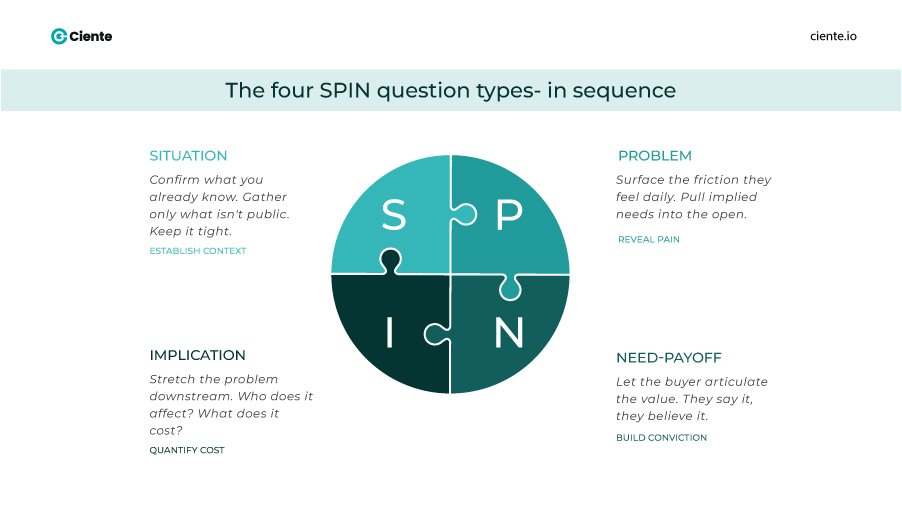
What came out of it was SPIN selling. Four question types: Situation, Problem, Implication, Need-Payoff. It still aligns closely with a structured approach like a proven sales process that guides reps through each stage intentionally.

Simple on paper. Brutally hard to execute well.

And here’s the thing: the psychology behind it stands.

Even with AI in the mix, even with buyers conducting 70% of their research before they’ll take a call, the framework still works especially as modern teams rethink their approach with AI in sales. Because human decision-making hasn’t changed. What has actually changed is how impatient buyers have become, and how quickly they’ll tune out an SDR who hasn’t done their homework.

The real problem in most B2B sales cycles? SDRs pitch too early, often without fully understanding effective sales prospecting practices that set the foundation for better conversations. They walk in, start talking about features, and the buyer hasn’t even admitted to themselves that they have a problem worth solving yet.

SPIN fixes that. It turns the rep from someone pushing a product into someone helping a buyer think- guiding them through their own discovery rather than dragging them through a deck.

The Philosophy of the Question-Led Journey

Here’s something that surprises people: top salespeople aren’t the best talkers. They’re the best listeners.

Conversation intelligence platforms have been tracking this for years now, and the data repeats the same thing which aligns with insights from sales performance metrics that truly matter. SDRs closing the biggest deals ask more questions and talk less. But it’s not just about asking more. The type of question is everything.

SPIN works because of one core insight: buyers don’t buy because they understand your product from the inside out. They buy because they feel like you understand their problem.

Get a prospect through all four stages well, and you’ve built enough internal certainty that even a skeptical buying committee starts moving.

1. Situation Questions: Avoiding the Data-Dump Trap

Situation questions are the basics. Where are you now? What are you working with? What does your current setup look like? They’re necessary. But they’re also where bad reps lose the room before the conversation even begins.

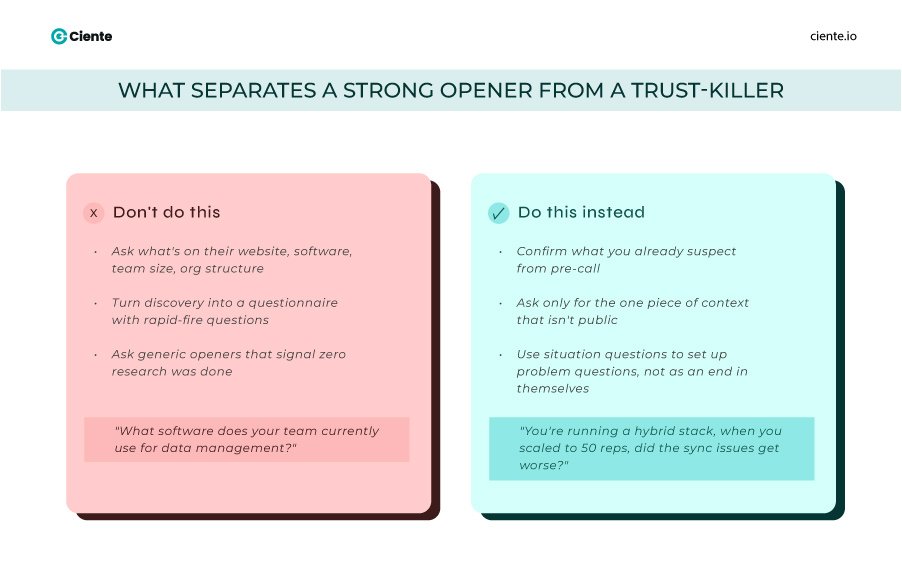
Today’s buyers will not sit through a discovery call that feels like a questionnaire. If you’re asking a VP of Operations what software they use when that information is sitting right there on their website, you’ve just told them you didn’t prepare.

That’s a trust problem that’s hard to retrace.

Trust builder vs trust killer

The best SDRs keep situation questions tight. They use them to confirm what they already suspect, or to receive the one piece of context that isn’t public. Nothing more.

Gong’s research found that top performers actually ask fewer situation questions than their peers, largely because they rely on strong data sources and B2B databases before the call. Because they’ve already done the work before the call. The goal isn’t to gather information.

It’s to set up the next stage without wasting anyone’s time.

2. Problem Questions: Identifying Implied Needs

Most buyers don’t walk into a sales conversation knowing exactly what’s wrong. They know something feels off. A process that’s slower than it should be. A tool the team complains about, but nobody’s formally flagged. A gap they’ve learned to work around.

These are implied needs. And problem questions are what pull them to the surface.

The mistake most reps make here is asking something that puts the buyer on defense. “Are you happy with your current vendor?” Almost never works. People reflexively say yes even when they’re not.

The better approach? Ask something that makes them think about the friction they experience daily. “How often does your team end up manually reconciling data because your systems fell out of sync?”

That’s not a threatening question. It just invites them to reflect- and when they start reflecting, the cracks in the status quo show up on their own.

Never forget that in B2B, inertia is your real competition which is why aligning your sales and marketing strategy becomes critical to drive momentum. Not the other vendor on the shortlist. Inaction. If a buyer doesn’t feel the pain of the problem, they will choose to do nothing. Every time.

Problem questions are what start chipping away at that comfort.

3. Implication Questions: Quantifying the Cost of Inaction

This is where most reps blow it. They find a problem, feel good about it, and immediately pivot to the demo. Big mistake.

Implication questions are the hardest part of SPIN. They’re also the most valuable- by a significant margin.

These questions take whatever problem you just uncovered and stretch it- what happens downstream because of this problem? What does it cost the business? Who else does it affect?

“If that manual reconciliation is eating four hours a week, what’s that doing to your team’s ability to hit launch deadlines?”

That question changes the nature of the conversation. You’re no longer talking about a software inconvenience. You’re talking about missed targets, stretched teams, and lost revenue.

Suddenly, the problem is a liability.

This is where loss aversion kicks in, reinforcing why a strong sales pipeline strategy is essential to keep deals moving forward.

The buyer stops thinking “It would be nice to fix this someday” and starts thinking “We’re actively bleeding because we haven’t fixed this.” That mental shift: that’s when your solution stops being a budget line and starts being a business case.

How an SDR handles implication questions is the clearest predictor of how they’ll perform in the back half of the funnel.

4. Need-Payoff Questions: Turning Problems into Explicit Needs

The last stage is the payoff, literally and figuratively. But there’s a catch most reps miss. You don’t get a say in what the value is. The buyer has to say it.

“If we took that reconciliation process completely off your team’s plate, what would they be doing with those four hours instead?”

When a buyer answers that question, something shifts. They’ve now articulated (out loud, in their own words) what life looks like with the problem solved. They’ve moved from vague dissatisfaction to a clear, stated desire for something better.

And because they said it themselves, they believe it in a way they never would if you’d said it for them.

There’s also a practical upside here.

That answer becomes their internal pitch when the CFO asks why they’re recommending this spend, similar to how qualified opportunities are justified in a sales accepted opportunity framework. They’re not repeating your talking points- they’re defending a conclusion they reached themselves. That’s a much harder thing to poke holes in.

You’ve essentially helped them become your advocate without them realizing that’s what happened.

Why Methodology Matters

Rackham found something counterintuitive in his research: the techniques that work great in small, fast sales often actively hurt you in large, complex ones.

Hard closes, urgency tactics, feature dumps- these can work when you’re selling something low-stakes on a single call. Try them in a six-month enterprise deal with eight stakeholders, and you’ll lose trust faster than you built it.

In a complex sale, closing isn’t a moment. It’s a sequence that depends heavily on managing a structured sales cadence across touchpoints.

Every interaction needs to end with a commitment, i.e., a next step, a follow-up, a decision, that keeps the deal moving forward.

SPIN was built for exactly this environment. It’s designed for slow burns. Its whole purpose is cultivating the buyer’s internal conviction over time, so that by the time you make a decision, it doesn’t feel like a leap- it feels obvious.

When the problem feels bigger than the price tag, the deal closes itself.

Data-Backed Best Practices for Modern Teams

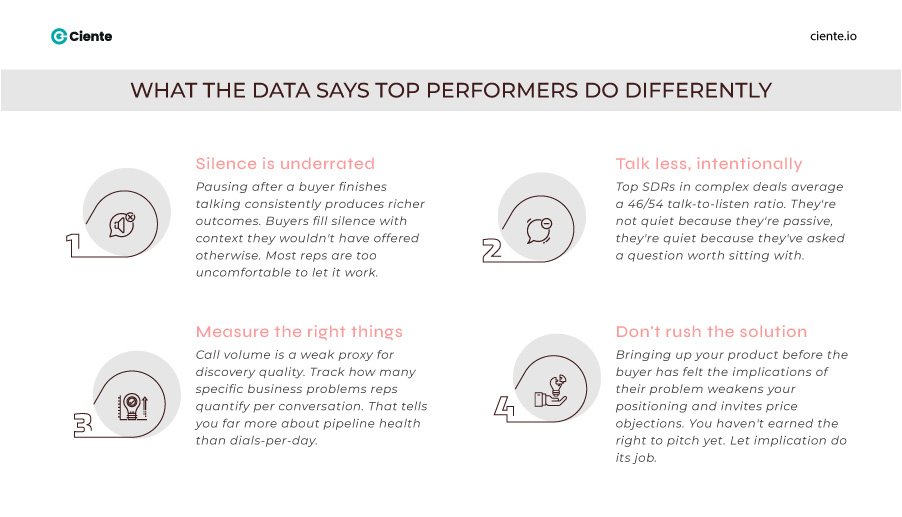
Data says top performers do differently

A few things modern sales data consistently shows that pair well with SPIN, especially when supported by strong sales analytics and ROI-driven decision making.

1. Silence is underrated. Pausing after a buyer finishes talking consistently leads to richer outcomes. Buyers fill the silence with context they wouldn’t have offered otherwise. Most reps are too uncomfortable with silence to let it work.

2. Talk less. The best SDRs in complex deals entail around a 46/54 talk-to-listen ratio. They’re not quiet because they’re passive- they’re quiet because they’ve asked a question worth sitting with. SPIN questions are the tool that makes this ratio natural rather than forced.

3. Measure the right things. Call volume is a weak proxy for discovery quality. which is why tracking the right sales KPIs becomes far more important. Track how many specific business problems reps actually quantify per conversation. That number tells you far more about pipeline health than dials-per-day ever will.

4. Don’t rush the solution. Bringing up your product before the buyer has genuinely felt the implications of their problem often weakens your positioning within the broader sales funnel. is one of the fastest ways to invite price objections. You haven’t earned the right to pitch yet. Let the implication stage do its job first.

The Spin Method Needs to Make a Comeback.

Four spin questions

Better sales performance isn’t a hustle problem. It’s a precision problem.

SPIN has lasted this long because it doesn’t try to manipulate anyone, much like modern approaches focused on improving overall sales performance. It takes the buyer seriously. It recognizes that no SDR, no matter how good, can convince a company to change. Only the buyer can do that.

The SDR’s job is to create the conditions for unavoidable realizations.

Work through the situation carefully. Dig into the problem. Spend real time in implication- more than feels comfortable. Then ask the need-payoff question and let the buyer land there themselves.

Done right, you’re helping someone find the clarity they’ve been stuck without.

Stop training your SDRs to pitch. Train them to ask better questions.

Alphabets Quarterly Revenue Exceeds Wall Street

Alphabet’s Quarterly Revenue Exceeds Wall Street Expectations

Alphabet’s Quarterly Revenue Exceeds Wall Street Expectations

Google Cloud just silenced the AI skeptics. With a massive revenue surge, the search giant is proving that AI has become a hot profit machine.

If you’re still waiting for the AI bubble to burst, Google Cloud just threw a bucket of cold water on that theory.

Alphabet’s latest earnings aren’t just a win; they’re a loud, expensive proof of concept. While critics spent the last year wondering when all those billions in GPU spending would actually turn into profit, Google just looked at the camera and said: Now.

Google Cloud’s revenue didn’t merely beat estimates. It surged nearly 30%. But the real story isn’t the number- it’s the velocity. We’re seeing a clear pull-through effect for the first time.

Companies are no longer experimenting with Vertex AI or Gemini in a sandbox. They are diving face-first into full-scale production. The cloud has officially transitioned from a storage locker to a high-octane AI engine room.

Here’s the nuance that the headline misses: this wasn’t just about selling more compute power. It’s about ecosystem gravity. Google is finally leveraging the fact that they own the entire stack- from their custom TPU chips to the Gemini models, all the way down to the Workspace apps people use every day.

By integrating AI so deeply into their existing infrastructure, they’ve made switching costs higher than ever. If your data is already in BigQuery, moving to another cloud for your AI needs now feels like trying to change your car’s engine while driving 80 mph.

But let’s observe the hidden cost of winning. Alphabet’s capital expenditure is still eye-watering. They are spending billions to build the cathedrals of the AI age, and while the revenue is finally showing up, the pressure to keep this growth vertical is immense.

It’s a high-stakes arms race where steady growth is no longer an option- you’re either accelerating, or you’re invisible.

The takeaway?

The skeptics who called AI a hype cycle are having a very bad week. Google Cloud has proven that enterprise AI is an accurate, revenue-generating machine, not just a series of fancy demos.

With this, we’re watching the incumbents fortify their kingdoms in real-time.

PayPal to Make Venmo a Separate Segment Within the Company

PayPal to Make Venmo a Separate Segment Within the Company

PayPal to Make Venmo a Separate Segment Within the Company

PayPal is finally letting Venmo move out. Is this a strategic masterstroke or a surrender? Here’s why the fintech divorce of the decade matters.

It’s official: PayPal is looking for a clean break.

After years of trying to force Venmo into the boring parent brand of traditional payment processes, the rumor mill (and balance sheets) assert a massive spin-off is finally on the table. It’s the corporate equivalent of a parent admitting their kid is way cooler than they are and finally letting them move out.

But here’s the thing: it’s a desperate attempt to fix two fundamentally different business identities that have been stifling each other for a decade.

PayPal is the dependable workhorse of the early internet. It’s the checkout button we trust because it feels safe, corporate, and a bit clinical.

Venmo, on the other hand, is a cultural verb. It’s how we split mimosas, pay the dog walker, and, weirdly enough, spy on our exes’ social feeds. By keeping them under one roof, PayPal has essentially been trying to run a high-security bank and a social network at the same time.

And the result? A bloated Super App vision that nobody actually asked for.

The real nuance here is the monetization trap.

PayPal makes its money from transaction fees; Venmo is a goldmine of user data and peer-to-peer volume, which has struggled to turn a profit. Investors are bored with PayPal’s slow growth, and they’re frustrated that Venmo’s massive cultural footprint hasn’t translated into significant dividends.

A spin-off allows Venmo to finally lean into crypto, social commerce, or even neo-banking without being dragged down by PayPal’s legacy compliance baggage.

Of course, there’s a catch.

Without PayPal’s massive treasury backing it up, Venmo has to grow up fast. It will be flying solo in a shark tank filled with Cash App, Zelle, and Apple Pay. Is Venmo a strong enough brand to survive without its parent’s deep pockets?

This restructuring sounds more like a confession. PayPal is admitting that the everything app dream is dead, and specialization is the only way to survive. The great divorce is coming- let’s see who gets to keep the users in the settlement.

Sales Goals

SMART Sales Goals for Every Go-to-Market Team

SMART Sales Goals for Every Go-to-Market Team

GTM teams set goals all the time. Most of them are either too vague to act on or too narrow to mean anything. SMART goals are not a framework to follow rigidly. They are a forcing function that reveals whether you actually understand your motion, your buyer, and your organization’s capacity. Here is what that looks like in practice.

Every GTM team has goals. The question is whether those goals are doing any work.

There is a version of goal-setting that happens in planning cycles that looks productive and produces almost nothing. Numbers get written down. Slides get built. Leadership reviews them. Everyone nods. Then the quarter begins and the real work happens in a different direction entirely, because the goals were never connected to the actual motion the team was running.

The SMART framework, Specific, Measurable, Achievable, Relevant, and Time-bound, gets taught as a productivity concept. It is actually something more uncomfortable than that. It is a test. And most GTM goals fail it not because teams are unsophisticated, but because passing the test requires a level of organizational clarity that many teams have not yet achieved.

Writing a SMART goal forces you to know three things you might not know: what you are actually trying to produce, whether you can track it honestly, and whether the number is grounded in reality or aspiration. Those three things turn out to be hard.

Why GTM Is the Right Unit of Analysis

Before getting into what SMART goals look like for each function, it is worth being clear about why GTM teams specifically, rather than sales teams or marketing teams in isolation, need a goal-setting framework that connects across them.

Your GTM pieces make this point clearly: GTM is a full-organization strategy. Marketing is not driving it. Sales is not driving it. It is everyone working from the same roadmap toward the same outcome. That means the goals have to connect. A marketing goal that runs in one direction while sales is running in another is not a goal-setting failure. It is a strategy failure.

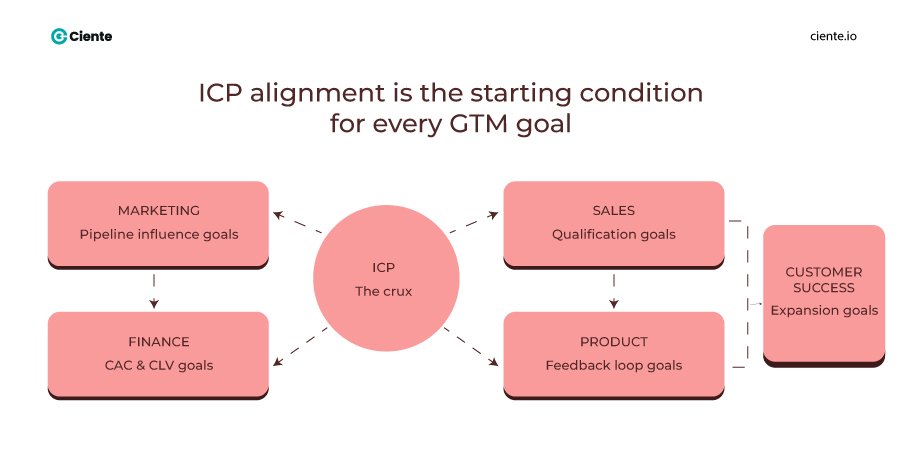
The ICP sits at the center of this. Your checklist treats the ICP as the crux of GTM success, the place where research investment is highest and where every downstream function draws its direction. SMART goals for a GTM team are only meaningful when the ICP is agreed upon, because the goal is always implicitly “produce this outcome with this buyer.” If the buyer is undefined, the goal is undefined, regardless of how precise the number looks.

So the starting condition for any GTM goal-setting exercise is ICP alignment. Not the broad version where everyone agrees the ICP is “mid-market B2B companies in tech.” The specific version where sales and marketing can both name the accounts that qualify and the ones that do not. That clarity is what makes the goals below actionable rather than decorative.

Marketing SMART Goals: From Activity to Influence

ICP alignment is the starting condition for every GTM goal

Marketing is often where the goal-setting problem shows up first, because marketing has the most metrics available and therefore the most places to hide.

A weak marketing goal looks like this: increase website traffic by 30% this quarter. It is measurable. It might even be achievable. But it is not relevant in the GTM sense unless that traffic has a defined relationship to pipeline. Traffic from the wrong industry, the wrong role, the wrong company size, does not advance the GTM motion. It creates the appearance of momentum.

A SMART marketing goal for a GTM team is organized around pipeline influence, not traffic or MQL volume, especially when you understand how metrics connect across the funnel as explained in sales metrics that matter. Something like: generate 25 net-new opportunities from ICP-fit accounts within the top-down motion by the end of Q3, with marketing touchpoints documented in at least 60% of those opportunities at discovery stage.

That goal is specific about who qualifies. It is measurable if the CRM is set up correctly. It is achievable if the team has mapped the addressable account list. It is relevant because it connects directly to the motion the GTM team is running. And it is time-bound in a way that connects to how long it takes to move an ICP account from first contact to open opportunity.

Notice what is not in that goal: impressions, social engagement, email open rates, whitepaper downloads, which are often mistaken for progress instead of actual pipeline impact as discussed in sales pipeline analysis. Those things might support the goal. They are not the goal.

The other place marketing goal-setting goes wrong is in the content-volume trap, where teams prioritize output instead of impact, a challenge closely tied to content marketing vs sales for SaaS growth. Producing content is not a GTM outcome. Content is a vehicle for communicating the product’s value to the specific segments the GTM motion is targeting. A better goal: develop and distribute buying-committee-specific content for the three primary roles in target accounts, with sales adoption tracked across the next two quarters. This goal creates accountability between marketing and sales. If sales is not using the content, that is a signal. Either the content is wrong or the distribution is broken. Either way, something needs to change.

Sales SMART Goals: Qualification Over Volume

Sales goals in a GTM context have the same problem as marketing goals, but in reverse. Where marketing tends toward vanity, sales tends toward volume. More calls. More demos. More pipeline. The assumption is that enough activity will eventually produce the outcomes.

GTM does not run on enough activity. It runs on the right activity with the right accounts, which is why understanding sales prospecting vs lead generation becomes critical for targeting the right opportunities. And SMART goals for sales have to reflect that distinction.

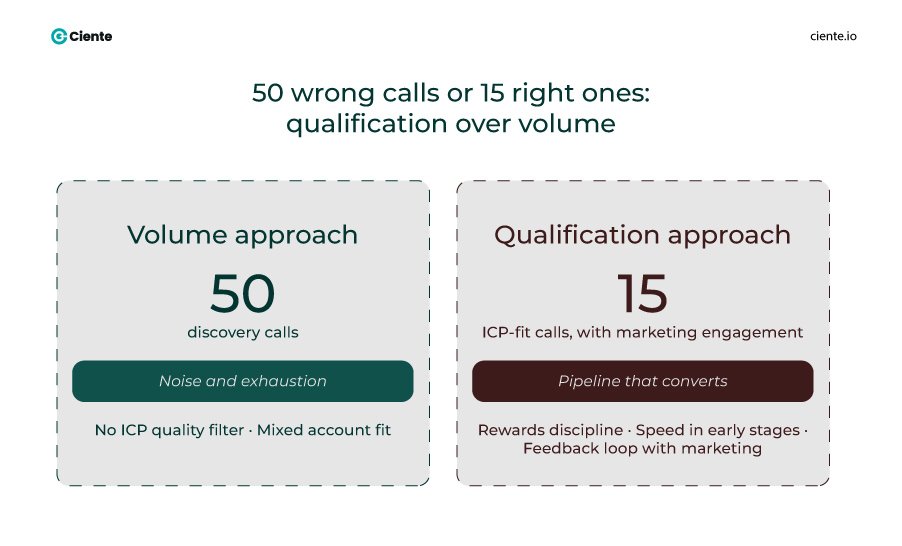
A volume-based sales goal: book 50 discovery calls this quarter, which often ignores the importance of structured qualification as outlined in the 5 step sales process. It is specific and measurable. But it has no quality filter. Fifty calls with accounts that do not match the ICP produce noise and exhaustion. Fifteen calls with accounts that do match it, where marketing has already created awareness and the buying committee has engaged with content, produce pipeline.

A SMART sales goal that fits the GTM motion: convert 40% of ICP-qualified opportunities into second-stage meetings within 14 days of opportunity creation, across the top-down accounts in the current target account list.

That goal rewards qualification over volume. It rewards speed and discipline in the early stages of the sales cycle. It is measurable without being gameable. And it creates a feedback loop with marketing: if opportunities are not converting at that rate, the team needs to understand whether the qualification is off, the messaging is wrong, or the account is not ready.

The other sales goal worth building explicitly in a GTM context is expansion, which becomes more effective when supported by strong account strategies like multi threading in sales. Your GTM strategy pieces acknowledge that the buyer relationship is long-term, and that sales acts as a consultant, not just a closer. Customer expansion does not happen by accident. It happens because someone in the sales team has a structured plan to deepen the relationship after the initial close.

A SMART expansion goal: identify two expansion opportunities within accounts closed in the prior two quarters, with a documented account plan and at least one executive-level conversation per account before end of Q2. That goal is specific, creates accountability for relationship-building, and is relevant to the GTM team’s broader growth motion rather than just the new logo pipeline.

Product SMART Goals: The Feedback Loop That Most Teams Break

Your GTM writing treats product as the true driver of long-term strategy. That is right, and it creates a specific responsibility for product teams in the GTM motion: the feedback loop.

The field is telling product teams things every day, and capturing these insights effectively often depends on systems highlighted in sales enablement platforms. Sales conversations reveal how buyers frame the problem the product is supposed to solve. Customer success conversations reveal where the product falls short of what was promised. These signals are the most valuable market research a product team can access, and in most organizations they stay in silos.

A SMART goal that directly addresses this: establish a documented feedback process between sales and product within 60 days, with monthly structured reviews of the top five objections encountered in sales conversations, resulting in at least two product positioning adjustments or roadmap inputs per quarter.

That goal is specific enough to change behavior. It is measurable through the review cadence and the documented outputs. It is achievable because the data already exists in the CRM and in sales call recordings. It is relevant because messaging that is not grounded in what the product actually does, and what the buyer actually believes about their problem, is messaging that will lose deals. And it is time-bound in a way that creates urgency without being unrealistic.

The broader point is that product goals in a GTM context are not just about feature delivery. They are about closing the loop between what the market is saying and what the product team is building toward. A GTM motion that does not have that loop operating will drift. The messaging will outpace the product, or the product will evolve in a direction the market was not asking for. Either failure is a GTM failure, and it starts with product goals that are not relevant to what sales and marketing are encountering.

Customer Success SMART Goals: Protecting the Foundation

GTM does not end at the initial sale. Your writing on this is direct: customer lifetime value is a KPI that customer success, finance, and marketing must all share ownership of. That means customer success goals cannot live in isolation from the GTM motion.

The most common mistake in customer success goal-setting is optimizing for renewals at the expense of expansion signals, instead of balancing both as part of a broader sales and marketing alignment. Renewals matter. But a customer who renews without growing is a customer who has not yet seen enough value to want more. And a customer who churns is a signal that the GTM motion failed somewhere: in the ICP definition, in the sales qualification, in the onboarding, or in the ongoing relationship.

A SMART customer success goal organized around the GTM motion: reduce churn in accounts acquired through the GTM launch by tracking engagement and intervention early, targeting a 90-day active adoption rate of 80% across the new account cohort.

That goal is specific to the accounts the GTM motion produced. It is measurable if onboarding and product usage data is tracked. It connects adoption to the broader GTM outcome: the product has to do what the GTM motion promised it would do, or the motion is undermined. And it is time-bound to the critical window where churn risk is highest.

The expansion piece of customer success goals deserves its own attention. A SMART goal for expansion: identify three expansion-ready accounts per quarter based on usage data and stakeholder relationship depth, with a formal handoff to sales that includes documented value realization and an account plan for the upsell conversation.

Notice that this goal creates a handoff with sales. Customer success knows when expansion is possible. Sales knows how to have the commercial conversation. The goal creates the bridge between them rather than leaving it to chance or goodwill.

Finance SMART Goals: Making the Math Honest

Finance is involved in GTM for a reason that your writing captures precisely: every campaign, every ad, every piece of content should be seen through a fiscal lens. GTM hinges on whether the money going in is producing outcomes worth the cost.

Most finance goals in a GTM context are lagging: revenue, margin, CAC, which is why tracking leading indicators through approaches like sales analysis to amplify ROI cycle becomes important. These matter. But they tell you what happened, not what is about to happen. The SMART goals that are most useful in a GTM context are the ones that create leading indicators of financial health.

A SMART finance goal: track and report CAC by acquisition channel on a monthly basis, with a defined threshold above which the channel is flagged for review by the GTM team before the next quarter’s planning cycle.

This goal does something important: it creates a governance mechanism. If one channel is producing customers at three times the cost of another, the GTM team needs to know that before it allocates the next quarter’s budget. Finance’s role is not just to count what was spent. It is to make the connection between spend and outcome visible enough that decisions can be made while there is still time to make them.

The other finance goal worth building explicitly: establish a CLV model for the top three ICP segments within the current quarter, so that marketing and sales have a consistent basis for prioritizing accounts by expected lifetime value rather than just by deal size.

That goal is practical and is missing in most GTM processes. Teams prioritize the largest deals because large deals feel like GTM success. But a smaller deal in a high-CLV segment may be worth more to the organization than a large one-time deal in a segment that churns quickly. Finance is the function best positioned to make that argument, and this goal creates the infrastructure for it.

The Goal That Ties All of Them Together

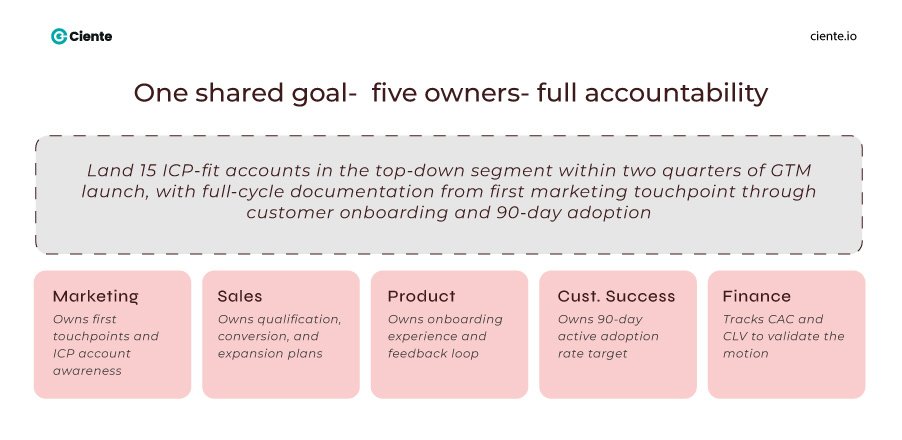
one shared goal - owners-full accountability

Every function in a GTM team can have well-crafted SMART goals and still fail if those goals are not connected to each other, reinforcing the need for why align sales marketing strategies.

The connecting goal is the one the GTM team sets collectively, before the individual functions set theirs. Something like: land 15 ICP-fit accounts in the top-down segment within two quarters of the GTM launch, with full-cycle documentation from first marketing touchpoint through customer onboarding and 90-day adoption.

That goal belongs to everyone. Marketing is accountable for the first touchpoints. Sales is accountable for the qualification and conversion. Product is accountable for the onboarding experience. Customer success is accountable for the 90-day adoption rate. Finance is accountable for tracking whether the CAC and CLV of those 15 accounts validates the motion.

qualification over volume

This is what your GTM writing describes when it talks about cross-departmental collaboration being necessary for success, not as a nice-to-have but as the mechanism through which GTM actually works. The shared goal creates the shared accountability. The individual SMART goals create the specific behaviors that add up to it.

Without the connecting goal, SMART goals become departmental targets that each team optimizes for individually. Marketing hits its MQL number. Sales hits its call number. Product ships its features. Customer success hits its renewal rate. And the GTM motion still underperforms because nobody was accountable for how the pieces fit together.

That is the actual point of SMART goals in a GTM context. Not precision for its own sake. Precision in service of a shared direction that every team can trace their work back to. When that connection is visible, the framework earns its place. When it is not, you are just writing numbers in a document.

Google

Google’s Pentagon Deal is a Shift We All Saw Coming

Google’s Pentagon Deal is a Shift We All Saw Coming

Google is back in the trenches. Project Highwing marks a secretive return to Pentagon AI deals. Has Silicon Valley finally surrendered its soul for security?

Google’s latest pivot back into the arms of the Pentagon with a classified AI deal, codenamed Project Highwing, is the kind of move that feels both inevitable and deeply unsettling.

That sounds like déjà vu. Remember Project Maven in 2018?

A massive internal revolt by thousands of Google users back then forced the company to tuck its tail and abandon its drone-imagery partnership with the military. It felt like a win for tech ethics. But fast-forward to 2026? The climate has shifted.

Between the existential race against China and the pressure to monetize every single neuron of Gemini’s brain, Google has decided that moral high ground doesn’t pay the bills.

Here’s the nuance that’s easy to miss: this isn’t just about drones anymore.

We are talking about decision-support systems- AI that processes a firehose of classified data to help commanders make life-and-death calls in real-time. By moving back into the defense sector under a veil of secrecy, Google isn’t just selling software; they are becoming a core pillar of the American military-industrial complex.

The catch? This time, the internal dissent is remarkably quiet.

Whether that’s because of a join or die corporate culture or a genuine belief that AI-driven warfare is a national security necessity, the result is the same: the barrier between Big Tech and Big Brother has officially dissolved.

Google is betting that in a world of high-stakes geopolitical tension, being patriotic is more profitable than being neutral. But as the lines between search algorithms and target acquisition blur, we have to ask: once you hand the keys of the world’s most powerful AI to the Pentagon, can you ever really get them back?