
A research loop traps B2B buyers. They don’t need another pitch; they need a framework to quantify the cost of doing nothing. That’s the real SPIN.
In the late 1980s, Neil Rackham and his peers at Huthwaite conducted 35,000 sales calls. Not to torture themselves- to find out what actually separates elite B2B performers from everyone else scrambling for quota.
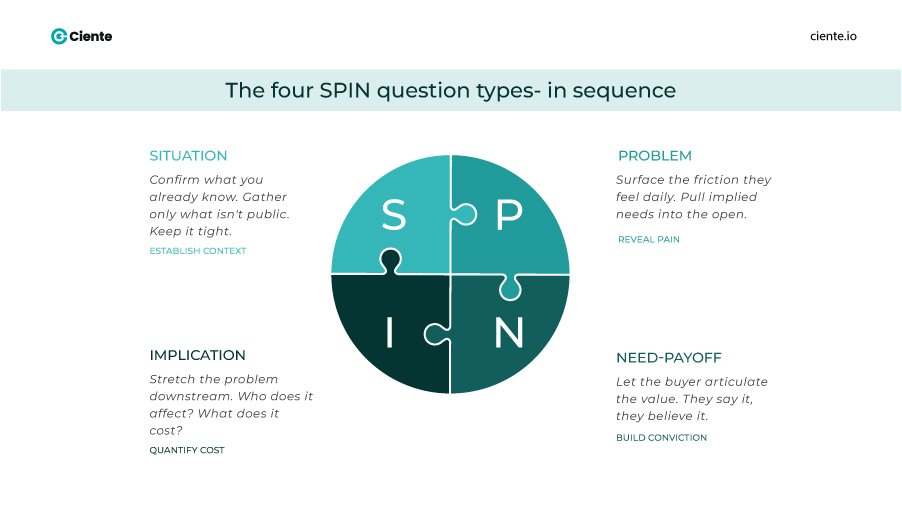
What came out of it was SPIN selling. Four question types: Situation, Problem, Implication, Need-Payoff. It still aligns closely with a structured approach like a proven sales process that guides reps through each stage intentionally.
Simple on paper. Brutally hard to execute well.
And here’s the thing: the psychology behind it stands.
Even with AI in the mix, even with buyers conducting 70% of their research before they’ll take a call, the framework still works especially as modern teams rethink their approach with AI in sales. Because human decision-making hasn’t changed. What has actually changed is how impatient buyers have become, and how quickly they’ll tune out an SDR who hasn’t done their homework.
The real problem in most B2B sales cycles? SDRs pitch too early, often without fully understanding effective sales prospecting practices that set the foundation for better conversations. They walk in, start talking about features, and the buyer hasn’t even admitted to themselves that they have a problem worth solving yet.
SPIN fixes that. It turns the rep from someone pushing a product into someone helping a buyer think- guiding them through their own discovery rather than dragging them through a deck.
The Philosophy of the Question-Led Journey
Here’s something that surprises people: top salespeople aren’t the best talkers. They’re the best listeners.
Conversation intelligence platforms have been tracking this for years now, and the data repeats the same thing which aligns with insights from sales performance metrics that truly matter. SDRs closing the biggest deals ask more questions and talk less. But it’s not just about asking more. The type of question is everything.
SPIN works because of one core insight: buyers don’t buy because they understand your product from the inside out. They buy because they feel like you understand their problem.
Get a prospect through all four stages well, and you’ve built enough internal certainty that even a skeptical buying committee starts moving.
1. Situation Questions: Avoiding the Data-Dump Trap
Situation questions are the basics. Where are you now? What are you working with? What does your current setup look like? They’re necessary. But they’re also where bad reps lose the room before the conversation even begins.
Today’s buyers will not sit through a discovery call that feels like a questionnaire. If you’re asking a VP of Operations what software they use when that information is sitting right there on their website, you’ve just told them you didn’t prepare.
That’s a trust problem that’s hard to retrace.
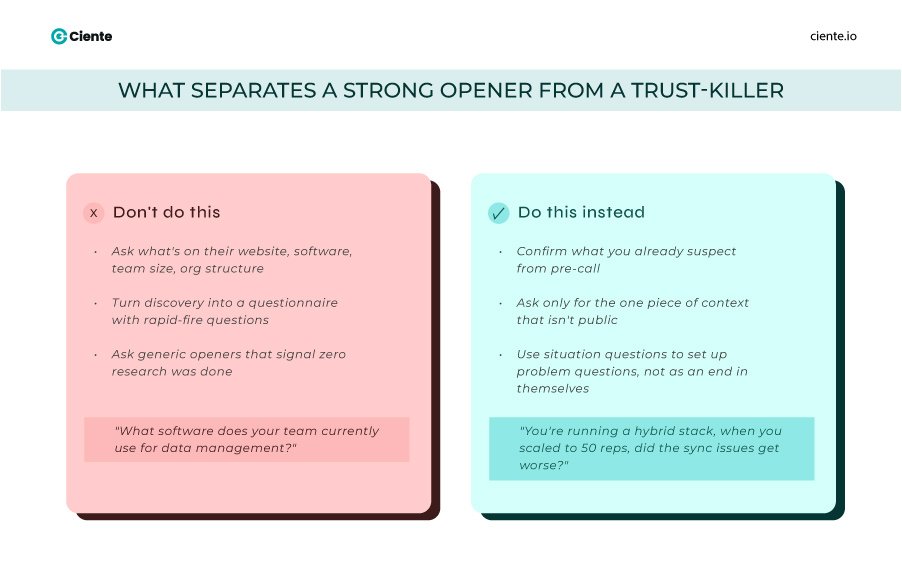
The best SDRs keep situation questions tight. They use them to confirm what they already suspect, or to receive the one piece of context that isn’t public. Nothing more.
Gong’s research found that top performers actually ask fewer situation questions than their peers, largely because they rely on strong data sources and B2B databases before the call. Because they’ve already done the work before the call. The goal isn’t to gather information.
It’s to set up the next stage without wasting anyone’s time.
2. Problem Questions: Identifying Implied Needs
Most buyers don’t walk into a sales conversation knowing exactly what’s wrong. They know something feels off. A process that’s slower than it should be. A tool the team complains about, but nobody’s formally flagged. A gap they’ve learned to work around.
These are implied needs. And problem questions are what pull them to the surface.
The mistake most reps make here is asking something that puts the buyer on defense. “Are you happy with your current vendor?” Almost never works. People reflexively say yes even when they’re not.
The better approach? Ask something that makes them think about the friction they experience daily. “How often does your team end up manually reconciling data because your systems fell out of sync?”
That’s not a threatening question. It just invites them to reflect- and when they start reflecting, the cracks in the status quo show up on their own.
Never forget that in B2B, inertia is your real competition which is why aligning your sales and marketing strategy becomes critical to drive momentum. Not the other vendor on the shortlist. Inaction. If a buyer doesn’t feel the pain of the problem, they will choose to do nothing. Every time.
Problem questions are what start chipping away at that comfort.
3. Implication Questions: Quantifying the Cost of Inaction
This is where most reps blow it. They find a problem, feel good about it, and immediately pivot to the demo. Big mistake.
Implication questions are the hardest part of SPIN. They’re also the most valuable- by a significant margin.
These questions take whatever problem you just uncovered and stretch it- what happens downstream because of this problem? What does it cost the business? Who else does it affect?
“If that manual reconciliation is eating four hours a week, what’s that doing to your team’s ability to hit launch deadlines?”
That question changes the nature of the conversation. You’re no longer talking about a software inconvenience. You’re talking about missed targets, stretched teams, and lost revenue.
Suddenly, the problem is a liability.
This is where loss aversion kicks in, reinforcing why a strong sales pipeline strategy is essential to keep deals moving forward.
The buyer stops thinking “It would be nice to fix this someday” and starts thinking “We’re actively bleeding because we haven’t fixed this.” That mental shift: that’s when your solution stops being a budget line and starts being a business case.
How an SDR handles implication questions is the clearest predictor of how they’ll perform in the back half of the funnel.
4. Need-Payoff Questions: Turning Problems into Explicit Needs
The last stage is the payoff, literally and figuratively. But there’s a catch most reps miss. You don’t get a say in what the value is. The buyer has to say it.
“If we took that reconciliation process completely off your team’s plate, what would they be doing with those four hours instead?”
When a buyer answers that question, something shifts. They’ve now articulated (out loud, in their own words) what life looks like with the problem solved. They’ve moved from vague dissatisfaction to a clear, stated desire for something better.
And because they said it themselves, they believe it in a way they never would if you’d said it for them.
There’s also a practical upside here.
That answer becomes their internal pitch when the CFO asks why they’re recommending this spend, similar to how qualified opportunities are justified in a sales accepted opportunity framework. They’re not repeating your talking points- they’re defending a conclusion they reached themselves. That’s a much harder thing to poke holes in.
You’ve essentially helped them become your advocate without them realizing that’s what happened.
Why Methodology Matters
Rackham found something counterintuitive in his research: the techniques that work great in small, fast sales often actively hurt you in large, complex ones.
Hard closes, urgency tactics, feature dumps- these can work when you’re selling something low-stakes on a single call. Try them in a six-month enterprise deal with eight stakeholders, and you’ll lose trust faster than you built it.
In a complex sale, closing isn’t a moment. It’s a sequence that depends heavily on managing a structured sales cadence across touchpoints.
Every interaction needs to end with a commitment, i.e., a next step, a follow-up, a decision, that keeps the deal moving forward.
SPIN was built for exactly this environment. It’s designed for slow burns. Its whole purpose is cultivating the buyer’s internal conviction over time, so that by the time you make a decision, it doesn’t feel like a leap- it feels obvious.
When the problem feels bigger than the price tag, the deal closes itself.
Data-Backed Best Practices for Modern Teams
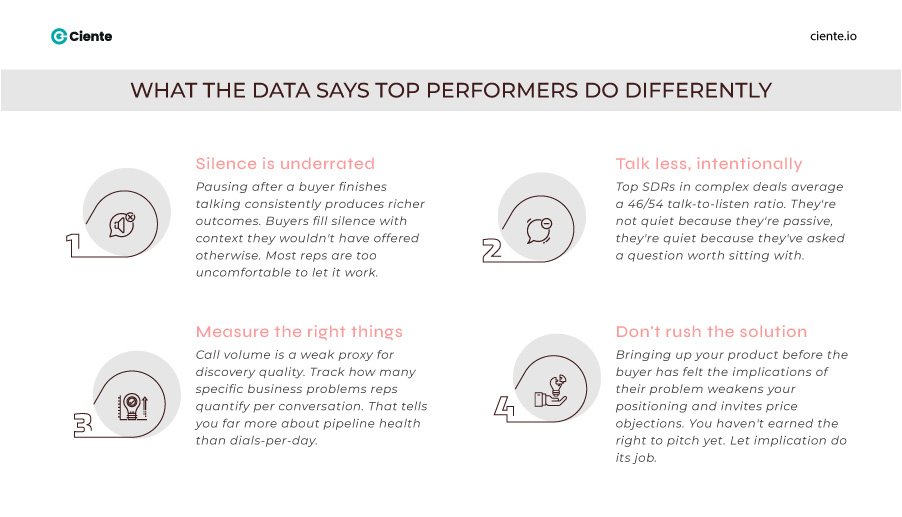
A few things modern sales data consistently shows that pair well with SPIN, especially when supported by strong sales analytics and ROI-driven decision making.
1. Silence is underrated. Pausing after a buyer finishes talking consistently leads to richer outcomes. Buyers fill the silence with context they wouldn’t have offered otherwise. Most reps are too uncomfortable with silence to let it work.
2. Talk less. The best SDRs in complex deals entail around a 46/54 talk-to-listen ratio. They’re not quiet because they’re passive- they’re quiet because they’ve asked a question worth sitting with. SPIN questions are the tool that makes this ratio natural rather than forced.
3. Measure the right things. Call volume is a weak proxy for discovery quality. which is why tracking the right sales KPIs becomes far more important. Track how many specific business problems reps actually quantify per conversation. That number tells you far more about pipeline health than dials-per-day ever will.
4. Don’t rush the solution. Bringing up your product before the buyer has genuinely felt the implications of their problem often weakens your positioning within the broader sales funnel. is one of the fastest ways to invite price objections. You haven’t earned the right to pitch yet. Let the implication stage do its job first.
The Spin Method Needs to Make a Comeback.
Better sales performance isn’t a hustle problem. It’s a precision problem.
SPIN has lasted this long because it doesn’t try to manipulate anyone, much like modern approaches focused on improving overall sales performance. It takes the buyer seriously. It recognizes that no SDR, no matter how good, can convince a company to change. Only the buyer can do that.
The SDR’s job is to create the conditions for unavoidable realizations.
Work through the situation carefully. Dig into the problem. Spend real time in implication- more than feels comfortable. Then ask the need-payoff question and let the buyer land there themselves.
Done right, you’re helping someone find the clarity they’ve been stuck without.
Stop training your SDRs to pitch. Train them to ask better questions.