RingCentral has acquired CommunityWFM.

RingCentral has acquired CommunityWFM.

RingCentral has acquired CommunityWFM.

RingCentral, a global leader in AI-powered business communications, has just acquired CommunityWFM.

This acquisition comes at the right time in tech history as demand for AI-powered WFM has risen sharply. As hybrid and remote workforces become the norm, organizations have been able to extract talent from around the globe.

However, managing them is quite different. With this move, RingCentral tackles two facets and enables global workforce management.

These are:

  1. Strengthen their global business communications.
  2. Use their AI capabilities to improve CommunityWFM’s contact centers.

RingCentral has tried to enter the CC-a-a-S but couldn’t because of a native WFM system. This acquisition will help them bridge this gap.

“By providing CommunityWFM’s AI-driven workforce management capabilities together with our AI-first RingCX platform, we’re giving businesses the complete set of tools to optimize operations while empowering their people—creating the foundation for superior agent performance and effortless customer experiences.” — Kira Makagon, President & COO, RingCentral.

This quote makes it clear that RingCentral wants to become a one-stop shop for businesses looking to optimize operations. Mix AI-Powered systems in this, and you get a powerful tool that can empower businesses.

The Benefits?

  1. Operations and leadership can benefit from better forecasting, less manual work, and better real-time adjustments in schedules.
  2. Customer experience (CX) may improve as staffing better matches demand (reduced wait times, fewer dropped calls, etc.).

But what are the things to watch out for?

  1. How RingCentral integrates CommunityWFM: technology, UI/UX changes, rollout timelines.
  2. Whether pricing tiers or feature bundles change over time.
  3. How competitors respond ‒ will other CCaaS / UCaaS vendors accelerate building/acquiring WFM?
  4. Feedback from actual users/employees: Does the promised benefit hold up in real usage?

As the global workforce transforms, RingCentral will find itself leading the pack. However, as with all things tech, only time will tell.

Making ChatGPT Safer: OpenAI Launches Parental Controls

Making ChatGPT Safer: OpenAI Launches Parental Controls

Making ChatGPT Safer: OpenAI Launches Parental Controls

The tragic passing of the 16-year-old Adam Raine struck the American Nation, allegedly enabled by a tech that promises a better hope for humanity.

In response to the tragedy, OpenAI has launched a suite of controls to present a better environment for its users. And one of the major ones is the parental controls- this will let parents have more control over their children’s AI usage.

  1. They will be able to link their accounts to their children’s.
  2. Set guidelines and behavioral rules, or disable features like chat memory and history.
  3. Notifications when their teens express “acute distress”.

However, the organization has taken another step forward to ensure that all its users get the help they need and deserve, especially if they are under duress. OpenAI has partnered up with physicians and mental health experts across the world to undertake this task.

The organization has created a council of experts in youth development, mental health, and human-computer interaction.

However, the truth is, AI systems will shape how future generations think. If the tech becomes smarter, faster, and wiser (will it?), many will seek its advice in professional and personal affairs.

The question is: will this help people grow or create an unforeseen web of emotional problems?

Top 5 Demand Generation Agencies of 2025: A Brief Insight

Top 5 Demand Generation Agencies of 2026: A Brief Insight

Top 5 Demand Generation Agencies of 2026: A Brief Insight

Right demand gen agencies can help convert a bunch of jargon into booming pipelines. Amid this intense saturation, which ones are truly worth your dollars?

Demand generation is a buzzword that’s thrown around to such an extent that it’s oversimplified to the point of being meaningless. It’s because they lack knowledge of what demand generation is.

Most agencies continue to be stuck in the lead gen bubble and term it as demand generation. They cling to the traditional reactive model- reacting to market whims as opposed to a more proactive approach that anticipates the shifting gears and shapes the market requirements.

The thing is, not all agencies know what they’re actually doing with demand generation. What they want is long-term sustainable growth and a demand that translates into trust and retention. But in reality, they end up chasing short-term wins that can’t afford stability or consistent growth.

To play the long game, it’s crucial to abandon this operating model.

It’s time to dive into the nucleus of what effective demand generation playbooks ask of you.

Demand generation doesn’t begin or even end at generating leads. It’s not all about MQLs delivery or traffic increase. And there are expert agencies in the market that recognize the need to abandon such limited knowledge.

Five Best B2B Demand Generation Agencies 2026

The leading demand gen providers don’t just throw corporate jargon around in hopes of partnering up with you. They primarily align themselves with your business objectives, and prioritize those- whether it’s elevating lead quality or accelerating pipeline growth.

The selected agencies have demonstrated their market expertise by delivering exemplary results to their clients.

Moreover, our research demonstrates that what makes these agencies the top-notch choice is their ability to step back and learn about your brand and your target market. Before jumping into developing strategies and roadmaps, they focus on understanding your market from the inside out.

The right demand gen agency isn’t about onboarding a service provider and hoping for the best. But about functioning with them in tandem.

This is the motto that these five demand generation agencies follow. And what makes them stand out.

Let’s dive in.

1. Ciente

Agencies tend to lean more towards creating a heap of content pieces, keyword-stuffing them, and publishing them in bulk.

But demand gen isn’t about volume. It’s the first thing on mind because most assume that their potential buyers are always in-market. This isn’t the actual case. Demand gen is supposed to build interest in those out of market. Isn’t that a bit tricky?

How do you sell to someone who doesn’t even have the need?

You create it.

image 4

Source: Ciente.io

Ciente is a demand gen engine that believes that trust is a fundamental road to growth. Our full-funnel customer-first approach is designed to do just that.

Focus on quality

Our years of on-the-ground experience have taught us that generating demand and translating it into a purchase is all about the right timing and the right content to the right-fitting buying accounts. It’s all about the quality, as opposed to the volume.

Trust building

And the primary step to delivering top-notch quality is about building unwavering trust. At Ciente, we dive deep into audience requirements and preferences. Our primary driver for building trust is our well-researched and up-to-date thought leadership content, from industry insights to the latest tech news.

Market understanding

Demand generation means playing a long game, one that focuses on understanding the market and your buyers, in or out of market. It’s the underlying foundation of our demand gen strategy- to adapt and be proactive, not coercive.

Targeting niche markets

Our focus is crucially on developing awareness and interest that stems from trust, reliability, and authenticity. And the content we publish across our chief and niche publications- Salestech, Infotech, and Martech– lays the groundwork to illustrate our commitment to the same.

Expert insights

Similarly, our expansive library of in-house podcasts, TechTalk, with its vast listenership, is standing proof of our audience-first framework. It’s more of a network, where we focus on decoding market pain points and challenges at the very root.

And delivering expert opinions and insights on the latest market trends from industry thought leaders themselves.

Developing a dialogue: The hidden value

The team at Ciente believes that at the crux of creating valuable content is developing a dialogue that directly correlates to your business hiccups and goals.

Gone are the days of strategies that go nowhere and wrap around the same jargon. Leads that don’t convert and intent that’s just curiosity? We don’t buy into that. Instead, Ciente believes in offering something of real value, something that educates and guides your prospects through the buying journey

Stuck choosing between roads that lead nowhere, we help you uncover a third secret door backed by the latest data insights and in-depth market research.

Services: Full-funnel Demand generation, Lead generation, Data-powered marketing, Content marketing, GTM, Branding and design, and Podcast marketing.

2. Ironpaper

Ironpaper is a B2B growth-centric demand generation agency that focuses primarily on helping clients optimize their sales processes. Its fundamental focus is developing B2B growth engines for marketing and sales success, from strategy to execution. And each facet is supported by data analytics and informed insights.

Demand gen programs at Ironpaper:

The marketing programs developed by the team at Ironpaper are more flexible. It’s technically a learn-and-grow model where they consistently conduct market tests and study buyer needs and opportunities to drive results that are achievable and measurable.

In simple terms, the set goals are realistic. And are preceded by a more adaptive strategic framework that can adapt according to market conditions and client needs.

image 3

Source: Ironpaper.com

Marketing and sales are age-old tactics, but Ironpaper has transformed the generic playbook to attract, engage, and convert ideal customers. From buyer engagement to acquisition, the brand’s mission is to lead with intelligence, maturity, and smartness.

These are the same components Ironpaper applies to the programs it develops.

The additional noteworthy components of Ironpaper’s demand gen:

First, they don’t believe in fluffy marketing or lackluster promises that don’t translate into tangible numbers. That’s their motto- to deliver measurable outcomes and focus on metrics that can be tied to revenue.

Second, Ironpaper’s team ensures that demand generation efforts are improved and iterated to align with sales enablement and qualified lead generation at every step. They don’t treat demand gen as a silo, but as a bridge that connects the right-fit buyer to the right solution.

Third, Ironpaper’s strategies are backed by informed insights and business goals tied together into a disciplined methodology. One that allows them to tackle any marketing or business hiccups, from complex decision-making processes to target account acceleration and sales opportunities development.

Their expertise?

Ironpaper’s objective is simple: “to help remarkable companies grow.” And they deliver on it. The marketing agency understands and highlights the potential you hold, helping you connect with your customers. And ascertain that the customer journey continues to enhance as buyers progress through the funnel.

With Ironpaper, you invest in instilling sustainable growth.

Services: Demand generation, Lead generation, ABM, Sales enablement, and Content marketing.

3. SmartBug Media

One of the leading names in demand generation, SmartBug Media is a full-funnel customer-focused digital marketing agency for businesses to optimize their entire customer lifecycle. Due to its robust capabilities, the company has been recognized as the largest and most decorated HubSpot partner.

It works as an end-to-end partner. And the priority is always consistent communication and keeping pace with clients.

This synergy between the two parties ensures that their values and goals remain streamlined for the duration of the alliance.

image 5

Source: smartbugmedia.com

SmartBug’s strategy is focused on building a resilient course for future growth and success. It doesn’t believe in short-term gains, but helps clients overcome persistent challenges and mitigate potential risks. Basically, it plays the long-term game.

Demand gen program at SmartBug Media:

The marketing agency is recognized for its ability to adapt and tailor solutions for diverse industrial domains and customer preferences. Especially given their expertise across varied verticals and research capabilities.

A misstep that most agencies make is viewing partnerships as one-offs. SmartBug exercises a different motto. For them, each partnership is about maintaining the same momentum at the beginning and after the partnership comes to an end. To ensure this, the team at SmartBug trains teams within the client organization to help them navigate any cracks or punctures in the long term.

Its demand gen approach centers on clients and their needs.

Their expertise?

In other words, its strategy rests on a single philosophy- meeting customers where they are. Before implementing any strategy or building roadmaps, SmartBug takes its sweet time understanding what the client and its audience require.

This tactic positions it as a strategic advisor, not as an implementer.

Services: Customer success and training, Demand generation, PPC and SEO, Revenue operations, E-commerce marketing, and Full customer lifecycle optimization.

4. Walker Sands

The majority of demand gen is about creative insight paired with informed strategies. How else do you instill interest in an audience where none exists?

Walker Sands is adept at this.

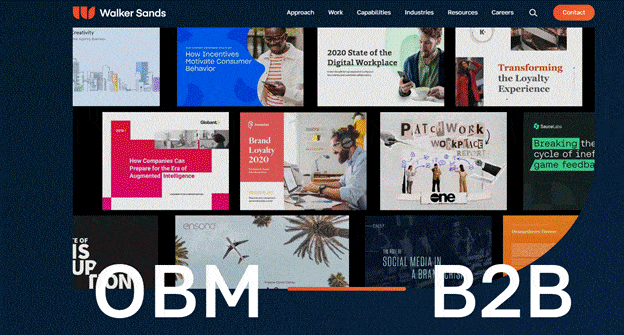
This B2B digital marketing company combines strategies with creative execution. And follow the “outcome-based” marketing philosophy. This means each of their development and brainstorming processes with clients begins with a single question: “How might we achieve your ideal business outcome among your target audience?”

image 6

Source: walkersands.com

Demand gen program at Walker Sands:

For Walker Sands, a truly effective demand gen strategy isn’t about checking steps on a list. It’s about what contributes to real growth- what is the outcome of your campaign? Where are the audience positioned across your overall strategy?

It all boils down to leading with intent and purpose in a way that automatically centers the buyers, not the organization. This way, the digital marketing agency builds its demand gen campaign on your requirements and goals.

You carry the conversation, and they act as consultants. This approach not only builds awareness for your brand or generates leads, but also positions you as a category leader.

Their expertise?

Walker Sands urges you to think bigger and look at the whole picture. Their demand gen strategy doesn’t float upon marketing channel KPIs. But facilitate marketing programs that tie to your brand needs, whether it’s positioning, growth, reputation building, or engagement.

They empower your brand to achieve the most critical goals and inculcate a full-funnel integrated marketing approach. One that is audience-obsessed and revenue-focused.

Services: Digital marketing, GTM, PR, Social media, Graphic and brand design, Copywriting, Campaign development, Content creation, and Digital marketing services.

5. Directive Consulting

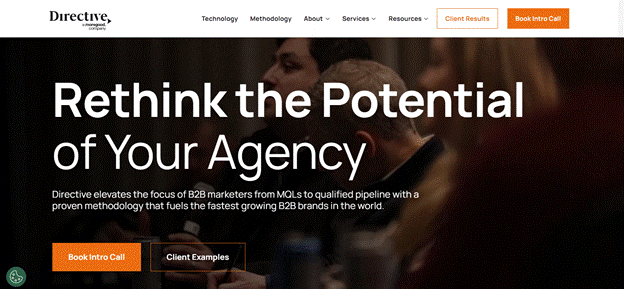
With marketing expertise across 200+ SaaS and tech organizations, Directive Consulting is recognized as a prominent name in B2B demand generation and performance marketing services. It operates on a single philosophy: campaigns aren’t merely optimized, they’re designed to convert accounts and close deals.

image 7

Source: directiveconsulting.com

In a market where strategies end up in loose threads, Directive ensures that every second of effort and resources spent is tied to the bottom line. In other terms, the agency takes a pipeline-first approach that strategically ties all the assets, channels, and dollars spent to revenue outcomes.

From strategy to execution, every tidbit is attributed the same amount of significance and attention. This ascertains that every campaign, whether GTM or content marketing, is highly impactful. They leverage SEO, paid media, and CRO to deliver the required quality and impact for their clients.

Demand gen program at Directive:

All of Directive’s marketing roadmaps are guided by the concept of “customer generation,” where revenue-centric metrics have precedence over vanity metrics such as impressions and clicks. They report all the tangible outcomes back to you to illustrate any cracks that require tweaking.

It’s about meaningful data, not just a database of noise that leads nowhere.

Their expertise?

Basically, Directive’s model is built for marketing leaders who wish to justify their ROI, reduce acquisition costs, and accelerate their pipeline- technically, whatever goal the client wishes to achieve. All strategies are developed in close consultation with the other party and connect to their broader business objectives.

And the focal point of the demand generation program remains on the entire funnel. It’s not just about attracting prospects, but also converting them with reliability and trust.

Services: Paid Media, Performance design and CRO, GTM, Revenue operations, SEO, and Content Marketing.

Where do brands go wrong with demand generation?

The above demand generation agencies are key market players that have mastered the head and the tail of demand generation. But their approach isn’t limited to hitting the required numbers and then moving on from the campaign. This limited purview only leads to short-term gains.

They know that staying top of mind and lasting success is built on a sturdy knowledge of what you’re doing. And that not all marketing strategies fall into the same basket, irrespective of the shared goal or the same starting point.

Demand gen isn’t another coattail to ride on or a trend to be chased. But this is the mistake B2B demand generation agencies are making- filtering their vitality into just another marketing technique, instead of looking at the whole picture.

Companies need to understand the market a bit better. They create a brand and related products, expecting demand to follow. This isn’t the actual case.

If customers don’t know you and trust your services, their chances of clicking on your ad or even contacting you are nil. This is when brands must tap into problem awareness instead of trying to solve a pain point that the customers aren’t even aware of yet.

If your potential customers don’t realize the problem, how do they know yours is the correct choice?

Demand may already exist in the market in the form of unmet needs. But most of the time, users don’t gauge this need; they remain unaware. Desire or interest (demand) doesn’t exist in this scenario.

So, what demand gen services tend to do is build the demand, i.e., the desire for specific solutions. They don’t merely capture existing demand but create it. But other service providers attempt to do the same.

So, how do you help your clients stand out?

For Ciente, it’s all in the strategy. You must position yourself as the answer to their needs and lacks, and create a demand where none exists in the first place.

In other terms, you create the buzz and position yourself as the solution to your customers’ most pressing needs. But customer needs and expectations fluctuate, which can be frustrating. And end up putting a dent in your strategies and outcome.

The agencies that understand this are the ones worth aligning with.

Nebius-Announces-a-Multi-year-Deal-With-Microsoft

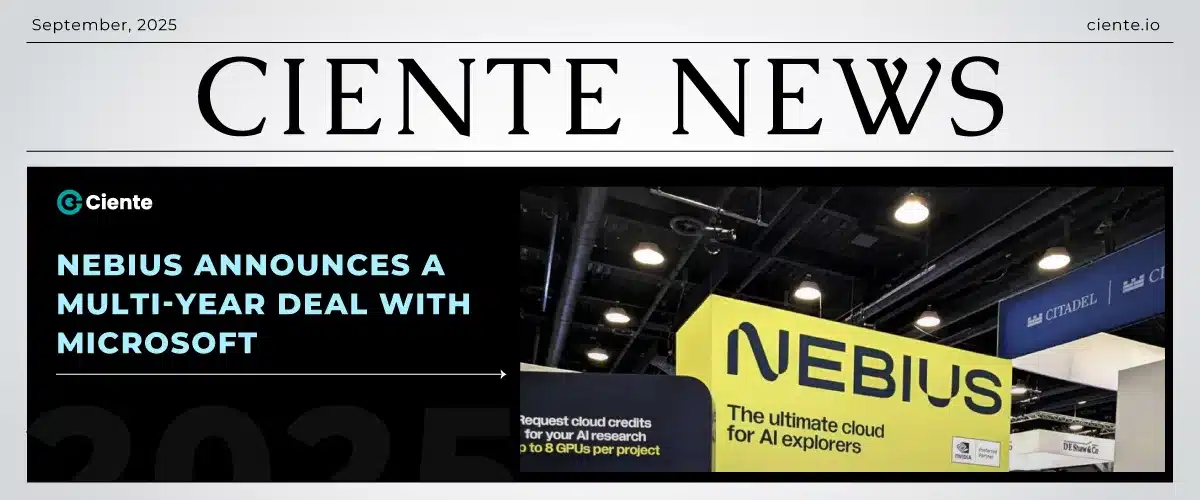
Nebius Announces a Multi-year Deal with Microsoft

Nebius Announces a Multi-year Deal with Microsoft

Nebius share jumps after the multi-billion-dollar Microsoft deal triggers a 6.6% boost for rival, CoreWeave.

There have been incessant discussions around what AI is capable of. The thirst and will to build more intelligent, faster, and agile models have observably become insatiable.

But little do they realize the well of computing power that each machine learning application and foundational model actually demands.

Across several countries, there are hundreds of data centers with servers that power your AI systems. And the hunger to unlock AI’s unimaginable potential has led to an unquenching demand for more data centers, and ultimately more computing power.

This is what underpins Microsoft’s latest alliance with Nebius, an Amsterdam-based tech firm.

Here are the tidbits.

The company, spun from the Russian Internet giant Yandex, develops GPUs to train AI models. Under this multi-year contract, the objective is to provide cloud computing power to support AI workload.

Following this arrangement, Microsoft will also receive additional cloud computing capacity. And a consistent supply of AI infrastructure to keep its momentum in the AI race.

On the other hand, the rising demand for Gen AI models can also encourage Microsoft to boost its need for compute power. This could easily result in $17.4 billion deal turning into $19.4 billion one.

It remains a future possibility, as the speculations assert.

For now, Wall Street’s cheers for Nebius sent its shares soaring almost 55% to $99.2 on Tuesday. And if the gains hold, it could add over $7.7 billion to the existing $15.3 billion market capitalization.

Where’s the market headed?

According to McKinsey & Company, the situation is about to turn even more dire- by 2030, data centers will potentially require $6.7 billion to keep pace with the demand for computing power. The race to clasp on to as much data center capacity as possible is on.

And it doesn’t show signs of slowing down in the near future.

With the AI boom widespread across the world, and superpowers such as China and the US competing in the race, the demand is only projected to surge.

Mastering Lead Generation for Financial Service & Product Industry

Mastering Lead Generation for Financial Service & Product Industry

Mastering Lead Generation for Financial Service & Product Industry

Marketing for the finance industry is not the same as other sectors. And while the same advice can help you set up it takes something else to win.

Imagine losing a million dollars overnight. If that doesn’t send a chill down your spine, what will?

But for those who do, this mishap is a tragedy.

This is what the buyers of any fintech have to deal with.

The possibility of losing money through no fault of one’s own. To wake up one day with their secured funds empty.

To say trust drives lead generation for the financial and FinTech industry would be quite an understatement. Without trust, the buyers would use their existing solutions till kingdom come. And maybe even then, they’d stick to what works, because our current systems give rise to uncertainty while simultaneously promising its elimination.

Financial buyers are tired of these paradoxical lies and move to organizations that prove they can be trusted or to traditional banking institutions- deeply embedded in the world economy.

If you want to generate leads for your financial or FinTech org, the question is, how do you disrupt the status quo and be considered the safe choice over traditional ones?

There is a leverage here, and it’s called convenience. And the buyers are all about it.

Why do FinTech and Financial services need lead generation?

Lead generation has been getting some bad rep lately. It’s perceived as a way to farm people’s information for data. There’s a reason buyers have become self-directed and choose to engage way later in their buying cycle.

Lead generation has become synonymous with lead lists, which it is not. While high-performing organizations have their own definitions of a lead, lead generation does have a broad definition.

It is the process of gaining the interest and trust of a potential buyer, and turning them (the people) into paying customers.

By this definition, FinTech and the financial services industry don’t just need lead generation but have to sustain themselves through it. Think of this: your SDRs are on-call (cold) and you try to explain what your organization does, and midway, they stop and say, “But our existing solution does this, too. Why do we switch?”

That is a rhetorical question.

They don’t or can’t switch because of the massive changes involved in using a financial service or tech.

There’s a lot of red tape that will hinder it, even if the buyer is genuinely interested in what you have to offer. Lead generation can bypass this by building trust before your SDRs even reach the prospect, as shown in these AI-powered lead generation strategies.

In fact, the buyer will reach you when their need for your solution eventually arises. Your SDRs will have to act as consultants here.

Strategies to Drive Quality Leads for the Financial Industry

Let’s divide this into two parts.

  1. Financial Services
  2. Fintech

Between the two, FinTech has an advantage being the new-age tech, especially after ’08. The crash made people realize just how volatile the banking sector can be and that people needed alternatives. Ever since then, financial services, especially banking, have not yet recovered this trust.

People look to private organizations that mitigate these damages. Instead of lining up in a queue to withdraw their savings, they are secure from the economic downturns in privatized solutions.

For example, Revolut, a tool designed to help you spend and save. But their real promise lies in keeping yourmoney safe.

But the real promise lay in its transparency and becoming a champion of underserved markets.

Something traditional services took a long time to position themselves as.

So, let’s talk about financial services first.

Lead Generation Strategies for Financial Services

Trust is a vital tenet for marketing. Ask any marketer, and they’ll tell you that first and foremost, marketing is all about communicating trust and building a relationship with it as the base.

For financial services, this tenet is magnified. It’s gospel.

The involvement of money means that for people investing in your services, you are a high-risk option. Imagine selling that to a client.

“Hey, you don’t know us, but we’d like to replace your current insurance provider, and maybe we’re not malicious. You can trust us with the livelihood and lives of your employees. We won’t cheat you. Promise!”

If only that were so easy.

1. Building a relationship.

Let’s assume a few things first,

  1. You have a client base, because if you don’t, you need customer acquisition, not lead gen. And customer acquisition requires a sales-led approach first.
  2. You know what you’re doing marketing-wise, i.e., your end goal- X amount of sales. You must have case studies, whitepapers, blogs, email marketing, advertising, and all the basics that need not be outlined because they come before lead generation.

The above two assumptions are also your first steps. But rarely does a financial service start without a client.

While you must have heard about thought-leadership, building relationships is a bit different. It involves inviting your core buyer to check what you have to offer. Many B2B buyers feel their sales calls are transactional.

Here is the opportunity for your brand and solution to try something different. Through sales or through marketing, build a rapport as a problem-solver.

This involves: –

  1. Being active where your buyers are- email, social media, ads, on-calls, etc.
  2. Listening to their problems and asking for market feedback (this is a tough one because it means divesting effort from direct sales and also because the market doesn’t have time to answer).
  3. Asking your sales teams to listen to the problems and using social and email to craft messaging relevant to real-time buyer problems.

This builds credibility. And it is a strategy that is easier said than done. But as you would know, people in finance are cutthroat. And what do cutthroat people like?

A little bit of ROI, honesty, and genuine interest in solving financial problems.

2. Understanding your context.

This is a point that might be universal to all lead generation strategies. To: –

  1. Understand the market’s history with your services
  2. Your context in the current market (which shapes marketing messages).

This step also assumes you have a clear vision of what you’re offering and to whom. If you or the top management don’t know that, then the sharks in finance are going to defeat you.

The reason this step is so important is that it will shape the way your marketing messages sound and your SDRs talk- shaping market perception. For example, let’s say you are a bank selling its salary account to an SME.

The SME has been working with bank XYZ International for a long time. There have been hiccups, yes. But they’re fine with how the bank has helped its employees. But you know the way the SME is growing, the bank XYZ won’t be able to handle the growth.

There aren’t enough insurance plans, and there’s no scope for any 401 (k) or other pension plans beyond government-sanctioned ones.

Your context is this: We safeguard you and your employees while you scale.

This is how context shapes marketing. Won’t you be interested after seeing this message?

3. Leveraging Loyalty.

Why would a buyer change providers? Even in the above example, the SME, now growing, can push the bank to grow, too. After all, loyalty is a major factor in the finance sector. It is a facet of trust.

And while businesses do switch for convenience and growth, they might not give up their existing vendors because they have built relationships. Penetrating new markets is easier, but when competition is at its peak- which it is for financial services- it isn’t.

The conversations you have with your leads will go nowhere.

There’s just too much. You’d have to understand their process, internal money flow, operations, taxes- everything. And let’s not forget the policies the government has imposed on both entities, which are stringent again, because money is involved.

The business has too much to lose in switching. How would you convince them otherwise?

You turn the playbook- you show them the cost of not switching; of loyalty failing when it matters.

Let’s drive this home with an example that does not paint financial services in a good light but also presents an opportunity.

The PPP Loan Disaster

The PPP Loan Disaster must be fresh in many business owners’ minds. COVID-19 struck, and many businesses feared they would go under, but when the Paycheck Protection Program was set in motion, many large banks like Wells Fargo and Bank of America prioritized their bigger clients.

The funding ran out in May, leaving small businesses hanging out to dry.

Tragic.

Loyalty became a cost for SMBs and SMEs who couldn’t survive the harshness of COVID-19 and the apathy of the financial service industry. Many sought refuge in Fintech solutions.

And this is where lead generation transforms from data to a human-human connection. The trick is in loyalty and staying with your customers in turbulent times.

If you make that promise and stand by it, your service would probably dominate the market for years.

For marketing messages, this could take the form of risk-assessment reports, case studies, blogs, outreach, etc. But those are channels and methods of conveying your core message. And the core message for financial services is clear: deliver on the promise of monetary security.

Because FinTech is doing it better.

Lead Generation Strategies for Fintech

For leaders in FinTech, the above section must have made it clear that you have advantages over traditional financial services. So your competition becomes other FinTech solutions, and while you may have trust for the time being, your competition is leveraging something greater: convenience.

Let us preface this part with a little disclaimer: Lead generation is somewhat universal in its methods of omnichannel and multichannel experiences, email marketing, and outreach.

Let’s focus on a real strategy. It has three facets:

  1. Design
  2. Integration
  3. Positioning

a. Design.

In product, design is vital and attention-grabbing (a crucial component of lead-gen!) But beyond that, design informs one thing: Is it easy to use?

Whether it’s the ease with which your client connects to or opens a bank, or the ease with which their finances improve. That’s why Revolut has become such a hot commodity.

Their website on its own screams good design. And if the website is that good, the product can’t be that bad, is what people usually think. And what do you know? Revolut is a great app for personal and business use alike.

The question for differentiation is: Can you build trust through design?

This is what brings leads in. The workflow looks something like this:

Great Idea→ Great Design→ People like Lenny Rachitsky (product people) talk about how great your product and design philosophy is→ organic leads and traffic.

Yes, that is what it looks like for the product ecosystem to thrive. Aesthetics and function are drivers of inbound lead generation.

b. Integration.

Which naturally leads to integration. Great design doesn’t mean the UI is fantastic; it means that the APIs integrate seamlessly with other existing stacks and workflows.

This is a major USP for most organizations, and the one with smooth integration will be the final choice. Whether a business’s AI system, banks, and other workflows can integrate your product will decide how viable your solution is for them.

c. Positioning.

This leads to the final strategy in FinTech lead generation. Positioning your product for the context of the buyer.

Here’s an example for this, too. UPI in India.

The Indian market is a bit different; adoption of tech takes time there. But PayTm, a Venmo-esque app, started gaining traction. And then the Indian government launched the UPI, a universal payment interface, and began the greatest FinTech boom in history.

The main point was to make transactions transparent in a country full of corruption.

Did anyone expect Google Pay to become such a dominant force in the market? But it did, and that’s because Google understood the market and its position. They saw people used PayTM and a native app called PhonePe and conquered the Indian transaction market.

Even now, the two FinTech apps are competitors for a large market. And they show all three facets outlined.

  1. Intuitive Design- they pick up QR codes faster than any app, show bank balances, payment history, spend, etc.
  2. Robust Integration – They are secure and linked to bank accounts.
  3. Positioning- Finding and capturing an emerging market.

This made it so that people flocked to these apps and not vice versa.

This went beyond lead generation and directly into market adoption. This is a clear advantage that products have over services- people can use it and experience the product before adopting it completely.

Lead Generation in finance is complex because it’s abstract.

Yes, there are many abstractions in finance because money is abstract and involves many restrictions, government-mandated regulations, and factors of trust.

It’s red tape everywhere. And lead generation needs to reflect that to gain the buyer for the long term. Without this, financial services become too risky, and FinTech becomes noisy and irrelevant.

It is a lot of work, but you don’t have to do it alone. Ciente has served finance and FinTech since our inception and has understood the principles that drive sales, trust, and growth.

And trust us, without these, a business in the finance industry cannot survive.

Today's rapidly growing digital-first landscape has elevated concerns around data privacy and security. From marketing to the SaaS landscape, this trend has etched itself into the future rulebooks. The thing is, data security isn't a trend. It's a gross dilemma. In recent developments, Hitachi Solutions has covered new heights. It developed a solution to overcome significant challenges in cloud interoperability across the public sector. All in a creative collaboration with Microsoft. Government bodies hold highly sensitive information, of citizens and businesses alike. And your phone numbers and physical addresses are merely the tip of the iceberg. These could easily be a target point for nation-states and cybercriminals. For a body with such a valuable database, data security often goes overlooked. Or at least, not as spotlighted as it should be. Why so? It's substantially due to immense budget constraints, outdated systems, a shortage of talent, and, significantly, the interconnected nature of govt. Services. These elements have hijacked the public sector's progress. These gaps have made the government organizations too vulnerable to hacking. So, Hitachi Solutions and Microsoft have engineered an innovative fix. One that retains the full value of Microsoft's AI tech to unlock more modern and responsive solutions for UK citizens- Secure multi-cloud operability for public institutions to help safeguard their data and accelerate responsiveness. Its chief capabilities comprise: • Private access within Microsoft business apps, AWS, and GCP databases. • Bi-directional data integration without any public internet exposure. • Zero-trust and scalable infrastructure that aligns with the UK's security frameworks. • Maximum use of existing assets doesn't facilitate data duplication. This innovative feat will aid the UK's public bodies in sharing and transferring sensitive public data by connecting systems, while ensuring compliance with requirements. The workflows and data that remain across different environments, such as GCP, Azure, AWS, and Oracle, can now be amalgamated into one. Expensive cloud migrations, primitive tools, and manual workloads are a hitch in the government's cloud operability. But Hitachi's solution is a saving grace. This secure multi-cloud connector facilitates Microsoft apps to access data across GCP, AWS, or Oracle environments in real-time. This is achieved through a private connection that doesn't require any duplication or public Internet access. "The flexibility to use the right tool for the job regardless of where data resides is essential for modern, efficient public services," chimes in the Commercial Director, Government for Hitachi Solutions. Hitachi Solutions' Secure Multi-Cloud Connector Transforms Govt. Cloud Interoperability

Hitachi Solutions’ Secure Multi-Cloud Connector Transforms Govt. Cloud Interoperability

Hitachi Solutions’ Secure Multi-Cloud Connector Transforms Govt. Cloud Interoperability

With the public sector more vulnerable to hacking, compliance came before innovation. But Hitachi’s new solution might just be the catalyst for change.

Today’s rapidly growing digital-first landscape has elevated concerns around data privacy and security. From marketing to the SaaS landscape, this trend has etched itself into the future rulebooks.

The thing is, data security isn’t a trend. It’s a gross dilemma.

In recent developments, Hitachi Solutions has covered new heights. It developed a solution to overcome significant challenges in cloud interoperability across the public sector. All in a creative collaboration with Microsoft.

Government bodies hold highly sensitive information, of citizens and businesses alike. And your phone numbers and physical addresses are merely the tip of the iceberg. These could easily be a target point for nation-states and cybercriminals.

For a body with such a valuable database, data security often goes overlooked. Or at least, not as spotlighted as it should be. Why so? It’s substantially due to immense budget constraints, outdated systems, a shortage of talent, and, significantly, the interconnected nature of govt. Services. These elements have hijacked the public sector’s progress.

These gaps have made the government organizations too vulnerable to hacking.

So, Hitachi Solutions and Microsoft have engineered an innovative fix. One that retains the full value of Microsoft’s AI tech to unlock more modern and responsive solutions for UK citizens-

Secure multi-cloud operability for public institutions to help safeguard their data and accelerate responsiveness. Its chief capabilities comprise:

  • Private access within Microsoft business apps, AWS, and GCP databases.
  • Bi-directional data integration without any public internet exposure.
  • Zero-trust and scalable infrastructure that aligns with the UK’s security frameworks.
  • Maximum use of existing assets doesn’t facilitate data duplication.

This innovative feat will aid the UK’s public bodies in sharing and transferring sensitive public data by connecting systems, while ensuring compliance with requirements. The workflows and data that remain across different environments, such as GCP, Azure, AWS, and Oracle, can now be amalgamated into one.

Expensive cloud migrations, primitive tools, and manual workloads are a hitch in the government’s cloud operability.

But Hitachi’s solution is a saving grace. This secure multi-cloud connector facilitates Microsoft apps to access data across GCP, AWS, or Oracle environments in real-time. This is achieved through a private connection that doesn’t require any duplication or public Internet access.

“The flexibility to use the right tool for the job regardless of where data resides is essential for modern, efficient public services,” chimes in the Commercial Director, Government for Hitachi Solutions.

This remains an explicitly forward-thinking step for Hitachi Solutions.

One that’ll help public institutions across the UK overcome their innovation lag and ensure compliance.