Brand Governance: Removing Inconsistencies for Better Messaging

Brand Governance: Removing Inconsistencies for Better Messaging

Brand Governance: Removing Inconsistencies for Better Messaging

Brand inconsistencies turn marketing spend into a budget sinkhole. Coherence has become more imperative than uniformity. Brand governance ensures exactly this.

Brands are expectations and associations that customers live through their experiences at multiple touchpoints. It’s basically the trust architecture.

This is why a sturdy brand identity is associated with high recall and recognition. The power is no joke. As the source of value creation, brands are the very essence of your business, and not merely a marketing problem.

It’s a business-wide thing.

Every deliverable is co-created across B2B. There’s a significant amount of to-and-fro between client expectations and brand promises. And what is truly governed is tone, knowledge IP, expertise, and how humans deliver value.

This is why, for B2B, brand governance is relatively challenging but crucial.

Brand Governance: Control or Curation?

What is brand governance, in the traditional sense?

Brand Governance is defined generally as,

Brand governance deploys a set of models, processes, and tools to ensure creative consistency and integrity across a brand’s assets.

What truly is brand governance? This is the misunderstanding that most organizations grapple with.

It previously meant control over creation. Control over the incorrect use of the logo. The wrong color. Off-tone messages. And non-creative teams delving into something they don’t understand.

According to Frontify, it meant,

Brand experts ruling over a brand with iron fists, controlling the use of assets, approving every project, and enforcing guidelines across every team.

It boiled down to uniformity- brand strength derived from consistency. Brand governance was a broadcast technique: one message, one center, and many receivers.

This traditional world of brand governance has been discarded.

The new world of brand management demands a generative and adaptive system.

There are a plethora of marketing channels and AI-generated content. Marketing has expanded and become hyper-targeted, with local teams across continents and personalized audience communications.

Will uniformity alone solve the consistency problem?

There’s no one-way top-down control on brand consistency. When brands share ownership with external agency partners on a global and local level, things get more intense.

A modern brand framework can offer more agility in how partners experiment with design and messaging components today. There’s no policing anymore. It’s enabling.

But with an added ingredient-

The actual objective today is coherence.

But coherence and cohesion aren’t derived from control. It requires clarity, intentional curation, and feedback loops.

A framework that allows teams to evolve brands intelligently, without straying too far off from their identity.

If control is all about “This isn’t allowed change,” then coherence is “Any change must trace back to who we actually are- the core brand values.

So, what is brand governance truly?

Brand Governance can be reiterated as an operating framework. One that ensures that all brand experiences are compounded towards brand equity and not fragmented.

This maintains meaning across different conditions of scale and speed, taking into account the local cultural, lingual, legal, and business nuances.

Brand Governance Ensures that Everything You Publish is On-Brand.

Your brand is a confused and fragmented entity without brand governance.

Consistency in your brand identity ensures that your brand and its offerings are easily recognized. And this directly links to your brand equity.

A Case Study

Think of a large multinational.

It has siloed marketing teams operating across three different regions- North America, Asia, and Europe. Now, all of the teams implement three different brand campaigns:

  1. The North American team opts for a dark blue, black, and silver palette. They aim for a modern and edgy appeal with the tagline- “disruptive innovation.” And the copy is quite jargon-heavy.
  2. The Asia team wishes to showcase stability and trust. They choose a simple gold and blue palette, and focus on the messaging- “long-term and reliable partnership.”
  3. The Europe team targets a very value-conscious market. They select orange and blue for all their social media campaigns, zeroing in on “cost-efficiency and speed” as their messaging.

A good brand helps you keep top of mind of consumers and makes you stand out in today’s crowded market. And a strong one ensures your customers feel closely connected to the brand’s mission.

But this only comes into fruition when your customers receive a cohesive brand experience.

Now, imagine there’s a CMO based in Japan who came across your partner-focused Asian ad and decides to research your brand. Their visit to your global website defaults to the North American jargon-heavy messaging. It’s disruptive. And when they visit your social media platform, they see a vibrant social feed.

Imagine each market segment receives a different core message. How do your potential buyers understand who you are?

This doesn’t show that the multinational is a diverse company. It instead posits that the company doesn’t know what it stands for. An innovator? A budget solution? Or a reliable partner?

There’s no unified narrative. No brand governance framework. This way, the company’s potential value is lost. It kills their experience and erodes trust.

The brand equity, rather than amplifying, is rapidly diluted.

Brand Governance’s Role Here?

  1. Imposes the same set of guidelines to maintain tone of voice, messaging themes, color palette, and logo usage.
  2. Requires that the core value and visual elements are adapted region-wise, and not fundamentally changed. This preserves the brand’s immediate recognizability.
  3. Necessitates centralizing assets to ensure all global and local teams use consistent and approved messaging elements.
  4. Ensures every touchpoint builds on the same building blocks of trust and meaning. It guarantees that there’s a single, strong brand image, not a fractured one.
  5. Establishes a simple chain of command for reviewing and approving all comms strategies before launch- to establish coherence.
  6. Defines an overarching core brand messaging and company mission. Regional teams can tailor the way they deliver this message, not tweaking the essential message.

Brand governance doesn’t work like Big Brother. It offers structure, accountability, and brand discipline, like a silent support system.

The ‘Speed vs. Governance’ Pain Point

Global B2B brands that operate in numerous local markets and multiple channel partners must contextually adapt.

It’s not only about language challenges, but also about legal and business ones. From regulatory nuances to relationship norms, every facet is offered precedence.

Does this always lead to an “off-branding”? Not quite.

It’s basically contextually aligned translations of the single brand value. Your US team might push for insight-first and assertive messaging, but the Japanese one would opt for humility

The way your value is delivered matters if the crux remains the same.

However, juggling between the different tones and voices can result in conflicts. Distinct channel partners in local markets use various tools and software to make edits for the ground they’re operating across.

What if there’s no structure to this process? There’s creative freedom, yet no uniformity- plurality without any cohesion.

But what if the system’s too rigid? Forced uniformity at the cost of resonance.

These muddy waters will make brand governance a board-level mandate.

Why Brand Governance is Significant in 2025 and Beyond

Buyers are opting for alignment and belief before they even perceive the solutions, as marketing becomes more relational. If each market territory perceives your brand differently, this belief will fracture. The content ecosystem will lose its grounding- proposals rewritten, locally edited case studies, and templated thought leadership content.

It isn’t disorganization. It’s knowledge entropy.

You prioritize content creation velocity. But does it codify what your brand actually stands for?

If not, brand building converts to brand dilution. Your brand’s voice is eroded, and authority is scarce because everyone is busy reinventing “how” it should speak. The derived insights that should contribute towards equity end up as fragments that make no sense.

AI tools have amplified this sprawl. Brands can generate human-sounding content that bypasses their core brand frameworks. What the marketers haven’t realized is that while it’s building momentum, it’s killing their voice.

In 2025 and beyond, brand governance isn’t a rulebook.

Have we forgotten the strong demand for dynamism and agility? Ridigity is killing momentum, and speed is killing clarity.

We must not only understand everything brand-related as a living system, but as an adaptive one. It’s about curating adaptive brand integrity.

Brand governance isn’t control. It’s momentum and coherence.

“You have to be more present with local content in real-time with digital; that wasn’t the case before.” – Global Marketing Director at Heineken.
Sora AI Update: Sam Altman Promises More Granular Control Over Character Generation

Sora AI Adds Granular Character Controls, Says Altman – Ciente

Sora AI Adds Granular Character Controls, Says Altman – Ciente

With the intensifying AI-creativity debate, could Sora 2 have made things worse for believing in the originality of AI content?

OpenAI’s new text-to-video model, Sora 2, has opened a fresh chapter in the copyright debate. Within hours of its release, the internet was flooded with AI-generated clips of Elsa, Spider-Man, and Mario moving with uncanny realism.

The company calls Sora 2 “a cinematic leap.” But creators call it something else: a wake-up call.

For years, AI companies have trained on oceans of creative work scraped from the web. Now, they’re not just learning from culture, but they’re reproducing it frame by frame.

The backlash came fast.

Artists and studios accused OpenAI of converting intellectual property into training fodder without consent. Legal experts warned that Sora’s realism blurs the line between paying homage and theft.

In response, OpenAI promised what it calls “granular control” for copyright holders. The update, expected later this year, will let creators choose how their material is used, or not used, in AI-generated videos.

It’s a step toward consent in a space long been ignored.

But the tension runs deeper. This isn’t only about protecting content. It’s about protecting context- the human meaning behind what machines remix.

Creative labor has always been the invisible fuel of innovation. When algorithms can replicate characters and worlds without permission, the idea of authorship itself becomes unstable.

Who owns the imagination when models can reassemble it on demand?

OpenAI has joined the Coalition for Content Provenance and Authenticity (C2PA) to track sources of all media content. With this, it will embed digital provenance data into each Sora output.

While these moves sound good on paper, the question begs: can control be granular when scale is infinite?

AI’s defenders call this an inevitable evolution of creativity. Its critics call it cultural extraction. Both sides are right.

OpenAI is now navigating a tightrope between innovation and infringement.

The company built the tool that broke the creative dam. Now, it must decide whether it wants to develop the walls that keep the flood in check.

Because this isn’t about technology anymore, it’s about ownership. And who gets to shape the next frame of the human story.

Crafting Memorable Marketing Campaigns: Beyond Mindshare

Crafting Memorable Marketing Campaigns: Beyond Mindshare

Crafting Memorable Marketing Campaigns: Beyond Mindshare

Memorability isn’t created by chance. The campaigns that stick in people’s minds is the one that has been crafted by a single creed: empathy.

When was the last time you saw a marketing campaign and actually remembered it?

Not the ones you scrolled past. Not the ones you skipped. The ones that made you stop and think about them later. Maybe even mention them to someone else.

Drawing a blank? You’re not alone.

Most campaigns die the second they’re seen. They follow a formula: attention grab, product insertion, call-to-action, hope for conversions. Repeat until the budget dies or someone gets a promotion.

But campaigns that stick? They ignore the formula entirely.

In an industry suffocating under content, AI slop, and everyone following the same “best practices,” breaking the mold isn’t some creative luxury. It’s how you survive.

Memorable Isn’t Viral

Viral is a lottery ticket. Everyone buys one, almost nobody wins, and the ones who do can’t explain how to do it again. Viral happens by accident most of the time.

Memorable is different. Memorable is built on purpose.

A campaign becomes memorable when it connects to something real. An emotion you forgot you had. A truth you’ve been ignoring. A way of seeing things you hadn’t considered. The campaigns we remember aren’t the loudest ones.

They’re the ones that made us feel.

Apple’s “Think Different” didn’t sell computers. Dove’s “Real Beauty” didn’t sell soap. Slack made email the villain before showing you their product.

They sold perspectives. Ways of thinking.

That’s where campaigns fall apart. Teams get so obsessed with features, benefits, and conversion rates that they forget to give people a reason to remember. They optimize for algorithms, not humans. They test every drop of personality out until nothing’s left.

What Actually Makes Campaigns Stick

Your brain doesn’t file away marketing messages in neat folders. It doesn’t sort by industry or product category.

It files by feeling.

Did something make you laugh? Make you uncomfortable? Confirm what you already believed? Challenge it?

B2B marketing, especially, is scared of feelings. Decision-makers want spreadsheets and ROI projections, not emotions. And sure, those matter when someone’s evaluating vendors. But the first time someone hears about your brand? When they’re just becoming aware you exist?

That’s when feelings matter most.

Monday.com could’ve made boring project management ads. Feature screenshots, pricing tiers, integration lists. Instead, they focused on the chaos of work. The feeling of juggling too much. Dropping the ball. They made you feel the problem before they offered a solution.

That sticks.

Simple Without Being Stupid

Simple and simplistic aren’t the same thing.

Simple means you took something complex and found its core. Simplistic means you dumbed it down because you don’t trust people to keep up.

The campaigns that last are simple on the surface. One idea, clearly communicated. But dig deeper, and there are layers. Meaning that it rewards attention.

Mailchimp ran “Did You Mean Mailchimp?” – wordplay on the surface. But actually a commentary on brand awareness, how people search, and why switching vendors feels hard. Simple to see, smart underneath.

Most campaigns try to cram everything in. Every feature, benefit, and use case. Worried that focusing on one thing means missing potential customers.

So they reach nobody.

Memorable campaigns pick one thing. Say it perfectly instead of saying ten things, okay.

Looking Different Matters

Most campaigns are identical.

Same stock photos. Same colors. Same headlines. Then marketers act confused when nothing lands.

Scroll LinkedIn for five minutes. Count how many posts look exactly alike. Same carousel format, same corporate voice, same “insights” nobody asked for. It’s wallpaper.

Being distinctive isn’t about being weird because you can. It’s about owning an angle only you can claim. Doing something that makes people pause because they genuinely haven’t seen it before.

Liquid Death sells water. They could’ve talked about purity or hydration or saving the planet. Instead, they packaged it like an energy drink and marketed it like a metal band. Not everyone’s going to like it. But people remember it.

Wrong question: will everyone like this?

Right question: Will anyone remember this?

Stories Beat Announcements

We’re built for stories. Been telling them since language existed. Stories have setup, conflict, and resolution. Structure. Stories stick in memory.

Most campaigns aren’t stories. They’re announcements. Feature launches, hiring posts, whitepaper drops.

Those are notifications. People dismiss notifications.

A memorable campaign takes you somewhere. Even if it’s just thirty seconds. There’s setup, tension, payoff. And the customer plays the hero – your product doesn’t.

Shopify doesn’t promote its platform. They tell stories about people who risked something, built from scratch, and went against conventional wisdom. Shopify is just the tool that made the story possible.

Most campaigns position the product as the hero. Memorable ones make the customer the hero.

Why Teams Can’t Pull This Off

Too Many Voices in the Room

Decision-by-committee murders creativity. When everyone needs approval, you get the safest possible option. Boring. Forgettable.

Memorable work needs someone willing to make a call. Someone who trusts the creative team to take risks. Leaders who know the difference between “I personally don’t like this” and “this won’t work.”

Most places default to risk aversion. Safer to ship something bland that nobody criticizes than something bold that might bomb.

Except bland campaigns bomb too. They do it quietly.

Chasing Short-Term Numbers

Data matters. But optimize everything for instant conversions, and you kill any chance of being memorable.

Why? Memorable campaigns pay off slowly. They build brand value over months and years. Create associations that compound. But if you’re only watching this month’s conversion rate, you’ll never approve anything without guaranteed immediate returns.

The most memorable campaigns often show weak early metrics. They’re brand investments, not performance plays. In marketing’s current obsession with attribution and instant ROI, that’s nearly impossible to sell.

Templates Killed Creativity

We’ve turned creativity into an assembly line.

Templates for everything. LinkedIn posts, emails, ads, and landing pages. Because templates sort of work, teams keep using them. But templates are fundamentally not distinctive.

You can’t template memorable. You can template efficiently. You can template consistently. Memorable campaigns break templates.

How Do Businesses Craft Memorable Campaigns?

Find Insight Before Ideas

Most brainstorms open with “What campaign should we run?”

Start wrong, end wrong.

Begin with insight. What non-obvious truth exists about your audience, your market, your product? What do you understand that competitors miss? What tension sits there unacknowledged?

Strong campaigns begin with sharp insights, then figure out creative expression. Weak campaigns start with out-of-the-box concepts and retrofit insights afterward.

Spend most of your time finding the insight. Creative follows.

Have an Opinion

Memorable campaigns take positions. Make statements. They don’t try to please everyone because trying to please everyone means connecting with nobody.

What does your brand actually believe? What are you against? What would you refuse to do even if it costs customers?

That’s your position. That’s what gets remembered.

Patagonia built its brand on strong positions. Telling people not to buy their products. Suing presidents. Donating the entire company to climate work. Conventional? No. Memorable? Obviously.

You don’t need that level of extremism. But you need to stand for something beyond “purchase our product.”

The Elevator Test

Can someone explain your campaign to a colleague in one sentence?

If it needs context or explanation or a deck, it’s not memorable. Memorable campaigns pass the elevator test. Simple enough to repeat, interesting enough that people want to.

“It’s the one where they…” should be enough.

Make People Part of It

The most memorable campaigns don’t broadcast to people. They bring people in.

Ask a question that matters. Create something people want to share or remix. Start conversations instead of making announcements.

Participation creates memory. Passive consumption creates nothing.

The Ice Bucket Challenge wasn’t memorable because the ALS Association had massive budgets or genius creatives. It was memorable because it turned watching into doing. People weren’t the audience; they were participants.

You probably won’t launch the next Ice Bucket Challenge. But you can make campaigns more participatory. Invite people in instead of shouting at them.

What Nobody Wants to Hear

Most campaigns shouldn’t try to be memorable.

Not every product launch needs cultural impact. Not every email needs buzz. Sometimes you need conversions, pipeline, and quarterly numbers to hit.

That’s real. That’s marketing.

But if every single campaign optimizes for immediate performance, if nothing builds long-term value, if you never risk anything creative… you’re teaching your audience to forget you exist.

You become background noise.

Strong marketing strategies balance both. Campaigns hitting immediate goals and campaigns building lasting brand value. Campaigns that convert and campaigns that connect.

The mistake is treating them as the same thing.

What This Means Tomorrow

You’re in your next planning meeting. Product launching, budget allocated, stakeholders waiting.

How do you push for memorable without looking naive?

Start small. Don’t bet everything on one risky concept. But push one campaign to be braver. Test one creative piece that breaks the template. Try one message with an actual position.

When it works – when people remember it, talk about it, when results compound over time – you’ve earned permission to try again.

The organizations winning in the coming years won’t be the ones with the biggest budgets or fanciest tools.

They’ll be the ones people actually remember.

Because in a world of infinite content, limited attention, and rising skepticism, being memorable isn’t optional.

It’s everything.

Memorability is Strategy, Not Luck

Most of this advice isn’t new. It’s old. The principles that made advertising work before programmatic existed, before marketing automation, before AI.

Human insight. Creative courage. Willingness to say something worth remembering.

We traded memorability for metrics somewhere and optimized creative messaging to the death. A/B testing ourselves into mediocrity.

Getting back isn’t complicated. Just requires remembering what marketing was meant to be.

Not an interruption. Not manipulation. Not noise.

Connection.

Make something memorable. Or keep blending into feeds.

Up to you.

Conversion-Centred Design: Intentional Designing that Converts

Conversion-Centred Design: Intentional Designing that Converts

Conversion-Centred Design: Intentional Designing that Converts

The missing framework for conversion-centric design outlines more than just visual cues- intent mapping. Is it neglecting intent that landing pages fail?

Designs help put problems into context. And offers better alternatives for handling them- offering diversity to one-dimensional thinking. That’s basically the overall psychology behind design: tangibility.

Great designs stem from a myriad of POVs. It’s all about embracing the chaos.

Good design is about experimenting and playing around, such that the process of making the right one always feels subjective. Whether you know the rules or not, it boils down to creating a design that translates thoughts into actions.

Isn’t this the crux of design’s role across marketing?

From Google to Microsoft, these market leaders are a standing proof. It’s not as if they knew which logo they would choose from day one, or the color that could become a part of their identity.

They experimented. They had their fair share of trial and error. And finally found out what sticks.

This has always been the better approach- the experimentation followed the basic principles of design, and honestly, that’s why it just worked (like Facebook’s blue-colored logo).

Conversion-centric design is all about this.

Before we dive into what conversion-centric design is, let’s get into what it’s not.

Conversion-Centric Design Isn’t All About Design.

There’s severe confusion here. And it’s about because marketers approach conversion-centric design with a very narrow vision.

Every resource that you encounter on this topic guides you towards just one thing- they teach you what to do.

Create focus. Use whitespace. Deploy urgency. Include directional cues.

It’s the same mantra repeated a hundred times over.

The traditional wisdom presumes conversion-centric design as a checklist. You apply these principles, and the conversion will follow.

But this is precisely where marketers falter.

These principles aren’t the problem. It’s the thinking behind executing them-

Landing pages don’t fail because of a lack of white space or wrong CTA placement. But when marketers inherently misunderstand what conversion-centric design truly means.

So, What is Conversion-Centric Design Then?

From the very words of the one who coined it- Oli Gardner, the co-founder of Unbounce, conversion-centric design is,

“Conversion-Centered Design is the original framework for creating high-converting campaigns. It’s time for the next evolution of landing page design.”

But the term “conversion-centric design” itself is misleading.

It implies that design, i.e., the visual arrangement, color theory, and button placement, are all central to conversions.

This is too limited.

Designs don’t drive conversions, but the clarity of the visitor’s intent aligns with the depth of desire.

So, basically, design is merely a vessel.

The frameworks obsess over attention ratios and button colors while neglecting the fundamental truth: Your design decisions must stem from understanding the “why” someone arrived on your landing page in the first place.

Let’s make a comparison.

Two landing pages are identical in every aspect. The layout remains the same, with matching CTA placements and the same color scheme. But while the first converts at 18%, the other does so at 2%.

What’s the disconnect?

The page with the 2% conversion rate relies on guesswork, whereas the other one understands the visitor’s intent to the bone.

This is precisely what standard playbooks miss.

Conversion-centric design begins even before you open your design tool. It starts with speculating and studying the visitor’s state of mind at the moment they land on your page.

This is intent-mapping.

Fundamental Blocks of Conversion-Centric Design

What They’re and What They Should Be

1. The Misleading Universal Principles

Traditional frameworks present principles as universal truths. Employ contrast, use encapsulation, and create urgency.

But the priority of these collapses the context into irrelevance.

For example, take scarcity and urgency. Every guide suggests them. Each landing page has something along the lines of- “Limited Time Offer” or “Only 10 seats left.”

The psychology behind this is sound- humans are loss-averse.

But urgency and scarcity only work when there’s existing intent.

Visitor intent should take precedence.

If a user is actively comparing solutions and vendors, urgency will help accelerate their buying decisions. But if they’re in the awareness stage?

The user barely has an understanding of their problem. Urgency will only create pressure without persuasion. And this then triggers abandonment.

The same applies to each facet of the “Conversion-centric Design Principles,” from social proof and testimonials to other proven tactics. They might work in the very beginning, until they don’t.

Whether they work or don’t is based on where the visitor is in their buyer’s journey.

When marketers apply these principles uniformly across landing pages, it’s lazy thinking masked as best practice. That’s not how you convert users.

2. The Wrong Focus on Fundamentally Flawed Landing Pages

Most conversion optimization frameworks focus on micro-tweaks to very intrinsically flawed landing pages.

You’re testing button colors. But you aren’t studying whether visitors even grasp what your brand is offering. You’re bust adjusting form fields when you haven’t even validated the offer behind the form.

The traditional framework treats visitors as numbers- as conversion machines.

Input the correct design elements Output high conversion rates.

But this way, users aren’t responding to your design. They’re only responding to whether your offer solves a pain point they actually have.

This is when even a sure-shot method such as A/B testing yields marginal improvements. Your team is busy optimizing the wrong variable.

A purpose-driven optimization asks the right questions:

  • Does your landing page match the actual intent of your traffic source?
  • Does your brand offer a solution to the specific pain point your visitors are expecting?
  • Will your articulated value resonate with the visitors’ current state of awareness?

These determine whether your conversion rates start at 10% or 1%.

Design optimization could push you from 10% to 12%, but no amount of color theory will rescue a landing page that misunderstands its audience.

3. Where’s the Intent?

Traditional frameworks assume a linear buyer’s journey-

Visitors arrive ⇒ Sees your page ⇒ Takes action.

This assumption is flawed. The modern visitor doesn’t just land on your page in a vacuum, but arrives with:

  • particular pain points
  • pre-held beliefs
  • diverse emotional states
  • varying levels of market understanding
  • different levels of decision-making authority

Your conversion-centric design should consider these variables, and not through personalization engines. There should be strategic clarity about who this particular landing page is for.

What most landing pages do is- they attempt to be everything for everyone. They comprise multiple value propositions and appeal to different market segments. But amidst all of this, the core message gets buried beneath several layers of features.

This is the opposite of conversion-centric design.

Conversion-centric design demands specificity- one page, one audience, one intent, and a single goal.

But it’s not because other audiences don’t matter. It’s because trying to convert everyone converts no one.

4. Maybe it’s the Focus That’s Lacking

Focus is the first principle of conversion-centric design.

From removing navigation to eliminating distractions, you maintain a 1:1 attention ratio. But this understanding is still incomplete.

The attention ratio isn’t about the links on your page, but cognitive load. The mental effort is necessary to highlight what you want your visitors to do and why they should do it.

The thing is, you can have a landing page with zero navigation links and panes, and still overwhelm them with:

  • jargon-infused copy
  • unclear value propositions
  • benefits that don’t align with their pain points
  • solutions that require too many mental calculations

However, the actual focus isn’t also visual minimalism. It’s all about the clarity of purpose- every component on your page should answer one of the three questions from a visitor’s perspective:

  • What is this?
  • Why should I care?
  • What happens if I do this?

So, if a component doesn’t answer any of the three questions, it’s merely creating cognitive overload. And this is irrespective of how neat your visual hierarchy is.

Design That Actually Matters: The Essential Conversion-Centric Design Framework

You come down to the design when you’ve aligned everything else properly-

  • Your offer solves an actual business challenge.
  • Marketing messages articulate value in concise terms.
  • The page addresses their current knowledge level.
  • There’s no unnecessary friction from the process.

Only after these does design optimization become more sturdy. Because you amplify messages that resonate with your values, rather than acting as a compensation for a weak foundation.

This is where CTA colors matter, white space becomes strategic, and directional cues guide rather than manipulate. And when urgency speeds decision-making, it does not create anxiety.

The traditional frameworks have always gotten the sequence backwards.

Design is taught, and strategy is implied.

But conversion-centric design is strategy-first, and design is the execution.

The Reiterated Conversion-Centric Design Framework

If the conventional seven principles prove insufficient, what framework should marketers actually use?

Begin with intent mapping. Before touching any design element, answer:

1. Intent Clarity

  • Why is a user landing on this page?
  • What problem do they want to solve?
  • What alternatives have they considered?

2. Awareness Level

  • Do they know they have a problem?
  • Do they understand what kind of solution they need?
  • Are they comparing specific vendors?

3. Decision Context

  • What objections do they need addressed?
  • What proof do they need to believe your claims?
  • What friction exists between consideration and conversion?

4. Outcome Visualization

  • Can they clearly picture what happens after conversion?
  • Do they understand the transformation your solution provides?
  • Have you articulated the cost of inaction?

Only after mapping these elements should you consider which design principles support your conversion goals.

The principles aren’t universal. They’re contextual tools to elevate your conversion strategy.

Conversion-Centric Design Eliminates Resistance by Citing Conversion As the Obvious Choice.

The traditional approach underlines conversion-centric design as a persuasion tactic. But it’s a framework to amplify clarity in your brand offerings.

You don’t get pushed, and neither do you coerce your audience into listening to you. But actually align yourself better with conversion-centric design.

It’s a strategic way of rethinking the relationship between page design and visitor intent.

Although the standard playbook remains useful, it’s incomplete. It’s all about techniques without context, and principles without purpose. It assumes that visitors are the same, and all landing pages serve the same functions.

This is why landing pages developed according to ‘best practices’ still convert poorly.

Before considering directional cues, white space, and colors, ask yourself: Does your page resonate with the visitor’s intent?

No amount of tweaking can rescue your conversion rate from a nosedive.

The playbooks teach you what to do, but now it’s time to understand why.

It’s simple- conversion-centric design should amplify the already compelling message.

Smarter Lead Generation with AI Agents: Turning Data into Qualified Opportunities

Smarter Lead Generation with AI Agents: Turning Data into Qualified Opportunities

Smarter Lead Generation with AI Agents: Turning Data into Qualified Opportunities

If any marketing function will improve with AI. It is lead gen. The opportunity there is vast and here’s what you can do to use it properly.

AI is used to eliminate low value opportunities, rank high value opportunities, and focus on the most valuable opportunities through a combination of analyzing customer data, intent prediction, and customization of outreach. By leveraging AI to generate leads, the companies will save time, increase conversions, and decrease expenses converting raw data into qualified opportunities, which will lead to real growth.

Generating leads has been one of the main components of business development. However, in the digital first generation, manual approaches fail to generate enough leads to keep the sales team busy, and most leads are not of the quality to qualify. This is where the AI Agents of Lead Generation are leaving a game changing impact. They are turning raw data into qualified opportunities that result in real revenue, by automating, being intelligent, and personalizing.

What Are AI Agents for Lead Generation?

Lead Generation AI Agents are smart autonomous applications that integrate machine learning (ML), natural language processing (NLP) and predictive analytics to simplify and streamline the sales funnel. Unlike traditional tools that can never learn or adapt to the behavior of buyers and can only automate repetitive tasks, these agents have the ability to learn based on the information, adapt and make decisions in real time.

The fundamental applications of AI agents are:

1. Data Collections Analysis : Pull data all time out of CRMs, emails, social sites, and web interactions to create a 360 Degree prospect.

2. Audience Segmentation : The potential leads are identified and delivered campaigns to the right audience, basing on demographics, behavioral and intent indicators.

3. Predictive Lead Scoring and Qualification : Predictive scoring models can be used to rank leads by purchase readiness to ensure that sales teams focus on high value leads.

4. One on One Outreach : Deliver emails, messages, and recommendations depending on the details of the prospect and their position in the buyer journey.

5. Live Interaction : Implement chat bots or virtual assistants, which can reply in real time, gather data and send follow ups without the involvement of a human.

In broader terms, AI in lead generation transforms simple marketing data in opportunities to sell, bridging marketing effort and helpful sales data. These agents do not simply automate but they think, predict and customize and the result is that businesses can scale lead generation with accuracy and efficiency.

AI Agents vs. Traditional Lead Generation Tools

AspectTraditional ToolsAI Agents for Lead Generation
Data HandlingManual or rule based; limited scopeAutomated, real time data collection across multiple platforms
Lead QualificationBasic filters; often volume over qualityPredictive lead scoring ensures focus on high intent prospects
PersonalizationGeneric, one size fits all messagingContextaware, tailored outreach at scale
Response SpeedDelayed follow ups, dependent on team availability24/7 engagement via chatbots and AI sales assistants
ScalabilityRequires more manpower to handle growthEasily scales without increasing headcount
Decision MakingBased on static rulesAdaptive, data driven, and continuously improving

Why Businesses Need AI in Lead Generation

The contemporary customer experience evolved radically. Customers do their research, compare options, and demand personal interactions long before they speak to a sales rep.

This has posed a challenge to businesses because the old way of lead generation may lead to wastage of time, low conversion rate, and lost opportunities.

This is where AI in lead generation comes in to make a difference:

  1. Accuracy Over Volume : AI based lead generation systems do not saturate sales teams with unqualified leads, but rather filter leads by analyzing demographics, behavioral and engagement history to weed out unsuitable matches. This is done to make sure that only the high potentials go into the sales pipeline.

  2. Increased Speed of Conversion : AI can convert purchase intent sooner than human measures by identifying digital signals (emails, web traffic or social media). This enables businesses to be quick and take the prospects through the funnel in a shorter time.

  3. Availability 24/7 : Customers are not 9 to 5 workers. Through the assistance of AI chatbots and virtual sales assistants, companies will be able to respond immediately to the questions, gather the leads during every hour, and ensure that the prospect is not bored by the process.

  4. Cost Efficiency : Automation of repetitive activities such as lead scoring, follow up emails and initial qualification decreases the workload of sales teams. This not only reduces acquisition costs, but it also releases human reps to concentrate on developing relationships and making sales.

  5. One to One Nurturing : AI is more than automation in that it can provide personalized outreach on the basis of buyer preferences and stage within the buyer journey. As an example, one lead can get a product demo invitation, and another one can be invited to a case study, both being provided at the correct moment to increase the conversion rates.

  6. Continuous Improvement : In contrast to the fixed systems, AI agents are improved with each interaction. With time they optimize lead scoring model, targeting and outreach plans, making a campaign smarter and smarter.

According to Salesforce’s Top AI Agent Statistics for 2025, 83% of sales teams using AI report revenue growth in the past year, compared to 66% for those without AI.

In simple terms, adopting AI in lead generation helps businesses do more than just generate contacts it enables them to generate qualified opportunities with AI that translate directly into revenue growth.

From Data to Qualified Opportunities with AI

All businesses have a lot of data: website traffic, email opens, social interactions, webinar registration, CRM databases, etc. The problem is that all this data is not actionable. Sales teams that do not have the right tools may be smothered in numbers without the knowledge of which prospects are actually willing to make a purchase. This is where AI lead generation agents will be invaluable, combining raw data into qualified opportunities that sales teams can feel comfortable taking action on using AI.

Here’s how it works:

1. Predictive Analytics : AI agents examine historical data on customers and present buyer indicators to determine patterns of conversion. One instance is the number of visits to a price page or white paper downloads which can reflect high intent when repeated. This also assists business in forecasting the most probable individual and the most probable time of conversion.

2. Lead Scoring Models : Unlike using generic rules (job title or company size), AI driven lead scoring assigns dynamic value to each lead based on a variety of factors behavior, firmographics, engagement history and even sentiment based on communications. This will make sure that sales reps work on the most sales ready prospects.

3. Hyper Personalized Nurturing : AI will allow the extent of personalization at scale. It will be able to promote the appropriate follow up step, such as a case study, product demonstration, or chatbot conversation, depending on the location of each lead in the buyer journey. This creates confidence and fastens the conversion process.

4. CRM Integration : AI agents do not operate alone. They also perfectly integrate with CRMs such as Salesforce or HubSpot to update lead scores, record interactions and directly push qualified opportunities into the sales pipeline. This brings about one source of truth and does away with manual data entry.

Real World Applications of AI Sales Agents

Already, AI sales agents are delivering quantifiable outcomes to businesses in different industries:

1. B2B SaaS Companies: AI is used to sort and prioritize the accounts with the highest purchase intent out of the hundreds of demo requests due to their size, historical activity,

and behavioral patterns rather than the sales team manually sorting requests. As an illustration, AI can indicate a prospect that has been browsing pricing pages repeatedly and those who responded to email marketing, providing sales reps with a high speed signal to follow up.

2. E commerce Brands: Chatbots now can do more than respond to frequently asked questions. They lead the shoppers in real time, suggest products based on the browsing history, and lead even after a working day. As an example, a client leaving a cart could get an immediate chatbot message with an offer in the form of a discount or recommending similar products so that they remain active and increase the number of sales.

3. Financial Services Firms: AI data tools can be used to predict high value clients by processing enormous amounts of data. Predictive models are used in place of the generic outreach to identify individuals who are likely to require services such as investment planning or insurance. This is a focused strategy that is time saving, low in acquisition, and lifetime clients.

The measurable impact? AI efficiency and personalization improve the lives of companies through increased rates of close, shortened sales periods, lower acquisition expenses, and enduring customer relationships.

Future of AI Powered Lead Generation

The future of AI in terms of lead generation will grow exponentially compared to the capabilities that it has to date:

Autonomous Negotiation:

The future AI sales representatives will have the ability to chat in real time with potential customers and address their objections, explain product features, and even make promotions, leaving the human reps to focus on making complicated deals

End to End Meeting Scheduling

 AI will integrate with calendars and suggest ideal meeting hours, instead of the back and forth email exchange, and book meetings with the decision makers immediately.

Hyper Personalized Product Advice and Recommendations

In addition to qualifying leads, the AI agents will be able to provide product suggestions that are highly personalized by features and pricing model to best align with each customer.

Cross Channel Consistency:

Future AI will be able to roam freely across email, social, chat, and voice, guaranteeing prospects a consistent and personalized touch on all points of contact.

Those businesses that are forward thinking and embracing such tools today place themselves at a competitive advantage tomorrow. AI will not only facilitate the generation of leads, but it will also turn the sales agents into real digital co workers, who can perform routine assignments but also increase the human creative power and strategy.

Conclusion

AI agents cease to be a futuristic concept since they are currently reinventing how businesses attract, qualify and convert leads today. They can use Agentic automation and intelligence to convert raw data in large volumes into viable opportunities, so that sales groups can work hard where it counts. Predictive analytics and real time engagement to hyper personalized nurturing, AI powered lead generation allows companies to scale smarter, close deals faster, and stronger customer relationships.

Since buyer expectations are still increasing, businesses that adopt AI powered lead generation will not just stay at the same level but achieve a strong competitive advantage in their industries. Basically, the transformation is not about substituting human sales forces it is also about enabling them with smart digital collaborators that open the door to greater efficiencies, accuracy and expansion.

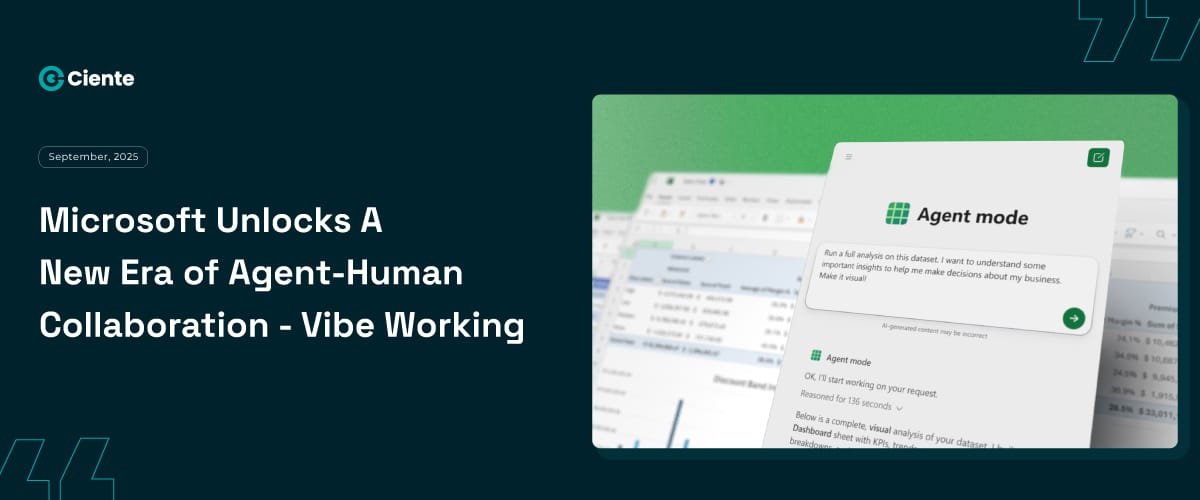
Microsoft Unlocks A New Era of Agent-Human Collaboration - Vibe Working

Microsoft Unlocks A New Era of Agent-Human Collaboration – Vibe Working

Microsoft Unlocks A New Era of Agent-Human Collaboration – Vibe Working

Microsoft unveils Copilot’s latest reasoning models to instill higher productivity across its Office apps.

AI is no longer about isolated experiments. It’s become a product imperative.

As this modern tech sweeps into the complex layers of the market ecosystem, it’s reshaping how users interact with each other and work.

At the steering wheel of this latest tech endeavor is Microsoft.

The tech powerhouse has brought Vibe Working to its Copilot 365. It’s derived from the notion of vibe coding, which was coined earlier this year by Andrej Karpathy.

The world is effectually shifting towards efficiency and productivity, and a significant driver of this is allowing AI agents to handle the intricacies. That’s what vibe coding does. It takes the manual wheels from the software developers and hands them to the AI agents. The role of the developer now is to focus solely on design quality and provide high-level direction, rather than writing each line of code by hand.

The priority shifts from the nitty-gritty of manual coding to the direction of the overall application.

Vibe working is similar. It’s all about AI-driven workflows where users leverage AI to accomplish mundane tasks through conversational and natural prompts.

Microsoft’s Agent Mode across its Office 365 is designed to do precisely this.

With a single, simple prompt, users can now work iteratively. They can steer AI through their multi-step tasks and deliver high-quality presentations, documents, and spreadsheets at the end of the day.

Agent Mode across Microsoft’s Office Apps and Office Agent in Copilot chat marks a new frontier. We have already held incessant discussions around the reliable and efficient nature of artificial intelligence.

Now it’s become an exciting reality.

It’s redefining human-machine collaboration. And inherently transforming how we work.

With this, efficiency will not just remain a demand but become a norm.