The SaaS Marketing Playbook: Trust, Not Leads, Is Your Only Currency in 2026
The MQL is dead, and attribution is a mirage. 2026’s SaaS marketing playbook demands a radical shift- are you brave enough to trust what you can’t measure?
Do your buyers really want a relationship with you?
The very nature of marketing is changing from transactional to relational. But what if only in theory? This tension sits at the center of modern B2B SaaS marketing principles.
Our ground-level reality and the published content pieces present two different worlds. Of course, buyer behavior evolves, but that doesn’t mean the intricacies of marketing itself are. The revamped SaaS marketing playbooks are a notch above the traditional ones- but have we stopped to consider in what ways? Inserting AI and automation in each messaging doesn’t do the trick. And neither does rapid tech adoption.
None of the playbooks actually stick. This is most visible in how SaaS inbound marketing has been diluted by automation and scale.
That’s why-
SaaS marketing playbook needs a transformation
Buyer trust remains at an all-time low. Trust across the board is down overall. But can you even blame the buyers?
AI slop can be discerned from a mile away. But there’s still a flurry of it that organizations continue to leverage to deliver immediate, short-term value. Even if your buyers aren’t here for merely the messaging, the “AI-ness” of it all is turning them away. You can have a strong solution to offer, but if it’s all curtailed behind the slop? You’d best believe your business is walking on edge.
Originality and human expertise are today’s differentiators.
Buyers are focusing more on peers and technical experts over marketing materials and top-down corporate messaging. The trust and credibility trends are leaning more towards “people like me”- third-party validation. And today, a blog about “5 ways to optimize your omnichannel marketing” will garner less appeal than “why email is the only channel that worked for me.”
They’re proceeding with caution- relationship-building isn’t on their priority list. Trust is- especially in B2B SaaS, a model built on a recurring foundation, unlike retail or construction.
What does all of this mean for your SaaS marketing playbook? Let’s take a deeper dive.
1. Information Inflation & The Proof Economy
Information inflation- this single phrase can offer you a mundane insight into why trust deficiency is a major theme to tackle in your 2026 SaaS marketing playbook. From trust-messaging to trust-delivery- the new mantra for modern lead gen has pivoted.
The cost of generating content is zero- all thanks to AI. Any startup or small business can create and publish the same number of blogs and whitepapers as Gartner or Salesforce. This is where content stops being a lead gen channel and becomes a publicity stunt.
While it’s well and good for SEO and awareness, your buyers care very little about how many blogs you published last month. They care about the insights, the claims you’re making. But for the routine B2B SaaS buyers, such claims carry no weight because, honestly, anyone can ask ChatGPT or Claude to generate them as of now.
This is precisely what led to the SaaS Sprawl of the early 2020s- the software bloat. But 2026 is helping CFOs redirect their strategy. The question isn’t “which tools can help us do even more,” but “which tools should be cut.”
To survive the cut, your marketing must pivot from information to proof. That’s at the crux for CMOs and CFOs alike.
If the Edelman Trust Barometer tells us anything, it’s that technical experts and peers are now the guardians of trust. Your corporate blog is viewed as propaganda until proven otherwise. The antidote to information inflation is founder-led sales and evangelist marketing, especially for SaaS startups.
You cannot automate trust.
You must put your engineers, your product managers, and your founders in front of the camera. When a buyer sees a real human explaining a complex problem, they lean in. Because buyers themselves are human- why would they resonate with a polished corporate animation?
The face of the B2B SaaS company is 2026’s marketing strategy.
2. The “Dark Funnel” Reality
If you’re building your SaaS marketing playbook around last-click attribution, you’re optimizing your company for irrelevance. Here’s the uncomfortable truth: the most profitable marketing activities in 2026 are invisible to your tracking software. And even the flurry of tech cannot change that.
RadiumOne data suggests that 84% of social sharing is dark social- it happens in private Slack communities, WhatsApp groups, Discord servers, and DMs. It occurs when your VP of Engineering asks a peer, “What are you using for CI/CD?” and gets a direct answer.
When that VP types your brand’s URL directly into their browser the next day, your HubSpot dashboard labels it as direct traffic. You pat yourself on the back for your strong brand-building strategies. But it can get worse- your team attributes it to the Google Ad they accidentally clicked three seconds before signing up.
This is the attribution mirage.
It leads marketing teams to cut the budget for the very things that actually work- podcasts, communities, and organic social. Because they don’t present an immediate and clear ROI on your dashboard.
But you don’t have to let your playbook drown in the drain. There’s a simple workaround.
The Fix:
- Split the Funnel: Draw the line between capturing demand (Google ads, SEO) and creating it (podcasts, thought leadership). You cannot assess demand creation with a tracking pixel.
- The “Self-Reported” Metric: Add a required free-text field to your demo request form asking: “How did you hear about us?” It can be surprising how many high-value enterprise deals assert they “heard you on a podcast” or “my friend recommended you.” All of this while your marketing software claims they came from organic search.
3. Un-gate Everything
The conventional SaaS marketing playbook was simple: gate your best content to receive an email. The nuance? A downloaded PDF doesn’t equate to a lead. It’s merely someone who wanted to read said PDF- competitor analysis or college research.
In 2026, gating content can become a friction point, or worse- a death sentence for your brand visibility.
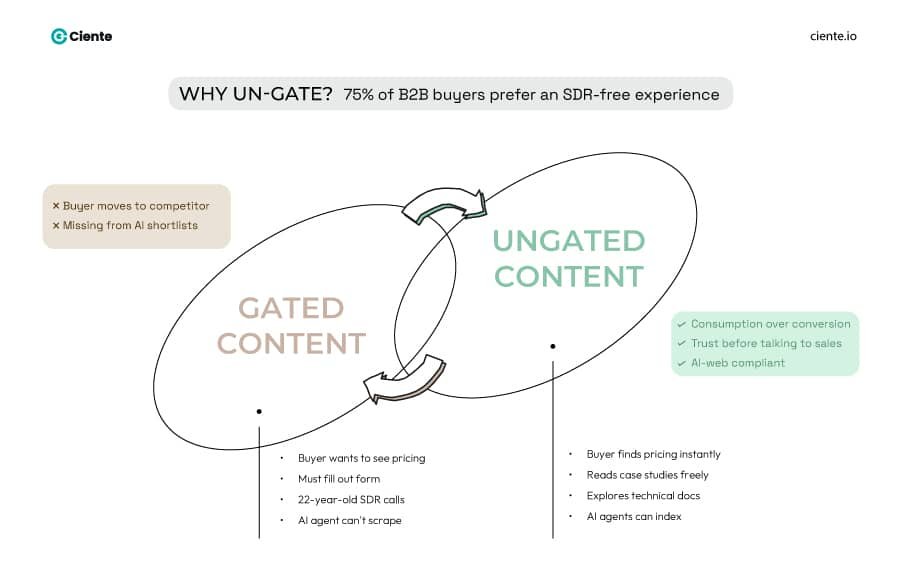
According to Gartner, 75% of B2B buyers prefer an SDR-free sales experience. They want to research, compare pricing, and understand the technical specs without a 22-year-old rep breathing down their neck.
If you force them to book a demo” only to see the pricing chart or read a SaaS marketing case study, they will simply move on to a competitor who doesn’t. It’s that straightforward.
However, the dilemma doesn’t end there. There’s a deeper, more technical reason to un-gate in 2026- AI agents.
Buyers are increasingly using AI agents, such as Copilots, to conduct their initial research. They just have to prompt their AI to “Find me the top 3 CRM tools for fintech and summarize their pricing.”
If your pricing and technical documentation are locked behind a form, the AI agent cannot scrape them. You’re missing from the buyer’s shortlist. This is a perspective you must insert.
Un-gating has become the technical compliance for the AI web. It’s not merely a marketing technique.
The Playbook Shift:
- Consumption > Conversion: Your marketing goal is to have your ideal customer consume your content AND trust your expertise before they even talk to SDRs.
- Retargeting Pools: Rather than capturing an email, capture a pixel. Leverage LinkedIn and Google retargeting to be present before people who actually want to read your high-value technical documentation.
4. Marketing to the “Invisible” Buyer
Most marketing teams are obsessed with capturing potential buyers. They spend 100% of their budget spamming the tiny fraction of the market that is ready to buy right now.
But according to the Ehrenberg-Bass Institute of Marketing Science, only 5% of B2B buyers are in-market to buy your solution at any given time. The other 95% are out of market, i.e., they are locked within contracts, happy with their current tool, or simply too busy to care.
If your SaaS marketing playbook focuses solely on lead gen that targets the 5%, you’re fighting a bloody war in a red ocean. You are competing on price and features for a tiny slice of the pie when the real money is in the 95%.
That’s where the mental availability comes in- the buying psychology that truly matters in today’s marketing landscape.
You should be marketing to people who cannot buy from you yet. You should be the voice they listen to on their commute, the newsletter they read on Sundays, and the LinkedIn post they share with their team.
Why?
Because eventually, that 95% will enter the market- the current contract will expire, or the current tool will break. When that trigger event happens, you must be top of mind. But if they have to Google “alternatives to [Competitor],” you’ve already lost.
The bottom line? Be the brand they type directly into the browser.
5. Retention is the New Acquisition (NRR > ARR)
In the growth-at-all-costs era, the hero metric was net new ARR. In the current efficiency era, that logic becomes a flaw.
HBR consistently cites that acquiring a new customer is 5 to 25 times more expensive than retaining an existing one. In a downturn, or a market saturated by the SaaS sprawl, retention is your only sustainable growth engine.
Your marketing shouldn’t stop when the deal is signed. A modern SaaS marketing playbook dictates that 30% of your budget must pour into customer marketing.
Focus on Net Revenue Retention (NRR). If your NRR is above 120%, your company grows 20% year-over-year even if you acquire zero new customers. That’s SaaS’s compound interest.
Tactics for 2026:
- Run a “features you might’ve missed” webinar series for existing customers.
- Curate case studies specifically designed to upsell existing clients to higher tiers.
- Treat your customer base as your most potent marketing channel. Happy customers in private Slack groups are worth more than any Google Ad campaign you will run.
Mantra for Your SaaS Marketing Playbook: Be Truer, Not Louder
The traditional SaaS marketing playbook offers a seductive promise: If you put $1 into the machine, you can track precisely where the $2 comes out. That’s how the recurring model works.
That promise is now a lie.
The most valuable assets you have- brand reputation, dark social word-of-mouth, and community trust- are precisely the things your attribution software cannot see or assess. And in 2026, marketing teams must accept that reality.
If you continue to manage your SaaS marketing playbook based on MQL volume and last-click attribution, you will optimize your company into obscurity. You’ll cut the podcast because it “doesn’t convert,” kill the community because “it’s hard to measure,” and gate your content because “we need emails.”
Meanwhile, your competitor will be building a media engine that distributes expertise- for free. They will occupy the dark funnel where your buyers actually live. They will accept the messiness of the 2026 buyer journey. And come to understand the new rule of B2B SaaS:
The only competitive advantage left is a genuine human connection in the AI era.
Your next move isn’t to find a better tool or a cheaper ad channel. It’s to have the courage to build a brand that doesn’t need to capture leads because it’s too busy engaging them.
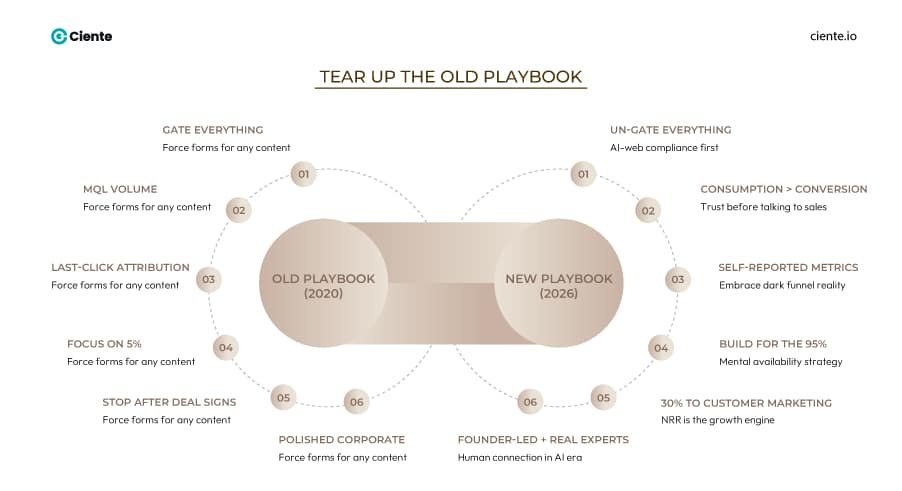
Tear up the old SaaS marketing playbook. The market has already moved on.