Chrome

Is it the End of the Chrome Era and the Beginning of a New One- of Aether OS and the Decentralized Web?

Is it the End of the Chrome Era and the Beginning of a New One- of Aether OS and the Decentralized Web?

Aether OS is using the AT Protocol to rebuild the browser from scratch. Will users finally ditch corporate tech for a truly open internet experience?

The open web has been a walled garden for a long time.

We use the same three browsers that report back to the same three companies. That’s precisely why Aether OS is actually interesting. It’s a new browser built entirely on the AT Protocol.

Does that name sound familiar? It’s because it’s the same engine that powers Bluesky. But Aether is taking that decentralized logic and applying it to how you actually navigate the entire internet.

Instead of your history and data sitting on a server in Mountain View, Aether keeps everything portable. You own your identity, even if you move from one app to another. Your profile and data come with you. It feels less like a browser and more like a digital passport.

The report from The Verge highlights how this could finally break the stranglehold that Chromium has on the market.

The best part of this setup is the lack of traditional tracking.

Since the AT Protocol is built for interoperability, Aether does not need to sell your soul to keep the lights on. It uses a peer-to-peer structure that makes the current version of the web look ancient.

You’re not just a user in a database anymore. You are a node in a living network.

Of course, the big question is whether people actually care enough to switch.

Most users are lazy. We stay with Chrome because it is already there. Aether OS should be more than just ethical. It must be faster and easier to use. And if they can pull that off? We might finally see the end of the corporate internet as we know it.

It’s a massive gamble on the idea that people actually value their digital freedom over convenience.

Answer Engine Optimization vs SEO

Answer Engine Optimization vs SEO: A Recursion in Marketing

Answer Engine Optimization vs SEO: A Recursion in Marketing

Everyone is treating AEO like a new discipline that replaces SEO. It does not. It is the same discipline with a sharper mandate. The brands that understand this will win. The ones chasing the new acronym without the foundation will not.

A new term enters the marketing conversation.

Decks get updated. Agencies rebrand their service pages. LinkedIn fills up with takes about how SEO is dead and AEO is the future and if you are not optimizing for answer engines right now you are already behind.

And somewhere in the middle of all of that noise, the actual idea gets lost. AEO is not a revolution. It is a recursion. The same loop, running again, with a slightly different interface on top.

Let us actually talk about what is happening here.

What AEO and SEO Are Actually Doing

The Definition Everyone Agrees On and the Conclusion They Get Wrong

SEO: optimize your content so search engines can find it, index it, rank it, and surface it to people looking for something relevant.

AEO: optimize your content so AI systems can find it, extract it, trust it, and surface it as a direct answer to a specific query.

There are clearly some similarities here.

The underlying requirement in both is identical. You need content that is clear, structured, authoritative, and genuinely useful to the person asking the question. The distribution layer changed. The crawlers are smarter. The interface looks different. But the job is the same job.

What the industry keeps getting wrong is treating AEO as a departure from SEO rather than a continuation of it. The blogs will tell you SEO is for rankings and AEO is for answers, and they are two separate strategies requiring two separate teams with two separate approaches.

That framing is wrong. And it is costing people real money, especially when marketing investments are already under pressure to show measurable ROI.

The Underlying Structure Has Not Changed

Go back to basics for a moment.

What does Google’s algorithm fundamentally reward? Content that demonstrates expertise, authority, and trustworthiness on a specific topic, structured clearly enough that a bot can understand what it means, distributed across a domain that has earned credibility over time.

What does an LLM reward when deciding what to cite? Content that demonstrates expertise, authority, and trustworthiness on a specific topic, structured clearly enough that the model can extract a reliable answer, sourced from a domain it has learned to treat as credible.

The words are almost identical. Because the logic is almost identical.

Yes, there are technical differences. Schema markup matters more for AEO. Conversational phrasing matters more for AEO. Concise answer blocks above the fold matter more for AEO. These are real differences at the execution level.

But they are not differences in the underlying structure. They are refinements of it. Tactical adjustments built on the same strategic foundation.

If your SEO is weak, your AEO will fail, just like any SaaS growth effort built without a strong foundational playbook. Not because AEO builds on SEO as a metaphor. Because literally, most AI systems use search indexes to find their sources. You cannot be cited if you cannot be found. You cannot be found if your SEO is broken.

SEO is the base. AEO is what happens at the top of a well-built structure.

The Buyer Behavior Underneath AEO vs SEO

Long-Tail Queries Are Not New. The Volume Is.

Here is what has actually changed.

Buyers have always had specific questions. Before AI, they typed fragments of those questions into Google and hoped the results would help them piece together an answer. The query was short because the search box rewarded brevity.

Now the query is the question. The full question, reflecting deeper buyer intent signals that modern SaaS marketing teams need to decode. The way they would actually say it to a knowledgeable colleague.

What is the best workflow management tool for a marketing team of four people who are already using HubSpot?

That is not a new need. It is a new way of expressing an old need. And the specificity of the expression is the important part.

Because that query contains everything a good marketer needs to know about the buyer. Team size. Existing stack. Function. The fact that they are evaluating, not just researching. The fact that they care about integration, not just features.

Your Sales Conversations Already Have the Answers

Your Sales Conversations Already Have the Answers, especially when aligned with structured approaches like lead scoring and buyer qualification. This is where the real opportunity lives, and almost nobody is pointing at it clearly.

The long-tail conversational queries your buyers are feeding into AI systems are not mysterious. They are predictable. Because the questions buyers ask AI are the same questions they ask your sales team.

What does your SDR hear in the first five minutes of every discovery call? What objections come up at the evaluation stage every single time? What does the champion ask before they go back to get internal buy-in?

Those questions are the queries. Not exact matches. But the intent, the language, the specific anxiety behind the words, that is all there in your CRM if you have been capturing it.

Map your sales conversation data against your content, just as you would when building an effective account-based marketing strategy. Find the questions that come up repeatedly with no strong answer in your content library. Build the answer. Structure it clearly. Publish it as a piece of content that actually helps the person asking.

That is AEO. And it is also SEO. Because a question that your buyers ask your sales team is a question that other buyers are typing into Google and now into ChatGPT and Perplexity as well.

The content that answers it well gets found in both places.

Brands Are Measuring the Wrong Thing

Brands Are Measuring the Wrong Thing, often relying too heavily on traditional performance marketing metrics. Here is where SaaS marketing teams are getting stuck.

AEO does not produce the same measurement trail that SEO does. Clicks, sessions, time on page, conversion events. The classic attribution model.

When an AI system cites your content and a buyer reads the answer and forms a preference for your brand without ever visiting your website, that does not show up anywhere in your GA4 dashboard. The contribution is real. The measurement is invisible.

So what happens? Marketing teams run one quarter of AEO-adjacent content, see no movement in the metrics they report to leadership, and quietly deprioritize it. The investment stops before the compounding starts.

This is the ROI problem, and it becomes even more complex when benchmark expectations are misaligned. Not that AEO does not produce returns. That the return does not fit inside the frameworks organizations have built to measure it.

What You Should Actually Be Tracking

The honest answer is that the right measurement for AEO-focused content is the same measurement that has always been right for trust-building content.

Are the right people coming in already understanding who you are and what you do? Are sales cycles shorter for prospects who found you through content versus cold outreach? Are deals closing faster because the buyer arrived pre-educated?

These are pipeline quality signals. Not click signals, and they tie directly into broader SaaS marketing challenges teams are trying to solve. And they require qualitative input from sales alongside the quantitative input from your analytics.

Ask your sales team directly. Are you getting prospects who already understand the problem well and are evaluating you seriously from the first call? More of those means the content is working. Whether they came from a Google result or a Perplexity citation is almost irrelevant to the business outcome.

The channel changed. The buyer behavior it produces has not.

Where AEO Is Actually a Real Differentiator

The One Thing That Is Genuinely Different

Not everything about this conversation is recursive.

There is one thing AEO introduces that traditional SEO never quite demanded. And it is worth being honest about.

Precision.

SEO has always rewarded comprehensiveness. Cover the topic thoroughly. Build the pillar page. Create the cluster of supporting content. Show the search engine that you are the authority on everything in this domain.

AEO rewards the opposite, much like how product-market fit demands precision over volume in messaging. Answer one question so clearly and completely that an AI system would be confident citing it as the definitive response to that specific query.

Not the comprehensive page. The precise answer. Specific enough to be unambiguous. Clear enough to be extracted without surrounding context. Trustworthy enough to be cited when someone asks a question with real stakes attached to it.

This is a different kind of content discipline, similar to how modern SaaS teams are evolving their strategies with AI-driven marketing approaches. It requires knowing your buyer’s specific questions at a level of detail that most content strategies never go to. It requires writing for the moment of need rather than for the category broadly.

And because it is harder, most brands are not doing it well. Which means the ones who do it well have a real advantage.

The Specific Query Is the Competitive Moat

The specific query is the competitive moat, especially in increasingly competitive SaaS markets. Think about what it means to be the brand that answers a very specific question for a very specific buyer in a very specific moment.

A founder searching for workflow tools for a small marketing team already using HubSpot is not in early awareness. They are close to a decision. The AI system that answers their question is not just providing information. It is shaping the shortlist. It is influencing which vendor they research next.

If your content is the answer, your brand is in the conversation before your sales team ever gets a call. That is not an SEO win. It is a trust win. And it starts with knowing the question well enough to answer it before it is asked.

That knowledge comes from your sales data. Your customer interviews. Your churn conversations. The questions in your support tickets. The objections in your lost deal analysis.

Not from keyword tools. From your buyers, just like the insights behind successful SaaS marketing campaigns.

AEO vs SEO, the topic itself is the disconnect between buyers and marketing teams

The industry will keep inventing new acronyms, just as it continues to evolve across different SaaS marketing channels.

AEO. GEO. AIO optimization. Whatever comes next. Each one will get a wave of content explaining why the previous approach is now obsolete, and this new framework is the thing everyone needs to urgently adopt.

And each time, the underlying logic will be the same.

Understand your buyer. Answer their actual questions. Build content that earns trust by being genuinely useful. Structure it so machines can read it. Distribute it on a domain that has earned credibility over time.

That is SEO. It is also AEO. It is also whatever the next acronym will be.

The interface has changed, but the underlying logic is still the same: solving buyer problems.

And the brands that are going to win in AI search are not the ones frantically optimizing for citations by hacking prompt patterns and stuffing schema. They are the ones who did the slow, deliberate work of understanding what their buyers actually need to know and building the clearest possible answer to it.


Full-Funnel Measurement Problem

A Full-Funnel Measurement Problem: The Organizational Reality of Deploying Methodological Frameworks

A Full-Funnel Measurement Problem: The Organizational Reality of Deploying Methodological Frameworks

Gauging how different touchpoints influence conversion is the ultimate trump card. But capturing this advantage requires a full-funnel measurement approach that most marketers don’t know how to embrace.

Full-funnel marketing has always been about offering a 360-degree experience to customers. It’s a broader and accurate picture of how customers experience your brand- from awareness to purchase and beyond. Addressing how each funnel stage affects a customer’s journey, from top-of-the-funnel sales to conversion-focused strategies. What it’s not is a means of doing more across the funnel stages.

However, the rumor is that the full-funnel is being unhanded by marketers in 2026.

In 2021, McKinsey & Company published a report asserting how crucial full-funnel marketing is for all businesses to truly influence their bottom line. But such claims have only been aspirational in nature. In another one of their more recent report, the consultancy finds a much more concerning gap in terms of the maturity to structurally implement it.

In other words, McKinsey’s 15-20% ROI lift promise is substantially observational and comes with its own conditions- it’s not merely implementing demand + brand together. It also demands a significant shift in your media allocation to those channels that actually offer higher returns, and then A/B test optimization for all performance marketing campaigns.

That’s why the idea works mostly in theory. And only a handful of full-funnel marketing campaigns have been able to make it through this darkened funnel. Something even last-click attribution can’t help you navigate.

Last-Click as the Full-Funnel Measurement Approach is Outdated

Last Click Attribution

When it comes to full-funnel measurement, here’s where more tension arrives.

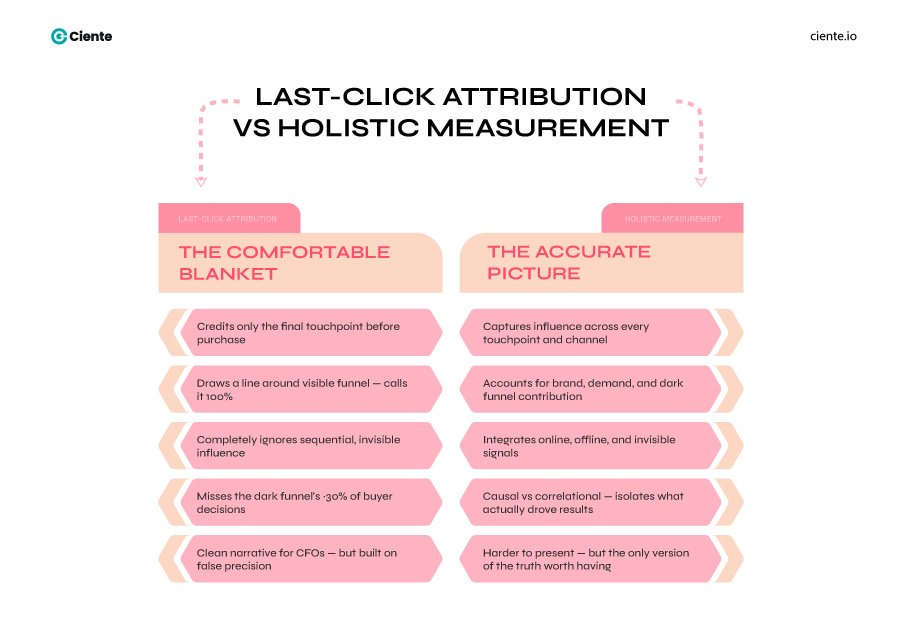
Only the last click has been rendered useless, especially when compared to more holistic approaches used in full-funnel marketing campaigns. It adds no greater value to the campaign influence that’s often sequential and invisible. However, it feels like the most comforting blanket for B2B marketers to fall into- now that the dark funnel has been added to the existing conundrum of multi-digital-channelism.

Your CMOs still must justify the marketing spend to CFOs and CEOs. The simplest answer with the cleanest narrative takes precedence over a probabilistic one. But always remember why last-click proved ineffectual in isolation.

Optimizing Correctly

Dark funnel isn’t a gap in your full-funnel marketing; it’s where your buyers also make purchasing decisions, often influenced by content syndication strategies and peer-driven insights. It’s the 30%. All last-click will do is draw a line around the visible funnel components and call it 100%.

The same goes for optimizing your full-funnel marketing campaigns for specific metrics. You know which ones are significant to your campaign performance, but this presumption is a mistake. That’s why justifying incrementality is one of the toughest obstacles to marketing investing, especially when aligning it with broader B2B lead generation strategies. you don’t always have the full picture, whether it’s retail or fintech.

The last few years have been troublesome for full-funnel measurement, particularly as marketers try to integrate it with evolving programmatic advertising strategies. It’s a blind spot that even the savviest marketers haven’t been able to navigate. Blame the poorly managed integrated data landscape. Because CMOs are waking up to realize that not all data is reliable. It’s become common sense.

That’s why last year, we witnessed a shift to more nuanced measurement tactics such as Multi-touch Attribution (MTA) and Marketing Mix Modeling (MMM). These seemed successful in connecting all the useful data to actual decision points, bridging the data silos.

But the question is, did these models still only present as buzzwords, or do they actually prove effective?

Shifting to Modern Full-Funnel Measurement Tactics: Is It Working?

The answer: the impact is a patchwork. The direction, every marketing professional knew, was right. But its operationality is where marketers are facing a snag.

The problem with MMM.

Why MMM Alone 1

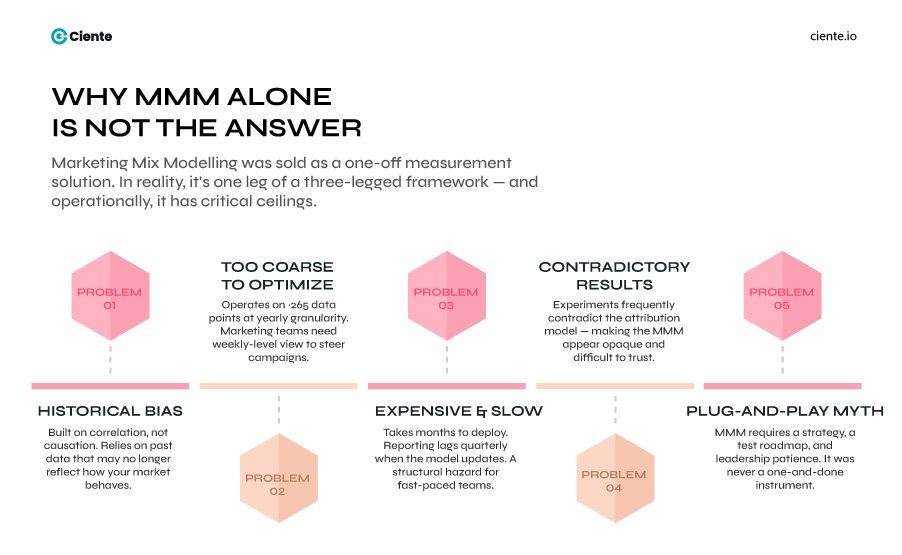
Traditional MMM is all about correlation. In marketing speak? The framework heavily relies on historical data. All the while offering a relatively bird’s-eye view of the customer journey. It’s a huge wall in today’s complex channel ecosystem- where marketers need a granular view for regular optimization.

Marketing Modeling Mix (MMM) operates on a specific number of observations, i.e., 265 data points at a yearly granularity level. Its success depends on striking a much-needed balance between reliability and granularity. That’s the ceiling, especially when marketing teams must optimize channels on a weekly basis.

There’s no silver bullet.

Simply planning a full-funnel marketing strategy isn’t everything. You must prove over time how the top and mid-funnel are valuable through a series of tests or indicators over the long haul.

So, even with MMM, there’s no straight answer. You might have an integrated full-funnel measurement system, but how do you prove its effectiveness? That takes patience- to run the tests, plan, and explain to leadership what you’re doing. You must continue conducting a series of re-tests.

MMM isn’t a plug-and-play solution that marketing has made it into.

This framework is expensive to hold up and often takes months to deploy. And historically, the reporting part of MMM is known to lag after each quarter, when the model requires an update. Marketers find that MMM appears too opaque and challenging to trust. And when they conduct more experiments, the results often contradict their attribution models.

For fast-paced marketing, it’s a structural and operational hazard.

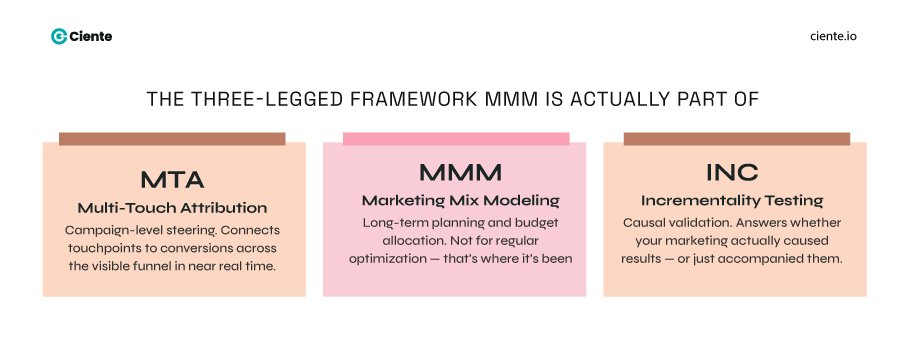
MMM and attribution aren’t interchangeable. While the former works ideally for long-term planning and budget allocation, it’s less suitable for regular campaign steering.

That’s where incrementality models cue in. Because MMM was sold as a one-off solution when in reality, it’s a part of a three-legged framework.

Three legged frameform

Brands want the ability to measure the impact of their entire media mix.

That’s where incrementality stems as a necessity, by design. It doesn’t operate on correlation but on causal impact. To back the MMM impact with real-world validation- does the model drive actual impact, or does it reflect historical patterns that no longer hold?

Where the Marketers Cannot See: Full-Funnel Measurement Framework for Modern Customer Journeys

Tactics tell you what happened, but frameworks tell you the ‘why- and whether your marketing actually caused it.’

A significant number of conversions, often credited to ads, would have occurred without any interventions. That has led to budget misallocations and opportunities slipping through in the past. Why should brands spend confidently on prospects that were going to convert either way? Meanwhile, marketers starve channels that truly generate new demand.

The marketing industry is beginning to quantify this. Over 52% of US brands and agencies are leveraging and investing in incrementality testing. But even this approach isn’t sufficient all on its own.

Marketers must lean into integrated frameworks that answer questions at different altitudes, similar to how businesses structure a B2B sales funnel. at the campaign and portfolio levels. But they must know where to start.

Here are three that actually get into the tidbits of full-funnel measurement. They aren’t strategies or tactics, but baselines that your brand must build upon.

A. The first one is easy vertical funnel analysis. You don’t just assess surface-level metrics, but dive into the depth of each funnel stage- top, mid, and bottom funnel activities to get a 360-degree view.

B.  The second is the all-seeing eye- omnichannel analysis. With this, you know you have a dynamic radar. You’re tracking impact across all channels- visible/invisible, online/offline. It requires integrating with third-party models and some complex attribution logic that focuses on the complicated interconnections of the buyer journey.

C. The third one is a closed-loop analysis, connecting engagement signals to conversion outcomes like those seen in bottom-of-the-funnel marketing strategies. It means relying on zero and first-party signals- connecting the dots from exposure to awareness, and then from comparison to purchase. You spotlight the most impactful paths of conversion and attribute credits based on causal influence.

These baselines are imperative, and not merely nice-to-haves.

There are no gold standards or silver bullets that’ll do the work for you. From MMM to incrementality tests, such techniques accompany specific plans and strategies that turn raw data into informed insights. Whether it’s MTA, MMM, and incrementality testing- none of it works without an integrated approach.

Even getting the most out of incrementality demands a much broader framework and strategy, much like implementing effective customer acquisition strategies. what to test, when to test it, and how to interpret the results. Incrementality is hard to run and decipher on its own.

So, rather than leaning on a single tactic, marketing requires an integrated framework- a future-proof alternative over others, especially in a privacy-conscious landscape. One that leans into what marketing causes, not what it accompanies as a byproduct.

That’s triangulation for you.

The Now of Full-Funnel Measurement: Triangulation

The majority of the focus of traditional full-funnel measurement falls on the finishing touches. Although MTA might highlight much of the process, it neglects some of the critical early-stage activities and movements that also contribute to a successful full-funnel marketing campaign.

Multiple unseen points contribute to an account’s conversion. MMM, MTA, and incrementality on their own miss on such sections.

As a solution, modern marketing is moving towards a new full-funnel measurement framework- triangulation.

Given the name already suggests, triangulation is a holistic and comprehensive framework that combines MTA, MMA, and incrementality. With such a model, marketers can capture and assess both above-the-line and below-the-line impact of advertising.

There’s no single source of truth here.

But an intermediary platform that allows you to align strengths, functions, and limitations to offer a better version of the truth. It offers an authentic base to help decision-makers make choices by adding on to existing experience and judgment.

Triangulation covers all bases. It provides a nuanced look into past behavior or functionalities that marketing has needed all along to make informed decisions about their future full-funnel campaigns.

The way we search and measure is changing. Rather than remaining hooked on playbooks that were effective once upon a time, marketers must evolve their approach with modern brand positioning strategies. At a time and metrics that said just enough about your customers, it’s time to pivot.

And triangulation could be the new pathway for modern marketers who are ready to invest in a more holistic approach.

Google

EU’s Patience is Running Out, Expects Google to Pay Up Instantly

EU’s Patience is Running Out, Expects Google to Pay Up Instantly

European publishers and tech firms are pushing the EU to wrap up its Google antitrust probe. Two years in, patience has run out.

A coalition of European publishers, tech firms, and startups has written to EU leaders demanding they complete their nearly two-year probe into Google’s search practices and fine Alphabet, preferably by next week.

Two years is a long time to investigate such an obvious situation.

The letter is by the European Publishers Council, which includes Axel Springer, News Corp, and Condé Nast. These groups want a formal non-compliance ruling- with a cease-and-desist order, and a real financial penalty. Google proposed its own remedies. Rivals say those don’t go far enough. They’re right.

Independent research found Google’s AI Overviews now correlate with a 58% drop in click-through rates for top-ranking pages. That’s nearly double what was recorded just a year earlier. Publishers aren’t losing revenue slowly. The floor is gone.

The politics complicate things. After earlier DMA fines impacted Apple and Meta, the White House labeled the penalties a “novel form of economic extortion” and signaled the U.S. would push back. So the Commission is weighing regulatory credibility against trade friction with Washington.

That’s the real obstacle here. Not the evidence. Not the complaints. The question is whether Brussels flinches under political pressure.

If it does, the Digital Markets Act becomes a suggestion. And Google knows it.

NVIDIA

The AI Industry’s Eyes Are on Jensen Huang at the AI Megaconference GTC

The AI Industry’s Eyes Are on Jensen Huang at the AI Megaconference GTC

NVIDIA’s GTC 2026 keynote is today. And the AI industry is tuned in- new chips, new software, and a CEO who knows exactly how to work a crowd.

Jensen Huang is all set to make history on the floor of the SAP Center in San Jose on Monday to deliver his keynote across 30k attendees from 190 countries.

It’s no longer a tech conference but a coronation.

Huang’s presentation covers NVIDIA’s push into AI inference, with new chips and software for autonomous agents. That matters. NVIDIA already commands an estimated 80% of the AI training market share. Inference is the next frontier, and as of now, Google, Amazon, and others are competing rigorously with custom chips. Huang wants that territory too.

He promised “a chip that will surprise the world” and teased “a few new chips the world has never seen before.” Bold word- but they better deliver.

GTC 2026 is where NVIDIA officially kicks off its Vera Rubin platform, replacing Blackwell and Blackwell Ultra. On the software side, NVIDIA is expected to unveil NemoClaw, an open-source platform for enterprise AI agents that offers businesses the right structure to build and deploy AI software.

Then there’s Groq. It’s the first major showcase since NVIDIA’s $20 billion licensing deal with the inference company in late 2025. Everyone wants to know how that integration actually works.

The broader picture is straightforward. NVIDIA is just selling chips, but it’s not merely that. It’s selling the whole stack: hardware, software, models, infrastructure. The company’s announcements today will influence technology roadmaps across the global semiconductor and server supply chains.

No other company in AI has that kind of reach right now. That’s the real story from San Jose.

Accenture

Accenture to Acquire Verum Partners, Expanding its Capital Projects Capabilities in Latin America

Accenture to Acquire Verum Partners, Expanding its Capital Projects Capabilities in Latin America

So Accenture is moving into Latin America in a meaningful way. Last week, the firm announced it is acquiring Verum Partners, a Belo Horizonte-based infrastructure and capital projects management company with 180 people and serious on-the-ground experience in mining, metals, energy, chemicals, and transportation. No price disclosed, as is customary for these things.

Verum does something specific and genuinely difficult. It takes the kind of industrial megaproject that routinely runs over budget and behind schedule and tries to make it not do that. Accenture’s own research puts the failure rate of large infrastructure projects at around 90% against original targets. That number is staggering every time you read it. Verum’s value is that it has people who actually go to the site, coordinate across contractors, and solve problems where the problems are. Accenture’s value is that it can layer AI and digital infrastructure on top of that. Together, the pitch is: faster, more predictable, less wasteful delivery of very large, very complex projects.

It is a good pitch. Brazil’s investment cycle is accelerating right now across mining expansion, grid modernization, transportation, and energy transition. There is a lot to build and a long history of it taking longer and costing more than anyone planned. This acquisition makes sense.

Belo Horizonte is an interesting place to anchor this. The name of the state it sits in, Minas Gerais, means General Mines, and that is not a historical footnote so much as an active description. The region is one of the most resource-rich in the Southern Hemisphere and has been the site of some of the most consequential infrastructure decisions Brazil has made, good and otherwise.

The announcement stays focused on the opportunity, which is fair. Efficiency, productivity, faster operational handover. These are the terms of the deal and they are real improvements worth making.

What does not make it into the press release, and rarely does in these situations, is the question of what sits alongside all this building. The Cerrado, the enormous biodiverse savanna that borders much of this industrial activity, is under significant pressure from exactly the kind of expansion this acquisition is designed to support. Brazil’s environmental licensing process is stretched. These are not Accenture’s problems to solve and the announcement was never going to raise them.

But they are the backdrop. And the companies whose projects Verum will now help deliver faster are operating inside that backdrop every day.

We are not saying do not build. Infrastructure matters, energy transition is real, and poorly managed projects have their own costs. We are just noting that “efficient” is a description of how something happens, not whether it should, and those two questions tend to travel separately in announcements like this one.

The Verum team built something worth acquiring. That much is clear.