Accenture Backs Alembic: Marketing Attribution Gets Real
Accenture invested in Alembic. The AI marketing platform connects marketing spend to revenue. Most companies can’t do this.
Here’s the problem. Marketing leaders don’t know which channels work. They run campaigns. They spend money. They hope something sticks. Gartner found that two-thirds of marketing execs struggle to prove campaign impact to their boards. They’re guessing, not strategizing.
Alembic solves this. It pulls data from broadcast, social, websites, and direct-to-consumer channels. Then it correlates that data with actual sales numbers. Each channel gets an impact score. You see what drives revenue.
Alembic owns a real edge. It handles channels that other platforms miss. Brand sponsorships. Events. Organic social posts. These defy traditional tracking. Alembic tracks them. It also models how policy changes and market shifts affect performance. Regulated industries desperately need this.
Accenture isn’t just writing checks. It’s folding Alembic into Song, its creative services division. Song already has Aaru for strategy, Writer for content, and AI Refinery for optimization. Adding Alembic creates a full stack. Clients get strategy, creation, execution, and measurement all connected. That’s Accenture’s real play.
Here’s what matters. Accenture’s own marketing team pilots Alembic right now. Internal adoption screams confidence. They’ll discover fast if it fails. They’ll sell hard if it works.
The funding round looks serious. Prysm Capital led. Accenture joined. Silver Lake Waterman participated. Serious money backs proven product-market fit. It isn’t hype.
But attribution remains brutal. Companies have chased this solution for years. Most failed. Alembic runs on NVIDIA SuperPODs and deploys causal inference to isolate real impact. Technically sound, yes. But does it actually solve the problem at scale? There’s no definite answer.
Accenture sees what two-thirds of marketing leaders need. It’s betting Alembic delivers. And the market will render judgment fast.
Fintech: Managing the Modern Undercurrents of Wealth Management
Financial advice is primarily limited to phone calls and emails. But with fintech making splashes, will wealth management firms come out of their bubble?
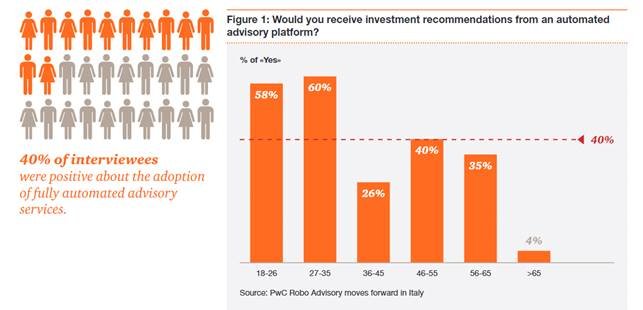
Precisely in 2017, PwC published a four-part report on the impact of fintech. One of them outlined the launch of “robo-advisors” investment platforms across Italy. It was fundamental to assessing whether the financial world was ready for automated advisory solutions.
And the analysis graph looked something like this:
Over 40% of the interviewees positively feel that the future of investment advice will be automated. That was the basic conclusion drawn over eight years ago.
And eight years later, financial institutions such as BlackRock and Charles Swab are amongst the first ones to incorporate robo-advisors into their portfolios.
But the survey also highlighted a hitch- one-size-fits-all advisory models wouldn’t cater to different customer profiles. And three different ones should be considered- traditional, multi-tasking, and intelligent. So, the underlying logic drifted strongly towards traditional advisory models. A few preferred banks opting for gradual digitization and automation to revamp this model.
However, eight years later, the demographics of the investors have changed. The same conclusion is deemed inconclusive today.
But we can’t blame the survey; it’s merely a comparison.
Wealth Management and Advisory Models: Targeting the Crux of the Problem
Automated advice, in the long term, didn’t hold a definitive face. And with investment performance and advisory services working in tandem, the expectations were always higher. Face-to-face carried more weight, and considering the risks, why shouldn’t it?
Fintech’s movement into wealth management was merely a whispered suggestion when this PwC report was published.
However, investor expectations today are afflicted with a generational gap. And at the center stage for the wealth management firms’ new clients are millennial investors. It’s a conundrum- the global wealth is shifting across generational demographics. While traditional wealth management firms wish to stick to old methodologies, with a few upgrades here and there, this creates a gap.
This doesn’t pair well with millennial investors’ requirements: faster, cheaper, and better service, with transparent fees and highly personalized advice. The impact of fintech on the wealth management industry is precisely about five customer-centric facets:
speed
quality
accessibility
efficacy
convenience
But they’re skeptical whether traditional advisory models can meet these demands. After all, this generation is more tech-savvy, especially after they witnessed what is one of the worst financial crises in 2008.
This has left wealth management firms under duress — they’ll have to meet millennial investors’ needs, reinforcing why thought leadership in fintech is a priority for firms aiming to stand out. And they want to retain the people element, while leveraging tech to augment existing skills and services.
With the firms realizing this shift, they’re poised to enter a new era of value creation. Led by the front-running driver of this much-needed transformation: Fintech. Much like how businesses embrace digital-first models in other industries, wealth firms are undergoing similar shifts outlined in digital transformation strategies.
You can trace fintech’s introduction back to the mid-20th century- to the ATMs and credit cards. However, it truly gained ample momentum when users began relying less on physical banks. A new era was born- one of mobile banking apps and digital wallets.
Hence, the way we view, leverage, and interact with money has evolved to some extent. The wealth management industry has now realized that fintech is a complement, not a substitute for traditional advisors.
Here, the blog navigates what fintech’s impact is actually about and why it holds a crucial space in wealth management.
What is Wealth Management?
The tools, actions, and tactics used to improve someone’s financial state or position are referred to as wealth management. It combines investment and portfolio management with financial life planning to achieve specific goals over a period.
There was a vital knowledge gap previously. People assumed that only high-net-worth families, industry leaders, and individuals could afford this financial service.
But the advent of fintech has proved them incorrect. It’s for everyone with a definite financial goal. That’s why we have JPMorgan, Goldman Sachs, and Morgan Stanley today.
Wealth management is basically consulting. Because financial markets are unpredictable, clients wish to manage their portfolio to avoid as much market turbulence as possible. These firms help clients plan out their retirements, accounting and tax, and legal and real estate planning. And curate a personalized fund-allocation strategy under a portfolio.
Not all investments yield expected returns. There’s substantial risk in managing portfolios when you don’t have financial as well as market knowledge. But there’s immense growth potential.
That’s the crux that clients and investors wish to target. And that’s precisely where fintech in wealth management becomes imperative. Especially in overcoming significant challenges that halt clients from gauging the best possible advice regarding their portfolios. And for firms to improve their value offerings.
Challenges such as these:
data security and privacy (high-value challenge)
modular coverage across both human and digital touchpoints
Customers must have better knowledge of investments
extent of reliability on tech platforms
pricing of wealth offerings
Fintech in Wealth Management: An Innovation or a Disruption?
Wealth management isn’t just money exchange. And neither is it a simple transaction.
It requires a portfolio-specific, personalized strategy to yield actual returns. And given that there are monetary processes involved, this function comes with greater client expectations:
These inefficiencies easily drive people out of this business or limit their growth. It has nudged financial institutions to question the adequacy of existing frameworks and the resilience of traditional banking systems.
Wealth management firms must improve their customer experiences. Or they end up in a ditch- losing mindshare. That’s precisely what 80% of investors and clients also prefer.
Because the investor base today wants to zero in on investment opportunities that transcend traditional assets. But very few actually hold any financial literacy.
How do wealth advisors match the expected levels of professional management- from financial planning for the middle class to sophisticated advice for the high-net-worth individuals?
Proactive digital adoption.
For cost-effectiveness. Transparency and control. Personalized investment strategies. Enhanced price-to-value. principles that closely align with how organizations measure and optimize marketing ROI today. That’s how clients choose the firms- they gravitate towards ones that offer them the security, trust, and safety net.
The Innovation
Amidst all the fintech innovations rampant in the market, there are some making huge waves-
Investors want personalized and accessible wealth management services. They have the appetite, just not the access to it. It’s because these clients, especially across Africa, Asia, and Latin America, have never had access to such sophisticated avenues.
Fintech is clearing away these hurdles. It’s eradicating the wealth managers’ dilemma- connecting them to previously untapped capital pools. Much like targeted demand generation unlocks new revenue opportunities.
Think of a mid-sized wealth management firm in Singapore. Its clients are, to a fault, ambitious and resourceful. And quite eager to diversify beyond local equities and bonds. They wish to take a leap of faith towards the venture capital opportunities in Europe and growth equity funds across Silicon Valley.
And they inquire about their wealth manager about this. The answer is always the same echo: a lack of access. Small funds lack track records. The paperwork is always too complex. Or fund allocation is only open for elite players (HNWIs).
This has halted wealth engagement, distribution, and ownership. And concentrated it within a few high-net-worth communities. Creating an inequality in credit and asset ownership.
It’s never been about scarcity. It’s about accessibility- Access parity.
The millennial investors of today, irrespective of class, look to diversify their portfolios into alternatives and seek safety from market volatility.
Fintech across wealth management is granting them that gateway. It’s becoming a norm — a revolution in financial advisory underlined by superior user experiences. Fintech is the missing puzzle to that access.
Fintech is the concrete filling the problem of financial inclusion. And the structural gaps are addressed by abolishing the need for traditional intermediaries and developing a low threshold for entry.
It’s an eager step towards wealth democratization through robo-advisors, mobile payment systems, peer-to-peer lending, and overall decentralization of finance.
There’s intense pressure on wealth advisors. From personal meetings to demand for lower fees and personalized advice, the dynamic client investors’ needs are creating an environment for firms to adopt new tech. With fintech, firms wish to unlock billions in untapped market demand.
Blockchain: The decentralized, tamper-resistant client ledger that can only be accessed by approved systems. One can merely store and share a golden copy of the clients’ data to retain integrity. You don’t have to store multiple client records. It also fosters real-time portfolio rebalancing without human intervention. Think of when a client’s portfolio deviates from its target due to unpredictable market movements. Enterprise blockchain solutions streamline this.
Cognitive computing, ML, and AI: This helps extract valuable insights from big data. similar to how AI agents are transforming automated workflows and personalization in modern business ecosystems. And facilitate high-level accuracy and algorithms by diving into heaps of client data and optimizing for higher returns on investment. AI helps predict which assets might potentially be at risk. Additionally, cognitive functions help answer complex client queries in real-time and instill deep personalization, curating investment strategies.
Robo-advisors: A shift from an advice-based model to an algorithm-based consultancy model. This mirrors how predictive intelligence has replaced traditional scoring frameworks in modern revenue systems. They are automated investment advice providers that help with financial planning based on clients’ risk appetite and cost minimization. Robo-advisors are basically poster children for low-barrier entry, transparent, and low-cost advisory services.
Embedded automation: Wealth management platforms and apps are being embedded into non-finance platforms, an evolution similar to how SaaS ecosystems are expanding across industries such as Shopify or Uber. Especially to streamline user access.
The incorporation of these tech and more into wealth management is the building block for a hybrid advice model.
What precisely does that look like?
Hybridity of Your Tech-Powered Wealth Management Services
Clients choose advisors for communication. And for emotional resonance. just as customer experience and nurturing play a critical role in long-term business relationships. That’s what drives connections in wealth management.
Personalized and relevant communication elevates confidence in advisors by 77%. And that’s a whopping lot. Meanwhile, a lack of responsiveness is cited as the second fundamental reason for dropping a wealth management advisor.
And often, administrative tasks take away crucial time that could be spent engaging with clients. That’s the door fintech has opened.
Fintech’s adoption in wealth management has helped automate menial and mundane tasks. Especially for advisors to do what they do best- communicate with their clients with trust and patience. From chasing paperwork to comprehensively understanding their financial situation and offering an impressive recommendation.
This is what actual wealth management advice is. The client-advisor relationship is the nucleus of wealth management.
And where investors aren’t happy with digital solutions or the flaws of a robo-advisor, human interaction is what’ll help row their boat. Face-to-face interaction often communicates more value than one can even assume in a broad industry with diverse segments and distinct requirements.
Wealth management today doesn’t boil down to the technicalities. It’s about flexible and tailored solutions that cater to all demographics. Because there’s a deep inclination towards digital interactions, and that’s true. But clients still appreciate personal, face-to-face communication–
“There is a need for digital wealth platforms to be both fully digital and fully human, as clients can switch seamlessly between the digital and human experience. This offers a hyperpersonalized experience that caters to the needs of different clients at different times.”
Fintech in the wealth management industry is no longer a differentiator as it was a decade ago.
From being a nice-to-have, tech in wealth management has become a must-have. Today’s investors, both Gen Z and millennials, are skeptical, cost-conscious, and research-oriented. Their general trust in banks and non-bank financial institutions isn’t at the levels it should be.
“The new generation of investors wants solutions based on their life goals and events- older millennials starting families want to know how they can save up for a house, and Gen Z are looking at the mounting national student loan debt, want to understand how they can pay for college.”
It’s why the wealth management advisory model is crucially built on communication. Because your millennial investors are hesitant, why we discussed the need for a hybrid advisory model.
Because fintech in wealth management is not merely about technological breakthroughs. It’s also about positioning, thought leadership, and building trust in regulated industries And how these emerging technologies integrate into existing traditional models. It trickles down to finding why fintech is a need in wealth management in the very first place-
The client demographics and the segments that actually opt for your financial advice have inherently changed.
It’s a remodeling of wealth management- one where digital tech frees advisors from time-consuming, computationally heavy tasks. And refocuses their priority towards relationship building to instill trust.
Everyone speaks as if we will eventually find the perfect mix of channels, the perfect cadence, the perfect system of nudges that will somehow turn strangers into customers.
Somehow, we convinced ourselves that acquisition is a matter of craftsmanship.
If we run intuitive campaigns, optimize conversion paths, and sharpen our templates, growth will happen. But something inside the modern GTM machine feels hollow. Mechanical. Forced.
Most companies do not have an acquisition problem because they lack channels. They have a problem because they lack architecture.
We keep polishing the parts without repairing the structure. We keep upgrading the tactics without changing the design. And so the system keeps producing the same outcomes: high visibility, low trust. Heavy activity, weak pull. Noise, but no gravity.
What is Customer Acquisition?
Customer acquisition strategies fail long before execution. They fail because the company misunderstands what an acquisition actually is. It is not attention. It does not lead. It is not traffic. It is not retargeting. It is not what the dashboards show.
Acquisition is the process through which a buyer slowly chooses to believe a better version of their own future with you in it.
Until that belief forms, nothing else matters.
After that belief forms, almost anything works.
What’s Not Working in the Conventional Customer Acquisition Strategies?
The tension in B2B today is that belief no longer forms through funnels.
It forms in places you cannot control, inside conversations you cannot access, and through impressions you did not even know you made. It forms through perception, momentum, consensus, and realization. These are the four forces that shape every customer acquisition strategy, whether you acknowledge them or not.
They do not overlap. They do not repeat each other. They cover the entire journey without competing for territory. They are the spine of acquisition. Beneath every tactic, these forces either support or sabotage you.
Let us go through them the way they exist in the real world, not how the marketing textbooks pretend they do.
The First Customer Acquisition Strategy: Shaping the Perception
Your buyer has already decided whether to take you seriously. Before they even read your website, interact with your campaign, watch your video, or click your ad.
This first decision is not conscious. It is not based on your messaging or features. It is based on perception, the silent filter that shapes how every future interaction will be interpreted.
Perception is not a brand in the cosmetic sense. It is not polish or storytelling. It is the deep mental shorthand a buyer forms about what you represent. The story the market tells itself about you without your involvement. It is your identity in the shadows, the one that appears before your actual content does.
Companies overlook perception because it seems intangible. It can’t fit in a spreadsheet. And does not offer instant gratification.
But perception decides whether your acquisition strategy has air to breathe or suffocates at the first touchpoint. A buyer who does not trust you will ignore you even if you present perfect logic. A buyer who trusts you will overlook the minute flaws.
That’s why traditional funnels are collapsing: buyers don’t believe in funnels. Their perception shapes their path.
Acquisition begins with the mind, not the funnel.
For years, marketers obsessed over channels and formats. But channels do not shape acquisition. Perception does. A thousand impressions cannot fix a broken perception. One moment of clarity can reshape it entirely.
Perception is the spark that determines whether a company can even enter the conversation.
The Second Customer Acquisition Strategy: What Moves Buyers Forward?
Once perception opens the door, momentum decides whether a buyer steps through it. Momentum is not frequency. It is not volume. It is not the act of showing up everywhere. It is the continuity of meaning across every interaction. The sense that your company has direction and that every message is part of the same arc.
Most teams confuse momentum with activity. They flood the market with high-frequency output that has no connective tissue. A disconnected series of campaigns, messages, experiments, and posts cannot create motion. It creates fatigue.
Momentum is the opposite of noise. It is accumulated clarity.
Every message reinforces the last. Every touchpoint pulls the buyer one step deeper into understanding, not because the content is persuasive, but because it is aligned with itself. That’s what differentiates a company with gravity from a company with reach.
Reach scatters attention. Gravity sustains it.
Markets do not reward inflated promises. They reward believable systems. Momentum is the feeling of believability that compounds. Without it, even great tactical work falls apart. With it, even modest tactics outperform expectations.
When momentum takes hold, the buyer does not feel marketed to. They feel guided rather than forced. And when momentum is absent, the buyer feels interrupted rather than moved.
Acquisition strategies collapse when they treat attention as an event instead of a progression. Momentum converts attention into movement.
The Third Customer Acquisition Strategy: Diving into the Internal Politics
This is the part of the acquisition no one prepares for, and the cost of ignoring it is devastating.
In B2B, you are not selling to one person. You are selling to a coalition. A buyer does not convert when they understand you. A buyer converts when the people around them stop resisting the change you represent.
Think of this:
Sarah is not the buyer. Sarah is the champion who must walk into an internal war. She carries your narrative into rooms where no one cares about your messaging, where everyone is incentivized to minimize risk, where the CFO is suspicious, the IT head is overwhelmed, and the legal team is anxious.
Most companies treat acquisition as if they are in conversation with the champion.
In reality, they are in conversation with the champion’s environment. If your value cannot survive those internal conversations, you will lose deals even when your champion believes in you.
Consensus is not persuasion. It is not a feature explanation. It is the alignment of incentives across the buying committee. And if this alignment does not happen, even the strongest acquisition strategy collapses under the weight of internal friction.
This is where most strategies die. Not in the funnel, not at the top, not in the ads. They die in the rooms you never entered.
A buyer may like you, but their committee must trust the choice. And trust cannot be established at the end. It must be architected from the beginning.
Customer acquisition strategies that ignore consensus build interest but cannot convert belief into commitment.
The Final Act of the Customer Acquisition Strategy is to Realize.
Most companies assume the acquisition ends at closed won. But that assumption turns the entire system into a short-term performance engine with no compounding power.
Real acquisition is only complete when the buyer experiences the transformation they were promised. That moment of realization, the moment where expectation aligns with outcome, is the real currency of growth.
If this experience is profound, customers become an extension of the acquisition engine itself. If this experience collapses, every marketing effort becomes more expensive, harder to scale, and weaker over time.
It becomes the foundation of exponential acquisition. The story of the customer’s transformation is the most credible form of demand creation. It invites more buyers into the narrative with more conviction than any performance play can replicate.
When realization is strong, acquisition gets cheaper every year. When realization is weak, acquisition becomes harder every year.
Most companies try to accelerate top-of-funnel motion without repairing the bottom-of-funnel truth. The result is a system that looks successful on dashboards but collapses in financials.
Realization is the force that closes the loop. It turns one successful outcome into the seed of the next. Without this loop, customer acquisition becomes an endless hunt.
With it, customer acquisition becomes a flywheel.
The Real Customer Acquisition Strategy: Unified, Human, and Structural
Everything above forms the architecture that decides whether tactics succeed or fail. But tactics still matter. They merely cannot operate without alignment.
So what does a customer acquisition strategy look like when these forces combine?
It looks like a company that understands its buyers’ psychology rather than channel behaviors. It’s like a market presence that builds trust rather than pressure. It’s a system- marketing, sales, and customer success become three limbs of the same body rather than competing silos.
It’s driven by intention and truth.
Your customers do not want a perfect funnel. They want clarity, conviction, and competence. When a company builds the architecture that supports these qualities, acquisition accelerates naturally.
And when a company refuses to build that architecture, acquisition becomes an endless negotiation with diminishing returns.
Customer acquisition strategies today are not failing because they are outdated.
They are failing because they lack cohesion. They are failing because they chase techniques instead of principles. They are failing because companies misunderstand the order of operations.
Perception shapes attention.
Momentum shapes movement.
Consensus shapes commitment.
Realization shapes the next cycle.
Ignore these forces, and you will keep reinventing campaigns without ever reinventing results. Understand them and you will stop chasing customers, because customers will begin to choose you before you even show up.
That is the only acquisition strategy that truly scales. That is the one the market cannot ignore.
Firmus Raises $327M for NVIDIA-Backed Data Centers – Ciente
Firmus Technologies’ data center strategy leans into clean energy hubs and campuses across Australia. A vision where renewable energy is a building block, and not an afterthought.
AI requires abundant power to mobilize the global economic model. But there’s already substantial strain put on power grids across the US, where data centers are the most prominent.
The global electricity demand to run these data centers could take a turn for the worse. Glitches, surging utilities bills, and short circuits- are only the beginning. And this growing tension will only skyrocket if there’s no antidote decided on.
AI data centers are multiplying at (not so)suprising speed. Tech companies and investors are investing billions into this infrastructure- they want numbers and power to back up AI at all costs.
How else will they keep on powering their AI models? And introduce at least one new model every other week? The power must come from somewhere else- this is the conclusion that the market has come to.
Remember, Google recently announced its moonshot project- Project Catcher? Space-based AI data centers that run on solar power-driven satellites. The Sun’s clean, limitless energy.
Firmus Technologies is taking a step in this direction: leveraging renewable energy to fuel the next phase of AI computing. In the recent funding round, it has accumulated over $327 million to back this project.
The money raised sent the NVIDIA-backed company’s market valuation to $600 million. And for the business, it’s a significant realization of their potential and faith in their vision- high-performance computing delivered through sustainable power. That this can work in the long-term, and generate the same results as the current data centers do.
This capital will be dedicated to site development, long-term energy sourcing, and infrastructure building across Tasmania, Perth, and Sydney. And the deliverables? 1.6 gigawatts worth of AI infrastructure by 2028.
It’s a win-win situation. If the project comes to fruition, and one of this scale, it would skyrocket Firmus’ reputation to being one of Australia’s leading data-center developers.
Introducing Firefox’s AI Window that Prioritizes User Choice
Mozilla Firefox introduces AI Window- intelligent AI browsing with user choice at its core.
It’s a new day. And there’s a new AI browser in the market.
The so-called independent browser has re-entered the AI battle. Mozilla, which has been pacing slowly for quite a while, has finally become yet another name in the overflowing bucket of AI models and upgrades. But that doesn’t mean it’s been entirely in the shadows.
Only recently, in September, did the company launch its “shake to summarize” feature. This allowed iPhone users to view summaries of all the web pages open on their browser. And now, it’s an “AI Window” with a conversational AI chatbot and assistant.
Well, most of the features are the same as those of its competitors. But there’s a differentiating point that Mozilla itself presses upon-
It’s not coercing AI upon its users but allowing them a choice. Even the AI Window, the company claims, is built through transparent user input. And it is an opt-in in an intelligent and user-controlled environment.
So, what it means is that Mozilla is handing users the reins to leverage the AI features merely to the extent they wish to.
According to them, other AI innovators want to keep you in a conversational loop. But Mozilla stands apart from this. They respect user privacy and free will, and AI is only a means to browse the web’s extended universe. One where artificial intelligence is a trustworthy companion that can improve your browsing experience.
While Mozilla offered very few details regarding their new feature, users will be able to choose between three different browsing experiences- classic, private, and now AI. They also said users will be able to select the AI model they want to leverage, but there’s no further comment on this specific attribute.
For Mozilla users excited to try out AI Windows, they can sign up to join their waitlist.
A Nuanced Insight into B2B’s Customer Acquisition Process
Stop optimizing your funnel. It’s a lie. Your B2B acquisition problem is a structural, human, trust-driven mess. Start there.
Let’s be honest. The B2B customer acquisition process is a complete mess.
It isn’t merely broken. It’s inherently misaligned with reality. We are all spending more money, burning out our teams, and getting weaker results. Costs are soaring. Real, high-quality pipeline is not.
We are trapped in a cycle of “more.” More MQLs. More cold emails. More ad spend. More content for the content graveyard. We run on a high-speed hamster wheel. We obsessively optimize a machine that points in the wrong direction.
Why? Because the model is based on a lie.
The lie is the linear funnel. The lie is that B2B buyers move in a clean, predictable path from Awareness to Purchase. The lie is that if we find the right MQL and “nurture” it with five emails, a sales-ready lead will magically appear.
That world is dead. It never existed.
The modern B2B buyer is entirely in charge. They are 70% of the way through their journey before they ever talk to a sales rep. They are self-educating in “dark-funnel” channels we cannot track. Think Slack communities. Think peer-review sites. Think private forums and social feeds. They form a consensus with a 10-person buying committee before we even know they are in the market.
We’ve responded by putting up more walls. More gates. More forms. We’ve turned the customer acquisition process into a gauntlet of transactional hurdles. We demand a prospect’s email address before we have even given them a reason to trust us.
The result is devastating. We are not building relationships. We are just qualifying MQLs. And this is killing our growth.
It is time to stop optimizing the broken model. It is time to build a new one. The fix is not a better funnel. The fix is an entirely different engine. It is an engine built on trust, momentum, and proven value.
What Is the Customer Acquisition Process, Really?
First, let us clear the air.
The customer acquisition process doesn’t merely concern your marketing funnel. It is not just your sales pipeline. It is definitely not just the MQL handoff.
A really functional customer acquisition process is the single, unified engine that aligns your entire revenue organization. Under one umbrella: acquisition and retention of high-quality accounts.
If your definition stops at “Closed-Won,” you have already lost. If your marketing team measures success on MQL volume while your sales team measures success on revenue, you are running two different companies.
This is the core human problem. We have functionally siloed our processes to the point of absurdity. The B2B buyer experiences a single, exhaustive journey. We manage it in three disconnected, misaligned pieces. The fix starts by acknowledging this deep structural flaw.
The Potential Gaps in Your Customer Acquisition Process
The first part of the new engine is about reframing the “top of the funnel.” The goal is not to “engage” as many people as possible. The goal is to become the only credible answer for the right people.
The old model was transactional. It said, “Give me your email for this e-book.” This is a low-trust interaction. It forces your buyer to lie with a fake email. It forces your sales team to pounce with an immediate, unwelcome SDR call.
The new model is about trust building.
This means you must stop gating your best content. Your best, insightful, and most strategic content should not be a “lead magnet.” It must be a brand magnet. It must be out in the open. Insert it on your blog. Publish it on your social media. And put it in your podcasts. Prove your expertise to the world.
When a prospect is in the dark funnel and learning on their own terms, you want them to find your ungated helpful content. You want them to read your article and think, “Finally, someone who actually gets it.” You want them to see your CEO’s LinkedIn post and feel understood.
It’s how you build trust before the transaction. The goal is to be so ridiculously generous with your expertise that when the buyer is finally ready to talk, you are the only company they trust enough to call.
It’s not about ignoring metrics. It is about changing it. Stop measuring MQLs. Start measuring “in-market” accounts that are consuming your ungated content. Start measuring the influence your content has on closed deals, not the leads it generated. This phase of the customer acquisition process is about winning the mindshare battle. When you win the mindshare, the “lead” is a byproduct. It is not the goal.
The Nitty-Gritty of Your Customer Acquisition Process: What it Should Be?
This nuance of B2B is often ignored.
We pretend we are selling to “Acme Corp.” We are not. We are selling to Sarah in Marketing. She is our champion. And Sarah is about to walk into an internal war.
She has to convince her skeptical boss, the Economic Buyer. She has to get approval from the overworked Head of IT, the Technical Buyer. She needs a sign-off from the paranoid Head of Legal, the Risk Buyer. She also needs to appease the end-users who hate change. These people do not share a brain. They often do not even share goals.
The traditional customer acquisition process is comically bad at this. We sent Sarah a generic, 30-slide “sales deck” full of our features. We expect her to do the rest. We are sending our champion into battle unarmed.
This part of the process is not about selling. It is about coalition-building. Your job is to make it easy for Sarah to build an internal consensus.
This means your sales process must become a consulting process. You need to map the buying committee. You must understand their individual pains. You have to create specific assets for them.
This is not a simple checklist. It is a unified strategy. When you learn the CFO is the blocker, you do not just send a pricing sheet. You co-build a custom, one-page ROI model with Sarah that speaks directly to the CFO’s P&L concerns. You do not send a 200-page compliance document when IT flags a security threat. You host a 30-minute “security and integration” call with their IT team and your engineer. You build peer-level trust.
You are building a micro-community around the solution. You are using tools like Digital Sales Rooms not as a content library. You are using them as a “deal cockpit.” All stakeholders can see the mutual action plan. They can access their specific documents. They can collaborate in one place.
The nuance here is critical. Your customer acquisition process must pivot. You must move from persuading a single buyer to empowering an entire committee. You win when your champion looks like a hero for finding you.
The Marketing-Sales Handoff: Customer Acquisition’s Treasure Trove
This is the most dangerous, most broken part of the entire B2B machine.
We have all seen it. The deal is finally done. The contracts are signed. The sales team celebrates. They ring the bell. They collect their commission. The “Closed-Won” deal is marked in the CRM.
And then there is silence.
The customer, who was just showered with attention, is thrown over a massive, invisible wall. They land in the lap of a “Customer Success” or “Onboarding” team. That team often has no idea what was promised. They do not know the customer’s actual goals. They do not understand why they bought it in the first place.
This is where B2B companies die. This is where the painfully built trust is shattered in an instant. The buyer’s remorse is immediate. The customer acquisition process has failed. And the metrics will not show it for another 12 months.
This part of the process is not about the signature. It is about the handoff.
A human-centric, high-trust customer acquisition process treats this handoff as the most critical step. The “sale” is not the endpoint. It is the transition point.
The fix is structural. The Customer Success Manager (CSM) should not meet the customer after they sign. The CSM must be part of the final stages of the sales process. They should be on the final call. They must co-create the “First 90-Day Value Plan.”
Think about the power of that. The customer sees a unified team. The CSM has full context. The promises made by sales are documented. They are transformed into an action plan before the ink is dry.
This simple, structural change obliterates the “wall.” It transforms this part of the process from a transactional event into the first act of a long-term, profitable relationship. It cements trust at the moment when trust is most fragile.
Your Best Customers Are Your Best Acquisition Channel
If your customer acquisition process stops at the first sale, you are operating an expensive, inefficient business. You are constantly hunting. You are incessantly trying to fill a leaky bucket.
This final phase is where the engine becomes a flywheel. It is where the process becomes self-funding and compounds.
This is not about “upselling” or “renewals.” Those are transactional outcomes. This is about proving and articulating the value you promised.
Your Customer Success team is not a “retention” department. They are your new growth department. Their job is not to be a friendly support rep. Their job is to be a strategic partner. They must be focused on making the customer a hero.
The CSM’s mandate is to quantify the value you have delivered. Six months post-sale, they should be working with your champion, Sarah, to build the “Value Realization Report.”
“Sarah, when we started, your team’s processing time was 40 hours a week. After implementing, you are down to 4 hours. We have verifiably saved your team 1,440 hours and $150,000 in six months.”
This report does two magic things.
First, it makes the renewal and expansion conversation a formality. The value is proven.
Second, it becomes the primary fuel for your entire acquisition engine.
That “Value Realization Report” is the single most powerful asset your company owns. It is the case study that Marketing turns into your next high-performing ad campaign. It is the proof point that your Sales team uses to arm the next champion in their own consensus-building battle.
This is the closed loop. The customer acquisition process for your next customer begins with the documented success of your current one.
Stop Optimizing the Funnel. Start Unifying the Engine for Your Customer Acquisition Process.
The B2B customer acquisition process is broken because it is siloed, transactional, and inhuman. We are so obsessed with our own internal metrics. We love MQLs, SQLs, and conversion rates. We have forgotten what the buyer actually experiences- a disjointed, high-friction, low-trust gauntlet.
You do not need a new dashboard to navigate this. And neither a new AI tool.
You need a new mandate.
The fix is structural. It is a commitment to unifying marketing, sales, and customer success under a single, unified revenue organization. It is about tearing down the walls between departments. It means rebuilding the entire process around the customer’s journey.
It is about changing your metrics. Stop celebrating MQLs. Start celebrating pipeline influence and proven customer value.
It is about building an engine, not a funnel. An engine where trust is the lubricant. An engine where proven value is the fuel. That is the only customer acquisition process that will win the next decade.