
Consultative selling promises better relationships and bigger deals. But the advantages go deeper than most sales teams realize, until it’s too late.
Most B2B sales teams love to tell themselves they practice consultative selling because it sounds sophisticated. It looks good on a slide deck for a board meeting. But if you actually sit in on their discovery calls, you see the same old routine. They run through a checklist of pain points, pinpoint a gap, much like a rigid approach seen in a typical sales process framework. and then spend forty minutes mentioning how their product fills that gap.
That is not consultative selling. That is just solution selling with a slightly more polite discovery process.
The real advantages of consultative selling aren’t just about being “nicer” to your prospects, but about fundamentally improving sales performance management outcomes and/or building a vague sense of rapport. They are structural. They change the math of your pipeline.
When you stop acting like a vendor and start acting like a consultant, you change the power dynamic of the entire deal.
Most teams miss the deeper benefits until it is too late, often because they fail to align with broader sales and marketing alignment. They focus on the tip of the iceberg, such as better relationships, while ignoring the massive advantages that sit below the surface.
These are the advantages that separate the teams that grow 30% year-over-year from the ones that are stuck fighting for every single percentage point.
The Core Consultative Selling Advantages for B2B Teams
The most overlooked advantage is the ability to reframe the problem. Trust is a byproduct. You don’t get trust by being friendly. You get trust by seeing a buyer’s business more clearly than they see it themselves.
Consultative sellers don’t just diagnose a problem; they go deeper than typical sales prospecting approaches. They often find a completely different problem than the one the buyer originally sought. That is where you find real leverage.
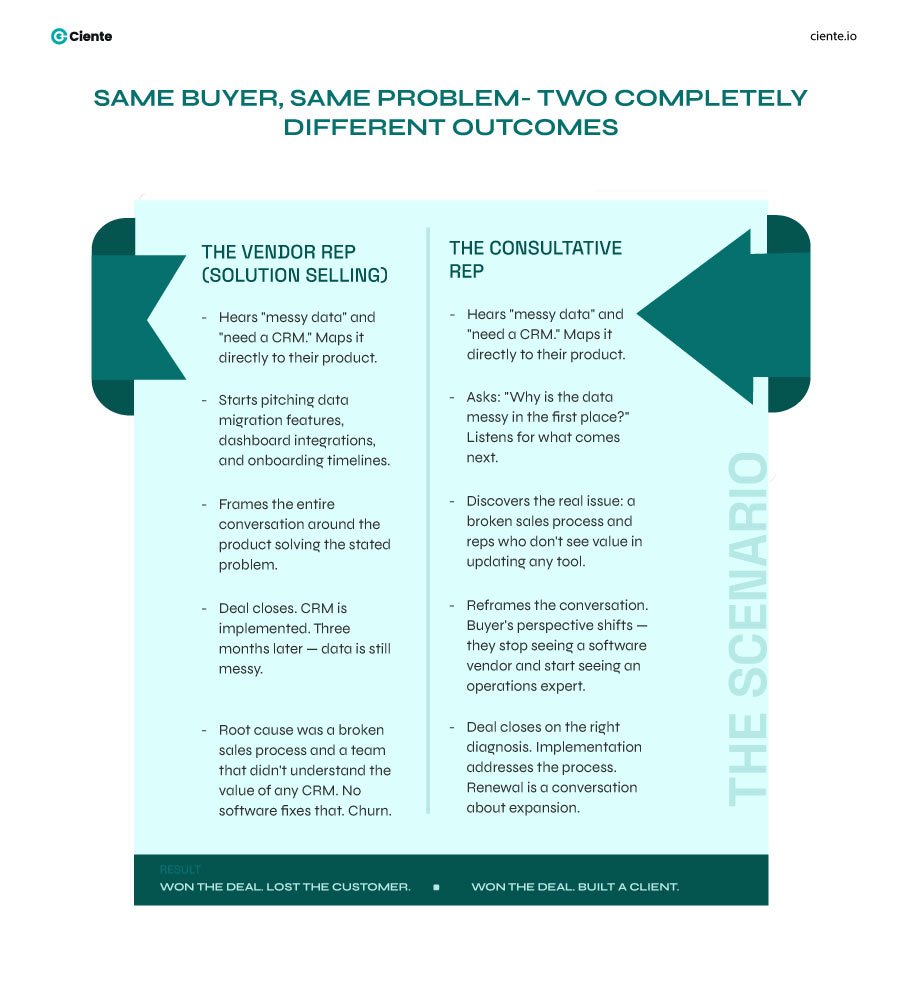
Think about a standard scenario.
A company reaches out because they think they need a new CRM, often influenced by trends in crm solutions. They say their sales data is messy. A typical SDR starts mentioning data migration and dashboard features. A consultative seller stops and asks why the data is messy in the first place. They might discover that the real issue is a lack of sales process or a team that doesn’t understand the value of the tool.
When you point that out, the buyer’s entire perspective shifts. They stop looking at you as someone selling software and start looking at you as an expert who understands their operations. That is a massive competitive moat.
Once a buyer sees you as a strategic partner, you move beyond transactional selling into more advanced sales enablement strategy. It becomes very hard for a competitor to come in and win on price alone. You aren’t just selling a tool anymore. You are selling a path to a better business outcome.
Realizing Consultative Selling Advantages in Win Rates and Deal Speed
There is a persistent myth in sales management, often driven by outdated sales metrics. That consultative selling is too slow. Managers worry that if reps spend too much time consulting, they won’t close enough deals.
The reality is exactly the opposite. You will see that over 86% of business buyers are more likely to buy from someone who actually understands their goals. On the flip side, nearly 60% of those same buyers feel that most sales reps don’t take the time to understand them at all.
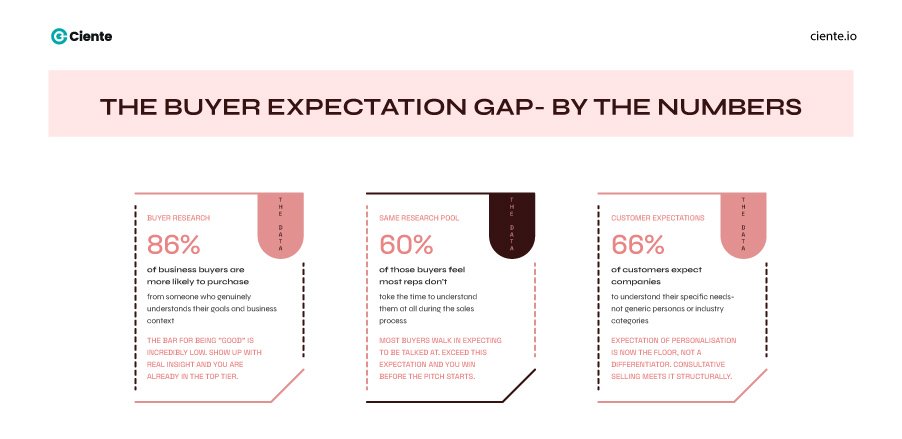
That means the bar for being good is incredibly low right now. Most buyers walk into a meeting expecting to be talked at. They expect to feel misunderstood.
One of the most immediate consultative selling advantages is reducing friction typically seen in sales cadence structures. Is that you clear this hurdle instantly by showing up with genuine insight. You observe fewer objections and faster decision-making when your recommendation aligns with the buyer’s day-to-day life.
In traditional sales, you spend half your time handling objections. But in a consultative model, you handle those objections before you ever make a pitch.
You aren’t selling them on a solution, but guiding them through a refined b2b sales funnel structure. You are presenting a logical conclusion that you both reached together during the discovery phase. That changes the psychology of the close entirely.
3. How Consultative Selling Advantages Build Long-Term Customer Trust
Sales leaders often mention trust as if it’s a fluffy, intangible metric. It shows up in CRM notes or is mentioned during a quarterly business review. But trust is a commercial asset with a very specific dollar value.
Research shows that over 66% of customers expect companies to understand their specific needs. Because of this, buyers will often choose a product that is slightly less perfect technically if they trust the person selling it more than your competitor.
That’s the advisory relationship in action. It acts as an insurance policy for the buyer. They know that if the implementation hits a snag or the market shifts, a consultative partner will help them navigate those changes. A product pusher will point to the contract and move.
This trust also compounds over time.
When you are a trusted consultant, you naturally unlock growth opportunities beyond traditional sales lead generation. Your customers start to reach out to you between purchase cycles. They might ask for your take on a new trend or a problem they are having with a different department.
It is how you get expansion revenue without having to run a formal, high-pressure sales motion.
You aren’t “upselling” them. You are just helping them solve the next problem in their business evolution. That is a revenue stream that traditional sales teams rarely tap into effectively.
Key Consultative Selling Advantages for Retention and LTV
If you are in a SaaS or service-based business, retention is your lifeblood and closely tied to the customer lifecycle sales funnel. That’s where product-centric selling is at its weakest.
If you win a deal because your product has one specific feature that the competitor doesn’t, you are in a dangerous position. The second that a competitor launches a similar feature, or your customer’s needs change, your reason for existing in their tech stack disappears. Half of once-loyal customers move to competitors simply because they feel their evolving needs aren’t being met.
One of the most durable consultative selling advantages for retention is that you anchor the relationship to the business outcome rather than the feature set.
Your history of offering good advice and your understanding of their internal culture can’t be copied by competitors.
You become an integrated part of their strategic planning process. When a competitor calls your customer to offer a lower price, the customer doesn’t just think about the software. They think about the value they get from your expertise.
That creates a level of loyalty that can survive market shifts and competitive pressure.
Strategic Consultative Selling Advantages in Competitive Markets
We have to be honest about the state of modern digital sales transformation.
Most categories are becoming commodities faster than we want to admit. Buyers have access to all the same information we do. They read comparison sites. They talk to their peers on LinkedIn. They often have a shortlist and a price range in mind before they ever talk to a rep.
If you show up to that first call and start listing features, you risk blending into generic sales prospecting tools comparisons. You are just another row on a spreadsheet. You are competing on price and specs.
But McKinsey research illustrates that the fastest-growing B2B companies engage customers earlier- with a consultative mindset. This timing is everything.
If you can get in early and help the buyer define their requirements, you get to shape the criteria they use to judge your competitors.
When your sales conversation is the most useful part of their entire evaluation process, you stop being just an “option.” You become the benchmark. You are the one setting the standard for what a successful solution looks like.
That is a strategic advantage that no software update can ever match.
Managing Large Buying Groups Using Consultative Selling Advantages
The modern buying group is getting bigger, making multi-threading in sales more critical than ever. and more complex every year. We are now seeing an average of ten unique decision-makers involved in a single deal. More than half of those groups now include VPs or C-suite executives.
Traditional solution selling usually falls apart in this environment. A rep might tell one story to a manager and a different story to a director, hoping that no one notices the discrepancy.
Consultative selling handles these large groups much more effectively. Because your approach is based on a deep, objective analysis of the business, you have a single source of truth that resonates across the entire committee.
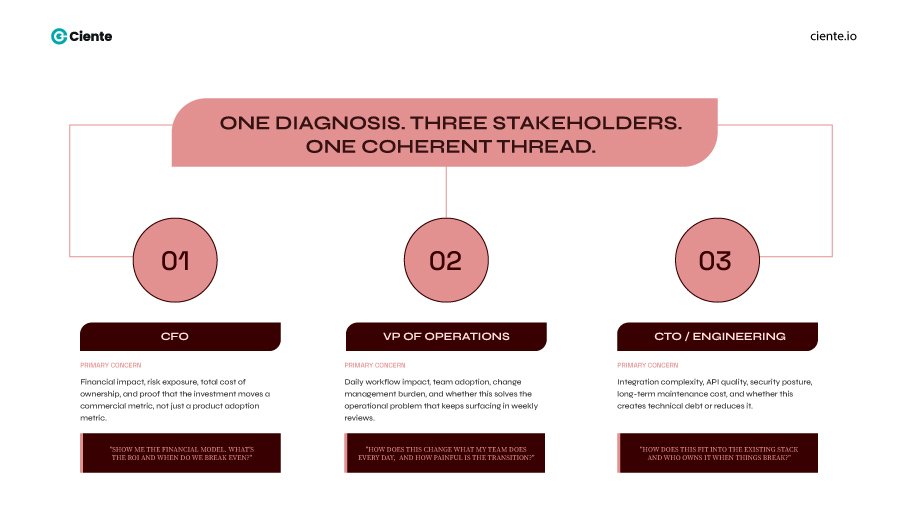
• The CFO cares about the financial impact and risk.
• The VP of Operations cares about how it changes the daily workflow.
• The CTO cares about how it integrates with the existing stack.
Even though you are talking to different people about different concerns, the underlying diagnosis is the same.
The coherence of your analysis becomes the thread that holds the entire buying committee together. That’s why consultative deals often move quickly through the final stages.
You aren’t spending weeks trying to settle internal disagreements between the buyer’s stakeholders because you have already aligned them around a common problem.
Why Sales Teams Struggle to Capture Consultative Selling Advantages
If the consultative selling advantages are so obvious, why aren’t they reflected in most sales enablement trends? Why isn’t every team doing this?
The problem is usually structural. Most companies attempt to solve this with a two-day training workshop. They teach people some active listening skills and give them a new set of discovery questions, and then they expect everything to change.
It doesn’t work because consultative selling requires genuine business acumen. You cannot fake this.
To ask a question that actually makes a senior executive stop and think, an SDR needs to understand how that specific company makes money. They need to understand the industry pressures and where the market is going.
You don’t get that from a workshop. You get it from years of focusing on a specific vertical and actually caring about business outcomes.
Research shows that proactive sellers, especially those leveraging Consultative selling is not a “tactic.”, outperform reactive ones. i.e., those who bring new ideas to the table and challenge the buyer’s assumptions, generate up to 30% more annual revenue than reactive sellers.
Being proactive is the core of the consultative approach.
Companies must transform their hiring and training to capture these advantages. You have to hire for curiosity. You have to invest in making your reps experts in their industry, not just experts in your product. And change your metrics to measure relationship quality, not just the call volume.
The Consultative Selling Advantage That Outlasts Products
Overall, products will always be duplicated. Features will be commoditized. Pricing will be undercut.
But what cannot be copied is a sales professional who understands a buyer’s world better than anyone else. That is the ultimate consultative selling advantage- it builds a durable commercial position.
It doesn’t wash away the next time a competitor releases a new version or cuts their price.
The teams that recognize this are the ones that invest in their people’s ability to think, not just their ability to pitch. But the ones that don’t will continue to struggle with flat retention numbers and deals that stall for no clear reason.
Consultative selling is not a “tactic.” It is a fundamental shift in how you provide value to the market.