
SaaS inbound marketing fails when volume replaces judgment. What changes when inbound focuses on helping buyers think rather than feeding content machines?
SaaS inbound marketing fails when volume replaces judgment. What changes when inbound focuses on helping buyers think rather than feeding content machines?
SaaS inbound marketing did not start as a content strategy. It began as a response to confusion.
Buying software stopped being simple. Teams no longer picked tools in isolation. A single decision began to touch workflows, budgets, reporting lines, and careers. People needed a way to think before they committed. Inbound marketing filled that gap.
Early on, the role was clear. Help buyers understand what they were stepping into. Reduce uncertainty before pressure enters the conversation. Offer them language they could use internally.
Then the scale arrived.
Inbound marketing expanded, but its purpose blurred. Publishing increased. Tooling grew heavier. Automation took over pacing. The work shifted from helping buyers think to keeping internal systems busy. This is how teams end up over-relying on SaaS marketing tools instead of judgment.
Nothing broke overnight. The drift was gradual. But the effect is apparent now. Plenty of content. Little conviction. Buyers arrive informed, yet unresolved. Sales conversations stall late. This is visible when you look at real funnel performance instead of surface metrics. More inbound gets produced to compensate.
That response makes the problem worse.
Inbound marketing is not failing because it is outdated. It is failing because it’s being used for the wrong job. That confusion sits at the core of broken B2B SaaS marketing principles.
How SaaS Inbound Marketing Turned into a Production System
Inbound marketing entered SaaS when information was scarce. Categories were forming. Language was unstable. A single article could reshape how a problem is framed.
That environment no longer exists.
Today, buyers arrive with opinions. They have read comparisons. They have spoken to peers. They carry internal constraints that content rarely addresses. The job of inbound marketing changed. Most teams did not adjust.
Instead, they scaled the old model. The same SaaS marketing playbook applied harder, not smarter.
More blogs. More keywords. More landing pages. Each addition felt reasonable. Together, they hollowed out intent. Content calendars replaced inquiry. SEO tools replaced judgment. Publishing became routine.
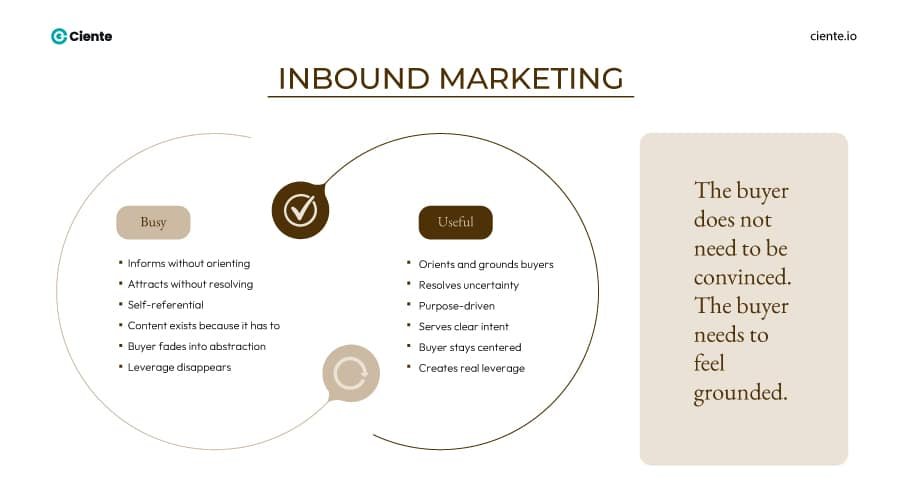
Metrics reinforced the behavior. Output was visible. Traffic was reportable. Influence was not. That’s the danger of misreading SaaS metrics as progress. Over time, inbound marketing became self-referential. Content existed because it had to.
The buyer faded into abstraction.
That’s where leverage disappears. Not because the content is low-quality, but because it no longer serves a clear purpose. It informs without orienting. It attracts without resolving.
Inbound marketing becomes busy. Not useful.
What SaaS Inbound Marketing Is Actually Supposed to Do
Inbound marketing is not demand creation. Most SaaS categories already have demand; what’s missing is fit, not traffic. That’s why many SaaS growth strategies stall after early traction.
What buyers lack is certainty.
Every serious software decision carries risk. Implementation can fail. Teams can resist. Budgets can tighten. Careers can take hits. These concerns dominate internal discussions, yet rarely surface in marketing content.
Inbound marketing earns its value when it helps buyers face those realities.
That does not mean reassurance. It means clarity. Clear trade-offs. Clear consequences. Clear boundaries. Buyers do not need to be convinced. They need to feel grounded.
Most inbound content misses this because it treats buying as a knowledge gap. It explains features. It lists benefits. It repeats pain points buyers already recognize.
The real work happens deeper.
As organizations grow, buying groups expand. This is where ignoring B2B SaaS customer segmentation breaks inbound completely. Incentives diverge. Legal slows things down. Security raises new questions. Finance asks different ones. No single asset converts anyone. Inbound marketing that stays stuck in early-stage education logic becomes irrelevant here. It keeps explaining when buyers are already aligned on the problem. What they need is help navigating the implications of solving it.
Effective inbound content does something quieter. It frames decisions. It gives buyers language that holds up under scrutiny. It makes choices defensible, not just attractive.
That work does not scale through volume. It scales through precision.
When SEO and Automation Start Working Against You in Inbound Marketing
SEO and automation are not the enemy. Abdicating judgment is.
Search rewards predictability. Automation rewards repetition. Buying decisions are neither.
When SEO drives inbound strategy, content drifts toward what is searchable rather than what is necessary. Questions buyers resolved months ago get answered again because they carry volume. Issues that influence real decisions are ignored because they resist clean measurement.
Automation compounds the drift.
Lifecycle systems assume forward motion. Buyers pause. Champions change. Priorities shift. Automated messages keep firing. Silence, which could allow reflection, disappears.
The cost shows up downstream. Sales meets prospects who have consumed content but lack conviction. Product teams inherit expectations shaped by oversimplified narratives. Customer teams manage disappointment that started long before onboarding.
Inbound marketing is designed to reduce friction across the system. Over-automation adds to it.
Tools are not the problem. Letting them think for you is.
What Effective SaaS Inbound Marketing Looks Like at Scale
As SaaS organizations mature, effective inbound marketing becomes quieter.
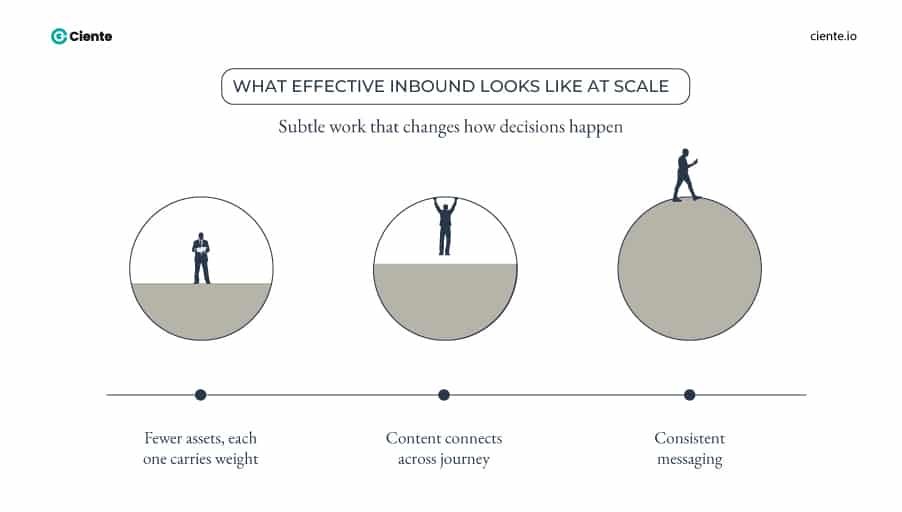
It produces fewer assets. Each one carries weight. Content connects across the buying journey rather than living in isolation. Messaging stays consistent because it reflects shared understanding, not campaign cycles.
That’s where many teams hesitate. Quiet work is hard to justify internally. Especially when SaaS marketing budgets demand visible activity over durable outcomes. It does not generate spikes. It does not look impressive in dashboards. But it changes how decisions happen. Inbound marketing at this stage stops trying to attract attention. It focuses on removing friction.
That friction shows up in predictable places. Buyers struggle to explain internally why a change is necessary now. Stakeholders talk past each other. Objections surface late because no one wanted to raise them earlier. Inbound content that matters addresses these moments directly.
It does not promise transformation. It explains disruption. It does not sell certainty. It outlines risk honestly. Buyers do not resent this. They trust it.
Effective inbound marketing starts behaving like infrastructure. It absorbs uncertainty before it hits sales calls. It shortens internal debates by giving teams shared reference points. It allows buying groups to align without forcing them.
When this works, the impact is indirect but visible. Conversations start higher. Objections surface earlier. Friction appears sooner and resolves faster. Marketing stops defending activity and starts enabling momentum.
Inbound marketing isn’t designed for rapid outcomes, but for the long haul.
Companies that treat inbound as a thinking discipline build trust that compounds quietly. Companies that treat it as a content factory accumulate output and call it progress.
Clarity scales. Volume does not.