
No one tells your story better than your customers. All the marketing narratives revolve around a customer’s perception of your product- that’s how relatability and resonance come to be.
Apple remains the unparalleled name in this category.
There are very few brands that can boast or are constantly in the headlines for their cult-like users- Apple is one of the countable few. The manufacturer has cultivated its products around its user community- evangelists and enthusiasts alike.
It’s not as if Apple needs the PR, but if it wants to get up on the leaderboard? That is its competitive edge: word-of-mouth from steadfast brand evangelists psychologically tethered to the brand. For the brand, it’s about retention and reducing churn, while for the users, ‘community’ holds a distinct persona.
When customers become part of a brand community, they earn a differentiator status. They build relationships with similar customers, so switching to competitors means losing all those perks.
And Apple’s community remains unparalleled. It’s a self-sustaining loyalty engine that brands spend thousands trying to replicate.
However, emotions rarely guide customers in B2B SaaS, where decisions are typically driven by structured SaaS market segmentation strategies and business needs.
There must be value that goes beyond profitability, but that value isn’t the psychological effect of belonging to a community. The “switching costs versus community identity” argument doesn’t land here.
Enterprise buyers operate on procurement logic. They must navigate approval chains and answer to finance teams that want hard ROI numbers, which is why tools like B2B SaaS contract management software become essential in the process. not a sense of belonging.
So, does community building matter in B2B SaaS? It does, but for entirely different reasons.
The Space for Community Building in B2B SaaS
Enterprise deals rarely close through a single conversation. They’re won and retained through internal champions: the practitioner fighting for your product in budget reviews, sends the Slack message that says “we can’t move off this tool,” and trains the new hire without being asked to.
Community is one of the most reliable ways to create those champions at scale, similar to how SaaS influencer marketing strategies build credibility through trusted voices.
It’s not about learning how to use a product.
Is that what happens when a power user finds a solution to a complex problem in your community forum, earns recognition for answering someone else’s question, or gets cited in a webinar your team runs? They’re building an identity around it.
That identity is what makes them an internal advocate, not a passive subscriber.
That’s the distinction worth making. It’s not emotional attachment to a brand but a professional identity built around mastery and visibility. Being known as the person who “knows the platform inside out” carries real career value for all practitioners.
And community is where that reputation gets built and reinforced over time.
Demand Gen Before the Sales Call
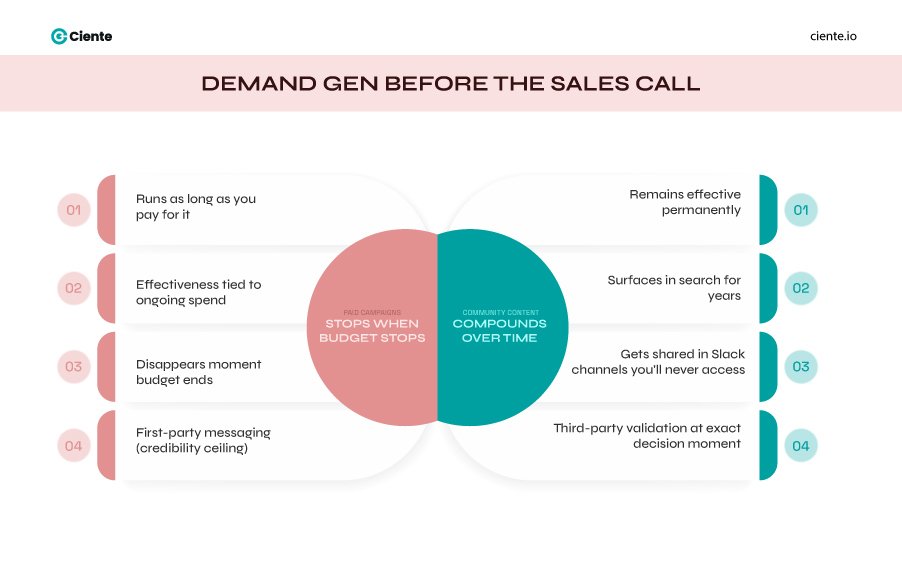
Enterprise buyers conduct their research before they engage with sales, often influenced by a mix of paid vs organic marketing in SaaS channels. They read threads. They watch what practitioners say on LinkedIn. They understand the questions asked in communities, and more importantly, how those questions are being answered and by whom.
Your community shapes that pre-sales perception in ways that advertising simply cannot.
A well-indexed forum thread where a practitioner solves a real problem is more credible than any product page you’ll ever write. It’s third-party validation at the exact moment a buyer is deciding whether your product is even worth a demo.
It is demand gen through earned trust, and it compounds, much like insights highlighted in SaaS marketing statistics around long-term growth channels.
Every answered question, every use case shared, every integration tutorial posted becomes a permanent asset.
Unlike a paid campaign that stops the moment the budget stops, community content remains effective, which is why balancing it with SaaS marketing budget allocation strategies is critical. It surfaces in search. It gets shared in Slack channels you’ll never have access to. It circulates in the exact peer conversations that actually move enterprise buying decisions.
For B2B SaaS teams operating with lean marketing budgets or targeting niche technical buyers, this matters enormously.
Your community can reach practitioners not accessible through traditional channels. And they trust each other far more than they trust your marketing team.
Market Expansion Within Accounts
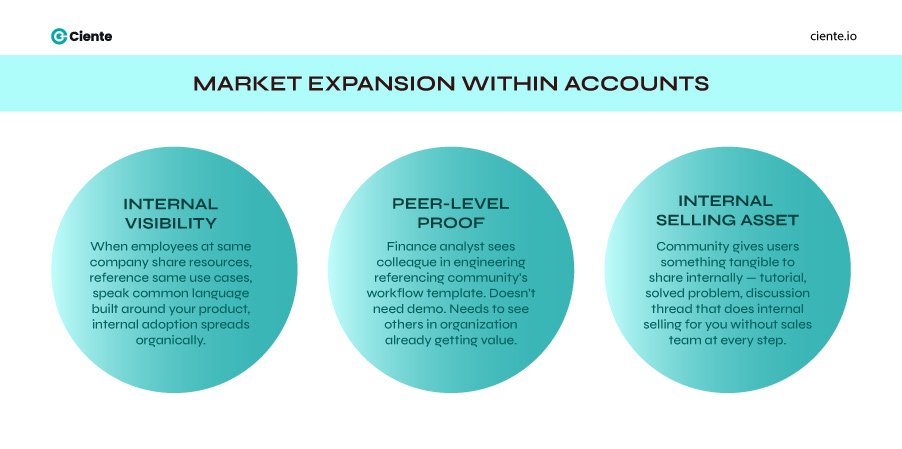
One of the most underrated plays in enterprise SaaS is account expansion- getting more teams inside an existing customer to adopt the product. It’s high-ROI, low-acquisition-cost growth, and most SaaS companies leave it largely to chance or to their customer success team alone.
Community accelerates this without your sales team involved at every step, similar to how scalable models like SaaS affiliate marketing drive distributed growth.
When employees at the same company share resources, reference the same use cases, and speak a common language built around your product, internal adoption spreads organically.
A finance analyst who sees a colleague in engineering referencing your community’s workflow template doesn’t need a demo. They need to see that other people in their organization are already getting value. And that there’s a place they can go to get up to speed quickly without indexing a support ticket.
Community creates that visibility.
It gives users something tangible to share internally- a tutorial, a solved problem, a discussion thread that does the internal selling for you. That’s not a small thing.
In large enterprise accounts, internal inertia is often the biggest barrier to expansion, and community is one of the few levers that works at the peer level, without requiring your team to orchestrate every conversation.
What This Means for How You Build
The implications here are practical. If demand gen and account expansion are your primary goals, the community you build should look very different from a traditional brand forum.
- A community optimized for demand generation needs to be public, indexable, and rich with practitioner-level content.
SEO is a feature, not an afterthought. The conversations happening there need to reflect real problems that real buyers are actively searching for solutions to- not curated success stories that read like press releases.
- A community optimized for expansion needs depth over breadth.
It should be a place where existing customers can effectively leverage the product, share institutional knowledge, and discover capabilities they haven’t yet. Access is often gated, but the value must be high enough that a user thinks to share it with a teammate without a reason.
Most SaaS companies don’t need to choose between these two goals entirely, especially as models like white-label SaaS for business growth expand how companies scale offerings. But they do need to be honest about which one is the bigger constraint right now- are you struggling to get qualified buyers into the pipeline? Or are you leaving expansion revenue sitting inside accounts you already have, because adoption stopped at the team that bought the solution?
The answer to that question should shape everything- the platform you choose, the content you invest in, the metrics you track, and the kind of community manager you hire.
Community building in B2B SaaS is not about turning your customers into fans.
It’s not about replicating Apple’s playbook in a market where buyers read procurement policies before they read product reviews. It’s about turning your best users into the most credible voice in your category, particularly as more industries explore why manufacturers are switching to SaaS and rely on peer validation. and giving the rest of your user base a reason to stay longer and engage others like them.
The impact isn’t merely emotional. It’s on the pipeline. Retention. That’s expansion revenue.
And in a market where every product category is becoming crowded and more commoditized, a well-built community might be the only growth lever that genuinely compounds.