Enterprise buyers don’t follow a single funnel, so why does your marketing strategy pick a side? The ABM vs inbound debate is costing SaaS teams more than they realize.
Most marketing debates are about budget in disguise.
“Should we do ABM or inbound?” translates to “where should we put the money?” This framing is incorrect to say the least but most enterprise SaaS marketing teams still leverage it.
ABM and inbound are different tools that solve different parts of the same problem. Why pit them against each other? And in enterprise SaaS, you need both, because enterprise buying is complicated enough that no single approach covers the whole journey. This is often misunderstood when teams frame it as part of the broader ABM vs lead generation debate.
What Each One Actually Does
Inbound marketing creates demand when the need isn’t yet discernible. You publish, optimize, and show up where your buyers are searching, which is the foundation of any strong inbound lead generation strategy. The leads come to you. Done well, it becomes a compounding asset- content that generates pipeline while your sales team sleeps.
ABM flips it. You identify who you want to sell to and go to them, with tailored messaging, multi-channel outreach, and content designed for specific companies or personas, not the internet at large, often powered by data-driven ABM strategies. You’re not casting a net. You’re fishing with a spear.
They sound like opposites. In practice, they operate on completely different timelines and serve different buyer states. That’s what most frameworks get wrong when they try to frame this as a choice.
Enterprise Buyers Don’t Follow the Funnel
Enterprise SaaS buyers aren’t Googling their problem, stumbling across your blog, and booking a demo the same afternoon.
Enterprise buying is a committee sport. There’s the economic buyer controlling the budget. The champion who wants the tool. The IT stakeholder is signing off on security. Legal review of the contract. And a procurement process with its own timeline sitting underneath all of it, completely indifferent to your Q4 targets.
Each of those people has a different intent. Different questions. Different objections that can quietly kill a deal weeks before it is supposed to close, which is why engaging multi-stakeholders in ABM becomes critical.
Inbound can reach some of them.
A VP of Marketing searching “best ABM platforms for enterprise” might find your blog and eventually request a demo. That happens, and it’s valuable. However, inbound has no mechanism to reach the CFO who is not searching for your category, or the IT director who needs to see your SOC 2 compliance documentation before the conversation can advance, or the procurement manager who requires a vendor comparison document before approving a pilot.
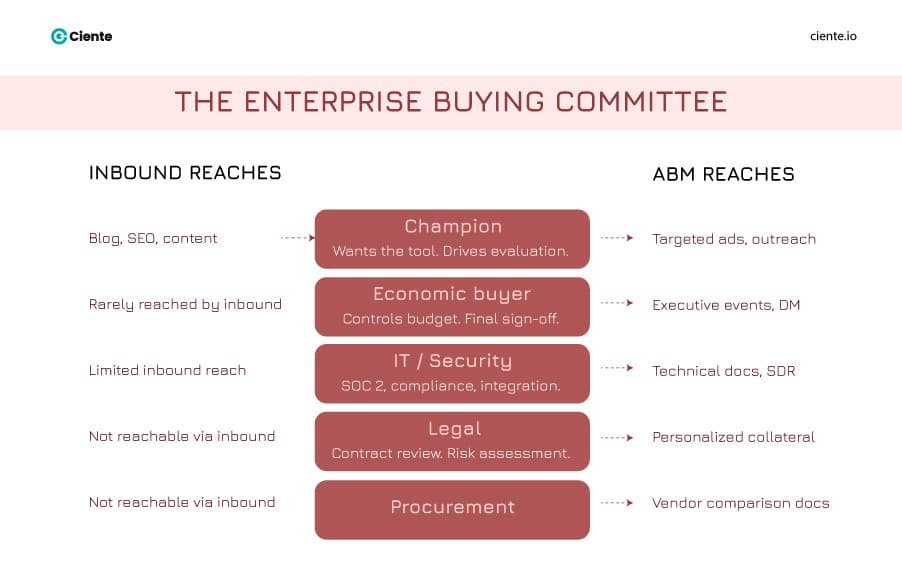
ABM isn’t a replacement for the inbound lead. It’s the infrastructure that turns a single interested contact into a closed deal across a six-person buying committee, especially when supported by buyer intent data in ABM campaigns. Without it, your best inbound leads stall somewhere in the middle of a process you can’t see and can’t influence.
Buyer Intent Is the Real Variable in the ABM vs Inbound Debate
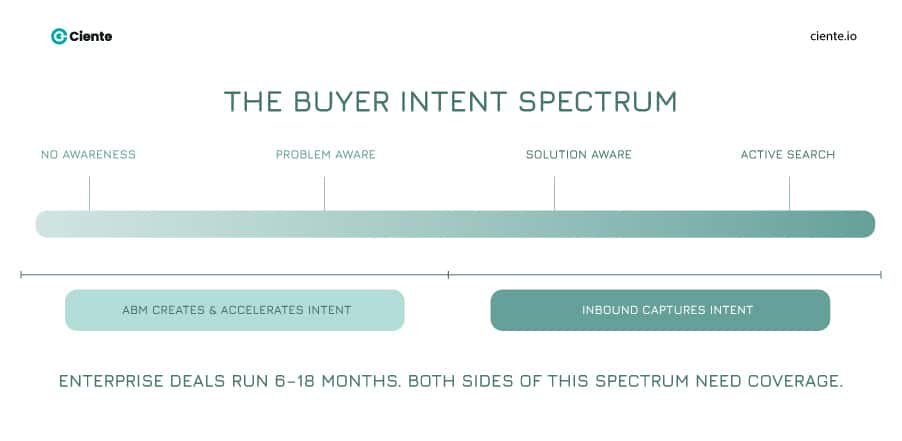
Teams pit ABM against inbound because they’re thinking about channels when they should be thinking about intent.
Inbound captures active intent.
Someone is searching, reading, and comparing- they have a question and want an answer. Your job is to be that answer, consistently, in every format and channel your buyers use when they’re in research mode.
Do that well over time, and you build a pipeline of buyers who came to you already educated, already halfway convinced, already able to articulate the problem to their leadership.
ABM creates intent in accounts that aren’t in searching mode, or accelerates intent in accounts already in your pipeline but going cold.
You’re not waiting for them to raise their hand. You’re showing up in their world, through targeted ads, personalized outreach, executive events, direct mail, and coordinated touches across multiple channels such as ABM display advertising strategies. until the problem you solve becomes too relevant to keep pushing off the agenda.
Both are about intent.
They merely meet buyers at completely different points in their awareness. And in enterprise SaaS, where deals run six to eighteen months and involve stakeholders who will never organically find you through search, you cannot afford to consider just one side.
The deals you lose aren’t your competitor’s from the get-go. Often, they lose to inertia, and inertia is exactly what ABM breaks.
What Inbound Actually Does in Enterprise
Inbound gets dismissed as a top-of-funnel SMB play. That’s lazy thinking.
In enterprise SaaS, inbound builds category authority.
You shape the narrative before a sales conversation ever starts when your content answers the questions your buyers are asking. So, by the time a prospect gets on a call with your AE? They’ve already formed opinions about the problem, the solution category, and the vendors worth considering.
Inbound determines whether you’re in that consideration set or not.
It also generates awareness among the individual contributors and mid-level managers who drive tool evaluation from the bottom up, the people who bring a shortlist to their VP before the VP has even acknowledged there’s a problem to solve.
These are the practitioners who become internal champions. They found you through a blog post, a LinkedIn comment, or a community thread.
That’s inbound working exactly as it should in an enterprise context.
And inbound creates a signal.
Companies visiting your site, engaging with your content, downloading your resources, and attending your webinars. Your ABM team should be working off that signal- prioritizing accounts showing some level of interest rather than going in completely cold.
The best ABM programs run on warm data, not a list someone pulled from a database.
Inbound feeds ABM. ABM converts it into revenue, which becomes clearer when you look at key ABM metrics to measure campaign success.
What ABM Actually Does in Enterprise
Inbound is democratic by design. It reaches whoever is searching. That’s fine for volume, but volume isn’t the constraint in enterprise SaaS. Precision is.
ABM lets you be deliberate.
You pick which accounts matter based on ICP fit, deal size, industry vertical, and strategic value, and you invest disproportionately in those accounts.
One focused ABM campaign against twenty named accounts can generate more pipeline than a hundred inbound leads from companies that were never going to close at enterprise deal sizes.
The math is different at the enterprise level, and your marketing motion has to reflect that.
ABM also works at a depth that inbound can’t match.
You can create content specific to a target account’s industry challenges, similar to how great ABM campaign examples demonstrate deep personalization. You can run executive roundtables for the economic buyers who don’t read blog posts and won’t respond to cold email.
You can coordinate your SDR outreach, paid retargeting, and field sales motion to target the same account from multiple directions over weeks, so that by the time a prospect gets on a call with sales, your brand isn’t a cold name but a familiar one.
That orchestration is what actually moves enterprise deals forward. It’s not scalable in the way inbound is, but it doesn’t need to be. It needs to be precise.
How to Think About the Split Between ABM and Inbound
The question isn’t ABM or inbound. It’s where your specific pipeline problem lives right now.
Thin top-of-funnel, not enough companies know you exist, not enough practitioners have heard your name, inbound deserves more investment. Build the content engine, get into the searches your buyers are running, and build the authority that makes your ABM outreach land better when you do run it.
Cold outreach into accounts that have never heard of you is a much harder problem than warm outreach into accounts that have already engaged with your content.
Good volume, but enterprise deals are not converting; you’re generating leads but not closing the accounts that actually move revenue. ABM deserves more focus. Tighten the ICP, build the target account list, and invest in the multi-channel orchestration that enterprise deal velocity actually requires.
Stop waiting for the right accounts to find you- find them.
Most mature enterprise SaaS marketing teams run both simultaneously, allowing them to inform each other constantly, much like the balance explained in this inbound vs outbound marketing guide. Inbound builds market presence and feeds intent signals. ABM converts those signals into the specific deals that matter. That’s not a complicated strategy. It’s just an honest one.
The Actual Mistake
Teams pick one approach, commit fully, and spend twelve months wondering why the results feel incomplete.
ABM without inbound means reaching out to accounts with no ambient awareness of your brand. You can personalize every touch, but still be talking to a cold room because there’s no content, no authority, no signal that preceded your outreach.
Inbound without ABM means waiting for the right accounts to find you.
In enterprise SaaS, the right accounts often don’t know to look. And even when they do find you, without ABM infrastructure, you have no way to systematically reach the rest of the buying committee once that first contact raises their hand.
The question was never ABM or inbound. It was always the scope of each and when.