
Every SaaS company has a go-to-market strategy. Almost none of them have actually built one. Here is what the term really means, why it keeps failing, and what understanding your buyer has to do with any of it.
Ask any SaaS founder what their go-to-market strategy is.
You will get one of two answers. A confident recitation of channels, a launch plan, maybe a persona deck. Or a vague gesture toward growth that has been dressed up in GTM language to sound like it was intentional.
Neither of those is a go-to-market strategy.
GTM has become one of those terms that gets used so often that it has stopped meaning anything. Marketers say it in planning meetings. VCs ask for it in pitch decks. RevOps teams build dashboards around it while debating different SaaS marketing approaches and playbooks. And somewhere in all of that repetition, the actual idea got hollowed out.
So let us start from the beginning.
What Go-to-Market Strategy Actually Means in B2B SaaS
Go-to-market does not mean a launch plan
A launch plan is a sequence of events. GTM is a theory of why a specific buyer will choose you, how they will find you, and what will make them stay.
Those are completely different things.
A launch plan says: we will post on LinkedIn, email our list, do a ProductHunt launch, run SaaS social media marketing campaigns, and send promotional sequences in week one. That is a campaign. That is not a strategy.
A go-to-market strategy says: this is who we are selling to and exactly why they have this problem right now, which starts with clearly defining your SaaS customer segments. This is the moment in their world when the problem becomes urgent. This is how they look for solutions. This is what makes our approach the one that fits their situation better than anything else available. This is how we reach them before they have already made a decision.
That requires you to actually understand the buyer. Not the persona card. The buyer.
It Is Engineering a Desired Outcome
Here is the frame that changes everything.
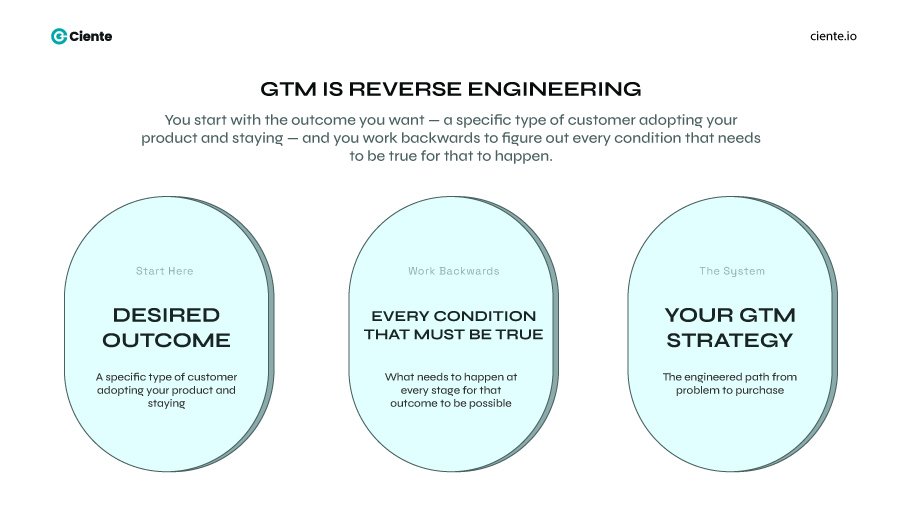
GTM is reverse engineering. You start with the outcome you want, which is a specific type of customer adopting your product and staying, and you work backwards to figure out every condition that needs to be true for that to happen.
What does the buyer need to believe? What objections will they arrive with? What internal champion do they need to have? What competitor will they compare you to, and why will you win that comparison? What does their buying committee care about that your champion does not?
Every single one of those questions has an answer. And your go-to-market strategy is the system that uses those answers to engineer the path from problem to purchase across the entire SaaS marketing funnel.
When you treat GTM as a launch plan, you skip the engineering. You go straight to broadcasting. And then you wonder why the pipeline is thin and the sales cycle is long.
Why B2B SaaS GTM Keeps Failing
The B2B Buyer Problem
There is a pattern in SaaS where the market gets blamed for not responding, even though the real issue often lies in poorly designed SaaS growth strategies.
The ICP is wrong. The timing is off. Buyers are not ready yet. The category needs more education.
Sometimes that is true. Most of the time, it is not.
Most of the time, the GTM failed because the team did not do the work to understand what the buyer actually needs to hear, from whom, at what moment, in what context. They made assumptions, built campaigns on those assumptions, measured the wrong things, and called it a strategy.
The buyer was never the problem. The understanding of the buyer was.
Flashy Content and Mass Ads Are Symptoms, Not Strategies
You can tell when a SaaS company does not have a real GTM because of what their marketing looks like.
Generic LinkedIn thought leadership that could apply to any company in any category instead of meaningful thought leadership in SaaS marketing that actually speaks to buyer problems. Case studies that say a lot without saying anything specific. Webinars that are demos wearing a disguise. Ads that lead to landing pages that explain features instead of solving the problem the buyer typed into Google at eleven at night while researching solutions through SEO for SaaS.
This is what happens when GTM gets reduced to output instead of thinking.
The content exists because it is on the checklist. The ads exist because the budget needs to be spent. The campaigns exist because someone needed to show activity.
None of it was built backwards from a deep understanding of who the buyer is and what would actually move them.
What Understanding the Buyer Really Requires
It Requires Sitting With Uncomfortable Specificity
Most teams do buyer research once, declare victory, and move on instead of continuously refining SaaS product-market alignment. They have a persona. They know the job title. They have the pain points listed in a slide deck somewhere.
That is surface level. It is not enough to build a GTM on.
Real buyer understanding means you know what the buyer’s world looks like on the day they realize they have your problem. You know who they talk to about it first. You know what they search for. You know what they read. You know what the conversation in the buying committee sounds like when your product comes up. You know what the person championing you internally has to say to get the budget approved.
You know what failure looks like for them if they choose wrong. You know what success looks like if they choose right. You know which of those two motivations is stronger.
That level of specificity feels excessive until you use it. Then it feels like the only way to build anything that actually works.
It Requires Sales and Marketing to Stop Living in Separate Buildings
Go to market strategy in B2B SaaS breaks down most consistently at the handoff between marketing and sales.
Marketing builds campaigns based on what they think buyers care about instead of grounding them in real lead generation for SaaS insights from the market. Sales has conversations with actual buyers every day and learns something completely different. Those two bodies of knowledge almost never talk to each other in a structured way.
So marketing keeps running campaigns built on assumptions that sales could correct in ten minutes. And sales keep having conversations that marketing could arm them for better if they knew what was actually happening in those calls.
GTM is supposed to be the system that connects those two realities. When it is treated as a launch plan that belongs to marketing, that connection never gets built.
It Requires You to Know Why You Win and Why You Lose
Not in the abstract. Specifically.
What are the three types of deals you win most reliably, and how do those wins reflect the core principles of B2B SaaS marketing you are applying? What do those buyers have in common? What did they believe before they met you that made them ready to buy?
What are the three types of deals you consistently lose? What objection comes up every time? What competitor keeps beating you in those situations and why?
A real go-to-market strategy is built around the answers to those questions. It amplifies the conditions that produce wins and avoids creating the conditions that produce losses.
Most SaaS companies do not have clean answers to those questions. Which means they are running a GTM motion without the most important data it needs.
What a Real B2B SaaS GTM Strategy Looks Like in Practice
Start With the Moment of Urgency
Every buyer has a moment when the problem you solve becomes urgent enough to act on. Something changes in their world. A new regulation. A failed audit. A competitor is doing something they cannot ignore. A new hire who is pushing for a solution. A board conversation that suddenly made the problem visible.
Your GTM strategy needs to be built around that moment. Not around your product launch calendar.
What triggers urgency for your buyer, and how does that connect to the total addressable market for your SaaS product? What event, condition, or context takes your problem from background noise to top priority? That is your entry point. That is where your messaging should meet them.
Define the Channel as a Consequence of the Buyer, Not a Default
Most SaaS companies pick channels based on what everyone else in their category is doing rather than building a B2B SaaS growth marketing strategy around the buyer. Everybody does LinkedIn. Everybody does content. Everybody does outbound sequences.
The channel should be chosen because that is where your specific buyer is, in the specific moment of urgency, looking for the specific information that moves them toward a decision.
If your buyer is a CISO who only trusts peer recommendations, your channel is community and referral. If your buyer is a RevOps manager who researches obsessively before talking to anyone, your channel is search and deep educational content. If your buyer is an enterprise CFO, your channel is the conversation your champion has in the room you will never be in.
Channel follows the buyer. Not the other way around.
Measure What Moves the Buyer, Not Just What the Dashboard Shows
The metrics SaaS companies typically track in GTM are activity metrics dressed up as outcome metrics.
Leads generated. MQLs. Opportunities created. These are only a small subset of the SaaS metrics that actually matter. These tell you what the funnel looks like. They do not tell you whether your GTM is actually working.
What moves a buyer from unaware to purchased to retained and eventually reduces churn across the lifecycle through effective churn reduction strategies in SaaS. Map that journey specifically. Then measure whether your GTM is actually producing the conditions that advance buyers along it.
That is a harder measurement problem. It requires conversations with customers, win-loss interviews, and honest analysis of why deals stall. It is worth doing. It is the only way to know if your strategy is working or if you are just generating activity.
GTM is not a marketing deliverable. It is not a launch plan. It is not a set of channels or a content calendar or a paid acquisition strategy.
It is the answer to a single question.
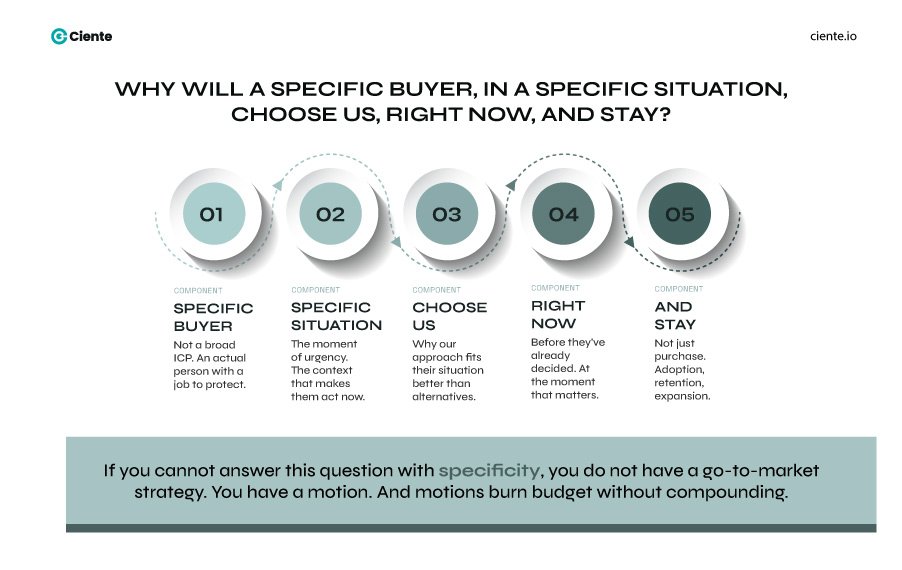
Why will a specific buyer, in a specific situation, choose us, right now, and stay?
If you cannot answer that question with specificity, you do not have a go-to-market strategy. You have a motion. And motions burn the budget without compounding.
The SaaS companies that are actually winning right now are the ones that did the slow, uncomfortable work of understanding their buyer at a level that most teams never bother to reach. They built the GTM backwards from that understanding. And the output looks different from the noise because it was made for a specific person, not a generic market.
That is the whole thing.
Go understand the buyer. The strategy follows from that. Everything else is just execution