1. In an enterprise environment where sales cycles stretch for 12-18 months, endurance matters as much as skill. What’s one philosophy more sales leaders should prioritize for high-pressure, ambiguous domains?
I’ll split this into two perspectives, outwards and inwards.
In a 12-18 months cycle, you aren’t selling to a client—you’re equipping a champion to sell to their own CFO, CIO/ CTO, Business leaders, legal & procurement teams.
High-pressure enterprise deals rarely fail because the buyer didn’t like your product or offering. They fail because the buyer lacks the political capital, clarity, or energy to navigate their own internal bureaucracy. Consultative selling including internal change management is as important as objection handling.
The deadliest risk in a long deal cycle isn’t a ‘No’ in the first quarter, it’s a ‘Maybe’ that dies in the fourth or fifth quarter.
Early and decisive disqualification must be encouraged rather than holding onto bad deals due to the fear of empty pipelines. Timely ending a dead-end engagement frees up hundreds of hours for deals having momentum.
2. The price of failure is amplified across high ACV sales motions such as enterprise digital twins and process intelligence – where the slightest deal stall can cause a massive pile-up. In your experience as a Director – Sales, are there any subtle warning signs or tells that are sure-shot signs that a deal is beginning to drift?
When you’re selling transformational software, you are asking an enterprise to rewire how they operate. Because of that, the warning signs aren’t explicit objections—those are behavioral shifts in how the customer interacts with your team. Deals almost never die in a dramatic flash of lightning. They die in a slow, comfortable drift.
- It all starts with the intent and purpose. Lack of agreement on the strategic objectives, potential benefits and executive alignment are the initial signs.
- Going back to re-justifying the business case during the later stages of the deal when discussion should be around functional, technical and implementation details.
- When the executive champion stops sharing the uncomfortable truths like which VP is working on a competing initiative, what is the immediate priority of the CFO, who is not comfortable with the initiative etc.
- Transformational initiatives require cross functional skin in the game. If senior stakeholders start delegating and sending junior representatives, indicates the initiative is no longer their priority and their bandwidth is diverted to something else, more important.
- Asymmetric mutual plan execution. You always respond on time but the functional, technical, legal, security details etc. you request always go into the black boxes.
3. CFOs block large-scale digital transformation projects if the value isn’t concrete and immediate. With the CFO the hardest audience to convince in a committee, is it effective to reiterate process optimization as an offensive strategy rather than a defensive cost-cutting exercise?
To win over a CFO on complex digital transformation, you must bridge both. The most effective sales motion doesn’t force a choice between offence and defense, rather re-frames process optimization as Operational Elasticity.
The path forward lies somewhere midway between the two and crafting a holistic framework around enterprise value across top, bottom and green (sustainability) line benefits. Share a path for operational elasticity i.e. start with a defensive foundation (working capital improvement, preventing leakages etc.) to fund the initiative and multiply the offensives (market expansion, time to market, capacity scaling etc.).
It’s like converging the continuous improvement & transformative engineering mindset with the quarter-on-quarter realities of the business.
4. You’ve spoken about balancing a deep engineering mindset with the messy realities of business transformation. Can you underscore a tipping point at which the pursuit of optimization might no longer serve the business?
Whatever we do business value should remain at the center, perfection should not become the enemy of the velocity of enterprise transformation. Here are the basic rules:
- Always assess costs vs benefits, the cost of a perfect solution should not exceed the expected benefits.
- Time to value should be fast, else people lose interest. Ultimately, seeing is believing, showcasing early results is critical for building momentum.
- Whenever in doubt, apply the simple 80:20 rule (Pareto’s principle). The long tail mostly results in diminishing returns to scale and adversely impacts unit economies.
5. Transformation is a long game, and large-scale enterprise transformation demands multi-stakeholder consensus. Can you walk our readers through at least three non-negotiables an organization aligned to succeed must underline- beyond value-centric messaging?
Technology is an important enabler, but true transformation is driven by people and sustained by processes. Turning high-ACV software investments into growing enterprise value, organizations must align around three non-negotiables:
- Most executive teams have no shortage of strategic vision. Strategy defines the What and the When—it is your north star and destination. But the piece most organizations miss is the second part: The Operating Model. The Operating Model is your How. It is the actual engine that drives execution. Don’t just invest in technology alone—invest in the framework that makes it powerful. Don’t run isolated experiments, build the right operating models, and unlock the true art of the possible.
- Scaling a transformation model requires a very intentional structure. Success relies entirely on seamless collaboration among four distinct pillars: The Business Functions (Operations, Finance, Supply Chain etc.), Process Owners, IT Teams, The Center of Excellence (CoE). Collaboration only works when roles and responsibilities are crystal clear. Let’s be honest: your CoE, process, and IT teams can design and deploy some of the most amazing, sophisticated solutions in the world. But they don’t run the business. The ultimate responsibility for driving the improvement roadmap and realizing measurable value lies squarely with the Business Functions. The CoE builds the radar; the Business Function pilots the ship.
- Transformation isn’t a tape you cross; it’s an operational muscle you build. Everything we’ve discussed is wrapped in Continuous Improvement. Once you have the metrics, the accountable people, the CoE expertise, and the technology platform, the magic lies in deploying them continuously—not as a one-off project. It’s about repeatedly moving the needle on the metrics that matter, so you can successfully run your daily business leveraging the latest digital interventions. But as any sales leader or COO knows, that “last mile”—where insights turn into front-line behavioral changes and hard dollars—is always the hardest.
6. With enterprise transformation software, the ROI isn’t immediate; its value often compounds over time. What is a legacy sales metric you believe leaders should discard that’s no longer suitable for future AI and automation initiatives? Is there a metric that should replace it?
Traditionally with static enterprise software (primarily a system of records/ transactions processing systems), the value is delivered in a single step: you deploy the software, train the users, and hand over the keys. Hence, legacy sales motions rely heavily on one overarching metric to measure success: Annual Contract Value (ACV).
When it comes to transformational software i.e. process intelligence, digital twins, and Agentic AI, ROI does not work that way. The software becomes smarter, more embedded, and more value-generative as it processes more system data and learns human workarounds. Value doesn’t plateau—it compounds. Evaluating these technologies using 15-year-old SaaS metrics creates a fundamental misalignment between how software is sold, how it is implemented, and how a customer experiences its impact.
Thus, we must stop using first year ACV as the only benchmark and include more metrics like Net New ACV (NNACV), Value Realized by the customer, Time to First Value, Expansion velocity etc. These metrics seamlessly align Sales incentives to Customer Value and hence joint success.
Therefore, for transformational software, judges of a deal’s quality must stop looking at the size of the initial landing and start looking at the trajectory of the account. If you want a health check on your sales motion, look at two numbers: Value Realization for the customer, and Net New ACV year-over-year for the business. NNACV tells you if you’ve built a partner who sees compounding value in your software every single year
7. Your Master Black Belt in Business Excellence offers you a unique perspective on organizational performance. Where have you found it most challenging to apply the principles of continuous improvement and ‘design thinking’- and what has it taught you about leadership?
A Master Black Belt teaches you to view the world through data, variation reduction, process maps, waste elimination and human-centric design. Frameworks like DMAIC (Define, Measure, Analyze, Improve, Control) are exceptionally powerful when applied to structured, deterministic environments like manufacturing, logistics, or core data pipelines.
Design Thinking relies heavily on empathy—understanding the user’s deepest pain points. But in complex enterprises, empathy mapping often reveals uncomfortable realities e.g. different departments have directly conflicting incentives and we all know, metrics drive behaviors.
Master Black Belt and Design Thinking equip you with the tools, but leadership teaches you that you can’t improve what you don’t understand from a human perspective. The hardest lesson in business excellence is realizing that people aren’t process bottlenecks to be engineered away—they are the engine. If your continuous improvement framework causes friction with your culture, don’t fix the culture to match the framework. Fix the framework to serve the people running the business. Ultimately, culture eats strategy for breakfast. Hence, shift from “Command & Control” to “Architect & Enable”.

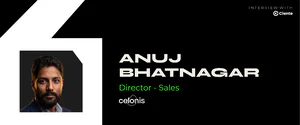
Anuj Bhatnagar, Director – Sales at Celonis
With over two decades of experience intersecting sales, strategic advisory, enterprise technology, and business excellence, Anuj specializes in bridging the gap between ambitious digital visions and hard-dollar outcomes.
Backed by an engineering foundation, an MBA from IIM Lucknow, and a Master Black Belt in Business Excellence, his approach marries deep technical rigor with pragmatic business acumen to help organizations navigate the evolving landscapes of Digital Transformation.