
Thought leadership in SaaS marketing is the norm, but only a fraction of it moves buyers. What truly separates content that builds authority from one that just fills calendars?
Most SaaS companies say they practice thought leadership. Few actually do.
That’s not a hot take. It’s what the data shows.
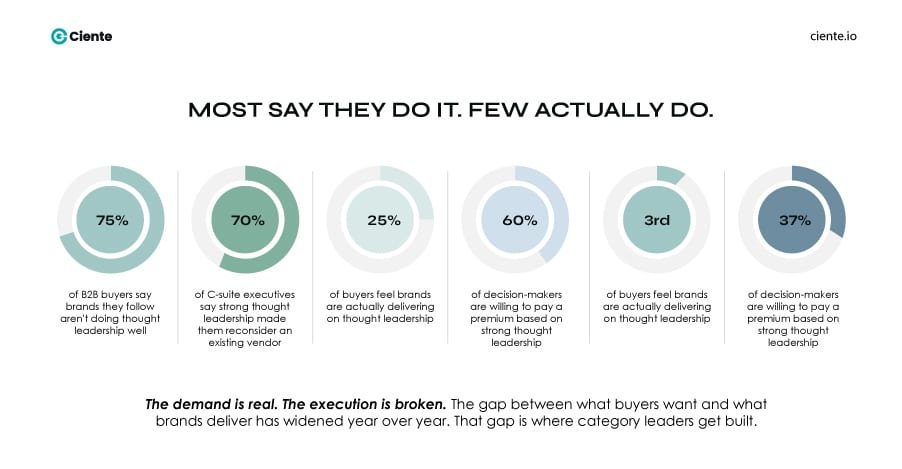
75% of B2B buyers say the brands they follow aren’t doing thought leadership well. While 70% of C-suite executives say strong thought leadership has made them reconsider an existing vendor relationship.
The demand is real; it’s the execution of your lead generation services strategy that’s broken.
So, if you’re a SaaS marketer trying to figure out where to put your energy- this one’s for you. Not a framework. Not a checklist. But a nuanced insight into the space thought leadership holds, especially in B2B SaaS marketing.
Thought Leadership in SaaS Marketing Is More Challenging Than It Looks
Every brand has blogs and a LinkedIn presence. All of them are “sharing insights.”
And that’s the conundrum.
When thought leadership became a recognized growth lever, it also became a template for marketers. The result? A flood of content that looks like thought leadership but functions like noise. SEO-optimized posts with no real opinion. Founder stories that follow the same vulnerability arc. Frameworks that repackage common sense.
Buyers, especially senior ones, see through it in a go.
The B2B International 2024 Superpowers Index found that being a genuine thought leader jumped from 20th to 3rd place as a decision-making driver globally. For millennial and Gen Z buyers, it ranks second. But only 25% of buyers feel brands are delivering on it. That gap has progressed year over year.
What this tells you: the bar isn’t just being present. It’s being genuinely useful to someone making a hard decision. That’s a higher bar than most content teams can clear.
And it’s getting harder.
AI has made mediocre content essentially free to produce. That’s raised the floor, but it’s also made the ceiling more valuable. a shift already reshaping AI SaaS trends in 2026. Undifferentiated content isn’t merely ignored- it actively erodes trust. When buyers can’t tell your insight from a GPT output, you’ve lost the game before it started.
The challenge for SaaS marketers isn’t volume. It’s intellectual courage. something often missing even in well-documented B2B SaaS marketing principles. Most content is optimized to offend nobody. That’s precisely why it moves nobody.
What Buyers Actually Respond to in B2B SaaS Thought Leadership
Let’s be specific about what moves people, because “authentic and human” isn’t the answer.
That framing is everywhere right now, and it’s mostly a distraction. Authenticity has become its own performance. The vulnerable LinkedIn post. The “lessons I learned the hard way” thread. These formats were differentiating once. Now they’re a genre.
What actually drives buyer behavior is rigor. Specificity.
A point of view that’s hard to fake. Over 60% of decision-makers say strong thought leadership makes them more willing to pay a premium. That’s not happening because a founder seems relatable. It’s happening because something they read made them think differently about a problem they have.
A few things that consistently work:
Proprietary data and perspective
If your product is part of a workflow, you see patterns your buyers can’t. That’s primary research they can’t get elsewhere. Gong‘s revenue intelligence reports. Carta’s equity benchmarks. That isn’t content but evidence. It has scarcity value.
Genuine contrarianism
Not manufactured edginess. An actual position that costs you something. That means some readers will disagree with your perspective. That’s the point.
Thought leadership that tries to appeal to everyone says nothing useful to anyone.
Practitioner-level specificity
There’s a readable difference between content written by someone who has lived a problem and content written about a problem. Senior buyers, the ones making vendor decisions, are sophisticated readers. They can tell. Write for people who know more than they think you do.
Sustained investment in one territory
Authority compounds over time. A single brilliant piece rarely builds a category. What builds categories is consistent, deepening engagement with a specific domain over months and years.
None of this is about tone. It’s about substance. The tone follows from actually having something worth saying.
The SaaS Content Trap: Volume Over Intellectual Commitment
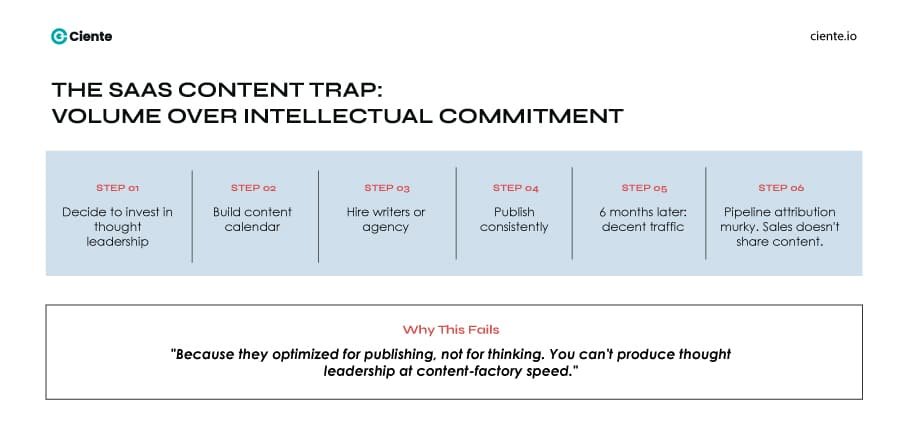
Here’s a common pattern in SaaS marketing-
A company decides to invest in thought leadership. They build a content calendar, often guided by a SaaS content marketing playbook. They hire writers or an agency. They publish consistently. Six months later, traffic is decent, but pipeline attribution is murky, and the sales team doesn’t share the content.
Why? Because they optimized for publishing, not for thinking.
You can’t produce thought leadership at content-factory speed. It requires people inside the organization, i.e., executives, product leaders, practitioners, to actually develop and defend a point of view.
That’s slower. It’s messier. It often can’t be delegated entirely to a content team.
The research backs this up.
According to B2B International, 37% of B2B companies with thought leadership programs describe them as “minimal,” meaning fewer than 5% of their internal experts actively contribute. Nearly everyone claims to practice thought leadership. But almost no one structures their organization to really support it.
The fix isn’t hiring more writers. It’s integrating content into how your company thinks, not just how it publishes. That means:
- Your subject matter experts must be part of the ideation process.
- Editorial decisions should be driven by “what’s true and interesting,” not just “what will rank.”
- Being willing to take positions in public that your competitors won’t touch.
It’s more challenging than a content calendar. It’s also the only version that works.
How SaaS Marketers Can Build Thought Leadership That Actually Compounds
Want to build something that compounds — something aligned with a long-term B2B SaaS growth marketing strategy that makes your brand the reference point in a category? Here’s where to focus.
1. Start with a narrow territory.
Don’t try to lead thought on the entire industry. Choose a specific pain point your buyers face and dive deep. the same focus required to define a strong SaaS product-market fit. Category authority comes from depth, not breadth.
2. Mine your product data.
What does your product see that nobody else does? Aggregate it. Anonymize it. Publish it. That’s the most defensible form of thought leadership because nobody can replicate your data set. Even small datasets are valuable if they’re specific and honest.
3. Anchor ideas to real people.
B2B buyers don’t follow brands. They follow people who think interesting thoughts.
Your thought leaders within your organization- the CEO, product head, and other customer-facing experts. Offer them the platform, nudge them to develop a perspective, and make it simpler to publish consistently.
4. Set a bar for positions, not just topics.
Before publishing anything, ask: Does this say something a competitor couldn’t or wouldn’t say? If the answer is no, it’s not thought leadership. It’s content marketing, and there’s nothing wrong with that, but don’t confuse the two.
5. Measure differently.
Thought leadership is notoriously hard to attribute in a last-touch model.
Track it through pipeline influence, deal velocity in accounts where prospects engaged with content, and qualitative sales feedback. and supporting SaaS metrics that reflect long-term impact. Is your sales team using the content in conversations? That’s a signal. If they’re not? Something’s off.
The compounding effect is real.
The compounding effect is real — especially when thought leadership is integrated into your broader SaaS growth strategies rather than treated as a standalone initiative.
The only hiccup? It takes 12-18 months of consistency to deliver clear returns. That’s a hard sell to a quarterly-focused revenue team. Make the case anyway.
Thought leadership in SaaS marketing isn’t dying. The generic version of it is.
Buyers want it more than ever. They’re just better at differentiating the real thing from its performance. That’s actually good news for marketers willing to do the harder work. Why? The field of genuine intellectual contribution is less crowded than the field of content production.
The opportunity is real.
The distance between what buyers want and what brands deliver has been the same even after two years. That gap is where category leaders get built.
The question is whether your organization is willing to invest in the substance of thought leadership, not just its format.