1. Strategy, in business speak, has become somewhat of a buzzword. Surface-level discussions on this topic dominate discourse. What is one thing about this concept you believe needs to be discussed but hasn’t been touched upon enough, especially as enterprises navigate AI, infrastructure modernization and sustainability pressures?
One thing that often gets lost when strategy becomes a buzzword is that strategy is fundamentally about choices. At the corporate level, it comes down to two questions: Where should we play? And how do we win? Those choices define who you want to be as a company, where you invest, what you build, who you compete with, what makes you different, and ultimately, how you’re going to win.
Strategy is also largely about pragmatism. Good strategy has to be pragmatic enough to operationalize and bring it into reality. It must be tied to what is happening on the ground.
In creating strategy, consider short-term, medium-term and long-term horizons. You must know not just what you’re going to do today and tomorrow, but the direction of travel. Know what your north star is and how you’re going to get there. The true north may not change, but the path to get there might.
Additionally, strategy is about creating value that is real and measurable. We’re not just doing things for the sake of doing things. We’re doing them to move the needle and add value, and we must ask who is benefiting.
Finally, strategy is about integration. Corporate strategy translates into go-to-market, portfolio, brand and all kinds of other strategies. But they can’t operate independently, they must be tied together through a unifying force. The goal of a well-executed strategy is to be that integrating force across all parts of the company.
The same principles apply as enterprises navigate AI, data infrastructure and sustainability. It’s about making choices around what data matters, where it sits and how you bring it together to drive value. It’s about pragmatism: not data for data’s sake, but data for outcomes. It’s about how data progresses over time, the value behind it and how it is integrated.
I apply those same strategic principles to how we think and plan around data, AI and emerging technologies.
2. As any strategist knows, leading or collaborating in a cross-functional team is easier said than done. While such approaches may look easy on paper, they seldom take ground reality into account. How can teams overcome the challenges associated with cross-functional collaboration and achieve their desired outcomes in a tangible way?
In many situations, strategy decks simply don’t translate to reality.
It’s not enough to say strategy is about data; strategy is fundamentally about people.
Many strategies and transformations fail because of the absence of change management.
One of my most important principles is that strategy starts with listening, specifically to the field and the people who actually do the work.
There’s a Japanese term, Genchi Genbutsu, that means “actual place, actual thing.” I think about it as the “go and see” principle: The best way to understand something is to go where the work is done, see how it’s done and then determine what you want to do about it.
You can apply that same principle to data. There’s a lot of fictitious, simulated and junk data sitting out there, and a smaller fraction of that actually matters. The question is: How do we tap the data that is real and usable and make real sense of it to drive real results?
3. Move fast and break things is a modern motto. Yet agility requires patience and the ability to identify market and perceptual gaps in thinking and behavior. How can a strategist balance patience with the speed at which they have to iterate?
The AI era is completely changing requirements for businesses. At the same time, macroeconomic and other disruptions happen almost daily, and markets are fluctuating dramatically.
However, patience is not a negative thing. Neither are speed and agility.
Both need to be built, but they need to be built in balance.
Hitachi is a great example. It’s a 100-plus-year-old company with a history, structure and traditions that can’t fluctuate on a daily basis. At the same time, however, Hitachi is consistently recognized among the world’s most innovative companies. It has figured out how to drive that balance.
The ability to see ahead, project with a longer horizon, sift signals from noise and plan accordingly allows you to be prepared and take action rather than being highly reactive. Hitachi’s planning horizon is not just the next year or even the next three to five years, it can extend decades into the future.
For me as a strategist, the translation is the importance of having a long-term vision, that north star, while also having the ability to twist, turn and pivot while getting there. We may know who we want to be three to five years from now, but tomorrow a major market disruption can happen. How do we adjust our interim strategies while keeping the long-term goal in place?
The same applies to data. When you deal with foundational data, that foundation needs to be trusted, secure, governed and high quality. But on top of that foundation, you can fine-tune, pursue emerging use cases and build in agility.
4. Go-to-Market has long been a fundamental concept in business. Yet, many teams don’t tap into its full potential. What is the vital piece or pieces of the puzzle that enterprise teams are missing out on, particularly when bringing complex technologies like AI, hybrid cloud and data infrastructure solutions to market?
AI is changing and challenging some of the fundamentals of go-to-market in the IT industry, especially when we talk about new and emerging technologies and solutions.
The first shift is in buying personas. Traditionally, companies like Hitachi Vantara have sold primarily to IT buyers. AI is driving a merger between business people, line-of-business leaders and IT. They are now having integrated conversations. Business people are becoming more technical, while technical people are under more pressure to become business-friendly so they can have a true conversation about value.
AI is also shifting buying criteria. In the storage industry, for example, buyers have traditionally focused on metrics such as price per bit, a relatively straightforward price-to-capacity relationship. Now that conversation is shifting toward questions about what is driving value, what use cases the technology supports and what it enables for the business.
AI is also shifting business models. Traditional business models in our industry have been focused on CapEx-type buying: a one-time purchase with support. We’re increasingly shifting toward as-a-service and consumption-based models, where you pay for the value you get and the amount you use.
That connects to another change: AI is shifting sales motions and skill sets. People who are used to operating in the old way need to learn new selling tactics, new selling tools and new processes for how they build and interact with customers. For example, prospects are increasingly using AI-enabled tools to research vendors, compare solutions and narrow their options before they ever engage with a seller. That puts more pressure on sales teams to move beyond basic product education and bring context, expertise and a clear articulation of business value to the conversation.
Finally, AI is accelerating the shift from selling products to selling solutions. That shift is not new, but AI is raising the complexity of the problems customers are trying to solve and increasing the need to bring infrastructure, software, services and expertise together around a business outcome. You’re not trying to push a product to a customer, you’re working to solve a problem. That requires flexibility around the bundle of products, services and software you put into the hands of customers.
Very rarely can one company do it all. The future of business is ecosystem-driven. You have to identify the partners that can come together as a coalition to meet the customer’s needs. That means going to market as an ecosystem and figuring out how value is shared across it.
In that context, I think the go-to-market motion is the new boundary of innovation. Tech companies have often looked at the product as the primary place where innovation happens. In a world driven by AI and emerging technology, go-to-market provides another dimension for innovation. Companies with the exact same product can completely differentiate themselves based on how they go to market, and that can determine whether they win.
5. Teams, especially in leaner environments, have to wear many hats: strategists, sales, marketing, etc. What practical takeaways can you share with teams that may be operating with limited resources or underdeveloped processes?
One of the biggest lessons the last few years have taught us is the way constraints can unlock innovation. Necessity is the mother of innovation. That lends itself to a few lessons for smaller organizations.
- Cross-functional is the name of the game. One of the biggest constraints to delivering value in the AI market right now is teams working in silos. Wearing multiple hats can be a good thing because it forces you into discussions where you’re looking at things not just from a marketing, sales, product, R&D, IT or finance perspective, but a combination of them all. That can become the secret sauce, as you may spot things that those working in silos cannot.
- Use the tools that are available to you. AI can be a massive tool in your hands that helps you cross boundaries and fill skill gaps. You may be a strong marketing person but not fully understand the mechanics of sales. AI can help you execute, or at least identify, where gaps are.
- Build your ecosystem. Your ecosystem is an advantage. Don’t try to do everything on your own. Trust your teams and your partners.
- Invest wisely. You have limited dollars at your disposal, and sometimes there is a tendency to over-rotate investment toward the areas you are already comfortable with. Instead, invest in the places where you are less comfortable so you can fill the gaps in the capabilities you don’t have.
- Keep in mind that lean teams are not necessarily a constraint. They can deliver winning results. You just have to figure out how to tap into the skills you have, identify the gaps you don’t have, and use AI and other tools to help you get there.
6. We are reaching a point where AI can simulate market models and automate the “analytical” parts of a GTM strategy. In an era of infinite noise, what is the role of human intuition in modern strategy? Is it a fallacy or the next frontier for organizational growth?
Understand what AI can and cannot do for you and how you, as a strategist, can best utilize it. AI is a fantastic data aggregator, but junk spawns junk. If your data is flawed, the strategic outputs will be flawed.
AI can also hallucinate. Human-in-the-loop oversight is still required, and that’s where you turn knowledge into wisdom. AI can process more data than any human ever could, but humans bring the judgment needed to apply that information in context. Also, AI is trained on data that exists from the past, but the future is largely unknown. You can train AI on what has happened and make projections forward, but ultimately a human can look down the road, think about what may be coming and understand how to make the right decision.
Strategy is also fundamentally about people and about identifying your secret sauce and differentiation. If every company in our space decided to use AI to create its strategy, we could all end up with the same strategies.
I think two dimensions will characterize the future of strategy.
- One is human-centered strategy. In a world flooded with AI and bots, there will be an elevated conversation around how strategy can be more human-centered and deliver value for stakeholders.
- The second is responsible strategy: How do we create something that is better for people, better for society, better for the planet and better for business at the same time, while making the best use of the resources available to us?
7. One thing that stands out is your emphasis on economic resilience. And that is the need of the hour for strategists and business leaders. What builds this ecosystem of resilience and growth even in challenging times, especially as organizations balance innovation, cost pressure and sustainability goals?
When we talk about sustainability, many people think of environmental or planetary sustainability. I think about it more broadly as the fundamental principles you follow to drive business longevity.
That means thinking beyond just the bottom line and considering what I call the double bottom line: not only what is good for investors, but what is good for the broader set of stakeholders.
Your stakeholders are your employees, customers, partners, the societies in which you operate and the planet at large. Are you delivering value for that ecosystem? When one part of the ecosystem is affected, the others can provide resilience. In that sense, longevity is synonymous with resilience. If you want to build a resilient business, your focus needs to extend beyond the bottom line.
The second piece of resilience goes back to the balance between patience and agility. Hyper-agility can break resilience when you become too reactive to whatever happens in the market. The better approach is to look ahead and ask: How do we build underlying resilience so that regardless of what changes at the surface, the fundamentals of the business are flexible enough to adapt while also staying the course and remaining consistent?
That starts at the top. Strategic resilience and strategic consistency require leadership teams to have clear, aligned goals, operate cross-functionally and drive the organization with clarity and purpose. Market volatility does not have to change who you are as a company. If you know what your core is, and your core remains intact, that is ultimately what gives you resilience.

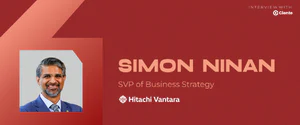
Simon Ninan, SVP of Business Strategy, Hitachi Vantara
Simon Ninan is the senior vice president of business strategy for Hitachi Vantara, the data infrastructure arm of global industrial powerhouse Hitachi and a market leader in AI-powered, mission-critical data platforms. In his role, Simon is responsible for developing and driving the company’s evolution towards growth, innovation and leadership in the AI era, bringing data to life through powerful solutions that drive real-world outcomes. The core pillars of this strategy include artificial intelligence, hybrid cloud and sovereign architectures, next-gen data centers, cyber-resilience, data management, and sustainability.
Simon is also a senior leader within the Corporate Strategy Office for Hitachi Ltd., the parent company of Hitachi Vantara. In this capacity, he leads advisory and business planning activities for regional tech-oriented and business model strategies that maximize cross-business synergies while capitalizing on emerging trends and opportunities.
Prior to Hitachi, Simon was a strategy leader with Monitor Deloitte consulting, including a stint as COO of its India practice. As an advisor to senior client executives across startups and Fortune 500 companies, he led several large-scale business and technology transformation programs, spanning new business and product standups, growth and scale programs, and business model transformations.
Simon has a passion for promoting responsible strategies that maximize value for business and society, and is a sought-after authority on the topics of AI data strategies and business models, data governance and sovereignty, and next-gen data center design. Simon holds a Bachelor of Engineering degree in Information Science and an MBA in Strategy and International Business; he resides with his wife and pre-teen son in the bustling Silicon Valley area.