CX management has been reduced to a checklist of channels. The organizations getting it right are asking a different question entirely: where does the experience break, and why does the customer feel it before we do?
The CX conversation has a channel obsession.
Omnichannel. Unified experience. Seamless touchpoints. Every piece of CX management literature circles back to the same argument: be everywhere your customer is, and make sure the experience looks the same in all those places.
This is not wrong. It is just not the thing.
A customer who encounters the same friction across five channels has not had an omnichannel experience. They have had five consistent disappointments. The channel strategy is fine. The experience is not. And no amount of channel unification fixes a flow problem.
What Customer Experience Management is really about
Every customer has a journey. Not the journey map your team built in a workshop with color-coded post-its, but the real experience that unfolds beyond structured customer journey mapping exercises. The actual path they take from first encountering your brand to deciding on using what they bought to deciding whether to stay.
That path has momentum, and it has places where the momentum stops.
Flow is the state where movement through that journey feels natural, something that effective customer journey orchestration aims to achieve across every interaction. The customer finds what they need before they have to think too hard about finding it. The next step is obvious. The information arrives before the question fully forms. There is no moment where they have to stop, recalibrate, and decide whether to continue.
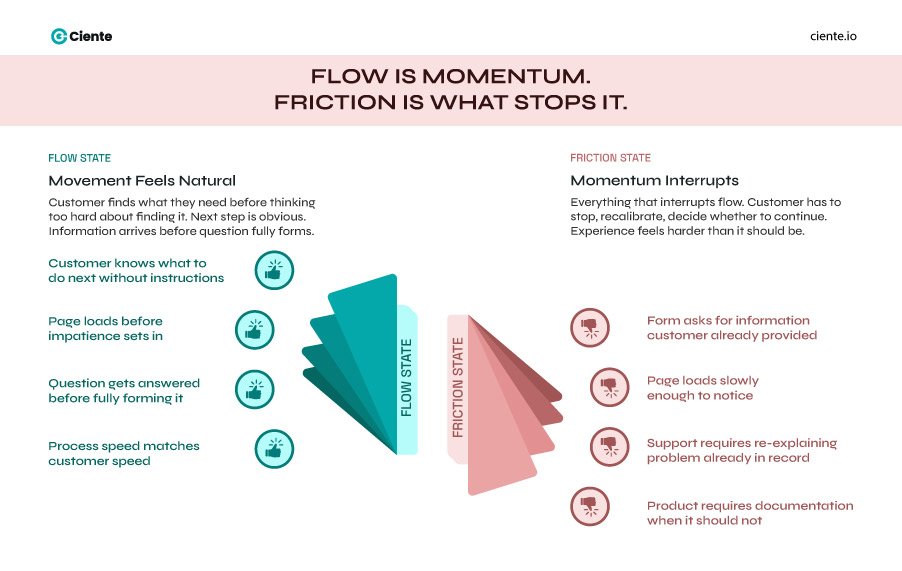
Friction is everything that interrupts that, often rooted in a lack of visibility that customer analytics can help uncover and address. A form that asks for information that the customer already provided. A page that loads slowly enough to notice. A support experience that requires re-explaining a problem that should already be in the record. A product that requires documentation to understand when it should not.
Friction is not always visible on a dashboard. But the customer feels it in the body before they can name it in a survey. They just know the experience felt harder than it should have been. And that feeling is the thing that decides whether they come back.
Where do customers spend more time than they should?
How can data analytics reveal those inefficiencies in real time? This question is where CX management gets honest.
Not where do customers spend time. Where do they spend more time than the task actually requires?
A customer who spends four minutes finding a phone number on a website spent three minutes and forty seconds in friction. A customer who has to re-enter a shipping address they already saved spent twenty seconds in friction. A customer waiting on hold after navigating an IVR that sent them to the wrong department spent however long that took in friction.
None of these register as catastrophic on their own. That is the problem. Friction accumulates below the threshold of the individual incident. No single moment is bad enough to document. The aggregate is what erodes the relationship.
The mapping exercise that matters is not a journey map. It is a friction inventory. Go through every interaction point a customer has with your organization and ask one question: does this take longer than it needs to? If yes, why? And what is the customer experiencing while they wait for it to resolve?
The answers to those questions are a CX roadmap that will do more for retention than any channel expansion.
Why do you encounter friction?
Friction has three parents, and they are rarely the ones who get held accountable.
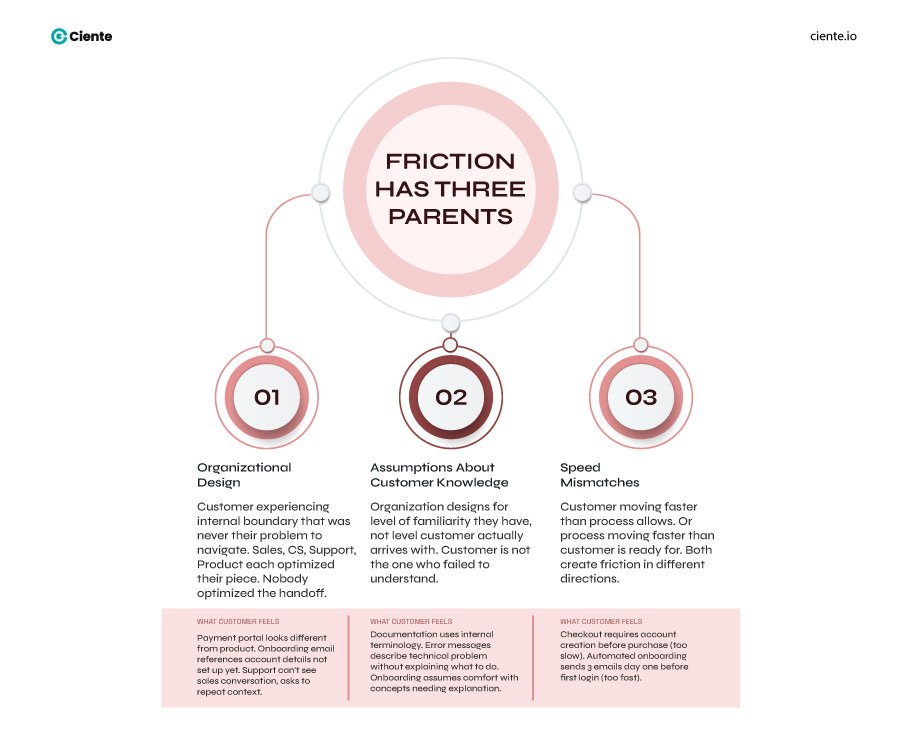
Organizational design. Most friction is the customer experiencing an internal boundary that was never their problem to navigate. Sales owns the pre-purchase experience. Customer success owns onboarding. Support owns service requests. Product owns the tool itself. Each team optimized their piece. Nobody optimized the handoff. The customer crosses those handoffs constantly and feels the seams every time.
The payment portal that looks different from the product they logged into. The onboarding email that references account details that have not been set up yet. The support rep who cannot see the sales conversation and asks the customer to repeat context that has been repeated twice. All of these are internal coordination failures wearing a customer experience face.
Assumptions about what the customer already knows. often stem from gaps in understanding customer behavior and psychology. Every organization knows its own product better than any customer ever will. That asymmetry creates friction when the organization designs for the level of familiarity they have rather than the level the customer actually arrives with. Documentation that uses internal terminology. Error messages that describe the technical problem without explaining what to do about it. Onboarding that assumes comfort with concepts that need to be explained.
The customer is not the one who failed to understand. The experience is the one that failed to explain.
Speed mismatches. Speed mismatches often emerge when marketing automation prioritizes efficiency over actual customer readiness. The customer is moving faster than the process allows. Or the process is moving faster than the customer is ready for. Both create friction in different directions.
A checkout that requires account creation before purchase is a process moving at the wrong speed for a first-time buyer. An automated onboarding sequence that sends three emails in the first day before the customer has logged in once is a process moving faster than the customer is ready for.
Matching process speed to customer speed is one of the most underrated CX improvements any organization can make.
Is your experience only digital?
This is the question that most CX frameworks skip, because digital is measurable and tangible is harder to quantify.
But brand is tangible. The customer holds it in some form, even when there is no physical product involved.
Think about what a customer actually carries with them between interactions with your brand, which ultimately shapes your customer value proposition. Not the app, not the website, not the email. The feeling they have about the organization. The story they tell themselves about whether they trust it. The memory of the last time something went well or badly.
That is the tangible brand. It is not a logo or a color palette. It is the residue of every experience accumulated into something the customer reaches for when they have to make a decision.
And here is what the digital-only view of CX misses: the tangible brand is built as much in the moments where nothing happens as in the moments where something does. The package that arrived better than expected. The email that remembered something personal about the account. The support conversation that ended with the problem actually resolved rather than technically closed. The renewal notice that arrived without a single piece of surprise pricing.
These moments are not digital or physical. They are human. They are evidence that the organization is paying attention.
The brands that customers hold onto are the ones that gave them something to hold. A story. A consistent experience of being understood. A track record of doing what they said they would.
Omnichannel is how you show up in the right places. Tangible brand is why the customer is glad you did.
The CX metrics that actually tell you something
Most CX dashboards measure satisfaction after the fact, even though advanced customer analytics platforms can provide deeper, real-time insights. NPS asks whether the customer would recommend. CSAT asks whether they were satisfied. CES asks whether the interaction was easy.
All useful. None of them tell you where the flow broke or why.
The metrics worth building are the ones that catch friction in motion.
Time-on-task. becomes more meaningful when analyzed through customer journey analytics that track behavior across touchpoints. How long does it take a customer to complete a specific action in your experience? Not the action as you designed it but as they actually do it. The gap between your assumption and reality is a friction map.
Drop-off at transition points. Where do customers leave a flow they started? A high drop-off rate at a specific step is not a mystery. It is a signal that something about that step is harder than what came before it. Find the step, understand the difficulty, remove it.
Repeat contact rate. If a customer contacts support and then contacts support again within seven days, the first interaction did not resolve the actual problem. It resolved the surface problem and left the root cause. Repeat contact rate is one of the most direct measures of CX quality available, and most organizations track it loosely if at all.
Silence. can be better understood when organizations unify their data through a customer data platform. The customer who stopped engaging and did not complain. Did not submit a ticket. Did not fill out the survey. Just quietly reduced their usage and eventually churned. This customer had a CX problem the organization never saw because the feedback channels only catch the people who feel strongly enough to respond. The rest leave without a data point.
Monitoring for early churn signals, engagement decline, feature abandonment, these are the early warning systems for a CX problem that has not escalated to a complaint yet.
The CX function most organizations have not built
There is a version of CX management that is a reactive function, often disconnected from broader customer success strategies. Something goes wrong, someone investigates, the experience gets patched.
There is another version that is a proactive one. A function that sits across the organization’s internal boundaries and is responsible not for any single touchpoint but for the coherence of the whole experience. That function maps the flow. It identifies the friction before it accumulates. It represents the customer in conversations where the customer is not in the room.
Most organizations do not have this function in a meaningful form. They have CX-adjacent roles scattered across teams that optimize locally. The customer experiences the aggregate.
Building that function is not a technology investment. It does benefit from alignment with customer acquisition strategies that ensure consistency from the first touchpoint. It is an organizational commitment to the idea that the experience as the customer lives it matters more than the experience as any individual team designed it.
That commitment changes what gets measured, what gets prioritized, and what gets fixed before the customer has to ask.
The customer flow does not care about your org chart. CX management that does not account for that will keep optimizing the wrong thing and wondering why satisfaction scores are not moving.