With B2B zeroing in on brand marketing, audio ads could take up the limelight again. But is marketing ready to take on the challenge head-on?
Channel and platform proliferation is a real deal for marketing. It’s actually marketing one of the most substantial pain points that’s only expanding in complexity. To avoid playing the blame game, the fault also lies with marketers.
It’s a cascading problem, a byproduct, not the actual one, but marketing has adopted such problems without realizing their long-term effects. Anything that they can justify or attach numbers to, they adopt- CTV, ABM, and intent signals are some examples that require no explanation, particularly with the growing focus on measurable marketing strategies.
Is it a Channel Problem?
Podcasts remain a trustworthy and one of the most consumed formats among professionals, making them a valuable channel within broader content strategies. From your CMOs and founders to your heads and VPs- all of them are tuned in.
However, B2B marketers are barely rushing to audio ads. Shouldn’t that be the logical follow-up?
The channel is highly talked of, but AI and automation sidelined the focus last year as marketers shifted toward AI-driven initiatives. Priorities changed- and now we are back to full-funnel and playbooks.
It’s marketing’s pattern, and we must stop pretending otherwise.
If you can follow up any buzzword with a “Here are 5 steps on how to…”, the industry will pay attention- not with the intent to understand, but with the need to duplicate it. That’s how short-term trends flourish in the first place.
The consequence?
B2B marketing teams are stretched thin. They’re overwhelmed. They’re managing SEO, paid search, LinkedIn, email, events, content, influencers, and more- with the same headcount as when there were merely four channels.
You question one of the marketing leaders about their channel mix, and they’ll list everything from LinkedIn to ABM, paid search to Quora. The reality behind the scenes- all of these are often managed by a team that hasn’t proportionally grown with the expectations placed on them, highlighting common marketing challenges.
Now someone suggests audio ads.
At first, audio seems like a channel that should be “given a try,” but it’s not merely adding audio to the mix. Think granularly-
- It’s another creative process to set up for.
- One more vendor relationship to manage.
- Another reporting gap that must be explained to stakeholders, especially when attribution models remain inconsistent.
- And another budget line to justify- the most crucial of all.
Cross out all the debate about reach, strategy, and even ROI. The true devil is in the details- it all boils down to having the room. The channel stack is already broken- and now you’re adding another one to a mix that your stakeholders still fail to trust.
Marketing’s operational reality is detrimental to the growth of audio ads.
Fatigue at the Nucleus of it All.
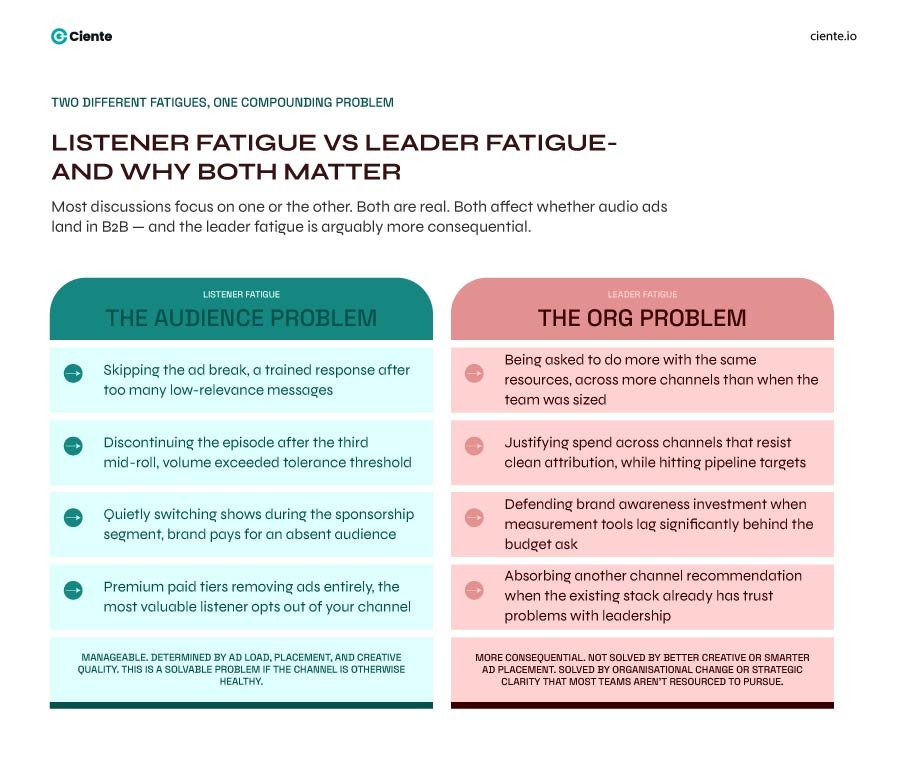
For quite some time, “fatigue” has been a constant term across all marketing conversations and messages. And rightfully so.
There’s an alternate version of this discussion that underscores listener fatigue, a concept closely tied to how audiences respond to repeated messaging.
It decodes the why behind the podcast audience skipping the ad break, listeners discontinuing the podcast episode after the third mid-roll, and those quietly switching shows during sponsorship.
All of these are fundamental to the space for audio ads in the podcast marketing sphere, and whether they can help brands grasp the erratic nature of consumer behavior.
Podcast listeners are unsurprisingly amidst the most attentive media consumers. The ads in the middle barely fazes them. The audience doesn’t stop supporting their favorite podcasts because they have ads, although there is a benchmark of how many ads they can listen to before it’s considered “too many.”
According to Sound Profitable’s Ad Nauseam, over 67% can tolerate up to 2-3 ads in a single episode. And over 35% of them would take a break and continue later if the number of ads were increased more than the typical.
However, this also hinges on where the ads are placed. Most obviously, prefer them to be either in the middle- serving as a break, or evenly spread throughout. That makes audio ads tolerable.
Tolerance is a huge factor in customer reactions to marketing messages and plays a key role in shaping engagement metrics. But most marketers oscillate between extremes- either it hits the mark, or it fails.
And the fatigue that B2B marketing leaders feel is different- it’s arguably more consequential. It’s the fatigue of being asked to do more with the same resources, justify spending across channels that resist clean attribution, and still hit pipeline targets that don’t align with brand awareness goals.
Audio ads, as a category, are almost entirely a brand play, aligning closely with long-term content marketing efforts. And branding is still the most challenging thing to budget for in B2B- because the measurement tools to defend it aren’t there yet. Attribution models continue to lag.
When you finally place audio ads in front of a CMO already fighting for budget across six other channels? It’s not an opportunity they’re missing out on. It’s yet another decision fatigue problem haunting them.
No One Wants to Pinpoint This Proliferation Problem
Channel proliferation is the silent crisis in B2B marketing right now, driven by the rapid expansion of tools and platforms. Every new platform, format, and tactic that gets validated elsewhere eventually lands on someone’s desk as a recommendation. And each one comes with its own tooling, learning curve, and reporting gap.
Audio is arriving at exactly the wrong time- when teams are already at capacity and leadership is pushing harder than ever for measurable, accountable spend.
The only scenario where audio doesn’t add to that pile-on is if it replaces something rather than sitting on top of it. Or if it’s ring-fenced as a brand budget that isn’t competing with demand gen dollars.
Both scenarios require a level of strategic clarity and organisational maturity that most B2B teams honestly aren’t equipped to handle.
So, Where Does That Leave Audio Ads?
Audio ads aren’t dead in B2B but remain a niche tactic within broader digital marketing strategies. However, they’re niche and should stay that way for now- at least until the measurement problem is solved, and teams have the headroom to experiment.
Brands want genuine value from the channels they invest in, focusing increasingly on measurable ROI. But that’s a lengthy game- from sponsoring specific podcasts that their ICP actually listens to and letting the host speak independently to measuring growth through brand recall and pipeline influence (rather than last-click conversion).
It’s a sophisticated play. And it requires a CMO who has stabilised everything else.
For everyone else focused on growth?
The reluctance to adopt audio presents a capacity gap. No amount of evangelising the format will change that until marketers are honest about what we’re asking marketing teams to take on.
The question was never really “does audio work in B2B?”
It has always been “Does B2B have the room for it right now?”
For most B2B teams competing in a tumultuous market, the answer is: not yet.