
The pricing model your SaaS marketing agency recommends says a lot about who benefits from the deal. Most buyers find out too late which side that is.
You get on a call with a SaaS marketing agency. The deck looks sharp. The case studies are impressive. The team seems to get your space. Then comes the pricing slide, and suddenly you’re nodding along to a structure you don’t fully understand, agreeing to terms you’ll regret in Q3.
It happens more than most SaaS leaders admit. Not because the agencies are dishonest, but because pricing models carry assumptions baked in, and nobody spells those out during the pitch. You sign on for “marketing support” and discover three months in that you’ve bought a reporting deck and a content calendar.
Before you write the first check, understand what each pricing model actually funds, and what it doesn’t.
The Four Pricing Models of SaaS Marketing Agencies
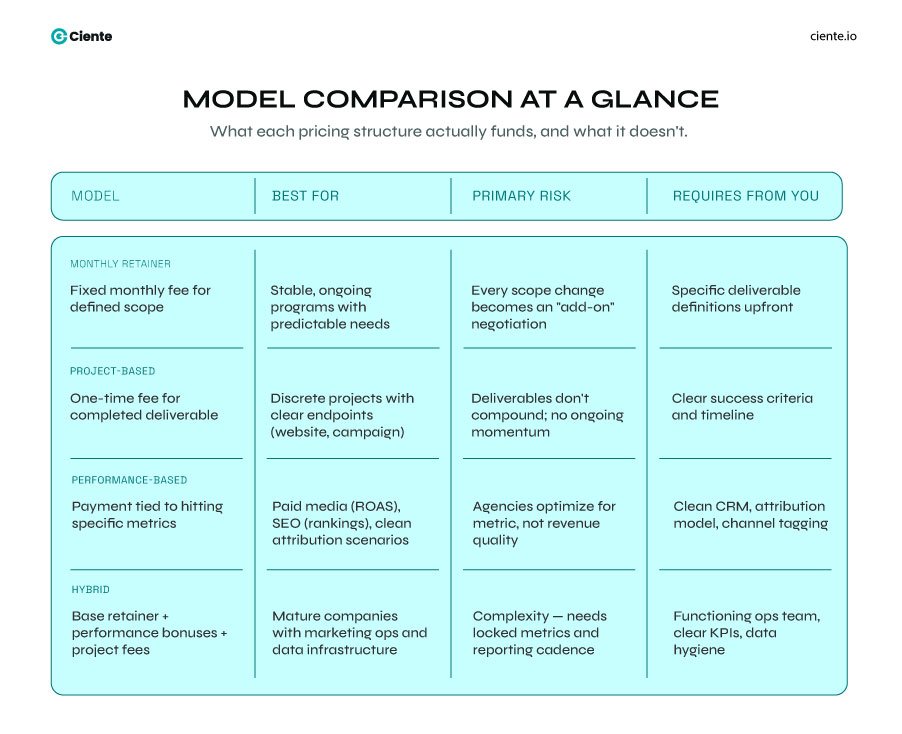
1. The Monthly Retainer
Talk to any SaaS marketing agency, and the retainer will be their default offer. You pay a fixed monthly fee, they deliver a defined scope of work, and both sides call it a partnership. Simple enough.
The word “defined” is where things get complicated.
Retainers look predictable on a spreadsheet. You know the line item, you know what the agency delivers, and the finance team stops asking questions.
But watch what happens when your priorities shift mid-quarter. A new competitor enters the market. Your ICP changes. Leadership now wants to do a campaign not included in the original scope.
Suddenly, every conversation with the agency includes the phrase “that would be an add-on.”
Agencies price retainers on perceived value, not on hours spent. That’s not inherently a problem, but you should be aware of it before the partnership.
A retainer built around a stable, predictable marketing program works. A retainer signed during a growth phase, when speed and flexibility matter most, starts feeling like a cage by month four.
When you evaluate a retainer, push the agency to be specific. What deliverables does the monthly fee actually cover? Who owns each one? What’s the process when you need something outside that scope?
Vague answers at this stage always become expensive arguments later.
2. Project-Based Pricing
Some SaaS companies aren’t keen on active agency relationships. They’ve a whole lot of marketing functions on their hands- whether it’s rebuilding a website, launching a campaign, or designing a content strategy from scratch.
Project-based pricing exists precisely for this.
On paper, it’s the cleanest model. Defined scope, defined timeline, defined cost. Once the project closes, the engagement ends. No retainer, no recurring dependency, no annual contracts.
The problem is that SaaS marketing doesn’t work like a construction project. A brand refresh doesn’t generate pipeline on its own. A messaging framework sitting in a Google Doc doesn’t acquire customers.
Project-based pricing buys you a deliverable, and deliverables don’t compound the way ongoing marketing does. Sustainable growth typically comes from long-term execution across channels, something many successful SaaS marketing campaigns rely on rather than one-off deliverables.
There’s also a practical issue with how agencies quote projects. Most of them build a buffer into the first number they give you. They’ve done enough engagements to know where scope shows up, and they price for it pre-emptively.
That buffer is a negotiation room that you must leverage.
Project-based pricing makes sense for discrete, time-bound requirements with clear success criteria. Use it for those. Don’t use it as a substitute for a real demand generation program. If you’re evaluating agencies for growth, it’s worth understanding how B2B SaaS marketing actually compounds through consistent demand generation rather than isolated projects.
3. Performance-Based Pricing
Every SaaS buyer, at some point, thinks performance-based pricing sounds perfect. The agency only gets paid when results come in. Aligned incentives. Shared risk. What could go wrong?
Quite a bit as it turns out.
Agencies operating on performance models optimize for the metric in the contract, full stop. This is why companies running SaaS performance marketing initiatives need clearly defined success metrics before entering a performance-based agreement. If you define success as MQLs, they’ll deliver MQLs. But without a structured qualification framework like a SaaS marketing lead scoring method, those leads rarely translate into revenue. Whether those leads turn into opportunities, whether sales can close them, whether they match your actual ICP- that’s outside the scope of their incentive.
They hit the number. You deal with the quality.
The other issue is attribution.
Performance pricing assumes you can cleanly trace outcomes back to the agency’s work. That requires solid CRM hygiene, clear channel tagging, and an attribution model your whole GTM team agrees on. Many companies also rely on modern SaaS marketing tools to track attribution and campaign impact accurately. Most SaaS companies aren’t there yet.
When attribution gets murky, performance-based engagements generate disputes and not results.
This pricing model works effectively only in specific situations. Paid media tied to ROAS. SEO work tied to ranking improvements on a defined keyword set. Demand generation with a pipeline contribution metric and clean tracking behind it.
In those narrow contexts, performance pricing creates real accountability. Outside them, it tends to create tension.
If an agency pushes performance pricing hard without asking how you track attribution, slow down. That enthusiasm usually means they know how to hit a metric, not how to grow your business.
4. Hybrid Pricing
Most agency relationships that last more than a year end up here, whether intentionally or not.
A base retainer funds the ongoing work. Performance bonuses activate when specific targets land. Project fees cover one-off needs that fall outside the core scope.
Hybrid pricing models exist because pure models break down at the edges. As SaaS businesses scale and diversify acquisition strategies, pricing structures often evolve alongside broader SaaS market trends. Retainers without accountability get complacent. Performance models without stability produce erratic behavior.
Hybrid structures try to solve both problems at once.
They mostly prove effective, but with specific complexities. You need clearly defined metrics, approved reporting cadences, and a shared understanding of what counts as a win.
If those things aren’t locked down in the contract? The performance component no longer works as a motivator and becomes a point of argument.
For SaaS companies with a functioning marketing ops team and clean data infrastructure, hybrid pricing is usually the right destination. Get there intentionally.
What the Pricing Structure Won’t Tell You
Every pricing model of a SaaS marketing agency is ultimately just a billing structure. It tells you how money moves. It doesn’t tell you whether the agency thinks clearly, understands your market, or will hold their own opinion when yours is wrong.
That last part matters more than most buyers realize.
The best SaaS marketing agency relationships work because the agency pushes back when the client is chasing the wrong metric or funding the wrong channel. That only happens when the agency has real conviction about the work. And conviction doesn’t show up in a pricing slide.
So before you spend time comparing pricing structures, evaluate the team:
- Look at what they’ve built for SaaS companies at your growth stage.
- Ask about client churn on their end.
- Find out who actually runs the day-to-day on your account versus who ran the pitch. Those two people are rarely the same person.
Red Flags Hidden in SaaS Agency Pricing
Some things to watch for, regardless of the model you choose.
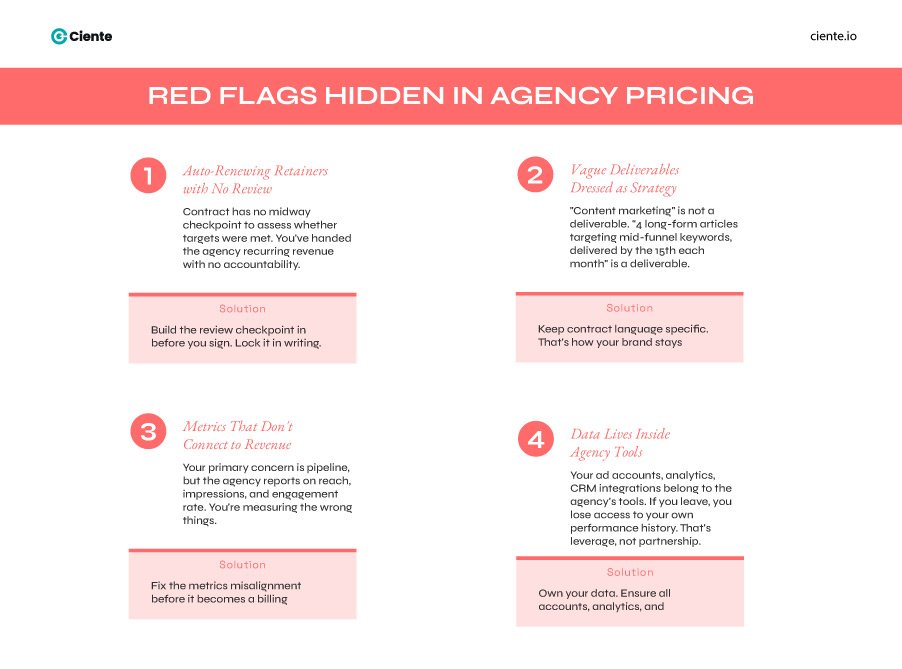
1. Auto-renewing retainers with no performance review built in.
Your contract should include a midway checkpoint to assess whether targets were met. And if there’s no such thing? You’ve handed the agency a recurring revenue stream with no accountability attached.
Solution: Build the review in before you sign.
2. Vague deliverables dressed up as strategy.
Content marketing is not a deliverable. But you know what is?
“4 long-form articles that target mid-funnel keywords, delivered by the 15th of each month. And performance review within 90 days.”
Solution: Keep the contract language specific. That’s how your brand remains protected when things drift.
3. Metrics that don’t connect to revenue.
You’re measuring the wrong things if your primary concern is pipeline and the agency reports on reach, impressions, and engagement rate. Ultimately, SaaS leaders should align reporting with good marketing ROI for SaaS rather than vanity metrics.
Solution: Fix the metrics misalignment before it becomes a billing argument.
4. Data that lives inside the agency’s tools.
Your ad accounts, your analytics, and your CRM integrations should belong to you. Some agencies build pricing models that create data dependency, intentionally or not. This is one of the common mistakes in outsourcing SaaS marketing that companies only discover after switching vendors.
If you ever leave, you lose access to your own performance history. That’s not a partnership structure. That’s leverage.
Solution: Collate and exchange data points that align across the dashboard.
Getting Your Pricing Model for SaaS Marketing Agency Just Right: The Loophole
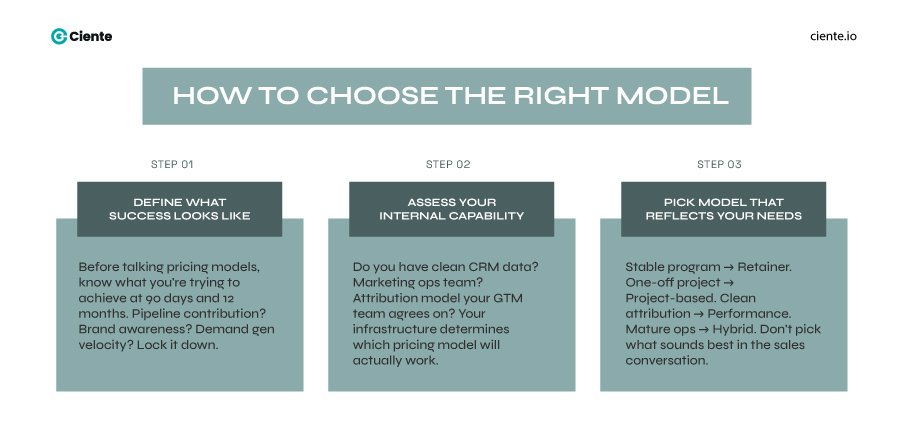
The pricing models of SaaS marketing agencies shape incentives, and incentives shape behavior. Pick the model that reflects your needs, not what sounds best in the context of a sales conversation. The right decision usually aligns with your broader B2B SaaS market strategy and long-term growth plans.
The SaaS companies that get real ROI from agency relationships share one trait: they dive into the engagement with more specificity than the agency expects. They know what success looks like at 90 days and at 12 months. They know how they’ll measure it.
And they hold the agency to both, in writing, from the first day.
That specificity matters more than which pricing model you choose. Get that right, and the billing structure is just a detail.