Outsourcing SaaS marketing fails less from bad agencies and more from internal gaps in strategy, ownership, and alignment that companies overlook.
Outsourcing SaaS marketing is one of the more rational decisions a growth-stage company can make. You get access to people who have done this before, those who bring perspective from working across multiple categories, and move faster than a team you are still building.
The logic for outsourcing SaaS marketing holds.
And yet, the pattern we keep seeing remains the same. It’s the agency’s fault when the numbers stagnate
. Most brands wait for the existing contract to end and then hire a new agency.
The cycle starts over.
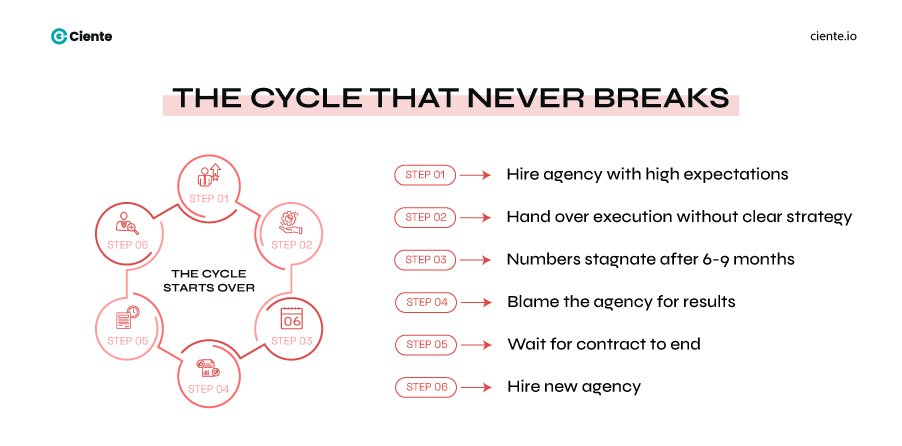
What doesn’t get examined is the set of decisions the company made before and during the engagement that made failure almost inevitable.
The mistakes that actually halt impact and cause organizational dysfunction in outsourced SaaS marketing are not the ones that make it onto the post-mortem. They often stem from deeper gaps in B2B SaaS marketing strategy that were never addressed internally. They are structural. They happen at the level of strategy, ownership, and internal alignment. And most marketing teams, even experienced ones, still can’t see them clearly enough to correct them.
The Mistakes in Outsourcing SaaS Marketing That Actually Cost You
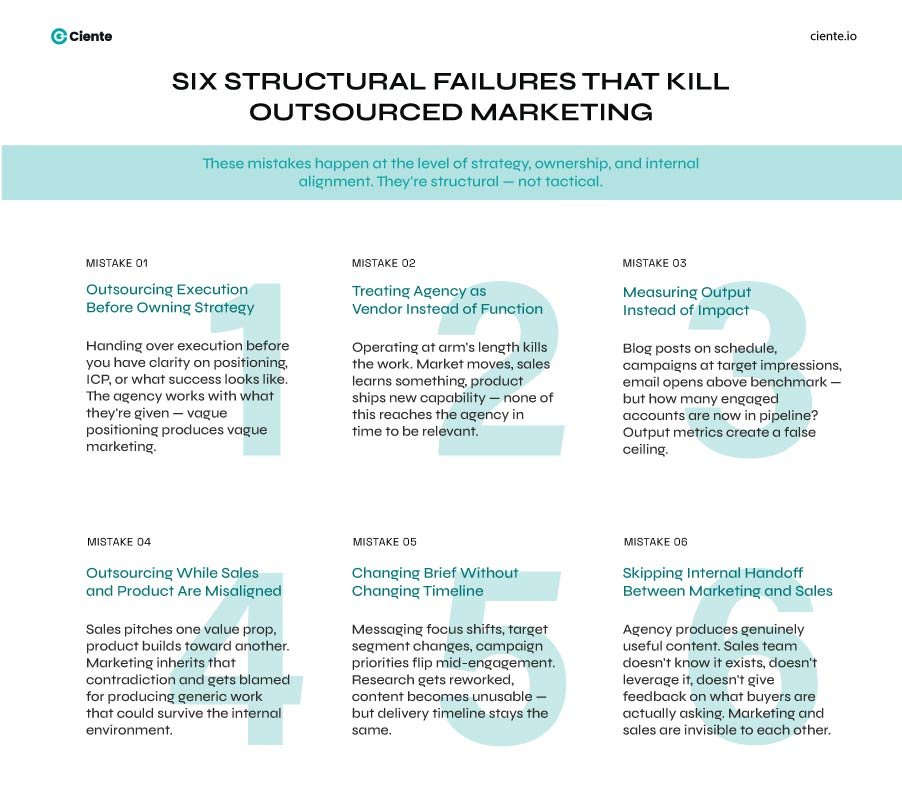
Outsourcing Execution Before Owning the Strategy
The most common mistake SaaS companies make when outsourcing marketing is handing over execution before they have clarity on their own strategy. The assumption is that the agency will figure it out. They are the experts, after all.
What actually happens is that the agency works with what they’re given.
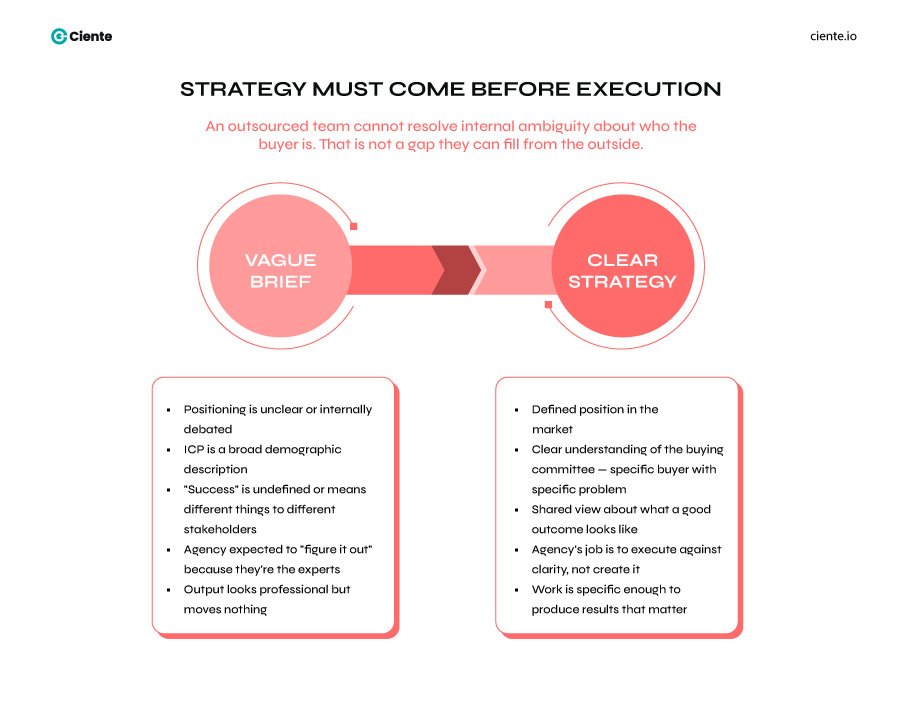
If the positioning is vague, they market something as vague. Without a clear understanding of the company’s SaaS product-market fit, even the best marketing execution struggles to resonate with buyers. If the ICP is a broad demographic description rather than a specific buyer with a specific problem, they produce content for that broad description. The output looks professional. It covers all the right channels. And it moves nothing, because the brief was never specific enough to produce anything that would—an issue many teams encounter when building a SaaS marketing funnel without clear buyer insight.
An outsourced team cannot resolve internal ambiguity about who the buyer is. That is not a gap they can fill from the outside.
The SaaS companies witnessing real returns from outsourcing are those that come in with a defined position, a clear understanding of the buying committee, and a view about what a good outcome actually looks like. The agency’s job is to execute against that clarity, not to create it.
Treating the Agency as a Vendor Instead of a Function
When a SaaS company operates an outsourced marketing agency at arm’s length, it becomes a transactional relationship. That kills the work.
The agency receives a brief => delivers against it => receives feedback two weeks later => adjusts.
Meanwhile, this is what’s happening:
- The market is moving
- Your sales team has learned something important from recent calls
- The product has shipped a capability that changes the story entirely.
None of this information reaches the agency in time for it to still be relevant. The organizational dysfunction this creates is subtle yet serious.
The internal team starts treating the agency as a supplier to manage rather than a function to work with. The agency, sensing the distance, stops proactively raising strategic questions and focuses on delivery.
And the company ends up with technically competent marketing that is consistently a half-step behind where the conversation actually is.
The SaaS companies that avoid this integrate the agency into their internal rhythm. Sales calls. Product reviews and quarterly planning. The agency needs the same context your VP of Marketing would need to make good decisions, and creating that access is the company’s responsibility, not the agency’s.
Measuring Output Instead of Impact
Ask a marketing team how their outsourced agency is performing. The answer you receive is almost always framed in outputs, rather than whether the work contributes to a measurable marketing ROI in SaaS. The answer you receive is almost always framed in outputs. The blog posts went out on schedule. The campaigns reached the targeted impressions. The email open rates were above benchmark.
What you rarely hear is how many of the accounts that engaged with that content are now in the active pipeline, and whether the deals that did close had any meaningful interaction with what marketing produced.
The reason this matters is that output metrics create a false ceiling—especially when companies rely on surface-level engagement data instead of deeper SaaS marketing performance metrics.
This is what happens when the agency is hitting deliverables, and that’s the only focus.
There’s no urgency to ask challenging questions about whether the campaigns are reaching the right people or changing perspectives. The engagement numbers justify the spend, and the contract is renewed. But the disconnect between marketing activity and revenue contribution stays invisible.
Vanity metrics are not a neutral measurement problem. They actively try to prevent a feedback loop that would force both the company and the agency to rethink the work.
And in B2B SaaS? A campaign that generates traffic but never reaches the three people who actually make the purchase decision is not a partial success. It’s a full miss.
Outsourcing Marketing While Sales and Product Are Misaligned
One of the more damaging things a SaaS company can do is bring in an outside marketing team before it has resolved the internal disagreement about what the product actually is and who it is for. These internal debates are often part of defining a clear B2B SaaS market strategy.
When sales is pitching one value proposition, and the product is building toward a different one, the marketing agency inherits that contradiction. They will surface it in the work because the work requires them to commit to a specific message, and that commitment will expose the fact that no one internally has done the same.
What follows is a cycle of revision that has nothing to do with the quality of the agency’s work.
The brief changes because the internal conversation about positioning hasn’t concluded. The content is revised because a stakeholder in a different function has a different buyer perspective. The campaign goes live late, with language that has been softened by committee until it says nothing specific about anything.
The agency is blamed for producing generic work. But the generic work was the only output that could survive that internal environment. The real failure was organizational, and it happened before the agency was ever briefed.
Changing the Brief Without Changing the Timeline
SaaS companies are fast-moving by nature, and the instinct to respond to new information quickly is not wrong. The problem: What happens when that instinct gets applied to an outsourced marketing engagement? And there’s no accounting for what a brief change actually costs?
The agency must rebuild when a company changes its messaging focus, its target segment, or its campaign priorities mid-engagement. Research gets reworked. Content that was in production becomes unusable. The channel mix must be reconsidered.
None of this is fast or free. But it happens internally at the agency and isn’t always visible to the client. The expectation remains that delivery will continue on the original timeline.
The organizational dysfunction this creates is a persistent tension between the client’s need for agility and the agency’s need for stability. The agency gradually learns to build in a buffer, and the client learns to distrust timelines. Both parties are stuck managing the relationship rather than the work.
The solution? It’s a clearly documented change management process that’s agreed on before the execution. It’s not negotiated mid-flight when both sides are already frustrated.
Skipping the Internal Handoff Between Marketing and Sales
A SaaS company can outsource the production of genuinely useful marketing content and still see zero return because the internal handoff between marketing and sales was never designed. This disconnect often appears when companies build SaaS lead generation programs without aligning teams around how leads are actually converted.
The sales team isn’t aware it exists, doesn’t leverage it in conversations, and does not give the agency feedback on what questions buyers are actually asking during the evaluation process.
What this produces is a marketing function and a sales function that are technically working on the same problem but are functionally invisible to each other.
The agency is producing content based on assumptions about the buyer that sales disproved six months ago, and sales are having conversations that marketing content could support, but doesn’t because no one built the bridge.
This is one of the most consistent and avoidable failures in outsourced SaaS marketing. The fix does not require a new tool or a new process. It requires someone on the internal team to own the connection between what the agency is producing and what the sales team actually needs. You must treat that as a standing responsibility rather than a quarterly check-in.
What the Pattern in Your Outsourcing Errors Is Actually Telling You
Look across these mistakes, and the common thread is not the agency. Marketing agencies are doing what they were asked to do. The thread is that SaaS companies consistently outsource marketing without doing the internal work that would make the outsourcing productive.
The positioning conversation should have happened before the agency was briefed. The alignment between sales and product should have been resolved before anyone wrote a content brief. The decision about what success looks like should have been made before the first campaign launched.
These are not things an agency can do for you.
The uncomfortable truth that most post-mortems overlook: the dysfunction the outsourced agency highlighted was already present within the organization. The agency didn’t create the misalignment between sales and marketing. They made it visible by trying to produce work that required both functions to agree on something.
The response is usually to blame the agency for the friction rather than to address the underlying disagreement that the agency’s work exposed.
Outsourcing SaaS marketing is successful when the company treats it as an extension of a clear internal strategy, not as a substitute for one.
The companies that partner correctly can highlight things about their market, messaging, and buyer that they would not have learned any other way. And those that get it wrong? Spend the budget, rotate through agencies, and keep asking why the numbers aren’t moving.
The numbers aren’t moving because the question was never really about the agency.