
Full-funnel marketing is not a campaign. It is how B2B teams win before the meeting is ever scheduled, and most companies are only working the bottom half of it.
The sales team is losing deals it never knew it was in
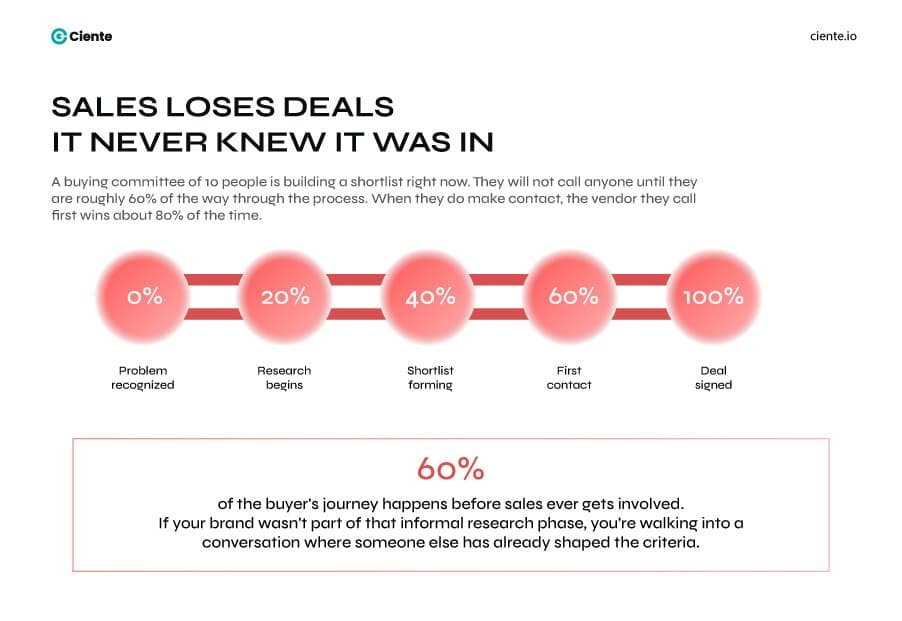
Somewhere right now, a buying committee of ten people is building a shortlist. They are reading comparison articles, watching demos on YouTube, asking peers on LinkedIn, and forming opinions about which vendors understand their problem and which ones are just selling. They will not call anyone until they are roughly 60 percent of the way through that process. When they do make contact, the vendor they call first wins the deal about 80 percent of the time. The vendors who did not make the shortlist will never know the conversation happened.
This is not a sales problem. It is a marketing problem. Specifically, it is the problem that happens when a company treats marketing as communication rather than what it actually is: the management of people, at scale, across time, in ways that determine whether the company is profitable or not.
Full-funnel marketing is the structural answer to that problem. Not the buzzword version, not the agency deck version with the colorful funnel graphic and three tiers labeled awareness, consideration, and decision. The real version, which is considerably less tidy and considerably more valuable. If you want a deeper breakdown, here’s a detailed guide to building a full-funnel marketing strategy that aligns marketing with revenue outcomes.
The Numbers Behind the Problem No One Wants to Name
Here is what the data says is actually happening. The average B2B win rate sits around 20 to 21 percent, a number that becomes more concerning when compared against industry B2B SaaS funnel conversion benchmarks. Sales cycles are 38 percent longer than they were in 2021. The typical buying group spans 10 to 11 stakeholders, and in enterprise deals that number can reach 17. Eighty-four percent of sales reps missed quota last year.
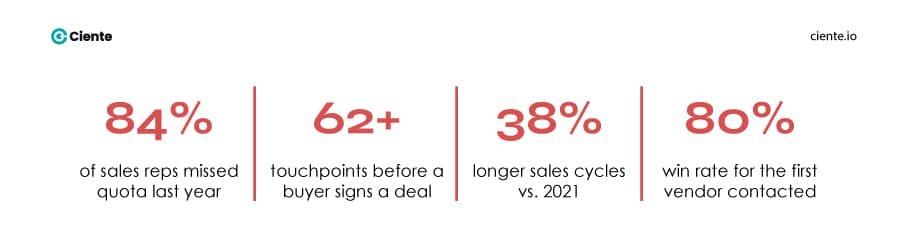
These are not numbers from a down market. Many of the companies behind these reps are growing revenue. The reps are missing quota inside growing companies because the pipeline they are working is structurally broken upstream.
The touchpoint problem most marketing leaders underestimate
The average B2B buyer engages in 62 or more touchpoints before signing a deal, spanning at least three channels and involving multiple members of a buying committee. Most marketing organizations are actively managing perhaps a third of those touchpoints. The rest are happening without them, in spaces they are not present, in conversations they are not part of, among stakeholders they have never tried to reach.
That is the gap the full-funnel strategy closes. It requires intentionally designing each stage of the journey, similar to how you would build a B2B sales funnel from awareness to revenue. Not by being everywhere randomly, but by being specifically present at the moments that shape how a buying group thinks about a category before they think about vendors.
What Full-Funnel Marketing Actually Means, and What It Does Not
Full-funnel is not a synonym for doing more marketing. It is a structural commitment to being present, credible, and useful at every stage of a buyer’s journey, not just when that buyer is ready to talk to sales, which is where many lower-vs-upper funnel marketing misunderstandings begin. It is a structural commitment to being present, credible, and useful at every stage of a buyer’s journey, not just when that buyer is ready to talk to sales.
In B2B, buying decisions are not made by individuals. They are made by groups, typically six to ten stakeholders with different priorities, different vocabularies, and different definitions of risk. A champion inside the organization may love your product. The CFO has not heard of you. The IT lead has concerns about integration that no one has addressed yet. Full-funnel strategy is the discipline of reaching all of them, with the right message, before any of them is formally in a B2B buying process.
By the time a prospect fills out a form or takes a sales call, the majority of their evaluation has already happened. If your brand was not part of that informal research phase, you are walking into a conversation where someone else has already shaped the criteria.
The shortlist is built before the search begins
94 percent of buying groups rank their shortlist in order of preference before initiating contact with sales. The vendor ranked first wins about 80 percent of the time. Read that slowly. The rank ordering is done before anyone picks up the phone. The deal is largely won or lost in a process that most sales teams have no visibility into and most marketing teams are not deliberately influencing.
Buying authority, the condition in which your brand is assumed to belong on the shortlist, is not awarded on the day someone fills out a form. It is accumulated over months of consistent presence, relevant content, and the kind of thought leadership that answers the question a buyer has before they know how to ask it publicly.
Why the Sales and Marketing Tension Is a Funnel Problem in Disguise
The tension between sales and marketing in B2B organizations is almost always a funnel problem. Sales says the leads are not ready. Marketing says sales is not following up. Both are usually right, and both are symptoms of a pipeline that was built without coordination across the full journey.
What changes when marketing works the whole funnel
When top-of-funnel investment is creating genuine awareness and category education, middle-of-the-funnel content is addressing the specific concerns of different buyer personas, and bottom-of-the-funnel assets are arming champions with materials to build internal consensus, the prospect who reaches sales is a different person. They have self-qualified. They have done some of the internal selling work because the content they consumed gave them the tools to do it.
86 percent of B2B deals stall before crossing the finish line, which is why structured lead nurturing strategies become critical to maintaining momentum across long buying cycles. A buyer who arrives with trust already built stalls at a very different rate than one who arrives skeptical and under-informed.
The frictionless experience is a revenue number, not a UX metric
97 percent of B2B buyers say a fast, easy digital experience is a key part of vendor evaluation, reinforcing why SEO for SaaS and digital discoverability are no longer optional in competitive markets. Buyers are also consumers. They are accustomed to experiences that anticipate their needs, and when a B2B buying process is opaque or misaligned with where they actually are in their thinking, they do not wait. They move toward the vendor who makes it easier. Friction at any stage of the funnel is not a design problem. It is a revenue leak.
What Leaders Should Actually Demand From Their Marketing Teams
The organizations that will win the next decade of B2B competition are not the ones with the biggest campaign budgets. They are the ones who understand marketing as the discipline of managing buyers profitably across time. That means measuring influence across the full cycle, not just the last click. It means investing in awareness even when the return is not immediately attributable. It means aligning marketing and sales around a shared definition of what a ready buyer actually looks like.
The compounding advantage most teams are leaving behind
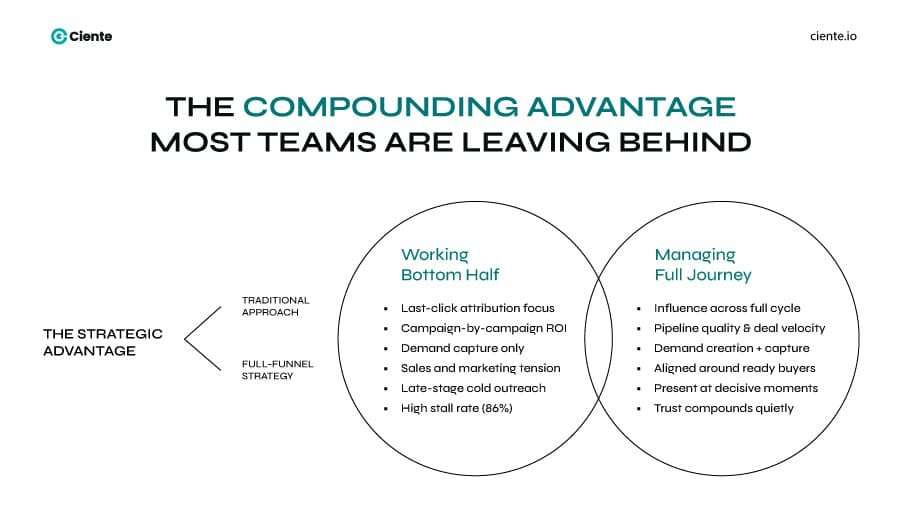
Full-funnel marketing asks more of teams and more of leadership. It requires patience for the investments that compound quietly, and discipline to protect them when quarterly pressure arrives. What it returns, in pipeline quality, deal velocity, and customer lifetime value, is not a soft promise. These improvements are often visible when teams track the right SaaS metrics across acquisition, activation, and retention.
The company that has educated the CFO about ROI frameworks, addressed the IT lead’s integration concerns through well-placed technical content, and given the internal champion the language to build internal consensus, that company is not competing on the same terms as the vendor who showed up with a cold outreach sequence in month nine of a ten-month buying journey.
None of this requires an unlimited budget. It requires a different orientation. The companies that compound their competitive advantage are not necessarily the ones with the most sophisticated technology stacks. They are the ones that understand a simple thing clearly: a customer relationship begins long before a contract is signed, and the value of that relationship, its length, its depth, its profitability, is determined largely by what happened before the first sales call.
Marketing is not the department that explains what the product does. It is the function that manages how people think, feel, and decide profitably, across the entire arc of their journey.
The funnel has always been there. Most companies are only working the bottom half of it. That is the gap, and it is solvable. Not with more campaigns. With a strategy built around the buyer’s full journey, from the moment they develop a problem to the moment they sign a contract, and every quiet, decisive moment in between.
That is not a brand story. That is a business model.