
Marketing teams have more data today than they’ve ever had: open rates, click-through rates, conversion dashboards, attribution reports.
Nearly every interaction a customer has with a brand gets measured and logged somewhere now. You can even see this shift in Google’s evolving sender requirements, which weigh recipient engagement and inbox behavior alongside technical compliance. Even mailbox providers stopped treating raw send volume as a meaningful number on its own.
Still, most companies can’t answer one simple question: is customer behavior actually getting better?
Customers open emails and lose interest anyway. They click links without becoming more loyal. They engage with individual campaigns and quietly drift away from the brand as a whole. It’s not really a data problem most lifecycle programs just get judged by campaign results instead of how customer behavior changes over time.
Metrics record what already happened, which is useful but limited. Behavioral signals fill in the part campaign metrics usually miss: why something happened, and where customer behavior might be heading next. That’s the real shift lifecycle marketing needs right now, from metrics-first thinking to signals-first thinking.
Why Traditional Lifecycle Marketing Metrics Are Losing Their Edge
Lifecycle teams have leaned on a familiar set of metrics for years now: open rates for visibility, click-through rates for engagement, conversion rates for outcomes. These metrics still have a job. They’re only good for answering one question: what happened?
Which is exactly where the trouble starts.
Most traditional KPIs are lagging indicators; they capture an outcome once it’s already taken shape. Fine for describing the past. Not so good at explaining why customers behaved a certain way, or what’s coming next.
Here’s a case worth knowing. Open rate climbs for a few months straight, and the team reads it as good news. But on its own, the metric can’t say whether customers are actually moving forward in their relationship with the brand. People keep opening emails out of habit, or just because they recognize the sender, while their trust in the communication quietly erodes underneath.
CTR has its own version of this problem. Customers click links, browse pages, consume content the metric dutifully records all of it. But if retention is dropping at the same time, none of that activity is going anywhere. There’s no progression behind it.
And that’s how one of the more dangerous traps in lifecycle marketing takes shape: campaign metrics look perfectly healthy while customer engagement with the brand quietly falls apart underneath. Traditional KPIs were never built to catch that in time.
Metrics vs. Signals: What’s the Difference in Lifecycle Marketing?
Marketers use these words as if they mean the same thing. They don’t.
| Header label | Metrics | Signals |
|---|---|---|
| Answer the question | What happened? | Why did it happen? |
| Orientation | Past | Future |
| Focus | Campaign | Customer |
| Reveal | Outcome | Intent |
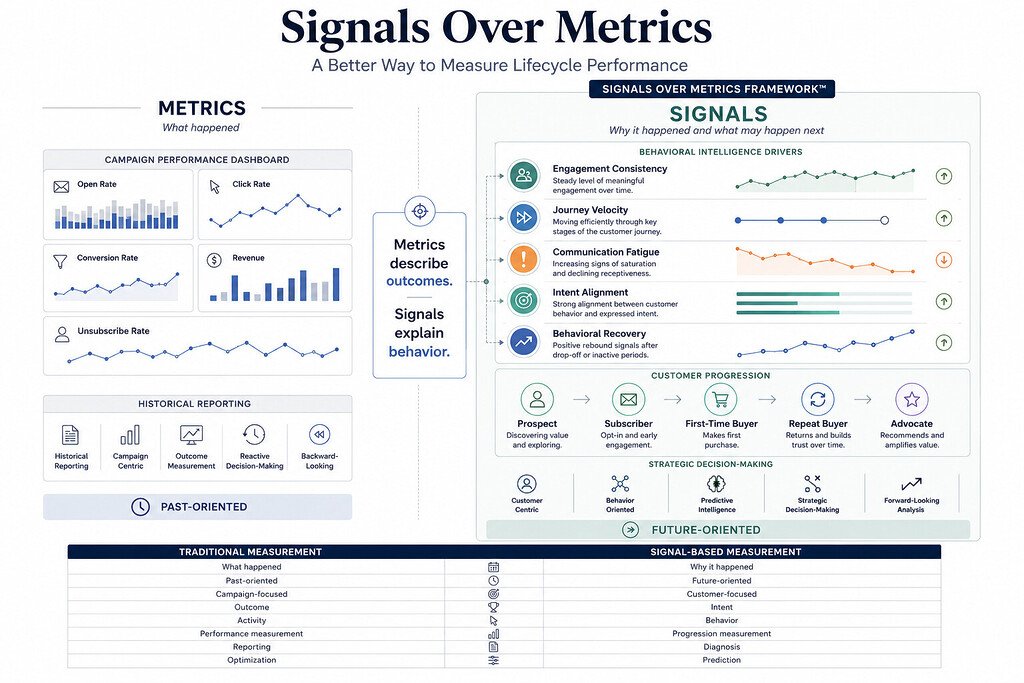
Metrics measure outcomes open rates, click-through rates, conversions, revenue. Run a campaign, check the numbers, see if it worked. Clean, useful, limited.
Behavioral signals track something harder to quantify: whether patterns are changing. Is this customer engaging more consistently than last month or less? Is the average time to purchase getting shorter across a segment, or longer? Is any of this communication landing differently than it was 60 days ago? These are the questions signals are built to answer and they tend to surface problems earlier than any campaign report will.
Here’s the framing I find most useful. Signals are the navigation. Metrics are how you know you actually got somewhere.
The Signals Over Metrics Framework
I’ve audited a lot of lifecycle marketing programs over the past several years, and one pattern kept showing up everywhere: strong campaign metrics sitting right next to weakening customer progression. That’s basically where this framework came from.
It has five interconnected layers. Each one answers a different question, and together they give you a practical way to read lifecycle performance beyond whatever the campaign metrics alone can show.
Layer 1. Customer Progression
Lifecycle marketing isn’t really about engagement for its own sake — it’s about moving customers between stages:
Prospect → Subscriber → First-Time Buyer → Repeat Buyer → Advocate
Skip the movement between stages and even strong engagement won’t create lasting value. The first question any team should ask is simple: are customers actually moving forward, or just staying put?
Layer 2. Behavioral Signals
Every interaction leaves a piece of a story behind timing, how consistently someone shows up, what kind of content they’re drawn to, how fast they make decisions. Here’s what metrics don’t do: they record an outcome but skip the explanation. Behavioral signals fill that gap. They explain the process that produced the outcome, which means a team can catch a shift before a report ever surfaces it.
Layer 3. Signal Quality
Not all signals are created equal. The same click can mean genuine interest, a random tap, or pure muscle memory. So the question isn’t just how much activity there is it’s what that activity actually reflects. A customer whose engagement is becoming more deliberate and consistent is fundamentally different from one who’s clicking out of habit while slowly checking out.
Layer 4. Progression Velocity
Speed matters here, not just direction. A subscriber who becomes a buyer in two weeks tells a different story than one who takes four months. When velocity drops across a segment when the average time between stages quietly stretches that’s usually friction or communication overload announcing itself early, well before it shows up in revenue figures.
Layer 5. Outcome Validation
Traditional metrics don’t disappear in this framework. Revenue, retention, and conversions still matter. Their role just shifts. Instead of leading the strategy, they confirm it. Signals tell you where customers are heading; metrics tell you whether they got there.
Why Customer Progression Matters More Than Campaign Performance
Businesses don’t make money from clicks. Revenue comes from movement a visitor turns into a subscriber, that subscriber eventually buys something, comes back for more, and at some point starts recommending the brand to people they know. Each of those transitions is where real value gets created, and the whole job of lifecycle marketing is to make those transitions happen.
Campaigns are supposed to support that process. The problem is when they become a proxy for it. A campaign can hit every benchmark it was given and still not move a single customer forward in any meaningful way. HubSpot’s own research on email ROI gets at this directly open rate and CTR are legitimate optimization signals, but they don’t answer whether any of that engagement is turning into purchases, loyalty, or long-term retention.
Picture a team that’s been doing everything right by the numbers. Nurture sequences, reactivation flows, trigger-based messages the automation stack is solid, and every report confirms it. Emails get opened. Links get clicked.
Now look one level deeper. Conversion to first purchase: flat. Repeat purchase rate: not moving. The emails are landing, people are engaging but none of it is translating into the kind of customer behavior that actually builds a business. The system is optimized for activity. Activity isn’t the goal.
What’s missing is a measurement layer that tracks the thing that actually matters whether customers are advancing through stages, and how fast. The right questions aren’t “did they open it” but “did anything shift.”
Five Behavioral Signals Every Lifecycle Team Should Track
There are hundreds of potential signals you could track in practice. Most teams get the bulk of what they actually need from five core categories, tracked consistently.
Signal 1. Engagement Consistency
Forget the single open. Forget the single click. What you want to know is whether a person is showing up differently than they were three months ago, more, less, or more selectively. A customer who used to engage with almost everything and now only occasionally glances at a subject line is telling you something. The aggregate open rate for that segment might not have moved at all. In my experience auditing lifecycle programs, this is the signal that moves first, often by weeks, before anything shows up in campaign reporting.
Signal 2. Journey Velocity
Think of it as pace, not just direction. Getting a subscriber to their first purchase in 14 days is a meaningfully different outcome than taking 60. And when that average timeline starts stretching across a segment when it used to be 30 days and now it’s 45 without any obvious campaign change, something in the experience is creating drag. The friction might be in the messaging, the offer timing, or the content mix. But velocity dropping is the signal that there’s friction to find.
Signal 3. Communication Fatigue
There’s a threshold most teams never explicitly define, but customers feel it anyway the point where getting another email from a brand stops feeling useful and starts feeling like noise. Below that threshold, frequency builds familiarity. Above it, people start opening things less carefully, clicking less deliberately, and eventually tuning the whole thing out. What makes this hard to catch is that open rates can stay perfectly respectable while the quality of attention behind each open quietly collapses. Heavily automated programs tend to cross this threshold faster, precisely because they’re designed to send more.
Signal 4. Intent Alignment
A message that would have worked perfectly three months ago can completely miss today, not because the writing got worse, but because the customer moved. New subscribers, repeat buyers, and lapsed customers are three fundamentally different audiences sitting inside what looks like one list. Send them the same content, and you’ll get engagement numbers that technically look fine while none of the right people are doing the right things. The longer a program runs without updating who it thinks it’s talking to, the more this gap widens.
Signal 5. Behavioral Recovery
Every system loses people for stretches of time. What separates a resilient lifecycle program from a fragile one is whether customers come back after going quiet, not whether they stay active constantly. I’d argue this is the most underrated signal on this list. Teams track acquisition obsessively and retention reasonably well, but recovery after disengagement rarely gets measured at all.
These five, tracked together, tell you something no campaign report can: not what customers did last week, but where the whole relationship is heading.
A Simple Lifecycle Health Check
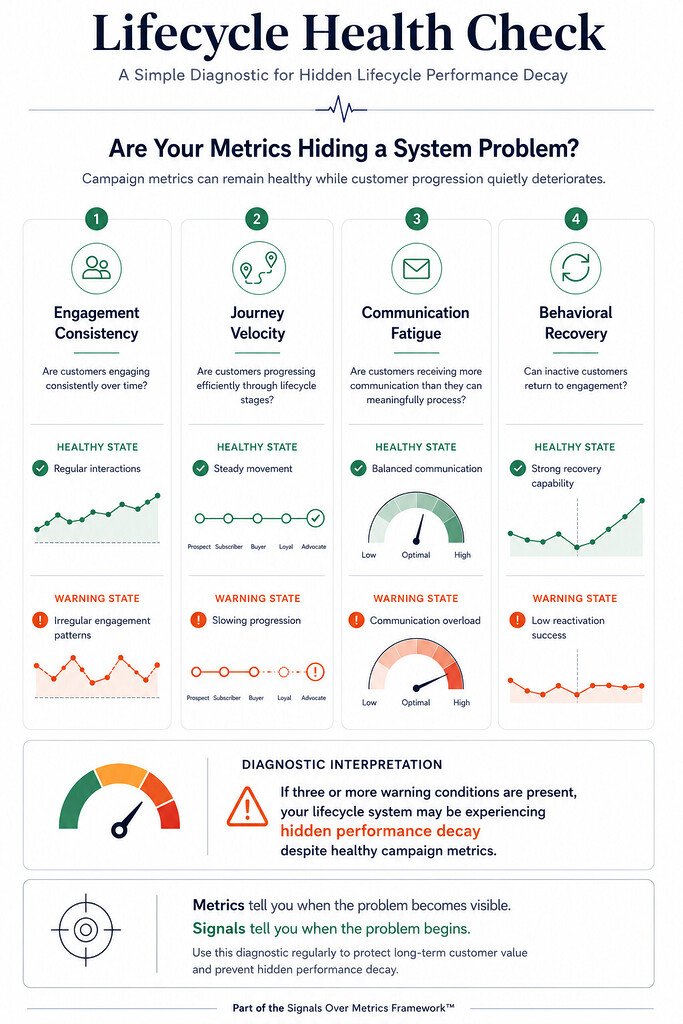
Lifecycle systems don’t usually collapse overnight. The decay is quieter communications get a little less relevant, the path to purchase stretches a bit longer, automations pile up one by one. None of it looks alarming in isolation, which is exactly why campaign-level KPIs can stay flat for months while the underlying system slowly loses traction.
A quick way to pressure-test things: ask the team four questions. Is Engagement Consistency declining? Is Journey Velocity slowing? Is Communication Fatigue rising? Is Behavioral Recovery getting worse?
One “yes” isn’t a crisis. But when three or four of these are trending the wrong way simultaneously, something is usually breaking down even if the open rate, CTR, and revenue dashboard still look fine. That gap between what the metrics show and what’s actually happening is precisely what behavioral signals are built to close.
The Hidden Risk of Optimizing for Metrics
The teams that fall into this trap aren’t making careless decisions that’s what makes it worth understanding. Open rate is underperforming, so they run tests. Subject lines, send times, segment splits. It works. CTR gets the same treatment, then revenue per send, then automation coverage. Each quarter, the stack gets a little bigger, the send volume a little higher, the optimization a little tighter. The dashboard keeps confirming it’s the right direction.
What doesn’t show up on the dashboard is what it feels like to be on the receiving end of all of it.
For a while, none of this registers anywhere. Unsubscribes stay low. Revenue holds. Open rate honestly can look fine for months. Meanwhile, communication fatigue is building, engagement quality is eroding, and trust is doing that slow, invisible thing it does before it’s gone. Recent research from Sinch Mailgun supports this finding: fewer than a quarter of senders actually test inbox placement, and most can’t accurately define their own delivery rate. So when disengagement finally spikes, or retention numbers start slipping, or deliverability tanks, teams treat it like something new. It isn’t new. It’s been accumulating. The metrics weren’t tracking the right layer to show it.
A real example. An e-commerce client came to me with a system running more than twenty active automations. Everything on the dashboard looked fine: open rate holding steady, CTR where they expected it, campaigns producing revenue consistently. When I pulled the progression data, the picture was different. Time to first purchase had climbed from 24 days to 45 over the same period, and the repeat purchase rate had dropped 26% quarter over quarter. Digging into the flows, several automations were essentially stepping on each other, hitting the same customers multiple times within short windows, creating pressure without adding value.
There was no shortage of engagement. There was too much of the wrong kind and nothing in the standard campaign reporting was set up to surface it.
How to Build a Signal-Based Lifecycle Marketing Measurement System
Shifting from metrics to signals doesn’t mean throwing out your existing reports or analytics tools most companies already have plenty of data sitting around. The real problem is that measurement systems are still built around campaigns rather than customers. Here’s a practical way to fix that.
Step 1. Map out how a customer actually moves through your business.
Not the ideal path, the real one, from first contact to loyalty. This sounds basic, but most teams skip it and jump straight to measuring. Without a progression model underneath, any signal you track is floating without context.
Step 2. Figure out which behaviors actually mean something.
An email open can be habit. A click can be accidental. What tends to matter more: whether someone keeps showing up consistently, whether they come back after going quiet, whether the time to their next purchase is getting shorter. These reflect real momentum. Pick the two or three signals from the list above that map most naturally to your business model and start there don’t try to track everything at once.
Step 3. Look at quality, not just quantity.
Two customers can both click a link, but one is genuinely engaged, and one is bored-scrolling volume alone won’t separate them. Start watching whether engagement is becoming more consistent over time, whether it reflects real intent rather than reflex. That’s the layer where problems become visible before they register anywhere in a report.
Step 4. Track how customers move between stages, full stop.
Not campaign open rates, not click rates, those measure the message, not the journey. The numbers that actually tell you something: what percentage of subscribers eventually make a purchase, how the average time between first and second purchase has shifted, at what point in the sequence customers tend to go quiet and stay quiet. That’s where you see whether the system is doing what it’s supposed to do.
Step 5. Bring in the traditional metrics at the end, not the beginning.
Revenue, retention, conversion rate these confirm whether a signal-based decision actually moved the needle. That’s a useful function. It just works better as a checkpoint than as a compass.
Conclusion
Years of investment in campaigns, automations, segmentation, and personalization lifecycle marketing have gotten genuinely sophisticated. Most teams can now do things with their data that would’ve been technically impossible a decade ago. And yet the fundamental question are customers actually getting closer to the brand, or just receiving more emails, still goes unmeasured in a lot of programs.
Salesforce’s State of the Connected Customer research puts data behind something most lifecycle practitioners already feel: customers increasingly weigh how a brand treats them against what the brand actually sells. Experience isn’t a soft concept anymore it’s competitive infrastructure.
The teams that crack this first won’t get there through better copywriting or smarter A/B tests. They’ll get there by measuring what’s actually changing in customer behavior, not just what the last campaign produced. That gap between what’s measurable and what’s actually being measured is where the next real advantage lives.
Where are your customers headed next? Most dashboards still can’t tell you. That’s the problem worth solving.