
Retail media networks are now a top-three advertising channel globally. Here’s what that actually means for brands, retailers, and the marketers stuck between both.
There are 277 retail media networks operating globally as of late 2025.
Two hundred and seventy-seven.
Most brands are using one. Maybe two. And the ones winning deals and moving product are already asking the right question: not which network to be on, but how to actually use them instead of just paying to exist on them.
That’s the gap this piece is about.
What a retail media network actually is
What a retail media network actually is—and where it fits within a larger retail media advertising strategy is often misunderstood. Strip away the jargon, and a retail media network is simple: it’s a retailer selling advertising space to brands using the retailer’s own customer data.
Amazon does it. Walmart does it. Kroger, Target, Home Depot, CVS, Instacart — they all do it now. And the reason every retailer with a loyalty program and a website is building one is not altruistic.
Retail media generates 50% to 70% operating margins for retailers. The core retail business, by comparison, is lucky to hit 3%.
So yes, every retailer that can is building a media network. Because it turns their customer data — which they already have — into a revenue line that is more profitable than selling the products themselves.
That’s the business case on the retailer side. Now here’s what it actually is for brands.
For brands, a retail media network is the ability to place ads in front of people who are already shopping. Not people who might buy. People with credit cards in hand, in a specific aisle — digital or physical — actively looking at the category your product sits in.
That’s a different kind of attention than what search or social can offer, especially when compared to evolving social media lead generation strategies. And that difference is why the money is moving.
The numbers that explain the shift
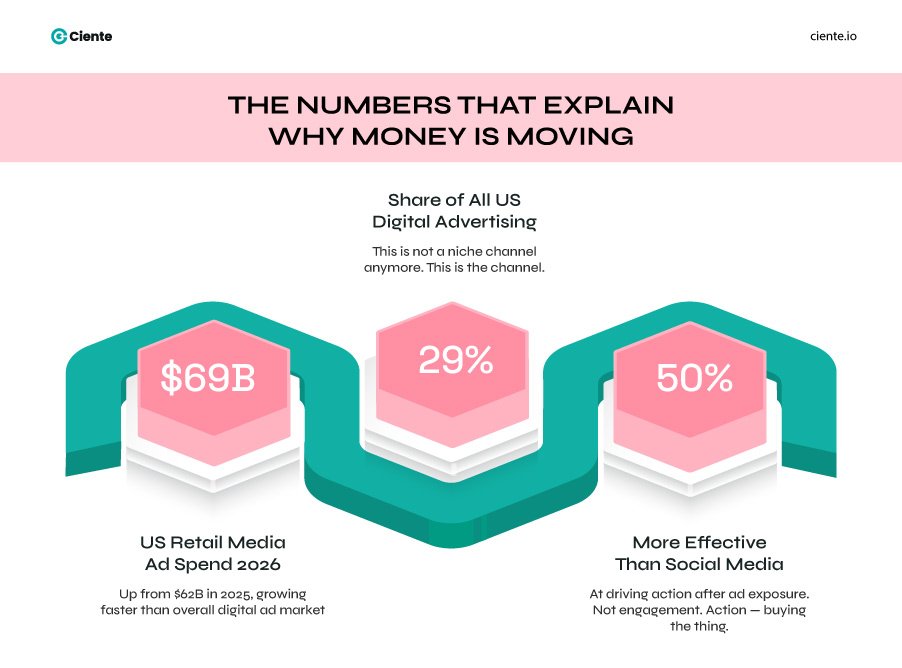
US retail media ad spend is projected to reach $69 billion in 2026. That’s up from $62 billion in 2025. It’s growing faster than the overall digital ad market.
To put that in context: retail media spend now accounts for nearly 29% of all US digital advertising. That is not a niche channel anymore. That is the channel.
Retail media is 50% more effective than social media at driving action after ad exposure. Not engagement. Action — as in, someone going and buying the thing.
The reason is straightforward: the targeting is based on purchase history, not behavioral inference. When Kroger knows someone buys protein bars every three weeks, and that person is now on the Kroger app, an ad for protein bars is not a guess. It is an educated certainty.
That is what first-party data actually means when it is working properly, something many AI marketing strategies attempt to replicate but rarely match in precision. Not demographics. Not lookalike audiences. Actual purchase behavior, closed-loop, attributed back to a sale.
Where retail media is going in 2026 — and what’s actually changing
1.) Off-site is where the growth is happening
On-site retail media, sponsored products, and banner ads on the retailer’s media platform have been the foundation. It still works. But the ceiling is becoming visible.
The next phase is off-site, extending into channels like CTV and programmatic, much like a modern go-to-market strategy would require.
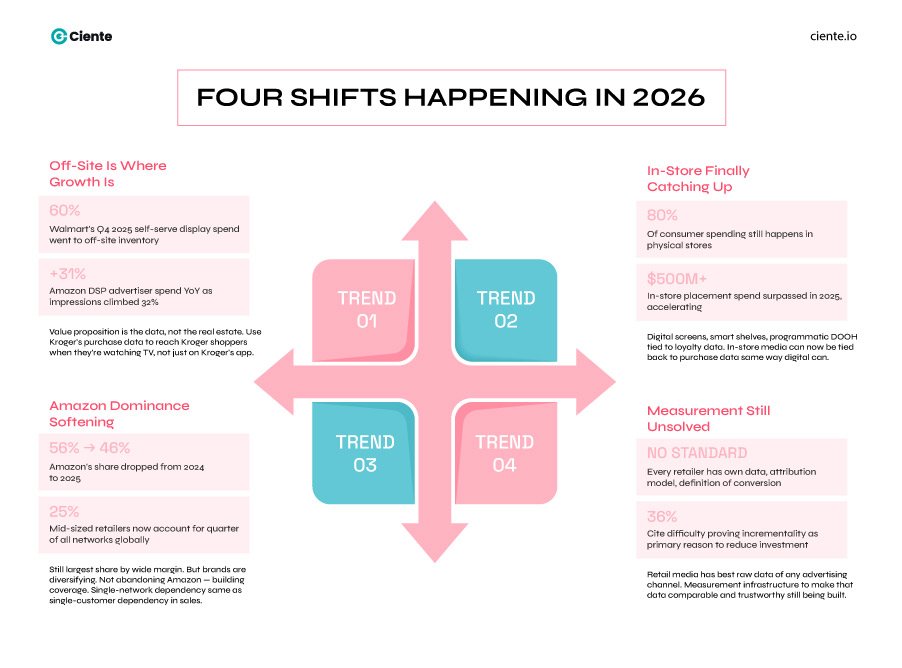
60% of Walmart’s self-serve display spend in Q4 2025 went to off-site inventory. Amazon DSP advertisers increased spend 31% year-over-year as impressions climbed 32%.
The value proposition is the data, not the real estate. aligning closely with principles behind data-driven creative strategy. Once a brand understands that, the question becomes: how do we use Kroger’s purchase data to reach Kroger shoppers when they are watching TV, not just when they are on Kroger’s app?
That is what off-site retail media enables. And it is growing fast.
2.) In-store is finally catching up
80% of consumer spending still happens in physical stores. a shift also explored in the future of the retail media landscape. 90% of retail media advertising, until recently, has been online.
That gap is closing.
Digital screens, smart shelves, programmatic digital out-of-home tied to loyalty data — in-store retail media is scaling. Walmart is testing immersive formats. Spend on in-store placements was projected to surpass $500 million in 2025 and is accelerating.
The interesting part: in-store media can now be tied back to purchase data the same way digital can. Closed-loop attribution at the shelf level is no longer theoretical.
3.) Amazon’s dominance is softening — but not disappearing
Amazon’s share of retail media spend dropped from 56% in 2024 to 46% in 2025. That is still the largest share in the market by a wide margin. But brands are diversifying.
Walmart Connect is growing fast. Mid-sized retailers now account for a quarter of all retail media networks globally. The brands moving money are not abandoning Amazon — they are building coverage.
The strategic logic is simple, much like portfolio thinking in a partner marketing strategy.
If your category exists across multiple retail environments, your media should too. Single-network dependency is the same as single-customer dependency in sales. It works until it doesn’t.
4.) Measurement is still the biggest unsolved problem
Measurement is still the biggest unsolved problem, especially when not aligned with a structured CRM strategy. Every retailer has its own data, its own attribution model, and its own definition of what counts as a conversion.
There is no standard. And that is a genuine problem when a brand is trying to compare ROAS across Amazon, Walmart, and three grocery networks simultaneously.
36% of marketers cite difficulty proving incrementality as the primary reason they would reduce retail media investment. Another 32% point to lower ROI compared to other channels.
The irony is that retail media has the best raw data of any advertising channel. The measurement infrastructure to make that data comparable and trustworthy is still being built.
Bain has called this the end of retail media’s ‘easy growth’ phase. The networks that survive 2026 with budget share intact will be the ones that give brands transparency, not just reach.
What the brands getting this right are actually doing
They are not treating retail media as a replacement for search or social. They are treating it as the connective tissue between demand generation and point of purchase.
The brands winning are running upper-funnel campaigns as part of a cohesive cross-channel marketing strategy. Not ROAS in isolation. Full-funnel incrementality.
They are also not concentrating budget in one network, similar to how effective account-based marketing strategies distribute effort across accounts and touchpoints. They are building a portfolio, Amazon for scale and catalog breadth, Walmart for value-oriented shopper access, Kroger or Target for grocery and CPG relevance, and off-site inventory through DSPs to extend reach beyond the retailer’s owned properties.
CPG brands in the US now allocate 39% of their total advertising spend to retail media. Some have reported 154% return for every dollar spent when precision targeting and first-party data are used correctly.
That number is not a guarantee. It is a ceiling — and most brands are nowhere near it because they are still treating retail media as digital shelf-space rather than a data-driven performance channel.
The thing nobody wants to say out loud
Most brands on retail media networks are there because the retailer made it very easy to spend money—something that often leads to weak content strategy alignment.
Self-serve dashboards, sponsored product placements, a few toggles and a credit card — it is genuinely frictionless to start. And genuinely difficult to know if it is working.
The 2026 maturity question for the industry is whether brands start demanding rigor similar to what is expected in a strong product launch strategy. Comparable attribution. Incrementality testing. Cross-network reporting that does not require a team of analysts to reconcile.
The networks that build that infrastructure will keep the budgets. The ones that don’t will start losing share to the ones that do.
277 networks. Most of them will not make it past the decade.
The ones that will are building trust with advertisers, much like brands that invest in long-term B2B media partnerships.