
The most expensive lie in modern B2B growth operations is the belief that human-to-human connection can be programmatically managed, optimized, and scaled.
Corporate boardrooms treat the go-to-market engine like a software architecture-assuming that if you input a precise positioning statement at the top, a perfectly aligned, predictable conversation will automatically execute at the bottom.
This is an illusion. The live sales call is an environment of pure entropy. It is chaotic, highly volatile, and fundamentally unpredictable. No matter how many millions an enterprise invests in defining its corporate narrative, that entire strategic apparatus is instantly at the mercy of two human beings reacting to one another in real time.
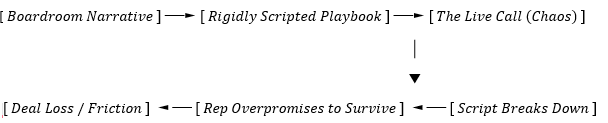
When a Sales Development Representative (SDR) or Account Executive (AE) steps into the flow of a live conversation, psychological survival mechanisms take over. If a buyer surfaces an unexpected objection, expresses subtle irritation, or shifts the conversational focus, the corporate script breaks down.
In that high-pressure flow, reps say things they didn’t intend to say, stumble over brand messaging, or-most destructively-overpromise on product capabilities just to keep the opportunity alive. Organizations try to fix this by tightening control, enforcing stricter talk tracks, and monitoring compliance metrics. However, these challenges often stem from a broader B2B marketing strategy that overemphasizes control instead of adaptability. But you cannot script authenticity, and you cannot automate a relationship. The more marketing tries to control the exact words a seller says, the more fragile the execution becomes when it hits real-world chaos.
1. The Weaponized Checklist: How Frameworks Like BANT Box In the Room
To cope with the wild unpredictability of human interaction, sales leadership has long relied on linear qualification frameworks. Systems like BANT (Budget, Authority, Need, Timeline), ANUM, or MEDDPICC were originally designed to protect an organization’s time by filtering out non-viable prospects.
Over time, these frameworks have evolved into an operational trap. They force sellers to treat an open-ended human dialogue as a rigid corporate interrogation.

The fundamental flaw with these qualification grids is that modern B2B buyers have developed complete pattern recognition. They are hyper-aware of the playbook. The moment a rep starts steering the call to check off their internal qualification boxes, the buyer realizes exactly what is being done to them. They recognize that the seller is not listening to solve a problem; they are listening to fulfill an administrative metric in their CRM.
This dynamic immediately boxes in the conversation, triggering an instinctive defensive reaction from the buyer:
- Defensive Retraction: Buyers intentionally obscure their true pain points, offering vague, surface-level answers to avoid being aggressively managed down a pipeline.
- Artificial Friction: Forcing a timeline or budget question before establishing relational trust causes the buyer to mentally categorize the vendor as an aggressive commodity supplier rather than a strategic partner.
- The Loss of Nuance: When a seller is consumed by the need to extract specific data points to satisfy a framework, they miss the subtle emotional cues, unspoken corporate politics, and true underlying anxieties that actually dictate enterprise purchasing decisions.
2. The Proof Point Collapse: The Brutality of Unbacked Talk
There is no moment in the enterprise sales cycle more damaging to brand equity than the Proof Point failure. This occurs when a representative successfully articulates a bold, high-level strategic promise, but completely falters the moment the buyer asks for empirical validation.
It is brutal to witness. A seller builds initial momentum by echoing marketing’s top-of-funnel positioning– talking smoothly about transformation, efficiency, and architectural optimization. But enterprise buyers are deeply cynical. They do not buy promises; they buy mitigated risk. The moment the customer asks, “Can you show me exactly how that mechanism worked for an organization running our specific legacy stack?” or “What data supports that performance claim?” the call hangs in the balance.
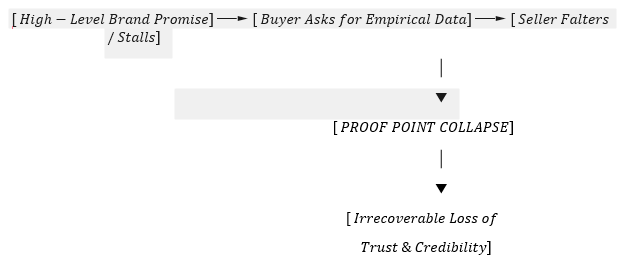
If the rep responds with ambiguity, attempts to deflect with more high-level marketing language, or promises to “circle back with the technical team after the call,” the momentum is completely lost. Trust is asymmetrical- it takes weeks to construct through content and brand positioning, but it evaporates in three seconds of conversational hesitation.
When a seller cannot back up their talk with immediate, contextual proof points, it exposes a fatal divide between marketing’s public claims and the product’s operational reality. The buyer realizes that the corporate narrative is just promotional fluff, and the deal stalls indefinitely.
3. The Tactical Pivot: Arming Sellers with Enablement
If marketing cannot control the chaotic nature of human-to-human connection, and if rigid qualification scripts only serve to alienate the buyer, how can the marketing engine actually protect the deal?
The solution requires a complete philosophical shift: Marketing must stop trying to tell sellers exactly what to say, and start arming them with the boundaries of what is possible and the reality of what the buyer has already done. This shift aligns with a data-driven marketing strategy that equips revenue teams with actionable insights instead of rigid scripts.
Instead of distributing rigid script templates, marketing must provide two specific strategic assets directly to the front lines:
A Map of Product Horizons (The Possibilities)
Sellers overpromise when they do not understand the technical boundaries of their own solution. Marketing must translate complex product roadmaps into a clear taxonomy of capabilities-defining exactly what the product can do today, what it can do with configuration, and what is a future vision.
By understanding the full horizon of possibilities, a rep caught in the flow of a chaotic call no longer needs to guess or make false promises to save face. They can confidently map the buyer’s spontaneous requests directly to documented product realities.
A Map of Intent Telemetry (The Behavioral Data)
The most valuable asset marketing can hand a seller before a call is a clear picture of the buyer’s digital footprint. A strong full-funnel marketing strategy ensures this behavioral intelligence is captured and shared across every customer touchpoint. Sellers should never walk into an interaction blind, forcing a generic qualification checklist on a prospect who has already spent weeks researching the solution. Marketing must pass down deep behavioral telemetry:
- Which specific integration documentation has the prospect’s technical team reviewed?
- What latent industry pain points have they explored across your owned content networks? Insights from a well-planned SaaS content marketing strategy can help uncover these interests before the conversation begins.
- Where did their attention linger within your digital resources before they booked the call?
When a representative possesses this behavioral intelligence, the need for an aggressive, framework-driven interrogation disappears. The seller doesn’t have to guess what might turn the buyer off, because they already know exactly what brought them to the table.
4. The Real-World Re-Engineering: From Interrogation to Facilitation
To transform this philosophy into an operational revenue engine, organizations must explicitly replace the traditional, script-heavy enablement model with an intelligence-driven framework.
| Operational Vector | The Legacy Interrogation Model | The Reality-Grounded Facilitation Engine |
| Conversational Tooling | Rigid scripts, static talk tracks, and mandatory qualification checklists. | Dynamic battlecards focused on product horizons and operational boundaries. |
| Buyer Context | Handing off a raw email address and a basic corporate title to the field. | Delivering rich intent profiles detailing content consumption and tech stack indicators. |
| Validation Architecture | Static, high-level case study PDFs buried in an unmanaged internal drive. | Mid-call proof-point kits organized by specific technical architectures and industry metrics. |
| Success Evaluation | Monitoring call compliance (Did the rep say the exact scripted lines?). | Assessing contextual relevance (Did the rep anchor the conversation to observed buyer behavior?). |

Ultimately, an enterprise marketing strategy survives the live call only when it embraces the inherent chaos of human interaction. This principle is especially relevant in AI’s role in B2B SaaS marketing strategy, where technology supports human conversations instead of replacing them. When you stop treating sales representatives like automated software bots and stop treating buyers like targets to be qualified through a checklist, the nature of the transaction changes.
By arming your field team with empirical proof points, absolute clarity on product capabilities, and deep behavioural data, you give them the freedom to navigate the unpredictable flow of a live call naturally. Strategy does not realize its value by eliminating the human element-it wins by making the human element intelligent.