
Stop settling for narrative dressed up as data in 2026. Closed-loop marketing is your fix, connecting every revenue outcome back to the marketing action that fueled it.
Most B2B organizations are sitting on more data than they can act on. The problem was never collection. It is that the data sits in systems that were never designed to tell you whether your marketing actually drove revenue.
Closed-loop marketing is the fix for that, aligning with broader frameworks designed to connect data with measurable outcomes. It means connecting every downstream sales outcome back to the upstream marketing action that generated it. Which campaign sourced the lead? Which content piece moved a deal from stalled to active? Which channel observed the accounts that actually closed?
Without those answers, budget decisions get made by instinct, not evidence. It’s an increasingly expensive way to operate
in 2026.
The pressure to actually implement it has not been this high before. Here is what is changing, where most companies are still getting it wrong, and what the organizations doing it well have figured out.
Attribution is not solved. It is just better disguised.
Ask a VP of Marketing what drove the pipeline last quarter, and you will usually get a confident answer that unravels under scrutiny. Last-touch attribution in the CRM. Campaign dashboards that track impressions and MQLs but stop at revenue. A general sense that the big content push helped.
None of that is attribution. It is a narrative dressed up as data.
The buying journey in B2B has made this harder, not easier, especially in an increasingly omnichannel environment.
A committee of seven or eight people might read your thought leadership on a third-party platform, attend a webinar, get hit by a retargeting ad, and then respond to an outbound sequence before sales ever log a first call.
First-touch and last-touch models were designed for a world where one person clicked one thing and bought another. That world does not exist in the B2B landscape. It probably never did.
Closed-loop marketing does not just give you better reports.
It changes the feedback mechanism.
Instead of looking backwards at what happened and guessing at causes, the data flows continuously. What buyers engaged with before they raised their hand informs how you build the next campaign, a principle central to performance-driven marketing approaches. What deals closed fastest tells you something about which content is actually doing work in the funnel.
The loop earns its name because the output genuinely shapes the next input.
Where the loop breaks
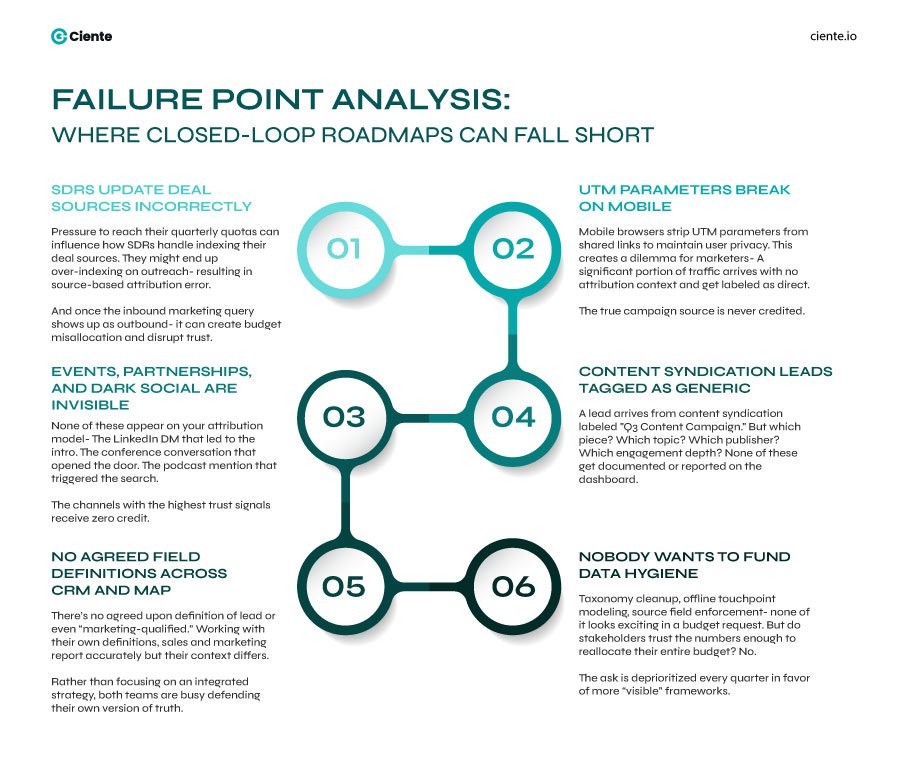
Most companies that say they have closed-loop marketing do not. They have a CRM connected to a marketing automation platform, often without fully optimizing how these systems integrate. But the connection is only as good as the data going into it, and that data is usually a mess.
Sales reps update deal sources inconsistently, or not at all.
parameters break on mobile. Events, partner referrals, and dark social touchpoints aren’t outlined in the attribution model. Content syndication leads arrive tagged with a generic campaign name, without any substance. Six months in, marketing has a dashboard, and sales has a gut feeling- the two can’t converse in any meaningful way.
The part nobody wants to spend money on is data hygiene.
Agreed on field definitions across CRM and MAP. Consistent lead source taxonomy that sales actually follow. A model for capturing offline touchpoints. These are not glamorous problems to solve, but they are the reason most closed-loop initiatives produce impressive-looking reports that nobody trusts.
The loop does not close just because data moves between platforms. It closes when every revenue outcome can be traced back to a specific decision, and that learning actually changes the next one.
What the organizations doing this well have in common
They changed what marketing is accountable for
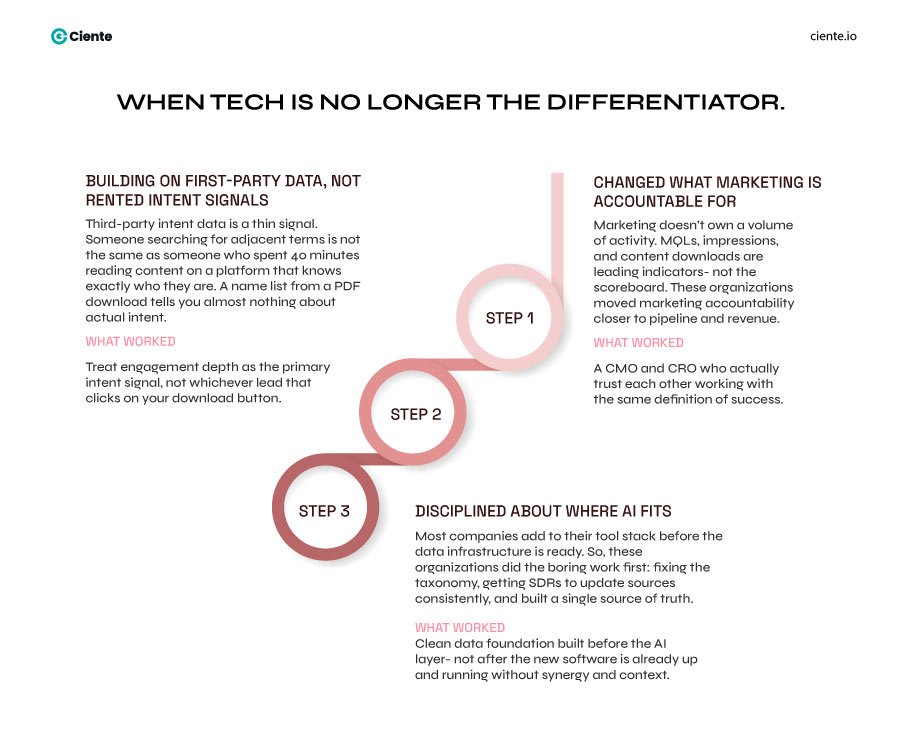
The practical shift underneath closed-loop marketing is that marketing owns a number, not a volume of activity. MQLs, impressions, and content downloads are fine as leading indicators, though they often fail to reflect true revenue impact. They are not the scoreboard.
The organizations making closed-loop work move marketing accountability closer to the pipeline and revenue, which is uncomfortable because it requires a true relationship with sales rather than a handoff model.
That means joint ownership of the CRM, rather than relying on a traditional handoff between teams.
Agreed definitions for what counts as marketing-sourced versus influenced. Regular reviews where both teams assess the same data and ask the same questions. It also means being willing to cut programs that look productive on a campaign dashboard but produce nothing downstream.
Most marketing teams are not there yet. But others tend to have a CMO and CRO who actually trust each other.
They built on first-party data, not rented intent signals
Third-party intent data is not worthless, but it is a thin signal.
Someone searching for terms adjacent to your category is not the same as someone who spent forty minutes reading your content on a platform that knows exactly who they are.
The shift toward first-party behavioral data is real, and it is making closed-loop attribution meaningfully more accurate, particularly with insights from behavioral tracking.
For B2B companies offering content syndication, this distinction matters.
A platform that passes back engagement-level data, which topics a reader spent time on, how many times they returned, and what they read before filling out a form, gives you something to work with. A platform that sends you a list of names because they downloaded a PDF tells you almost nothing about intent.
The signal quality gap between these two is where the demand generation budget gets wasted.
They are careful about where AI fits.
Predictive lead scoring, AI-assisted campaign optimization, and intent modeling can genuinely improve a closed-loop system when applied correctly.
The problem is that most companies purchase these tools before their data infrastructure is ready to support them. A scoring model trained on bad attribution data will optimize toward whatever noise the data contains. It will do that confidently and at scale.
The companies gauging real value from AI in this context built a clean data foundation first, often supported by evolving automation trends. That meant boring work: fixing the taxonomy, getting sales to update sources consistently, building a single source of truth for campaign performance.
Once that was in place, the AI layer had something worth learning from.
The part that actually determines whether this works
The technology is not the hard part. Marketing and sales operate from the same definition of success.
These two functions have always operated on different clocks, incentives, and interpretations of what a good lead is. Closed-loop marketing requires that the gap be closed, not because alignment is a pleasant organizational value, but because the data cannot flow correctly when the people responsible for entering it do not believe in the system.
An SDR who thinks marketing leads are junk will not update the source field carefully. A marketing team that cannot see what happens to their leads after handoff has no way to learn from the results.
Whoever sponsors a closed-loop initiative needs real authority over both functions, or direct access to someone who does. Without that, you get two parallel reporting systems with different numbers, and a quarterly conversation where each team defends its own version of the truth.
The loop stays open.
So can it unlock your data?
Yes. But the question worth sitting with is what your data is actually ready to support right now.
Most B2B organizations have fragmented data, not inert data. It exists. It is merely spread across platforms that do not share a common definition of what matters, tracked in ways that serve whoever built the dashboard rather than who makes the next budget decision.
Closed-loop marketing does not remedy that by adding more tools, but by aligning strategy, execution, and measurement. It forces a cleaner question: did this marketing activity contribute to revenue, and by how much?
When that question becomes the actual operating standard, not just something in a strategy deck, the data that matters surfaces quickly. And so does the data that has been burning budget without producing anything you can trace to a deal.
That is the real unlock. Not a better dashboard.
A tighter feedback loop between what marketing does and what sales closes, with enough data discipline in between that the learning is actually usable.
In 2026, the companies building that loop are compounding their advantage every quarter, reflecting broader shifts in B2B marketing evolution. But those still leaning on last-touch attribution and quarterly gut checks are falling further behind, whether or not their dashboards suggest otherwise.