
Retail media strategy has outgrown the retailer’s walls. So why are most brands still thinking inside those walls?
All your retail media networks (RMNs) operate in different languages. There’s no standard guideline for measuring campaigns across multiple platforms and retailers. It makes any form of comparison impossible for brands to assess.
Retail marketers usually leverage 3-5 RMNs simultaneously- it’s the norm. Amazon reports ROAS in one way, Criteo and Walmart report it in another. You can’t compare apples to oranges.
The lack of a standardized framework induces fragmented campaigning for retail marketers. It’s a growing frustration- even in 2026.
And in today’s environment, relying on instinct instead of structured planning is risky — especially when building a long-term data-driven marketing strategy.
Without the precise data, marketers have no reliable answers. Especially when their CMO questions incrementality, “Are we actually driving new sales, or am I just paying to reach people who would’ve bought anyway?”
Without an accurate picture, your teams can’t gauge the impact of the spending, and neither allocate any more of it.
That’s precisely why retail media is gaining momentum in market conversations. “What is retail media” and “retail news” leaped 4% and 1300% on Google Trends in the past year.
Marketers want answers. Solutions to these fragmented networks.
And it’s exactly why we’re here.
What is Retail Media?
If you put the retail media landscape in a single picture, this is what it’ll look like:
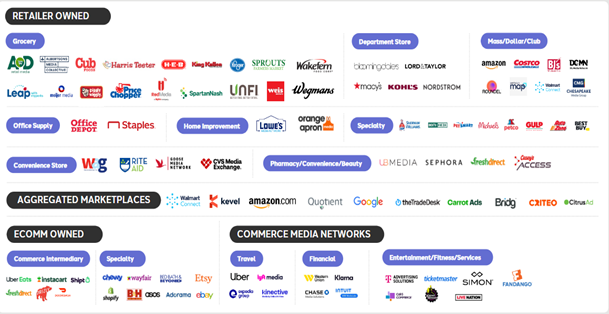
Last year, Dentsu projected that the future of retail media “will be in data and audiences.” And they were correct. The marketplace might still focus on commoditized ad formats, but the influx of digital channels is changing this quite rapidly. Sponsored search and banner ads are rampant- and sadly, still receive the majority of dollars and attention.
But it isn’t a sustainable model. In simple words, we must grasp what retail media truly is:
The ads are placed on a retailer’s e-commerce site or app by a brand to influence the customer at the point of purchase. This model enables brands to boost their visibility on the ‘digital shelf’, similar to an endcap or special in-aisle feature in a physical store.”
This retail media definition illustrates why brands are attracted to retail media, from its targeting capability to closed-loop attribution. Especially in a day and age where the attribution equation has a gaping hole due to dark social.
And since last year, buyer confidence and trust have died on the edge of the hill. Blame inflation or geopolitical tensions- marketers are left adjusting strategies and creatives at the blink of an eye. But the hope in retail media has remained constant- or rather, seen an upward climb.
So, is retail media also commerce media?
It depends on who you’re asking. It’s actually the most critical thing to understand about these terms.
They’re used interchangeably in several marketing conversations. And at the surface level, that makes sense. Both are about reaching people close to a purchase decision, using data that’s grounded in actual buying behavior.
The overlap is real.
But there is a meaningful distinction worth making. One that’s become more relevant as the industry has matured.
Retail media, specifically
Retail media is advertising that lives within a retailer’s owned ecosystem, i.e., their website, app, and in-store screens. It runs on “that” retailer’s first-party shopper data- Amazon Ads, Walmart Connect, Target’s Roundel, Kroger Precision Marketing.
The defining characteristic is that the media and the data both belong to the retailer. You’re advertising inside someone’s store, using their knowledge of their customers.
That’s a specific thing. It has a clear boundary.
Where commerce media means something different
Commerce media, when used distinctly, refers to a broader approach. That means applying purchase-intent data and transaction signals to advertising across platforms that aren’t necessarily retailers. Financial services platforms, travel booking sites, food delivery apps. These aren’t retailers, but they neglect behavioral and transactional data that’s just as commercially rich.
This expansion mirrors what’s happening across the broader ecosystem of retail media advertising and adtech companies, where boundaries between retail, commerce, and media continue to blur. It’s worth knowing it carries commercial framing.
But the underlying concept is legitimate: the logic of retail media, i.e., use real purchase signals, not paradoxes, can exist outside of retail environments.
Retail media is defined by its ecosystem. Commerce media is defined by its data logic.
Why brands and retailers are both leaning into retail media
US advertisers spent $60.32 billion on retail media in 2025 and plan to allocate $71.09 billion in 2026, according to eMarketer. And three-quarters of them plan to increase their retail media spend.
Brands and retailers have found their moat.
It’s because retail media is perceived as a more reliable line item. Especially owing to the erratic shifts in consumer behavior and e-commerce growth. More marketers are trusting everything data- it’s the source of all truth. A single point of stability.
For marketers, media planning strategy has become a holy grail.
It realizes the full potential of first-party data, granting the opportunity to optimize their bottom line. Moving beyond the traditional transactional value perspective, retail media comes down to creating incremental growth for customer lifetime value. And while creating a flywheel of the retailer’s own business.
Retailers become a platform.
But the hiccup here is: what if retail brands are underestimating the prowess of their own data ecosystem?
RMNs are less confident in their ability to differentiate amidst the crowded marketplace. The heap of first-party data vendors and media providers adds to the competitive set. As data sources and ad tech stack diverge- there’s a lack of compatibility.
How do RMNs measure, access, and scale their offerings as data silos persist due to a lack of an omnichannel identity framework?
The Three Foundational Philosophies of a New-Era Retail Media Strategy
If anything, retail media should sit inside a broader B2B marketing strategy that defines long-term growth, not just quarterly performance.
But that’s all non-negotiable. That’s where we make the error of judgment- tactics aren’t strategy.
We offer the backbone of a true retail media strategy- the three philosophies that should guide you from the get-go, not when you’re already halfway through the race.
1. Proximity
First, it’s all about the thinking. Traditional media focuses on GRPs, impressions, and the market as its sea. That’s their first mistake. It’s never about how many accounts you reach.
What makes the actual difference? How close to the purchasing decision do you reach these accounts? Purchase proximity.
Guide every strategic decision of your retail media strategy through that lens- why one shopper searching for exactly what you sell is better than five passive scrollers.
2. Retailer is Your Partner
Marketers still approach retail media the way they do billboards- at arm’s length. That’s what differentiates champion retail media from those who remain at the bottom of the barrel.
Retailers are your strategic partners- an extension of your brand. Not publishers. This is where structured B2B media partnerships become a competitive advantage rather than a transactional relationship.
And it includes sharing that first-party data.
3. Campaigns are Just Levers
This ties directly to the measurement fragmentation pain point.
Optimizing within each platform is a tempting opportunity. You chase ROAS on Amazon, CTR on Walmart, and so on. But those metrics are siloed and generally self-reported by the same networks selling the inventory.
It’s misleading.
Measurement maturity like this doesn’t happen in isolation. It’s part of aligning creative execution with analytics — where creative strategy meets data.
Here’s the Retail Media Strategy That Moves Beyond Fancy Labels- And What to Actually Do About It
Most retail media “strategies” I see are just media plans with a fancier label. A spreadsheet of placements, some budget splits, and a kick-off call with the account team.
But that’s not a retail media strategy.
1. Real strategy starts before the brief.
It starts with an honest answer: where is our customer closest to saying yes? That’s the only moment that actually matters in retail media.
Find that moment in your funnel and build your entire retail media strategy around it.
That means conducting a purchase journey audit before you allocate a single dollar.
Map the path- Retail media doesn’t operate in a silo; it should support a full-funnel marketing strategy that connects awareness, consideration, and conversion seamlessly. Where are people searching? What keywords are they using at high-intent moments? That’s your priority inventory.
Sponsored search placements on high-intent keywords should almost always come before display, before off-site, before anything. Start there. Then expand.
And don’t spread budget across six networks because your agency suggested “diversification.” Pick two or three networks where your category actually has purchase momentum, go deep, and prove the model before you scale horizontally.
More RMNs means more fragmented data, more account management overhead, and a measurement nightmare you won’t untangle until the budget’s already spent.
2. Look at your retailer relationships with honesty.
Are you showing up as a partner or just a line item in their ad revenue report? Because the brands getting early access to new inventory, richer shopper data, and joint business planning aren’t necessarily the biggest spenders.
They’re the ones bringing something to the table beyond a media budget.
Tactically, this means requesting and actually using the retailer’s first-party audience data.
Most brands pay for sponsored listings without a conversation about shopper segmentation. That’s leaving serious value on the table. What can you do here?
- Push for a quarterly business review with your retail media account team.
- Bring your own category data.
- Ask what they notice in search trends that you don’t.
Make the relationship bilateral.
Also: negotiate for measurement access upfront. It shouldn’t be an afterthought.
Know exactly what data you’ll receive, in what format, and on what timeline before you sign off on the campaign.
Too many brands discover post-campaign that the reporting doesn’t offer them what they need to make the next decision. That’s a commercial conversation, not a technical one. Have it early.
3. Set up your measurement framework before you scale.
This won’t work after your Q3 spend has been spent.
Here’s a simple way to think about it: run a small incrementality test before committing your full budget to any single network.
Most major platforms, such as Amazon, Walmart Connect, and Criteo, offer holdout testing in some form. Leverage it. Even a rough incrementality read is more valuable than a polished ROAS number generated and reported by the platform.
Know your baseline conversion rate. Know what “normal” looks like without the media running. Then you have something real to compare against.
Beyond that, build a cross-network scorecard that you own- not one stitched together from three different platform dashboards. It doesn’t need to be sophisticated.
It needs to answer: which network drove genuine incremental sales, at what cost, and does that justify the spend relative to the alternative? That’s it. If you can answer that cleanly every month, you’re already ahead of most marketers operating in this space.
Because if you can’t answer “did this actually grow our business,” you’re just funding a retailer’s P&L and calling it marketing. That’s not a position anyone wants to be in, especially when you’re in a room with your CFO- trying hard to justify the spend.
How AI Is Transforming Retail Media Strategy: Opportunity or Overwhelm?
Here’s the honest truth: most B2B brands are sleeping on AI in retail media. They hear “AI-powered bidding” and assume it’s an Amazon feature someone else is managing.
That’s a mistake. B2B brands should care more about AI’s intersection with retail media than they presently do.
Why?
It’s not automated bidding- that ship has sailed. The platforms already do that whether you ask them to or not.
The real opportunity is in what AI lets you do with your own data. That means synthesising performance signals across five different networks, modelling incrementality, and simulating budget allocation scenarios — which is exactly where a modern AI marketing strategy begins to redefine competitive advantage.
It’s a win for B2B brands across 3 cases:
- Where sales cycles are longer
- Attribution is messier
- Buying committees don’t exactly impulse-buy
AI-driven measurement isn’t a nice-to-have. It’s the only realistic way to prove that retail media is has vitality beyond generating impressions nobody can link to revenue.
It’s your workaround from the fragmentation conundrum- the goldmine.
The brands that figure this out first will have a defensible argument for why retail media deserves a bigger slice of the budget.
And in a room full of stakeholders asking hard questions, that argument is worth more than any ROAS figure a platform ever handed you.
The bottom line is that retail media has officially leveled up.
AI-driven attribution has pushed traditional retail media strategies to pivot. And the brands still chasing CPC efficiency will get left behind.
The question your CMO is already asking, i.e., “are we driving new sales, or just reaching people who would’ve bought anyway?” is now the defining question of the entire industry.
Leaders like Thomas Hanel at Mars are no longer optimizing for media efficiency. They’re demanding iROAS, sales per click, and proof of genuine incremental growth. That’s the shift.
And with AI finally making real-time incrementality measurement possible without a six-week analytics detour, there’s no excuse not to hold your retail media to that standard.
The next time a platform hands you a shiny ROAS number? Ask the harder question. Did it actually move the needle or just the numbers in your PPT?