
SaaS marketing doesn’t fail because of bad systems. It fails because of too many of them. What does a focused, anti-sprawl SaaS marketing tools stack should look like in 2026?
“The first problem is that your business operation gets defined by how the application runs, and that should never be the case. You should define what your business operations are, and software as a solution for it, not a cause for it.”
– Nintex’s Chief Product Officer
The last two decades witnessed a tool sprawl- it became a SaaS trend that every business was flocking towards. This pattern mirrors how many SaaS growth strategies mistake scale for progress.
Software, as opposed to talent, was seen as a quick fix, a solution to any niche business problem. Talent diminished under the weight of tool management. And it’s extremely challenging to converge a room of talent to build something enterprise production-grade.
The simpler solution? Each department within an organization adopted different SaaS applications that would solve its specific problem. This raises a pain.
App developers aren’t concerned about agility.
Most of these tools have this hard-coding that runs on the assumption that all businesses operate the same way. That limits the scope of any SaaS application from the get-go. It might contribute to a niche workflow, but remain fragmented from the overall business operations.
Each tool now holds trapped knowledge- how do you harness that? Through band aids and bubble gum?
And SaaS marketing isn’t immune to the tool sprawl, just because it’s closer to the business model. Instead, they must be more conscious.
The Case for Value-driven SaaS Marketing Tools
Especially after the advent of AI, marketing teams have been obsessing over which AI tool will serve them best. They think of it as the new bubble gum for their infrastructure. Tech stacks. Dashboards. Competitor analysis. Market research. Collaboration tools. Data analytics. Automation.
The list is endless. There’s a tool for literally everything a marketer wants to do. Overlapping features and messy subscriptions plague even SaaS marketing.
How do they create that balanced messaging- the balance between their own tech stack, and the promise they’re selling to their buyers?
There must not be a disconnect between the reality they practice and what they promise. There goes your differentiator. Tool sprawl quietly undermines long-term B2B SaaS marketing trust. You aren’t adding to your buyer’s sprawl because you entail the knowledge and practices of how to navigate one.
That’s crucial. Because when your own peers (competitors and buyers) are aware of this, it could be challenging to market a SaaS solution that only adds to their existing pile of applications, without a real bottom-line effect.
What would an Actually Effective SaaS Marketing Tools’ Box Look Like?
Research says that centralized knowledge bases can surge productivity by 30%. Because with structured documentation, resolution time smoothens, which influences efficiency overall.
But if the same enterprise knowledge ends up fragmented? That fragmentation eventually shows up in weak real funnel performance. It can kill productivity and subsequent outcomes. And your tech stack is a significant force in determining that.
Imagine you’re marketing a SaaS solution and your team leverages over 30 different cloud services (on average, the marketing department uses 120).
Each software has its own knowledge that’s trapped within it, while even the handoff isn’t smooth. That adds friction. And even the context switches- now the human marketers have to invest cognitive capacity to resolve the tangles. This is how SaaS inbound marketing turns into execution without judgment.
That’s the inversion of agency.
To illustrate why SaaS marketing tools selection matters, we present two different scenarios. The messaging to the C-suite audience remains the same-
You first define your business processes and then the pain points. The SaaS solution must be a solution to it. The agency remains in your hands- our solution doesn’t define your processes.
These are the SaaS marketing tools in your imaginary martech stack:
- Ahrefs or SEMrush for topic and research purposes.
- Mutiny for message-testing and conversion potential.
- Clearbit or 6Sense to outline account information.
- Hootsuite for scheduling.
- Customer.io for events and the buyer journey.
- Sparktoro to gather buyer signals from Reddit and other niche platforms.
And then, all of these are integrated with GA4.
Scenario 1: The Observable Stack
In a case where all the above-mentioned tools are integrated with GA4, you get a single source of truth. The data isn’t forgotten, and your dashboard isn’t a graveyard of forgotten numbers. Visibility matters most when SaaS marketing budgets are under scrutiny. It connects your purpose to tangible outcomes.
- With Clearbit/6Sense, you have the whole picture in your GA4 reports- company names and buying stages. This shows you don’t follow anonymous clicks but chase a high-intent pipeline.
- With Mutiny/Wynter, every click, download, or website interaction is tracked into GA4. That spotlights how your brand assets are faring with customers- no black box marketing.
- With Ahrefs/SEMrush, you can align audience interest and search trends with real-time customer behavior. It’ll outline the gap or the bridge between what customers search and what they actually do.
This integrated tech stack creates a flow- it creates a central hub where your C-suite can observe. However, there’s a string missing, especially from the 2026 viewpoint.
GA4 is your lens. But your strategy still requires a data warehouse to offer scalable analysis across the data’s lifecycle- to transform data into AI to action quicker. And that’s a tidbit your CTO will ask you as soon as you present your tech stack- where’s BigQuery?
It’s an imperative in 2026 where strategies are directly driven by agentic AI, especially when it can immediately analyze your data and suggest changes across your email or SEO framework.
Beyond the integration buzzword, your C-suite will still see 7 different UIs and credit card bills. You can’t sell them integration that doesn’t follow any rational- it’s still a heap of applications that create a hefty stack. That mistake is baked into most modern SaaS marketing playbooks.
You must rationalize. Your existing tech stack might offer you a cleaner perspective on the marketing data, but it doesn’t eliminate what you don’t need.
You must cut the middleman. SaaS marketing tools such as Mutiny and Customer.io are replaceable by HubSpot and Salesforce, respectively. Because they consolidate numerous marketing processes into one. And are rather native to the platforms- integration is child’s play.
Think of SaaS marketing tools not in silos- but as an operating system. One that renders 50% of the buyer’s toolkit unnecessary. So, don’t merely think of connecting the tools; think of consolidating them.
And that takes us to our second scenario.
The Pruned SaaS Marketing Tool Stack We Propose (Scenario 2)
2026 isn’t about rerouting back to the tool sprawl. And it definitely isn’t about choosing the better tools. The strategy requires pruning- with purpose. You choose SaaS marketing tools that require less hand-holding and offer agency to the marketer.
1. Buffer: Social scheduling and distribution

Why: Buffer is all about authenticity, and so is social media in 2026. This tool doesn’t try to be everything at once- a CRM, social listener, and scheduler. You don’t need to add complicated management to your list, unlike Hootsuite, which is feature-heavy.
Buffer frees up your time to focus on the creativity part- content and storytelling, not dashboard management.
2. Wynter: High-quality market research

Why: Teams convince themselves they understand their buyer. They internalize language. They ship positioning based on internal consensus, not external comprehension. Then they scale it across ads, landing pages, emails, and sales decks- only to wonder why nothing lands.
Wynter interrupts that loop.
Its value isn’t research volume. It’s friction at the right moment- before you scale messaging. Before you spend on traffic. Before your narrative calcifies across channels.
Wynter forces you to confront a hard truth: what you intend to communicate and what buyers actually hear are rarely the same thing.
3. Clearbit (now with HubSpot): Data enrichment
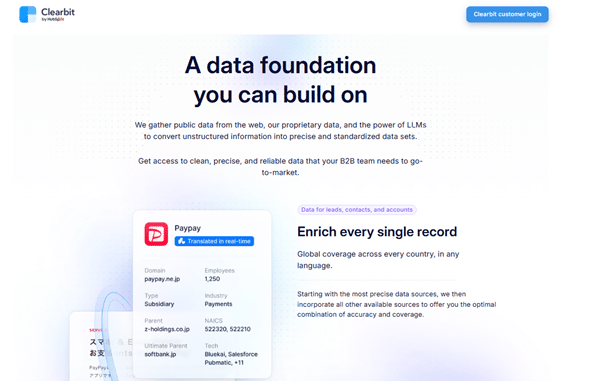
Why: Clearbit is not a data enrichment tool in the marketing sense most teams use it for. It’s not there to help you spam smarter. Its real value lies in restoring context to otherwise anonymous behavior.
When someone lands on your site, downloads a whitepaper, or revisits a pricing page, the raw event itself means nothing in isolation. Clearbit assigns gravity to that action. Industry. Company size. Growth signals. Tech stack. Hiring velocity.
All of this reframes the same click into a distinct intent narrative.
4. Customer.io: Central hub for customer engagement
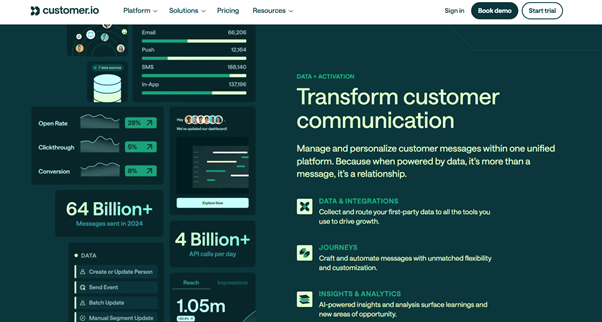
Why: Most lifecycle tools promise personalization. Very few respect restraint.
Customer.io works when you stop treating it like an email automation engine and start using it as a behavioral orchestration layer. It reacts to what users do, not what marketers hope they’ll do.
Every SaaS product already generates signals. Feature adoption. Drop-offs. Inactivity. Re-engagement. Customer.io turns these signals into timing intelligence. Not just “send an email,” but why now, to whom, and with what context.
5. Ahrefs: Market research
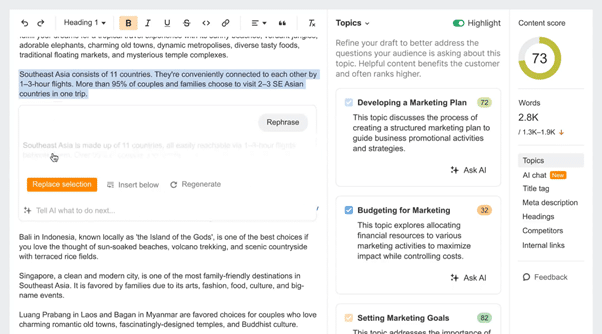
Why: Ahrefs is often reduced to a keyword mining utility. That’s a waste.
At its best, Ahrefs is a demand sensing tool. It shows you what people are already trying to understand, solve, or compare- before they ever reach your product.
In SaaS marketing, this is critical. You’re rarely creating demand from scratch. You’re entering an existing conversation. Ahrefs helps you map that conversation with precision. What problems are persistent? What language buyers use. What topics plateau? What spikes briefly and dies.
When integrated with product and revenue data, Ahrefs becomes a feedback loop.
The Anti-Sprawl Philosophy for Your SaaS Marketing Tools Collection
Tool sprawl doesn’t happen because teams love software. It happens because teams avoid hard decisions.
Every SaaS marketing tool you add should answer one question clearly: What agency does this give my team that we didn’t have before? And if the answer is efficiency without clarity, it’s not enough. If the answer is automation without accountability, it’s dangerous.
The goal is not to own the most advanced stack. It’s to maintain strategic coherence as your company scales- fewer tools, clear roles, and observable outcomes.
In 2026, SaaS buyers are hyper-aware of bloat. They feel it internally. They recognize it externally. If your marketing stack is chaotic, your message will be too.
Prune aggressively. Consolidate intentionally. Let tools serve the strategy, not define it.
That’s how SaaS marketing regains its edge.