
The marketing budget for SaaS companies has to be up there with Ali vs. Fraser in terms of the sheer debate around it.
It’s controversial to say the least. When setting budgets for your B2B SaaS (Or B2C), you’ll hear the conversation going something like this: the budget has to 10% or 8% of the ARR, or you need to find your context and choose the budget instead of using an arbitrary benchmarkespecially if you’re aligning spend with broader SaaS growth strategies.
It’s a lot. Any business leader thinking about this is going to be a bit overwhelmed.
Marketing spend is not an easy topic to tackle, and neither is it so cleanly explained in a blog topic.
But we can give you the tools to figure this problem out. Which is, essentially, an optimization problem. One that requires thought from its leadership. Treat this as an open letter. First, to the marketing leader of the organization, and second, to the founder or Chief Exec.
SaaS marketing budgets are dynamic. But there is a problem.
This is the first part of the open letter. Even though it’s written in an SEO-style blog format. It is not- the purpose behind it is to reach leaders (future and present) like you. And we still believe in organic; it’s a great channel, particularly when supported by a focused SEO for SaaS strategy.
What the marketing leader needs to know for SaaS marketing budgets in 2026
The pipeline is, for all intents and purposes, polluted. You know your ROI best. There’s no one else disputing you over there. But, aren’t marketing leaders forgetting two important things?
And these two ideas are parroted on and on by every blog and almost all LinkedIn posts: –
- Marketing noise
- Marketing as a strategic function is deeply explored in modern B2B SaaS marketing frameworks.
These two might seem disconnected to you, but they are not.
Trust is by far the most crucial resource in a B2B deal- Org A will buy from Org B when the people running Org A trust the people in B. But, we can observe a clear relationship, as marketing noise of an organization increases, trust decreases (This is just an observation.)
And trust is a strategic lever. This connects us to marketing as a strategic function.
You hold the most data in an organization. The behavioral insights that marketing teams have are off the charts. But as time passes, the amount of useful data shrinks, and you need more effort to target similar customers, which makes precise B2B SaaS customer segmentation even more critical. And what about the insights? How do they manifest?
Poorly.
Marketing’s two problems contribute directly to the budget issues-
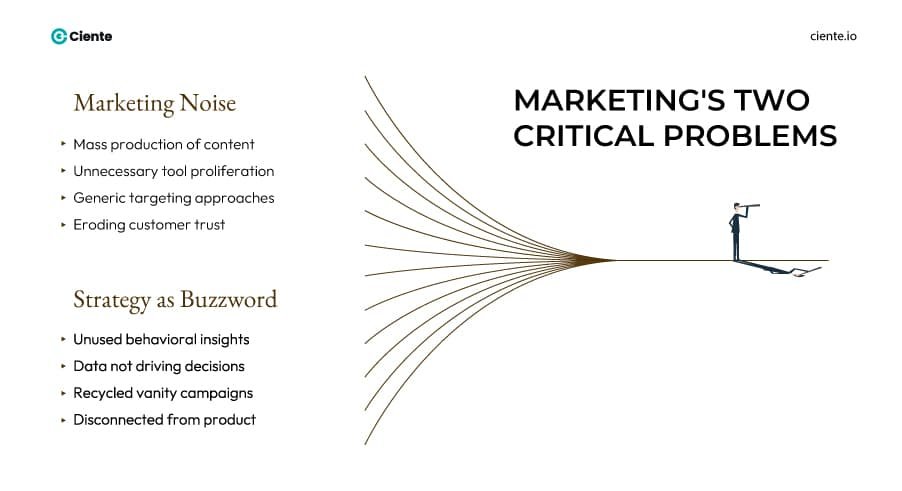
- Noise means mass production and the usage of unnecessary tools for content creation and targeting.
- Marketing not as a strategy means unused data and insights are used to recycle old or “vanity” campaigns. Strategy becomes a buzzword, not an activity.
But how does that look in practice? Let’s illustrate it with an example that every marketing leader deals with: CAC.
CAC
Customer acquisition cost is one of the most vital SaaS metrics to understand B2B SaaS marketing budgets and how to optimize them.
Let’s start with a hot take: CAC is not marketing’s responsibility solely. And thinking so affects organizational behavior. Every overhead cost actually drains from the treasury, but paradoxically, it is marketing that bears the brunt of it.
What happens when a feature fails to live up to its promise? The usual human response is to assign blame to product managers and developers, who will then shift it to marketing.
“They can’t upsell it. We created a perfectly valid function- the marketing lacks.”
Well, there goes your budget. No one asked you whether this feature was important. Nor if it added to the userbase, sound familiar? Yet, the archaic system of measuring CAC continues to prosper.
What, in theory, could help improve CAC and budget slashes? Well, it would require breaking silos within marketing itself.
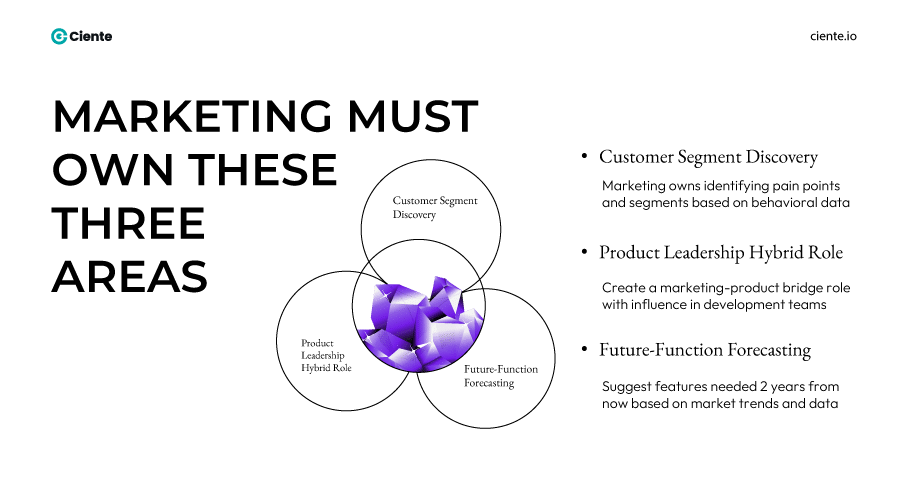
- Marketing will have to own the customer segment and pain point discovery.
- Marketing will have to place or create a hybrid role for at least one product leader. One that will gain influence in developmental teams.
- It will have to suggest ‘functions’ that a tool will need. Not today. But two years from now.
As a marketing leader, these three will not sound far-fetched to you because you know this to be true. Your data knows what is true. What is lacking is influence, which can only be gained through strategic execution.
What co-founders and CEOs need to know about SaaS marketing budgets in 2026
If you read the section above, you might find some ideas that seem disruptive. They are supposed to be.
Let’s be blunt here: your marketing team is performing under pressure. But not the kind that produces results- they are engaging in volume work because there is a belief that more pipeline equals more conversations equals more closes, despite what real B2B SaaS funnel conversion benchmarks often reveal about quality over volume.
No. It doesn’t work like that. The buyers are hyperaware- they conduct research before ever talking to an SDR. Your prospect has a literal list of people they’d like to buy from- and many teams are not on it.
So, to get on that list as soon as possible, marketing teams mass blast, increase CAC in the process, and don’t create a pipeline that will serve you in the future. Of course, how can they?
Think of this: you need marketing to get your leads and exposure. What do you do?
- Hire a person to handle marketing
- Give them ROI targets for today
- Expect the numbers to flow in
But you are still paying their salaries- for 3 years at least. But every time, there is disappointment. You’ve heard that marketing is a lever of growth- why isn’t it for you? Why do costs balloon up, and your CMO needs yet another new tool?
Because the market itself suffers from short-termism. It pays to get results today. But the time passes anyway- short-term vision kills long-term thinking.
And the worst part? You pay from your pockets for the long term. That’s the tragedy of marketing and business leaders.
Yes, it is a growth function, but only if you manage short and long-term vision.
What can business leaders do to help improve SaaS marketing budget constraints?
Here’s an executive version for you: –
Stop setting annual ROI targets. Marketing can’t build long-term positioning while being measured quarterly. Your marketing leader needs permission to invest in programs that won’t show returns for 18 months.
Restructure authority. If marketing is going to own customer discovery and forecast product needs two years out, they need a seat in product planning.
Change the question. Stop asking ‘how many MQLs this quarter’ and start asking ‘what percentage of our ICP has us on their shortlist.’ That’s the metric that matters.
Your CAC will tell you if you’re doing this right. If it’s climbing while your win rate stays flat, you’re funding noise. If it’s stable while your average deal size grows, you’re building trust. The number itself matters less than the trend and what it’s buying you.
B2B SaaS Budgets are optimizing for human problems
The optimization problem isn’t in the percentage of ARR you spend. It’s in whether you’re structured to let marketing be strategic or just productive. Your marketing leader knows what needs to happen. The question is whether you’ll give them the authority and timeline to do it.