
Most B2B companies think their customer value proposition works until they lose deals they should have won and can’t figure out why.
The B2B market is valued at $30.1 trillion in 2025. And it’s projected to reach $44.5 trillion by 2029. There’s no doubt that the B2B business is expanding rigorously.
And that has birthed unprecedented competition. Your proof of concept and solution could turn out to be one of the best out there. You did everything right. But you still lost out on a significant account. The focus is now on the disappointing outcome.
Where was the hitch?
The prospect failed to gauge the value of your offerings. You can’t see value when it’s not communicated properly.
Creating Value and Communicating Value
The thing is that we, as marketers, are all aware that buyers today conduct their research beforehand. They aren’t waiting around for your presentation. They’ve done research on your company, along with who your existing customers are. This knowledge from the buyers‘ side has taken up the complexities a notch. There are more unknowns in the equation than there were before.
We are neglecting a very real concern: customers must feel comfortable with their decisions, which is deeply tied to how well you understand and act on the voice of the customer.
And it’s non-negotiable.
Most businesses underplay that their customer accounts have competing solutions to choose from. And that their own solution has specific shortcomings that can hinder their own marketing and sales efforts. Using unsubstantiated statements such as “we can help you save money” can broadly affect your business performance. A simple research conducted hereinafter will determine whether you have the resources (people, processes, experience, and tools) to help them save monetary spend.
A persuasive customer value proposition isn’t about curating a fairy tale.
Such realizations are lost on organizations.
And the consequence?
Marketing concocts promotional and advertising copy, or sales collateral, with promises the business can’t keep. That’s precisely what SDRs or purchasing managers have come to believe value propositions are. Yes, they are supposed to be persuasive. But they aren’t false claims and assertions that aren’t backed up. Statements can turn out deceptive. Especially if they aren’t demonstrated in a way that tackles the concerns of impending risks and uncertainties.
But customer value proposition isn’t marketing fluff.
Defining Customer Value Proposition: What It Is and What It’s Definitely Not
Customer value proposition can be defined as, according to Salesforce:
“A customer value proposition is a statement that summarizes why a potential customer should choose your product or service over the competition. It highlights your product’s specific benefits and value. And also conveys why it’s the best available solution for your prospects’ needs or challenges.”
It illustrates how much your business is worth to your customers. But a nuanced insight into customer understanding is lost to the B2B marketplace.
Your prospects want you to construct a picture of the potential for value. This goes beyond what is. The uncertainties. Beyond the tangible worth. And into how your offering could become a strategic advantage. From the solution that is delivered currently to its realized value, i.e., what it could become. But this can only be actualized when B2B businesses grasp what is crucial for their customers.
That means the outcomes they’re trying to achieve, and what the chief decision-makers care about. Even Salesforce’s State of Sales report asserts that 86% of B2B buyers are more likely to purchase when their goals are understood.
Half of the shenanigans is precisely about that: understanding your customers through the context of your solution, often powered by effective customer analytics solutions.
The Trap That Sabotages Your Customer Value Proposition
Sit in any B2B marketing meeting, and you’ll witness the same ritual.
Product managers presenting features. Engineers explaining architecture. Marketing is trying to translate technical specs into “benefits.” Everyone nodding along as if they’re building something prospects actually care about.
They’re not.
Here’s what’s actually happening.
You’re describing your world. The technology you chose. The problems you solved during development, instead of aligning with insights derived from customer data platforms. The integrations you’re proud of. But nobody buying enterprise software wakes up thinking “I need robust API capabilities today.” They wake up thinking, “If we get breached again, I’m getting fired.”
That gap?
That’s where most customer value propositions die.
Most companies build their value story by inventory. Start with what we built. List the features. Add superlatives. Call it enterprise-grade or next-generation or AI-powered. Ship it to the website. Wonder why demo requests aren’t flooding in.
Because you’re speaking a language prospects don’t use when they’re actually trying to solve problems. Your customer value proposition is written for your board deck, not for someone Googling solutions at 11 PM because their current system just crashed again.
Their reality isn’t comparable to your feature list, and mapping that reality requires a structured customer journey mapping approach.
It’s budget meetings where they’re fighting for dollars against three other initiatives. It’s internal skeptics who’ve seen “transformative solutions” fail before. It’s the unspoken pressure not to screw this up because the last vendor they picked turned into a twelve-month disaster.
When Slack launched, they had every reason to talk about their “threaded asynchronous communication platform with enterprise SSO.” Instead, they said, “Be less busy.” Two words that every burned-out knowledge worker immediately felt in their bones.
That’s a customer value proposition rooted in customer truth, not product capability.
Why Every B2B Customer Value Proposition Sounds Like a Template
Pull up ten SaaS homepages right now. Any category. Marketing automation. Project management. Analytics platforms. And now read their headlines.
- “Transform how your business operates.”
- “Empower teams to achieve unprecedented results.”
- “Drive measurable growth at scale.”
It’s the same Mad Libs template with words rearranged. And everybody thinks they’re being original.
The real issue?
Companies confuse a customer value proposition with corporate diplomacy. They’re trying to appeal to everyone in their addressable market. So they file down every edge. Remove specifics. Add qualifiers and escape hatches until the statement means everything and therefore nothing.
Let’s be honest: in the current MarTech and AdTech landscape, value has become a hollowed-out term. We throw it around in slide decks and pitch meetings like a security blanket, yet most organizations struggle to articulate why a prospect should cut a check to them rather than the competition.
If you look at the standard definitions (the kind you’ll find in a Coursera module), a Customer Value Proposition (CVP) is often described as a “statement of benefits.” But in the high-stakes world of B2B, a CVP is more of a strategic anchor than it’s regarded.
And it’s also the core reason your business deserves to exist in a crowded marketplace.
While giants like Salesforce approach the CVP through the lens of CRM enablement, and academic platforms treat it as a UX design exercise, we need to look at it for what it truly is: The ultimate de-risking tool for your buyer.
The Customer Value Proposition Canvas Beyond the Clichés
To build a CVP that actually moves the needle, we have to move away from gut feelings and toward the Value Proposition Canvas. Popularized by Alexander Osterwalder, this framework is the antidote to the feature-first trap that stagnates several tech startups.
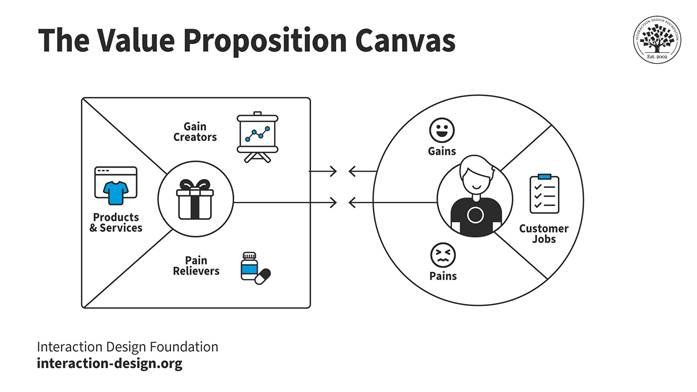
The canvas forces a brutal honesty.
You have the ICP on one side of the coin.
The savviest marketing teams only consider job titles, but a truly nuanced strategy digs into the Jobs-to-be-Done. What is the CTO actually trying to achieve at 2:00 PM on a Tuesday? Not “synergy.” They’re rather looking to migrate legacy data without a system crash that can cost them millions.
On the other side is your Value Map.
That is where you align your products’ “pain relievers” with the customer’s actual stressors. As the Interaction Design Foundation (IxDF) notes, the magic happens at the Fit. If your product offers a “gain” that the customer doesn’t actually value (e.g., a fancy UI for a backend developer who prefers a CLI), you don’t have a value proposition. It’s really a mismatch.
The B2B Reality: It’s Never Just One Canvas
Here is where the academic models often fall short: they assume a 1:1 relationship between the seller and the buyer. You are selling to a buying committee in B2B tech.
A single CVP cannot simultaneously satisfy a CFO, a CTO, and a Head of Marketing. Their pains are diametrically opposed. The CFO wants to see a reduction in Ops; the Head of Marketing wants to see an explosion in lead volume, even if it costs more.
So to succeed, your CVP must be modular. You need a master brand promise supported by persona-specific sub-canvases that speak directly to the unique anxieties of each stakeholder.
The HBS Lens on Evidence-Based Customer Proposition Value
The proof is in the profits. But how do you make it more visible?
Harvard Business School (HBS) takes a more clinical, yet equally vital, approach: the Three-Question Framework. If you can’t answer these three things with data, your CVP is just marketing fluff.
- Focus: Which customers should we serve?
- Intent: What is the job they need done?
- Differentiation: What is the offering that does it best?
The nuance here lies in the word “Best.”
In the B2B tech world, “best” is rarely about having the most features; it’s about Evidence-Based Value.
As HBS researchers assert, a value proposition is a promise of a future result. If you can’t point to a case study where you reduced churn by 15% or cut cloud latency by 200ms, your CVP lacks the trust component of E-E-A-T.
| CVP Type | Target Goal | The Proof Needed |
| Efficiency-Driven | Reducing Cost/Time | Hard ROI data, time-savings benchmarks. |
| Growth-Driven | Increasing Revenue | Conversion lift metrics, market share data. |
| Risk-Driven | Security/Compliance | Certifications (SOC2), uptime guarantees. |
Navigating the Differentiation Crisis
If we compare other blogs online, a glaring SEO gap emerges: they rarely mention the competitor’s CVP.
You do not exist in a vacuum. Your value is relative.
If your competitor (Platform X) claims they are the “easiest to use,” and you also claim the same, you have effectively neutralized each other, which weakens your broader customer acquisition strategies. You are now competing on price- a race to the bottom that no one wins.
An impactful CVP identifies the unfair advantage.
That isn’t just a USP; it’s a structural reality of your business that is hard to replicate. Is it your proprietary dataset? Your white-glove implementation team? Your niche focuses on the mid-market?
Whatever it is, it must be the North Star of your messaging.
What Actually Makes a Customer Value Proposition Work
Let’s dissect what separates customer value propositions that prospects screenshot and send to colleagues from those they scroll past without registering.
1. First thing: resonance over relevance. Relevance is the baseline. “Yes, this is adjacent to our problem space.” Resonance is the gut punch. “Wait, they understand exactly what I’m dealing with.”
Resonance comes from proximity. You’ve sat in the miserable meetings, and you understand behavioral nuances through the psychology of personalization. You’ve heard the passive-aggressive Slack messages flying around after another vendor implementation goes sideways. You know the specific terminology they use with each other versus the sanitized corporate-speak they use with vendors.
Your customer value proposition should read like it was written by someone who’s lived in their world, not someone who read their Wikipedia page.
2. Then precision, but not the way you think. Most B2B companies hear “be specific,” and they bolt numbers onto vague claims. “Reduce costs significantly” becomes “reduce costs by up to 40%.” But that “up to” is doing suspicious work. Up to 40% could mean 2%. It could mean 40% if you’re already optimized, the stars align, and you implement perfectly.
True precision means you’ve done enough customer research to know what’s actually achievable, often backed by insights from data analytics to improve customer experience. Not the best case. Not the one customer who used your product in precisely the right conditions. The realistic middle of the distribution.
3. When you say “20 to 30% reduction in inventory carrying costs,” you should be ready to explain what drives that range. What conditions push results toward 30%? What factors keep them closer to 20%? What happens if they’re understaffed or if their ERP is ancient, or if their warehouse manager resists change?
But here’s the trap. Precision isn’t certainty. B2B companies want to promise guaranteed outcomes because guarantees feel like they close deals. Except that nothing in B2B is guaranteed. Too many variables outside your control. Customer execution matters. Market conditions shift. Internal adoption determines everything.
Sophisticated customer value propositions acknowledge this without sounding wishy-washy. They frame value as potential, not inevitability. “Companies in similar situations typically achieve X when they implement Y under conditions Z.” That’s honest.
And the scarcity of honesty in B2B makes truth stand out.
4. Last piece: contrast, not comparison. Your customer value proposition can’t just claim you’re incrementally better. Better is a sliding scale that invites endless debate. Different is a category shift that changes the conversation.
Look at how Gong positioned itself.
They could’ve said, “better call recording with AI transcription.” Instead, they said “revenue intelligence.” Suddenly, they’re not competing with call recording tools. They’re competing with spreadsheets, executive intuition, and quarterly surprises.
That reframing is what a strong customer value proposition accomplishes.
The Evolutionary Nature of Value in B2B Relationships
Here’s what trips up even sophisticated B2B companies. They treat their customer value proposition like a wedding vow. Written once, repeated forever, never questioned.
But the value you deliver in month one isn’t comparable to the value you offer in month eighteen. It’s about solving the immediate problem initially. Getting the system live. Replacing the broken process. And achieving that first win that justifies the purchase decision.
A year in, the customer has solved that problem. Now they’re looking at adjacent use cases. They want to expand into other departments. They need deeper customization. The original customer value proposition that got them to sign has become irrelevant to their current needs.
If you keep selling them the same value, you lose them. Not to a competitor necessarily. Just to apathy. They stop seeing new value, so they stop engaging. The relationship flatlines.
Savvy B2B companies version their customer value proposition across the customer lifecycle, aligning messaging at every stage. There’s the acquisition value proposition. The onboarding value proposition. The expansion value proposition. The renewal value proposition. Each one speaks to what matters at that specific moment.
But here’s the nuance. These aren’t entirely different statements. They’re variations on a core theme. The through line stays consistent. What changes is the emphasis. Which benefits do you highlight? Which outcomes do you focus on? Which proof points do you reference?
It requires discipline. Because it’s easier to have one customer value proposition and use it everywhere. But easy doesn’t win in B2B. Relevant wins. And relevance shifts as the relationship matures.
Testing Whether Your Customer Value Proposition Actually Works
Most B2B companies operate on faith when it comes to their customer value proposition. They believe it works because they’ve been using it. Or because the exec team approved it. Or because it sounds good in their heads.
Meanwhile, prospects are bouncing off their website, often due to digital fatigue impacting engagement and decision-making. Win rates are declining. But nobody connects those symptoms to a weak customer value proposition because nobody’s actually testing it.
Here’s a real test.
Take your customer value proposition to the five lost deals from the last quarter, and evaluate how it impacted your overall customer acquisition process. The ones where you made it to the final stages and then the prospect went with a competitor or chose to do nothing.
Ask them: What value did you think we were offering? What value did the winner offer that felt more compelling? Where did our story fall short?
The answers are brutal and clarifying. You’ll discover your customer value proposition emphasized benefits they didn’t care about. Or that it promised outcomes they didn’t believe were achievable. Or that it sounded identical to two other vendors they were evaluating.
That feedback is the raw material for improvement, especially when paired with structured CX analytics to measure and refine performance. But most companies never collect it because they’re afraid of what they’ll hear.
Another test. Record three sales calls where reps are presenting your value proposition. Not demos. Not pricing discussions. The part where they’re supposed to articulate why the prospect should care.
Listen to how the customer value proposition translates from page to conversation. Is your sales team using it? Are they adapting it to the specific prospect’s situation? Or are they improvising entirely different value statements?
If there’s a gap between your official customer value proposition and what your best reps actually say, it signals misalignment that better lead nurturing strategies can help bridge. Your customer value proposition doesn’t work in the field. Your reps have figured out what does work, and they’re using that instead.
Pay attention to that gap-
It’s telling you something important about what actually resonates versus what you think should resonate.
What Looks Good in Practice: Examples of Great Customer Value Propositions
Enough theory. What does a customer value proposition that works actually sound like?
Take Stripe. They don’t say “comprehensive payment processing platform with global coverage and advanced fraud detection.” They say, “increase revenue and optimize your payments stack.” Then they break it down: “Accept payments. Send payouts. Automate financial processes.”
Simple. Outcome-oriented. Jargon-free. You immediately understand what they do and why it matters.
Or look at how Figma positioned itself against Adobe XD and Sketch. They didn’t claim better features. They claimed a fundamentally different approach: “Nothing great is built alone.” Their customer value proposition was about collaboration, not capability. They positioned design tools as team sports, not solo activities.
That’s strategic. Because once you accept that premise, you need tools built for collaboration. And suddenly, Figma isn’t competing on features. They’re competing on philosophy.
The pattern here?
Strong customer value propositions take a stance. They reflect an opinion about how the world should work. Weak customer value propositions try to appeal to everyone by standing for nothing.
When Notion launched, they could have positioned themselves as “another productivity tool.” Instead, they said, “all your work in one place.” That’s not just a feature list. That’s a rejection of the multi-tool chaos most teams were living in. They weren’t selling software. They were selling simply.
These examples share something important. They’re not about the product. They’re about the change the product enables. The state you’re in before versus the state you’ll be in after.
That’s what a customer value proposition actually needs to communicate.
Is Your CVP Resonating or Just Occupying Space?
How do you know if your CVP is working? You don’t look at your website traffic; you look at your sales cycle.
A strong CVP acts as a lubricant. It resolves objections before they are even voiced. If your sales team is constantly getting stuck in feature parity battles, i.e., where the prospect is comparing your checkbox list against a competitor’s, your CVP has failed to establish a high-level business case.
5 Red Flags Your Customer Value Proposition is Stagnant:
- The “We Do Everything” Syndrome: If your value prop is a paragraph long and mentions five different industries, it means you haven’t made a choice. And strategy is the art of making choices.
- Lack of Narrative Flow: Does your homepage tell a story? Or is it a collection of disparate buzzwords? A good CVP follows a logical flow: Problem -> Agitation -> Solution -> Result.
- Low Internal Adoption: Ask your top three account executives to define your value prop. If you get three different answers, your internal “Brand Voice” is fractured.
- The Absence of “No”: A great CVP should actually repel the wrong customers. If you are trying to be valuable to everyone, you are valuable to no one.
- Stale Proof Points: If your newest case study is from 2022, your CVP is basically a historical document.
The Strategic Weight of Getting the Customer Value Proposition Right
Your customer value proposition isn’t a marketing exercise.
It’s a strategic decision about how you compete. Get it wrong, and you’ll chase prospects who aren’t a fit. You’ll compete on price because you can’t articulate differentiated value. You’ll churn customers who expected something you never intended to deliver.
Get it right and everything downstream becomes easier. Your marketing writes itself because the message is clear. Sales has a story that resonates. Customer success can reinforce value at every milestone. Renewals become automatic because delivered value matches promised value.
In a market growing from $30 trillion to $44 trillion, precision matters.
There’s too much competition. Too much noise. Too many alternatives. Your customer value proposition is the signal that cuts through. It’s how prospects decide you’re worth their attention.
That’s not fluff.
That’s the foundation of everything else you do. And foundations built on vague promises and borrowed language crack under pressure. The companies winning today have figured this out. They’ve done the hard work of understanding their customers deeply enough to articulate value in terms that matter.
That’s what separates the strategic from the also-ran. Not better products. Not bigger budgets. Better clarity about what value means to the people who matter most.
Customer Value Proposition as a Living Document
The biggest mistake B2B leaders make is treating the Customer Value Proposition as a “set it and forget it” task. In an era where AI is disrupting software cycles every six months, your value is in constant flux.
What was valuable in a high-interest-rate environment (cost-cutting) might be less valuable in a growth-focused bull market (scaling). To maintain your edge, you must treat your CVP as a living document. Conduct quarterly value audits. Talk to your customers- not just the happy ones, but the ones who churned. Ask them where the promise broke.
Building a world-class CVP isn’t about finding your truth, not the ‘right’ truth. When you align the technical capabilities of your platform with the deep-seated professional goals of your buyer, you stop selling software and start selling a better version of your customer’s business.