If your strategy looks like everyone else’s, it’s working against you. With homogenization eating B2B marketing alive, you don’t have to follow the herd.
There’s a physicist named Derek J. de Solla Price who, back in 1963, cracked open something that most marketers still haven’t come to terms with.
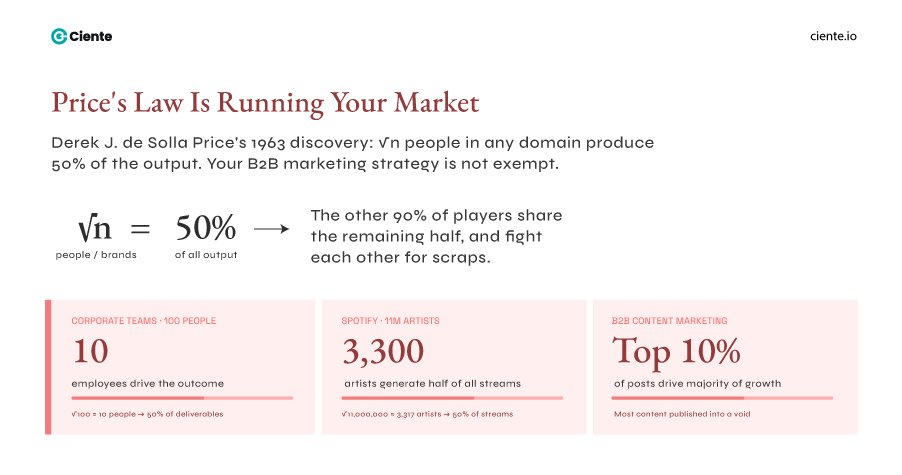
He was studying scientific publications- trying to figure out why certain researchers dominated their fields while the rest published into a void. And that’s when he noticed the distribution of output wasn’t a bell curve. It wasn’t even close. It followed what’s now called Price’s Law: the square root of the number of people in any domain does 50% of the work.
In a company of 100 people, 10 carry the outcome. On Spotify’s 11 million artists, 3,300 generate half of all streams. In content, your top 10% of posts drive the majority of your growth.
This is the mathematical structure of every complex system- and your B2B marketing strategy is not exempt from it.
The uncomfortable part? Most B2B playbooks are designed around the assumption that volume and consistency are enough. They’re not. And in 2026, with homogenization gulping down the industry, following the playbook everyone else is means blending into the 90%- the half of the distribution that doesn’t drive outcomes.
Here’s how to build a B2B marketing strategy that actually places you in the square root.
The Two Biggest Problems with B2B Marketing Strategy Right Now
Before we dive into fixes, let’s name the disease.
A. Homogenization is Killing Differentiation in B2B Marketing
Open LinkedIn on any given Tuesday. Count how many posts follow the beat of: bold claim → three-word lines → “here’s the framework” → carousel. You’ll lose count by 9 AM.
Now open your competitors’ websites. Read their hero copy. “We help [ICP] achieve [outcome] with [solution].” Sound familiar? That’s because everyone is hired from the same playbook, the same templates and AI tools, with the same prompts.
Homogenization is a massive creative and structural hiccup, something already highlighted in broader discussions around evolving marketing competencies.
When every B2B brand looks, sounds, and positions the same way, buyers stop being able to distinguish between vendors on merit. They default to brand recognition (which you probably don’t have if you’re not already winning) or price (which is a race to the bottom).
Neither is that where you want to compete.
The worst part is that homogenization is accelerating. AI-assisted content at scale has made it cheaper and easier than ever to produce mediocre content that sounds repetitive and baseless, a trend accelerated by how artificial intelligence is transforming marketing workflows. Volume is no longer a moat.
B. Incoherence is the Silent Strategy Killer
The second problem is subtler and more dangerous.
Most B2B marketing has become practically incoherent.
The ICP in the product copy doesn’t match the ICP in the ads. The positioning on the website is three pivots behind the sales deck. The content team is optimizing for awareness, while the demand gen team is screaming for pipeline, and neither team has briefed the other.
Incoherence creates what seems like a marketing problem but is actually a signal problem—often rooted in a deeper misconception of marketing strategy itself. Your buyers can’t understand what you do, who you serve, or why they should care- not because they’re not smart, but because you haven’t given them a consistent signal to receive.
That is the “Polyscene” problem: a market so noisy, so crowded with competing frequencies, that unclear signals don’t just underperform- they disappear.
What a B2B Marketing Strategy Must Do in 2026
Here’s the reframe. Your B2B marketing strategy doesn’t need more channels or more content—it needs smarter prioritization, much like what’s discussed in emerging B2B marketing trends for 2026. It needs signal concentration, i.e., the deliberate narrowing and sharpening of your message, market, and method until the 10% that matters is doing the work of 100%.
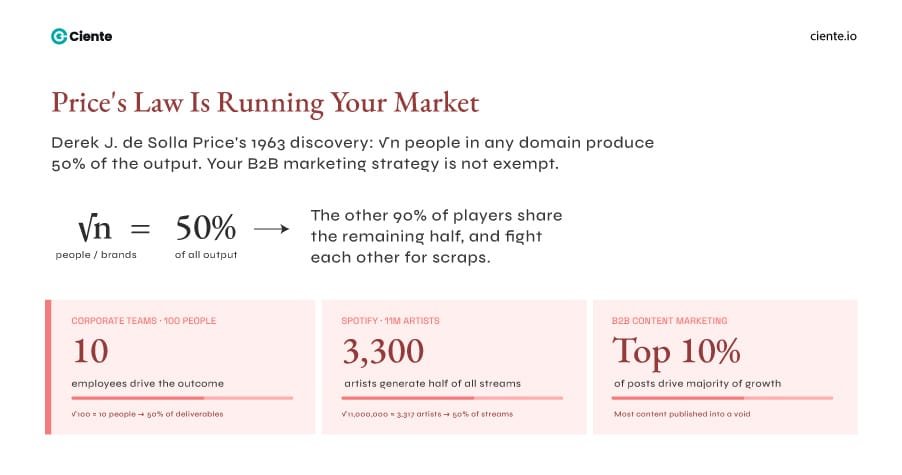
Price’s Law applied to B2B marketing means you cannot predict which campaigns, channels, or narratives will break through before testing them. But you can build a system that identifies your winners faster and doubles down on them harder than everyone else.
Define Your √n Market Before You Build Your B2B Marketing Strategy
Most B2B companies are fishing in oceans when they should be fishing in ponds.
The instinct to stay broad, “we serve mid-market and enterprise across three verticals, “feels like risk mitigation. It’s actually risk amplification, because you’re competing against specialists in every segment without being a specialist in any of them.
The first move in any serious B2B marketing strategy is radical specificity. Who, precisely, is your highest-signal buyer? Not your broadest possible ICP but your sharpest one. The segment where your win rate is highest, your deal cycles are shortest, and your customers stay the longest.
That’s your √n market. Every campaign you build should start there and expand outward only after you’ve dominated the center.
Build Coherence into Your B2B Marketing Strategy Architecture
Coherence is an architecture decision that should be present across every storyboard.
Every marketing tidbit should be extracted from a single source of truth, supported by structured execution frameworks like intelligent workflows in marketing. one narrative about your buyer, perceived risk of inaction, and why you’re the specific answer.
In practice, this means a positioning document that isn’t just a slide deck someone made 18 months ago. It’s a living brief that every piece of content, every ad, every sales call draws from. When someone reads your blog post, watches your webinar, and then talks to your AE- they should feel like they’re in the same universe.
Incoherent B2B marketing strategies feel expensive. Coherent ones compound.
Invest in Volume Early, Then Identify and Exploit Your Signal
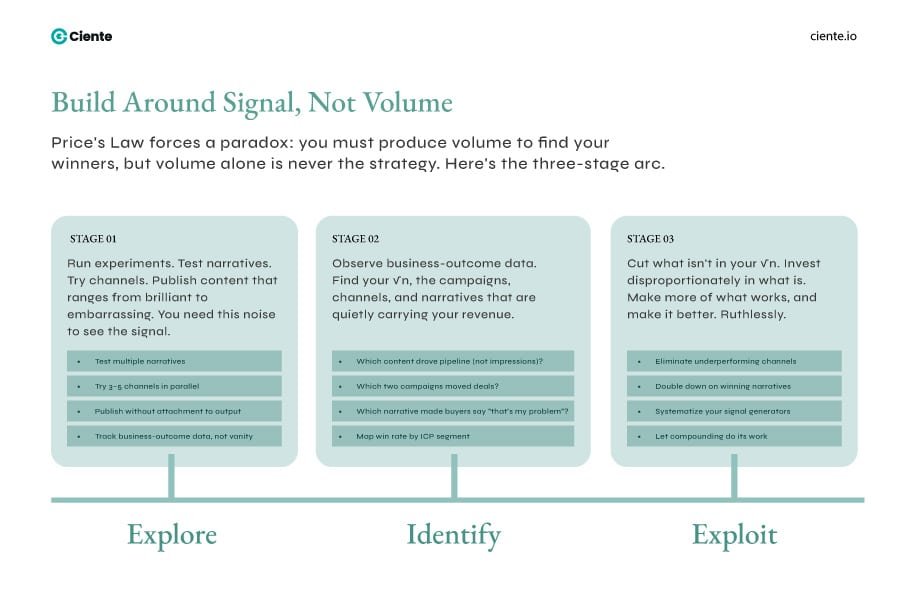
Here’s the paradox Price’s Law forces on you: you must produce volume to find your winners, but volume alone is not the strategy.
You’re in exploration mode in the early game of your B2B marketing, where approaches like quantitative marketing can help identify early signals faster. You run experiments, test narratives, try channels, and publish content that ranges from brilliant to embarrassing. You need this. You cannot know what your signal is until you’ve generated enough noise to see it.
But the mistake most B2B marketing teams make is staying in the early game forever. They’re proud of the 300 blog posts. They’re tracking impressions, open rates, and follower counts. They never stop to ask: which 30 of these actually drove the pipeline? Which two campaigns moved deals? Which narrative made buyers say, “That’s exactly my problem”?
The mid-game of a mature B2B marketing strategy is identification, often strengthened by tools such as lead enrichment for marketing success.
You observe your data- not vanity data but business-outcome data- and you find the √n. The channels that are quietly carrying your revenue. The content types that are actually converting. The messages that are making your sales team’s lives easier.
The late game is ruthless exploitation. You cut what isn’t in your √n and invest disproportionately in what is similar to how content atomization strategies focus only on high-performing assets.
You make more of what works, and you make it better.
The B2B Marketing Strategy Channels Worth Concentrating On
It isn’t a list of every channel that exists. It’s a filter for where to concentrate, given the homogenization problem.
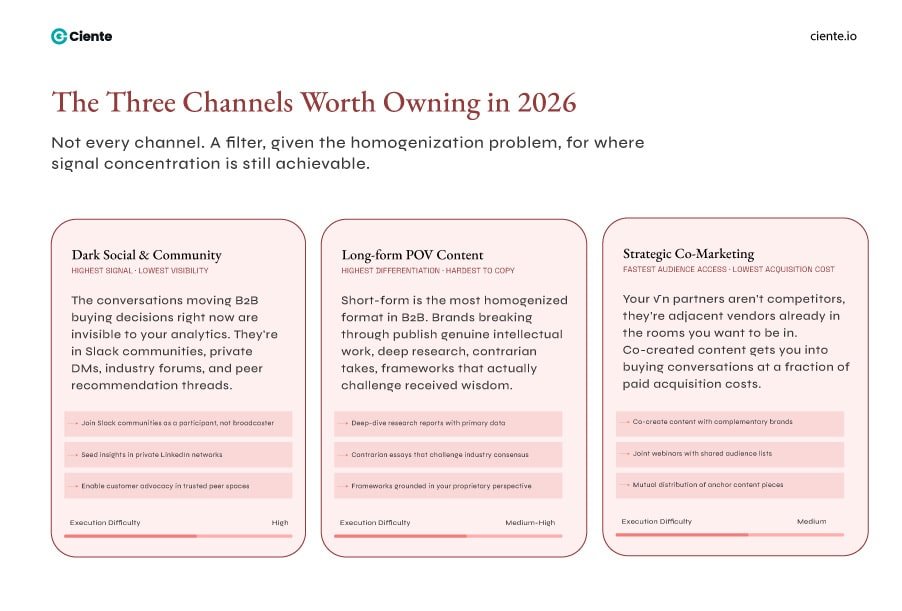
1. Dark social and community
The conversations that are moving B2B buying decisions right now aren’t happening on your website but across decentralized channels, much like strategies explored in podcast marketing. They’re in Slack communities, private LinkedIn DMs, industry forums, and peer recommendation threads. Your B2B marketing strategy needs a presence in these spaces- not as a broadcaster, but as a participant.
2. Long-form POV content
Short-form content is the most homogenized format in B2B. The brands breaking through are publishing genuine intellectual work, i.e., deep-dive research, contrarian takes, frameworks that actually challenge conventional wisdom. Long-form is harder. That’s precisely why it works.
3. Strategic co-marketing
often rooted in strong partner marketing strategies can unlock access to high-value audiences. Your √n partners aren’t your competitors but adjacent vendors already in the rooms you want to be in. Think co-created content, joint webinars, and shared audiences with complementary brands. These are what get you into buying conversations at a fraction of the cost of paid acquisition.
Is Your B2B Marketing Strategy Working?
Marketers must stop measuring what’s already easy to measure and “visible” on the dashboard. Start measuring what’s hard to measure but actually matters.
The metrics that belong in your B2B marketing strategy dashboard should go beyond surface-level KPIs, aligning with modern approaches like product-led marketing measurement. pipeline sourced or influenced by marketing, deal velocity by campaign or content type, win rate by ICP segment, and the qualitative stuff:
“Are your sales reps saying that buyers are coming in already educated? Are prospects referencing specific pieces of content in discovery calls?”
If your marketing is coherent and concentrated on the right signal, these metrics move. If they aren’t, no amount of impression volume will save you.
The Bottom Line on B2B Marketing Strategy in a Polyscene
The market is noisy. It will keep getting noisier. Do you think your brand will stand out if it out-volumes everyone else? That’s a fantasy.
But building just enough signal concentration to be unmistakably visible requires focused execution, similar to how email marketing strategies for enterprise buyers emphasize precision over volume. to exactly the right buyers can change your game.
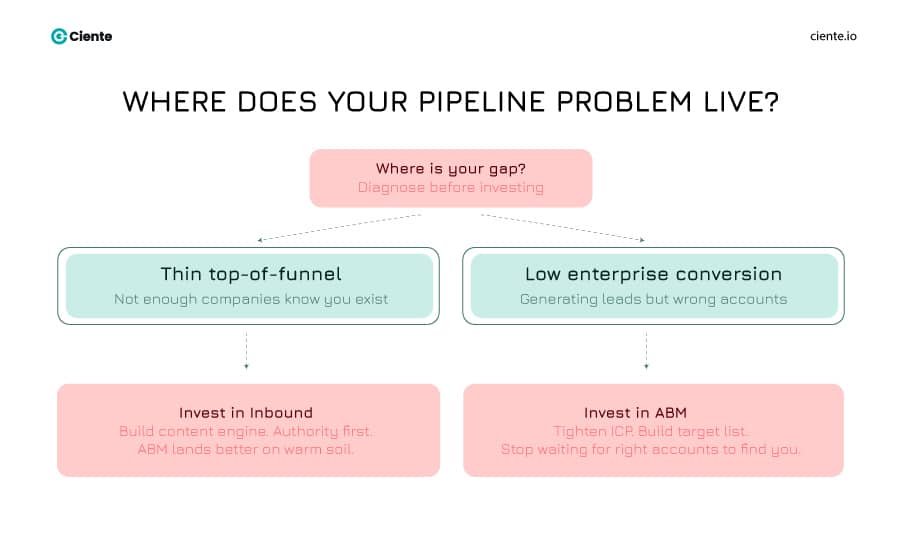
This is where Price’s Law comes in handy. It can be transformed into a navigational tool. Your competitors are doing 90% of the work, and it doesn’t even produce 50% of the results they need to lead the game. That’s the gap you can extract advantage from.
Find your √n. Build around it. And then let compounding do what it does best.