
Email is not dying. The gap between teams that have figured this out and those still doing spray-and-pray is, however, widening fast. Here is what the best email programs actually look like in 2026, why most still fall short, and the specific moves that separate signal from noise in a buyer’s inbox.
Nobody reads your email because they have to.
That seems obvious. But watch how most B2B email programs are built, and the entire architecture assumes obligation. Someone filled out a form, so now they are in the sequence. Someone attended a webinar, so now they get the nurture track. Someone’s firmographic profile matches the ICP, so now a rep is hitting them with a cadence every four days.
The buyer owes none of this a response. And increasingly, they are not giving one.
Between 80% of B2B buyers say email is their main or preferred communication channel with vendors, often by more than double any other channel. Email is not the problem. What gets sent through it is, especially when teams overlook the core components of a successful email program.
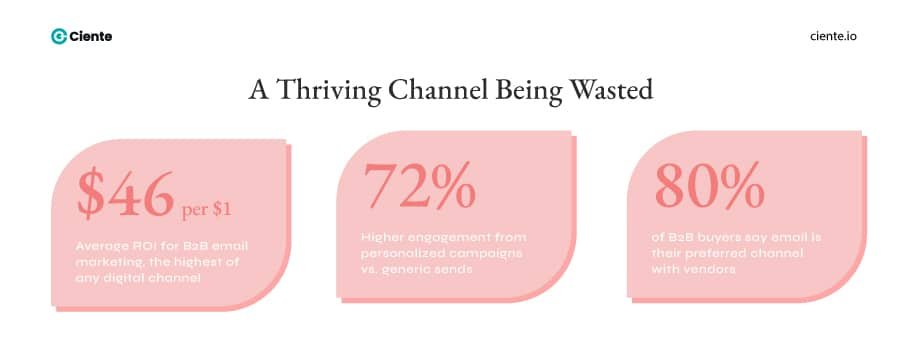
The irony is that the data has never been more favorable to email as a channel. The average ROI for B2B email marketing is $46 for every $1 spent. Personalized B2B email campaigns see 72% higher engagement than non-personalized ones. 91% of B2B marketers in 2025 report that email is critical to their overall IT-marketing strategy. These are not the numbers of a dying channel. They are the numbers of a channel being used well by some and used badly by most.
The gap between those two groups is what this piece is actually about.
The Inbox Is a Trust Environment, Not a Distribution Channel
Start here, because most email strategies get built backwards.
Teams ask: how do we get more emails delivered, opened, and clicked? That is the wrong first question. The right question is: why would a senior buyer, who receives hundreds of emails a day and trusts almost none of them, actually want to hear from you?
The answer has to exist before anything tactical makes sense. Without it, you are optimizing the delivery mechanism for a message that was never worth sending.
Your emails reveal the genuine content of your buyer’s content. If your emails are about what you sell, you have already lost. If your emails are about what your buyer is trying to solve, you have a chance, which is why email personalization strategies that go beyond surface-level tactics matter more than ever.
There is a version of this playing out across inboxes right now that illustrates both failure modes. On one end, the spray-and-pray approach: a cold sequence, generic value prop, three follow-ups that escalate in urgency, auto-populated first name. On the other end, an email that lands with a piece of original research about the exact compliance challenge this buyer’s industry is dealing with right now. No pitch. No CTA beyond “if this is relevant, here’s more.”
The first email is measurably cheaper to produce. The second one gets forwarded inside the account, which is ultimately what drives email-led lead generation in B2B environments.
Why the Buying Committee Changes Everything
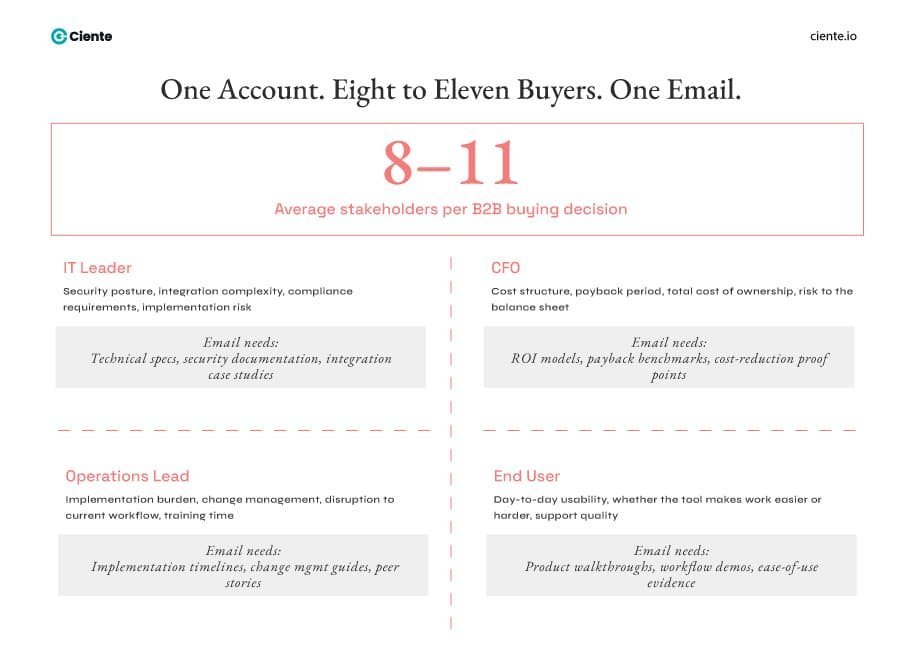
No longer is there a single buyer to tackle. A single account has an average of 8 to 11 buyers. All with different interests.
This is the structural reality that most email programs have not caught up to. Sequences are built for a persona. The persona is a single job title. But the person receiving the email is part of a committee, and the committee members each carry a different concern into the buying process.
The IT leader wants to know about security and integration. The CFO wants to know about cost and payback period. The operations leader wants to know about implementation burden and change management. The end user wants to know whether the product will make their day easier or harder. None of them want to receive the same email.
Create separate personas for each key role in the buying process. The IT manager cares about different things than the CFO. That is true and widely acknowledged. The part that is less widely acted on: the emails going to each of those people need to reflect their specific evaluation job, not a one-size-fits-all pitch for the product.
Email programs that account for committee buying are built around accounts, not individual contacts. The question driving content is not “what does this persona care about?” It is “where is this account in its evaluation, and who on the buying committee needs what right now?” Those are fundamentally different questions, and they produce fundamentally different emails, especially when you rethink email marketing strategies for enterprise buyers.
Subject Lines: The Test That Never Ends
One thing the email pieces in your library get right, consistently, is the subject line approach. Direct language. An honest tension stated plainly. Something that does not pretend the reader is not a skeptic.
“Protect your marketing tenure: escape the agency loop.” That subject line works because it names something the reader already feels before they open it. The fear is real. The subject line meets it where it lives.
Subject line personalization can drive about a 9% uplift in opens, while sender-name personalization, using a real person versus a generic brand, can lift opens by around 27%. The 27% from sender name personalization is the more interesting finding. Buyers open emails from people they recognize or trust. That’s what makes AI email personalization so effective. They skip emails from companies.
This is a forcing function. If the name in the from field is a brand rather than a human being, the email starts at a disadvantage. Moving to individual sender names, where the email appears to come from a person at the company rather than the company itself, is one of the higher-leverage structural changes an email program can make, similar to how email cadence directly impacts engagement outcomes. Not because it tricks anyone, but because it signals that a person wrote this, not a system.
The subject line test is also one that never really ends. What works in Q1 may not work in Q3. What works for financial services buyers may not work for IT buyers. The teams that treat subject line testing as a permanent program, not a one-time exercise, consistently outperform the ones that settled on a formula.
Segmentation: Behavioral Clusters over Demographic Boxes
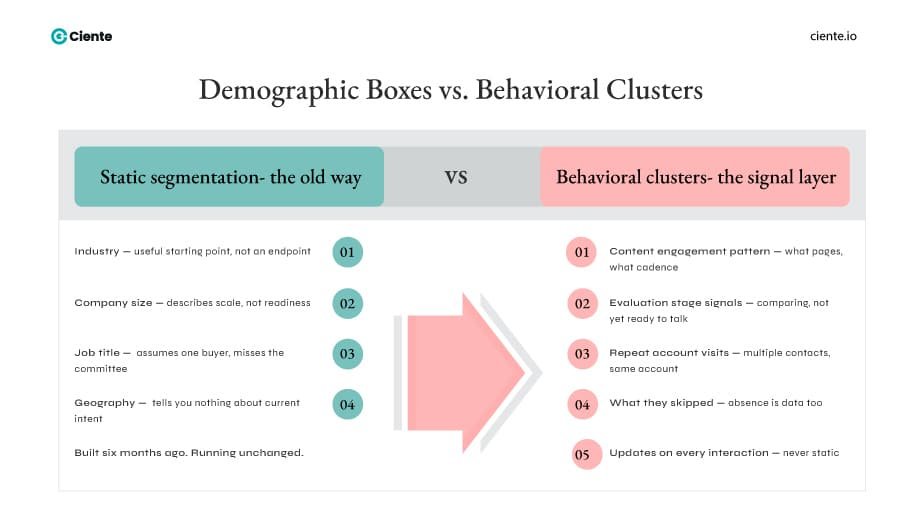
Most B2B segmentation is static. Industry, company size, job title, geography. These are useful starting points and completely insufficient as endpoints.
The limitation is that demographic segmentation tells you what someone is, not what they are doing right now. And what they are doing right now is almost always more predictive of their readiness to engage than any static attribute.
Winning teams treat deliverability as a strategic constraint, segment around buying-group jobs, and measure what matters: repeat engagement, account-level signals, and ICP fit over time principles that align closely with modern inbound strategies powered by email marketing.
The enterprise email piece in your library describes the approach clearly: behavioral clusters. Groups of prospects exhibiting similar behaviors with your content, similar engagement patterns, similar stages in their own evaluation journey. These clusters are more useful than demographic boxes because they reflect intent, not just identity.
The example from that piece is instructive. A cluster of prospects visiting both service pages and blog content but not booking calls. Instead of treating them as leads who need a harder push, the right interpretation was that they were comparing and had not yet reached the moment where a conversation made sense for them. The email response was to keep delivering value, not to escalate pressure. The relationship mattered more than the booking.
What this requires practically is a segmentation model that updates based on behavior. Not one that was built six months ago and has been running unchanged. Every interaction a contact has with your content is data: what they read, what they skipped, what they clicked, what they ignored. Programs that feed this back into segmentation continuously are in a categorically different position than programs that built a list and pressed send.
The Nurture Problem In Email Marketing Strategies: Most of It Is Not Nurturing
The word nurture gets used to describe almost any sequence of emails that is not an immediate pitch. Which means most nurture programs are just slower pitches.
Actual nurturing, the kind that builds the mindshare your buyer thinks of when a need finally crystallizes, requires delivering value in a form the buyer would seek out even if they were not in a buying cycle. That is a high bar. It means your email has to be worth reading on its own terms, not because it is a step toward selling something.
The newsletter format exists for this reason, acting as a cornerstone of email marketing as a content distribution channel. 81% of B2B marketers use email newsletters as their main form of content marketing, making it the most widely used content distribution channel in the B2B space. The newsletter works not because it is a clever tactical choice but because it is an honest form. It says: we are going to send you something worth reading, regularly, without immediately asking for anything. If you find it valuable, you will remember us when the moment comes.
The brands that have built genuine mindshare through email are the ones whose newsletters a buyer would recommend to a colleague. That is the test worth applying. Not open rate. Not click-through rate. Would someone forward this? If the answer is consistently no, the nurture program is not nurturing.
Deliverability Is Not an IT Problem
There is a tendency to treat deliverability as a technical matter, something managed by whoever set up the email platform. That framing is costly, especially when teams rely heavily on email marketing platforms without strategic oversight.
Only 18.2% of B2B senders have DMARC correctly configured and just 7.6% enforce quarantine or reject policies, leaving significant spoofing risks. Those numbers reflect a widespread assumption that deliverability takes care of itself. It does not.
Inbox providers are making increasingly sophisticated judgments about what reaches the inbox. These judgments are not just about authentication records and spam filters. They are about engagement signals. If a large percentage of your list routinely ignores your emails, that behavior gets read as a signal that your mail is not wanted. The filter gets applied not just to the individual recipient but to your entire domain.
The implication is uncomfortable but clear: sending to a large disengaged list actively harms your ability to reach the engaged portion. Volume is not neutral. A poorly maintained list does damage.
The practice this requires is one most teams resist: aggressive list hygiene. Removing contacts who have not engaged in a defined window. Sunsetting rather than continuously re-mailing. Scaling email marketing for B2B usually fails when teams try to scale volume over relevance. The number in the from-field on the batch report is not the goal. Actual reach to people who want to hear from you is.
AI in Email: The Limit Is Not the Tool[SK1]
AI-assisted content writing tools are now used by 58% of B2B email teams, shaping what many consider the future of email marketing. The tools are everywhere. The results are mixed, and the reason is not the tools.
AI can generate subject line variants quickly. It can personalize at scale based on firmographic and behavioral data. It can optimize send timing based on historical engagement patterns. These are real capabilities and they produce real efficiency gains in programs that are already well-designed.
What AI cannot do is manufacture relevance where none exists, or replace the underlying judgment about what this particular buyer in this particular moment actually needs to hear. Data-driven insights work best when guided by human creativity, strategic empathy, and the kind of nuanced storytelling that AI alone cannot replicate.
The programs using AI well are using it to execute a strategy that a human built. The programs using AI poorly are using it to generate volume without having done the strategy work first. More emails, faster. The buyer notices. It is not a good kind of noticing.
The email pieces in your content library make this concrete, similar to what we see across real-world SaaS email marketing examples. The voice in them is specific, direct, and unambiguous about what it believes. “Mediocre agencies and hidden agendas are marketing junk food.” That sentence did not come from a content generation tool. It came from a point of view. AI can help you scale that point of view once it exists. It cannot create the point of view for you.
What Actually Moves the Needle: The Metrics That Matter in Email Marketing Strategies
Apple Mail Privacy Protection and similar features artificially inflate opens, forcing teams to rely more on CTR, CTOR, and conversion metrics.
Open rates have been a compromised signal since 2021, which is why marketers are shifting focus toward more reliable email marketing performance metrics. That has not stopped them from appearing on dashboards as primary KPIs. The teams still optimizing for open rates are optimizing against a corrupted input.
Click-through rate tells you something real: did someone find the content interesting enough to act on it? Click-to-open rate, which measures clicks as a proportion of confirmed openers rather than total sends, is cleaner still. Conversion rate on the downstream action, the demo request, the content download, the meeting booked, is what actually connects email performance to business outcomes.
But the metric worth caring most about in a B2B email program is account-level engagement over time. Not individual contact clicks. Not single-email open rates. Which accounts are repeatedly engaging with your content across multiple contacts and multiple touchpoints? That pattern is the signal that an account is in an active evaluation. That is the intelligence worth feeding into sales.
Use engagement to identify which accounts are leaning in. Feed those signals into retargeting, SDR prioritization, and next-best content. That loop, from email engagement to sales action back to more relevant email, is what makes an email program a genuine part of the revenue motion rather than a separate channel reporting its own metrics to no one who acts on them.
Email is not complicated in its essence.
A person on your list receives something from you. They read it or they do not. If they read it and it was worth reading, they think slightly better of you. If they read it and it was not worth reading, they think slightly worse of you. If they do not read it, nothing happened, and you still paid to send it.
The math compounds. Do it for a year and you either have a list of people who genuinely want to hear from you, or you have a list of people who have learned to ignore you.
The strategic version of that simple reality involves segmentation and deliverability and AI tooling and buying committee mapping. All of that matters and all of it serves the same underlying principle: earn the read.