
Has your team lately sat down and thought- what made some of the SaaS marketing campaigns truly impactful?
No, it wasn’t a clever copy or an aesthetic.
When haven’t marketers heard that “this is the 5 simple ways to do X” or “7 methods can actually boost your ROI 10%”? It’s the template of new-age content.
Great content does demand clever thinking and execution skills- not just catchy headlines. But today, marketing has become just that. A monologue with zero substance for those who are really their audience- decision-makers. This disconnect is often visible across many SaaS marketing approaches that prioritise visibility over resonance.
A lot of the copies that we write are for the buyers in the true sense. But we end up curating resources for marketers who are researching for their own content piece. It’s an endless churn machine.
SEO doesn’t optimize for purchasing intent but for volume and search. And the search is filled with marketers researching the same thing. The content that “performs” never actually reaches the buyers. The actual buyers: the CFO, the VP of RevOps, and the CISO. This is why many B2B SaaS marketing strategies struggle to influence real buying committees.
There’s a cruel irony here.
Brands leverage engagement metrics from these assets to convince that their content strategy is working. To justify their marketing spend. The “Effective Content Strategy for Your Business in 3 Easy Steps” is bait, despite constant discussions around top content formats for SaaS marketing.
Most of your marketing campaigns are curated for the wrong audience. The proof? The buying accounts don’t even read any of it.
So, we spotlight a handful of SaaS marketing campaigns that truly moved the buyers. Not ones that got awards because they checked all the right boxes. Campaigns that spoke to the buying committee, not to those benchmarking strategies similar to some notable SaaS marketing case studies that focused on decision-makers.
Getting Through the Crisis: 3 SaaS Marketing Campaigns that Cut Through
These SaaS marketing campaigns where the metrics and the goal were actually aligned.
1. Drift
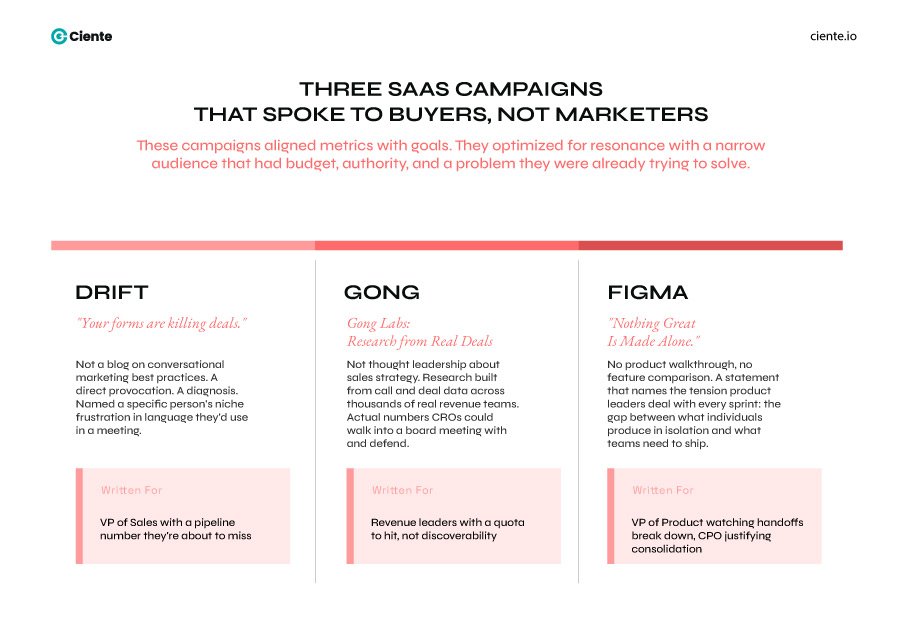
What Drift didn’t do was publish blogs on a conversational marketing best practice. What they did was publish a direct provocation at the VP of Sales: “Your forms are killing deals.”
It wasn’t merely a content strategy. It was a diagnosis. The campaign named a specific person’s very niche frustration in a language that one might use in a meeting.
But the twist? Drift’s social media manager wasn’t the one who shared it first. The sales leaders did. Because it wasn’t written for marketers. The audience is different- someone with a pipeline number they’re about to miss out on.
Read the breakdown of Drift’s conversational marketing strategy: Drift’s Content Marketing Approach
2. Gong
Gong understood that revenue leaders don’t search for frameworks. They search for answers to specific problems they’re already sitting inside.
So instead of publishing thought leadership about sales strategy, Gong published Gong Labs. These are research-designed, built directly from call and deal data across thousands of real revenue teams.
Every report gave CROs and VPs of Sales something they couldn’t get from a generic blog: actual numbers on how deals close, why discovery calls fail, and what separates high-performing reps from the rest. The kind of data a revenue leader could walk into a board meeting with and defend.
Most content teams write for discoverability. Gong wrote for credibility with a very specific person who had a quota to hit. That’s why it spread the way it did- because sales leaders sent it to each other.
Want to know more about Gong Labs? Go here: gong.io/blog.
3. Figma
Figma launched a campaign in 2022 with the line: “Nothing Great Is Made Alone.”
There was no product walkthrough, no feature comparison, and no customer quote. Just a statement that names the tension product and design leaders deal with every sprint: the gap between what individuals produce in isolation and what teams actually need to ship together.
The campaign wasn’t targeted at designers already inside the tool. It was aimed at the VP of Product, watching handoffs break down, and the CPO trying to justify a platform consolidation to the CEO.
Figma won a 2023 Fast Company Innovation by Design Award for this campaign, but that wasn’t the point. The point was that the people it was written for recognised themselves in it immediately.
When the buyer sees their own problem reflected back at them before you’ve talked about the product, you’ve already done the hardest part of the sale.
See the campaign: figma.com/nothing-great-is-made-alone
What Separates These Campaigns from the Rest
A Point of View Before a Product Pitch
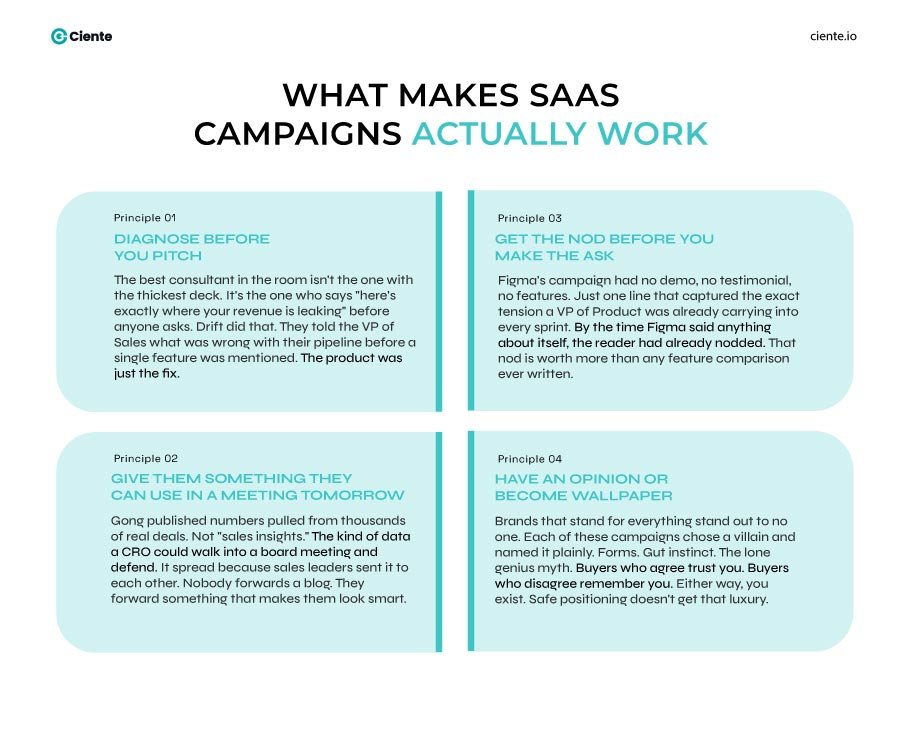
None of these campaigns led with what the product does. They led with what they believed. Drift believed forms were destroying pipeline conversations.
Gong believed revenue leaders were making consequential decisions without the data that actually mattered. Figma believed that the myth of the lone genius was the reason great product work kept falling apart at the handoff.
The product was the evidence for a position the brands had already staked out. And in a market where five competitors are bidding on the same keyword? A brand that has something to say will always out-position a brand that only has features to list.
Specificity Is What Makes the Right Buyer Feel Seen
The instinct to write for a broad audience is understandable. It feels like you’re maximising reach. But in B2B SaaS, broad copy is invisible copy—especially when companies haven’t defined their B2B SaaS customer segmentation clearly. When you name a specific role, a specific frustration, and a specific consequence, the buyer who fits that description feels like the piece is about their last internal meeting.
That’s a very different reaction than skimming a blog post and moving on.
Specificity doesn’t reduce your audience. It changes who your audience is. And the people you attract when you’re specific are actually inside your ICP, not five thousand marketers who clicked because the headline looked useful for their own content calendar. This alignment becomes critical when defining a clear SaaS product-market fit.
The Buyer Has to Be the Story
Most SaaS campaigns are, at their core, about the company- its capabilities, its customers, its accolades. And the campaigns above inverted that. The company was almost incidental. What was central was the buyer’s situation: the problem they were carrying, the conversation they were dreading, the number they were responsible for.
Buyers don’t make purchasing decisions to make vendors look good. They make them solve a problem and protect themselves professionally—something often misunderstood in many SaaS marketing funnel strategies. A campaign that acknowledges the weight of that decision will always land harder than one that leads with the product.
Having a Clear Position Builds More Trust Than Playing It Safe
Campaigns that are willing to name what they’re against are more credible than campaigns that promise everything to everyone. This is a core principle behind strong thought leadership in SaaS marketing.
- Drift named forms as the enemy of good sales conversations.
- Gong named intuition-based sales management as a liability.
- Figma named isolated individual workflows as the reason product work breaks down.
Buyers who agree with you immediately trust you more when you take a clear position. And buyers who disagree? They’ll at least remember you, which is more than vague positioning ever achieves.
It’s Channel Consistency Across the Funnel What Converts
The SaaS marketing campaigns actually driving impact aren’t standalone executions. They’re ecosystems- the ad, the landing page, the sales conversation, and the onboarding email all carry the same core tension and speak to one underlying problem.
When that chain breaks (and it most often breaks between marketing and sales), the campaign generates awareness. Still, it doesn’t convert into a pipeline—something many teams encounter when measuring good marketing ROI for SaaS.
Building that consistency is an operational challenge- something marketers mistake as a creative hiccup, but it’s what separates campaigns that produce metrics from campaigns that produce revenue.
Writing the Way Your Buyer Actually Thinks
Enterprise buyers are so accustomed to sanitised, qualified, corporate communication that writing like a human being has become a competitive advantage. But it’s not enough to merely simplify the language.
The campaigns above worked because they acknowledged what’s actually going on inside the buying organisation- the internal politics, the career risk of a bad vendor decision, the gap between what leadership believes and what the team actually experiences day to day.
That level of specificity doesn’t come from personas or research reports. It comes from talking to buyers directly, repeatedly, and listening for the things they say in internal meetings that they would never say in a vendor call.
The Brief Most Teams Never Write: Why SaaS Marketing Campaigns that Worked the Way They Did.
The question that separates impactful campaigns that perform is a simple one: who is actually on the other end of this? Not the persona or the ICP segment. The specific person who reads this decides whether it reflects their reality, and either forwards it to someone who matters or closes the tab.
Drift, Gong, and Figma didn’t optimise for traffic. They optimised for resonance with a narrow audience that had budget, authority, and a problem they were already trying to solve—an approach that contrasts with many traditional SaaS growth strategies focused purely on scale.
The content reached fewer people. But the people it reached were the right ones.
As long as content teams measure by volume and traffic, the incentive to write for buyers instead of researchers will never be strong enough on its own. That changes when leadership decides that one decision-maker reading the right piece and forwarding it upward is worth more than fifty thousand marketers clicking through for research they’ll repurpose into the next listicle.
Write it for the person who has to defend the decision in the next budget review. Everything else is content produced for the sake of having content.