
Product market fit is not a milestone you hit. It is a question you answer honestly. And the answer lives entirely inside your ICP, not your product roadmap.
Everybody is looking for product-market fit.
Founders obsess over it. Investors ask about it in every meeting. Marketing teams are told to go find it, like it is a thing sitting somewhere in a spreadsheet waiting to be discovered.
And yet most SaaS companies treat it like a vibe check.
Retention looks okay. NPS is fine. A few customers said they would be disappointed if the product went away. PMF confirmed. Moving on.
No. That is not it.
Product market fit is not a feeling. It is not a benchmark score. It is not something you declare in a board meeting and then stop thinking about.
It is an answer to one very specific, very uncomfortable question.
Why would someone who guards their budget like a bouncer at a velvet rope actually spend money on this?
And there are only two real answers.
There Are Only Two Ways to Find Product Market Fit
The First Way: You Create the Demand
Some products earn their place in the market by making people want something they did not know they needed.
This is the harder path. And the more glorious one when it works.
Nobody asked for Slack. Nobody filed a ticket saying please give us a product that replaces email with channels and turns our entire office into a group chat. The problem Slack solved was real, sure, but buyers were not lying awake at night searching for it. Slack created the category, made the pain legible, and then sold the cure to a problem they helped you realize you had.
This is demand creation. And it is fundamentally a marketing and storytelling problem before it is a product problem, something many companies attempt through broader SaaS marketing strategies.
You have to make the audience feel the problem before you can solve it. You have to build the language for something that does not have a language yet. You have to enamour people, which is not a word enough SaaS founders use, with a vision of what their world looks like with your product in it.
It is seductive. It is theatrical. It requires your marketing to do something most SaaS marketing completely refuses to do, which is to have a genuine point of view and make people feel something, a challenge often discussed in B2B SaaS marketing.
If your product is in this category and your marketing sounds like everyone else’s marketing, you are going to have a very hard time.
Because demand creation lives and dies on distinctiveness. Bland kills it before the product even gets a chance.
The Second Way: You Solve a Genuinely Exceptional Problem
The other path is quieter. Less glamorous. Significantly more reliable.
You find a problem that a specific group of people urgently, painfully, and expensively need solved. And you solve it better than anything else available.
Not better in a feature-count way. Better in a the-buyer-immediately-understands-why-this-is-the-right-answer way.
This is where most great B2B SaaS companies actually live. Not creating new categories. Finding the places where existing pain is being poorly addressed and doing the job properly, which is often the foundation of an effective B2B SaaS market strategy.
The signal for this kind of PMF is specific. Buyers do not need much convincing. The sales cycle is shorter than you expected. Customers come back and tell other people without being asked. Churn is low because the product is load-bearing in someone’s workflow, and removing it would hurt.
When a product genuinely solves an exceptional problem for the right person, the market pulls it in. You stop pushing and start receiving.
That pull is what PMF actually feels like. Not a score. Not a milestone. A gravitational shift where selling starts to feel less like hunting and more like answering.
The Rest Is Noise
And here is the uncomfortable part.
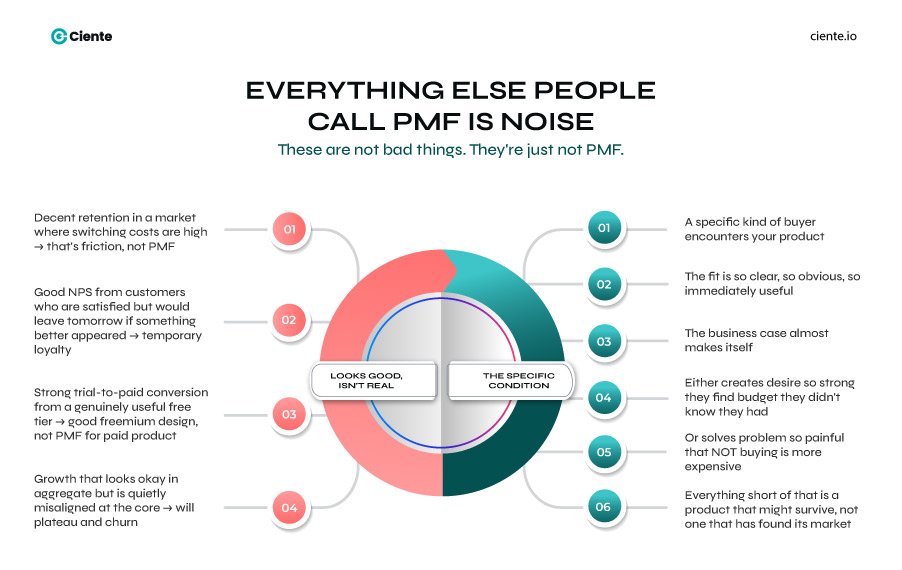
Everything else people call PMF is noise, especially when teams rely only on surface-level SaaS marketing benchmarks to judge success.
Decent retention in a market where switching costs are high is not PMF. It is friction. Good NPS scores from customers who are satisfied but would leave tomorrow if something better appeared is not PMF. It is temporary loyalty. Strong trial-to-paid conversion from a free tier that is genuinely useful is not PMF for your paid product. It is a good freemium design.
These are not bad things. They are just not PMF.
PMF is the specific condition where a specific kind of buyer encounters your product, and the fit is so clear, so obvious, so immediately useful that the business case almost makes itself.
Everything short of that is a product that might survive. Not a product that has found its market.
Why PMF Lives Entirely Inside Your ICP
The World is Stingy. Budgets Are Political. Decisions Are Scrutinized.
Let us talk about money for a second.
B2B buyers are not generous. They were not generous before economic uncertainty became the default weather. They are definitely not generous now.
Every dollar your ICP spends on software has to justify itself. Not just to the buyer but to their manager, their CFO, their procurement team, and sometimes their board. The approval chain for a mid-market SaaS purchase can involve more people than a small wedding.
In that environment, nice to have does not make it through the door.
What makes it through is one of two things. Either the product creates a desire so strong that people find a budget they did not know they had. Or the product solves a problem so painful that NOT buying it is the more expensive choice.
That is it. Those are the two categories. Everything else gets cut when budgets tighten.
And both of those conditions are entirely specific to your ICP. Not to the market. Not in the category. To the exact kind of buyer whose world your product was built to change.
The ICP Is Not a Marketing Exercise
This is where most SaaS teams make the mistake.
ICP gets treated as a marketing deliverable. A persona document. A targeting framework for ads. Something you define once and then hand to the content team.
But the ICP is actually where your PMF lives or does not live.
Because PMF is not a property of your product. It is a property of the relationship between your product and a specific person with a specific problem in a specific context.
Figma has PMF with collaborative design teams who are tired of file versioning hell. It does not have the same PMF as a solo graphic designer who works alone and does not care about real-time collaboration. Same product. Different ICP. Different fit.
Your job is to find the person for whom the fit is undeniable. Not pretty good. Undeniable.
That person is in there somewhere. Inside your current customer base or adjacent to it. In the churned customers who left not because the product failed them, but because they were never the right person to begin with. In the deals that closed fast and the ones that dragged forever and never converted.
The ICP who reflects your PMF is the one who gets it immediately. Who does not need extensive onboarding to see value? Who comes back and uses the product in ways you did not anticipate because they have made it part of how they work.
Find that person. Describe them precisely. Build everything around them.
Demand Creation Also Lives in the ICP
Even if you are on the demand creation path, the ICP is still where it all starts.
You are not creating demand for everyone. You are creating it for a specific audience that is primed to feel the problem you are naming once you name it for them.
Slack did not seduce accountants and SaaS startups in equal measure. It found its people first. The tech-forward teams who already felt the friction of email but had not found the language for it. Slack gave them the language. That audience pulled the product into the broader market.
Every demand creation story has a first audience. A group of people who were already almost there. Already feeling the edges of the problem. Already receptive to the vision.
That is still an ICP. It is just an ICP defined by psychology and context rather than purely by firmographics.
Who is primed to feel the thing you are creating demand for? Start there. Not with the total addressable market. With the people who will get it first and pull everyone else in behind them.
How to Know If You Actually Have Your PMF
The Honest Test
Stop looking at aggregate metrics for a minute.
Find your ten best customers and study what they share in common, a practice that often reveals patterns similar to those uncovered through competitor analysis in SaaS marketing. The ones who renewed fastest, expanded most, referred other buyers, complained least, and integrated your product deepest into how they work.
What do they have in common that your average customer does not?
That overlap is your actual ICP. And if your product is genuinely solving something exceptional for those ten customers, you have a version of PMF. Narrow, maybe. But real.
Now ask the uncomfortable follow-up.
Is the rest of your customer base actually in that group? Or have you been selling to anyone who would buy, building a user base that looks healthy in aggregate and is quietly misaligned at the core?
Because a broad customer base with mediocre fit is not PMF, even if the surface-level growth metrics look acceptable compared to typical good marketing ROI for SaaS. It is growth that will plateau and churn and eventually force a repositioning crisis that everyone will be surprised by, even though the signs were there the whole time.
PMF is narrow before it is wide. That narrowness is not a failure. It is a foundation.
The Sales Cycle Tells You Everything
Here is a simpler version of the test.
Look at your fastest closed deals. Not the largest. Fastest.
What made those deals fast? Was it the champion who immediately understood the product and needed almost no convincing? Was it the pain being so acute that the budget conversation was easy? Was it the product selling itself in the demo because the fit was so obvious?
Now look at your longest, most painful deals. The ones that dragged. The ones where every stage felt like wading through something thick.
What made those hard? Was it the wrong buyer? Wrong company size? Wrong use case? Wrong moment in their journey?
The pattern in the fast deals is where your PMF lives. The pattern in the slow deals is where it does not.
Build toward the fast deals. Stop chasing the slow ones and calling it ambition.
The Only Two Things Worth Building Toward
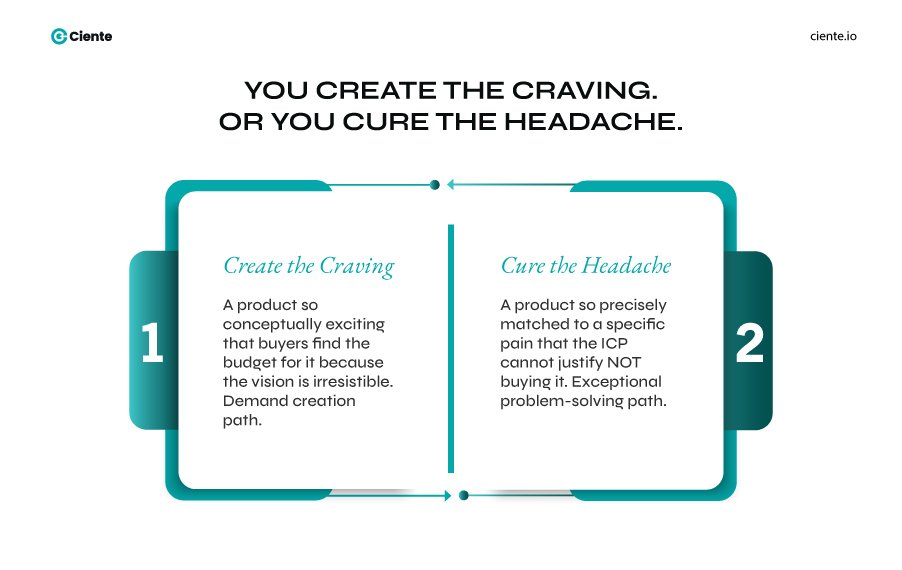
You create the craving. Or you cure the headache.
There is no third option that sustains a business through a market that has gotten stingy with its money and skeptical of its software vendors.
Nice products with moderate value propositions targeting vague ICPs are not finding PMF right now. They are finding growth that looks okay until it does not.
The SaaS companies that are genuinely winning have one of two things, and the companies that scale effectively usually align this clarity with strong SaaS growth strategies. A product so conceptually exciting that buyers find the budget for it because the vision is irresistible. Or a product so precisely matched to a specific pain that the ICP cannot justify not buying it.
Both of those require you to know exactly who you are building for. Not in a general sense. In a specific, granular, almost uncomfortably intimate sense.
Because PMF is not found in the market.
It is found in the person.
Go find that person. Build everything around them. Ignore almost everything else.
That is the whole thing.